


A thousand backlinks can look impressive in a spreadsheet. At the same time, they can also do almost nothing significant.
That is one of the biggest shifts in link building going into 2026. The question is no longer simply, “How many links did we build?” Instead, you have to ask:
Why would a credible website link to this page in the first place?
The answer to this question decides the quality of your backlinks.
Google says links help its systems discover pages and understand relevance. On the other hand, its Search Essentials emphasize helpful, reliable, people-first content and crawlable, descriptive links.
At the same time, Google's spam policies explicitly target manipulative link schemes. That includes excessive link exchanges, automated link creation, low-quality directories, and paid links that pass ranking credit without appropriate qualification.
So inbound link building in 2026 is no longer about manufacturing links. The strategy focuses more on building assets, relationships, relevance, and authority that naturally create link opportunities.
That changes the link-building plan.
What Are Inbound Links?
Inbound links are hyperlinks from another website pointing to a page on your website. They are commonly:
- Incoming links
- External links
- Referring links
For example, if an industry publication links to your research report, that link is an inbound link for your website.
| The difference between inbound and outbound links is very simple: Your website → another website = outbound link Another website → your website = inbound link |
But not all inbound links are equally valuable.
A contextual link from a respected publication discussing the exact subject your page covers can be far more meaningful than dozens of unrelated links from low-quality websites.
That is why modern link building needs to move beyond link counts.
The Easier Way To Understand Inbound Links
This pipeline will make it easy for you to understand how inbound links work:
Link → Context → Relevance → Trust → Discovery
The URL itself is only one part of the equation.
The page linking to you matters. At the same time, the surrounding content is also critical. Another thing to consider is the reasoning behind the link.
Eventually, what matters the most is the relationship between your brand and the topic.
Semrush's current guidance similarly emphasizes that a good backlink should come from an authoritative, relevant website and appear naturally within the linking site's content.
Why Inbound Links Still Matter In 2026
There is a temptation to assume that links have become less important because search has evolved. But that won’t be the right conclusion.
Google still uses links to discover pages and understand relationships between pages. Google also recommends descriptive, relevant anchor text and contextual information around links.
A ranking factor analysis in 2026 shows that 8 out of 20 factors that determine the highest-ranking positions correlate with the strength of the backlink profile, or its structure.
But there is another reason to care about inbound links in 2026: They can help build an entity's footprint across the web.
Suppose five respected publications from the following niches independently mention your company alongside:
- enterprise cybersecurity
- zero-trust security
- identity management
- cybersecurity compliance
Those links do more than create five new referring URLs. In reality, they create a pattern. Google sees that trusted sources are discussing your brand while talking about a specific subject.
That is where link building starts intersecting with topical authority and brand authority. And that is much more interesting than counting backlinks.
The 2026 Inbound Link Building Framework
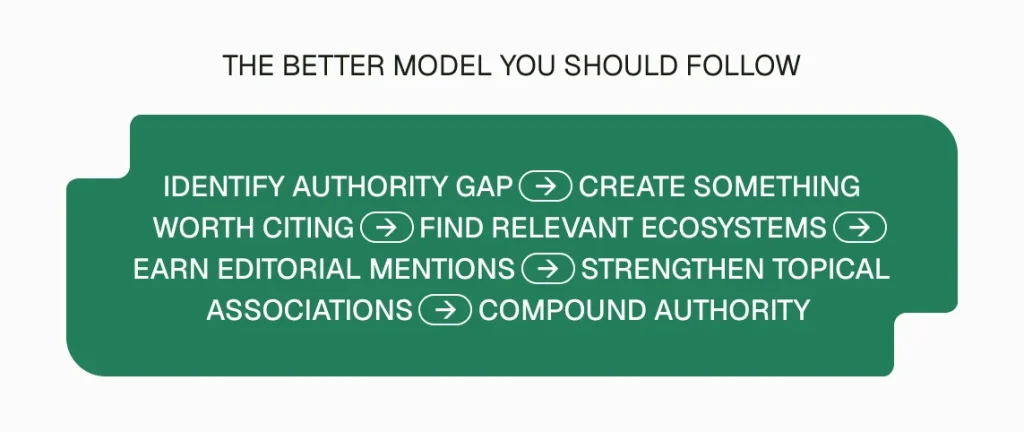
Before jumping into tactics, use this simple model.
Check Out The Old Model First: Create page → build links → increase rankings
The Better Model You Should Follow In 2026
| Identify authority gap → create something worth citing → find relevant ecosystems → earn editorial mentions → strengthen topical associations → compound authority |
Switching to a better model is important because the best inbound links are usually a by-product of something useful. A proprietary study can attract citations. Meanwhile, a calculator can attract references.
Similarly, a strong original resource can attract links. Again, a useful expert contribution can earn an editorial mention.
That said, a genuinely valuable guest article can introduce your brand to a new audience while creating a relevant contextual reference.
Simply put, that is the mindset behind the strategies below.
9 Inbound Link Building Strategies That Work In 2026
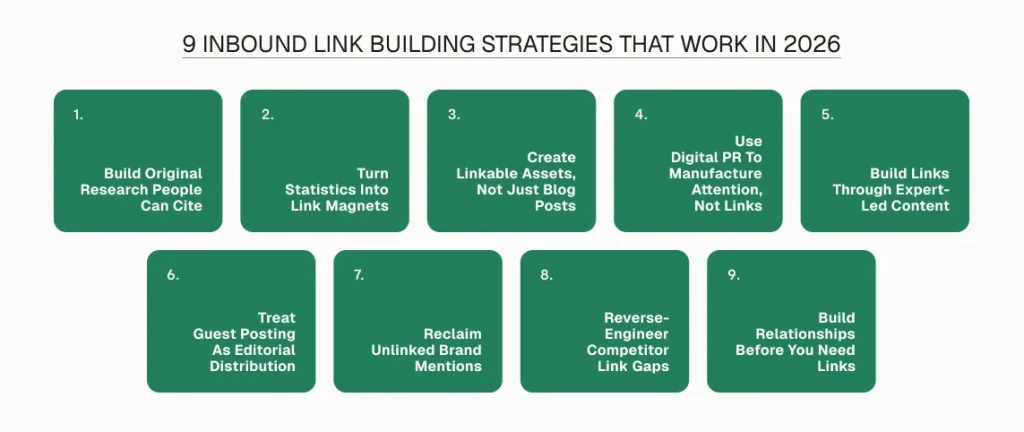
These 9 strategies are already proven. Meanwhile, their main goal is to earn relevant and contextual inbound links. In 2026, nobody focuses only on increasing their backlink count. Check out the strategies here:
1. Build Original Research People Can Cite
If you want inbound links, give publishers something they cannot easily find somewhere else. Original research is one of the strongest examples.
Instead of publishing another article titled “10 SEO Tips,” conduct a study. For example:
“We Analyzed 10,000 SaaS Pages: What Actually Correlates With Organic Visibility?”
Now journalists, bloggers, consultants, newsletters, and industry publications have a reason to reference your work. Your research becomes the source.
What Makes Research Linkable?
Look for:
- Original datasets
- Industry surveys
- Trend analysis
- Benchmark reports
- Statistical comparisons
- Longitudinal studies
- First-party customer data
- Expert surveys
- Market analyses
To sum up, the key is originality. Adding your own commentary to somebody else's statistics is the kind of content that’s required.
On the other hand, producing a dataset that other people cite is an authority asset.
2. Turn Statistics Into Link Magnets
Here's a surprisingly effective variation of the research strategy: Create pages designed to answer fact-finding searches. On that note, here are some kinds of statistics you can include:
- SEO statistics
- Link building statistics
- SaaS statistics
- Marketing statistics
- Industry benchmarks
- Conversion-rate benchmarks
But do you know what problem it solves? To be honest, writers need sources.
When somebody writes an article and needs a number to support a statement, they often search specifically for that number.
If your page provides a well-organized, trustworthy source, it can become a recurring citation target.
Ahrefs has previously highlighted statistics pages as a link-building opportunity because fact-finder queries can create linkable visibility.
The 2026 Upgrade To Link Building Strategies
Don't simply collect 50 statistics. Rather, own a dataset. Here is an example you can follow:
Instead of: “50 SEO statistics from around the web”, create “2026 State of B2B Link Building: Data From 500 SEO Campaigns.”
The second has a much stronger reason to be cited.
3. Create Linkable Assets, Not Just Blog Posts
Here's a quick test:
If your article disappeared tomorrow, would anyone need to replace the information it contained?
If the answer is no, it probably isn't a strong link asset. Linkable assets solve a problem or provide something people want to reference.
Here is an example that will help you to understand better:
| Asset | Why people link to it |
| Original research | Supports claims |
| Calculator | Helps readers perform a task |
| Template | Saves time |
| Benchmark report | Provides comparison data |
| Interactive tool | Provides utility |
| Industry database | Becomes a reference |
| Definitive guide | Centralizes information |
| Infographic | Makes complex information easier to understand |
| Case study | Demonstrates real-world evidence |
| Expert survey | Provides original opinions/data |
Semrush's 2026 link-building guidance also identifies original data, statistics pages, free tools, and calculators as formats that can attract links.
Here Is The Rule To Follow:
You need something that is utility-driven. For instance, you don't need to invent a viral campaign.
You need to create something another writer can confidently reference in their own work.
4. Use Digital PR To Manufacture Attention, Not Links
If you are not manufacturing links and mapping for attention instead, you are on the right track. For instance, if your entire PR campaign begins with: “How many backlinks can we get?” you are optimizing the wrong metric.
Instead, create something worth talking about. Now it can be a controversial finding or an unexpected statistic.
Even a new industry benchmark would qualify.
A proprietary study, a strong expert opinion, or a useful prediction can work just as well.
When reaching out to publishers, pitch the story, not the backlink. If the story is worth covering, the link can naturally follow.
This also fits the way search is changing. Brands now need to be visible not only in traditional search results but also in AI-powered search and answer engines.
In 2026, building visibility across both is more effective than focusing only on blue-link rankings.
5. Build Links Through Expert-Led Content
People link to people. That sounds obvious, but it has major implications for B2B brands. For instance, a generic company article saying: “Cybersecurity is important for businesses.” isn't particularly cite-worthy.
An article featuring an experienced security executive explaining why SMBs repeatedly fail at identity management is different.
To sum up, expertise creates information others can reference. Hence, the best thing for you is to build expert-led content through:
- Original interviews
- Expert roundups
- Founder commentary
- Subject-matter interviews
- First-hand case studies
- Industry predictions
- Data interpretation
- Practitioner insights
This also strengthens the credibility layer around the content itself.
| The key lesson from this: Don't just build links to your expertise. Put expertise into the pages you're trying to build links to. |
6. Treat Guest Posting As Editorial Distribution
Guest posting has been declared dead approximately 47 times. But still in 2026, the ground reality is that it isn't.
However, one thing is guaranteed: Bad guest posting is dead.
There is a huge difference.
Publishing hundreds of nearly identical articles on unrelated websites because each article contains an optimized anchor text is exactly the kind of behavior Google's link-spam policies warn against.
But contributing genuinely useful content to a relevant publication is another matter. To clarify, a strong guest contribution can deliver:
Relevant publication + expert content + contextual placement + appropriate anchor + qualified audience
That is not merely a backlink. It is editorial distribution. And that distinction is central to how Blogger Outreach positions link building.
Our objective is never to: “Get your URL inserted somewhere.” Instead, the scope of our entire work at Blogger Outreach is to:
Put your expertise in front of the right audience in the right editorial context.
Blogger Outreach's own case studies illustrate this approach. For VeePN, for example, the strategy combined authoritative cybersecurity publications, expert content, personalized outreach, and contextual placements.
The reported campaign results included a 176% increase in organic traffic and a 149% increase in referring domains.
Caution: Those are reported campaign outcomes. They dont guarantee that any individual backlink will produce the same result.
7. Reclaim Unlinked Brand Mentions
Sometimes you've already earned the hardest part, which is someone mentioning you. But they forgot the link. Now, that's an opportunity. So search for:
- Brand mentions
- Product mentions
- Founder mentions
- Campaign mentions
- Research references
- Images using your assets
- Company names without hyperlinks
Then contact the publisher. But remember that the pitch doesn't need to be complicated. Here is a template you can use:
“Thanks for mentioning [Brand]. Would you consider linking the mention to our original resource so readers can access the source directly?”
Semrush currently lists unlinked brand mentions as a practical backlink opportunity.
Why Is This Tactic Underrated?
You're not trying to convince someone that your brand deserves to exist. They already mentioned you.
In contrast, you're simply improving the reference. That's a much warmer conversation.
8. Reverse-Engineer Competitor Link Gaps
Your competitors have already done part of the prospecting for you.
If five relevant publications link to three competitors but never mention your brand, you've discovered a potential opportunity cluster.
Don't blindly copy the competitor's backlink profile. Study it. You can ask:
- Why did this publication link?
- Which page earned the link?
- Was it research?
- Was it an expert contribution?
- Was it a guest article?
- Was it a product comparison?
- Was it a resource?
- Was the competitor mentioned because of a specific event?
- What audience does the linking publication serve?
Then build a better reason to be included. To clarify, this is where link gap analysis becomes more useful than simply chasing a competitor's biggest referring domains.
9. Build Relationships Before You Need Links
This is the least scalable tactic. It may also be the most valuable.
Editors, journalists, publishers, podcast hosts, newsletter writers, researchers, and industry experts are people. Don't contact them only when you want something.
Follow their work. If you can, share useful resources. It will be helpful if you can also add meaningful commentary.
Eventually reference their research and introduce them to relevant experts.
Contribute without immediately asking for something.
Then, when you eventually have something genuinely valuable, your outreach isn't coming from a complete stranger.
That matters because modern link outreach is increasingly about trust and relevance, not volume.
Ahrefs has similarly argued that generic outreach is actually ineffective. So don’t reach out to people saying: “I just published something, please link to it.”
The Inbound Link Quality Checklist
Not every inbound link deserves the same weight. Before celebrating a new backlink, score it.
Ask these 8 questions:
| Signal | Question |
| Relevance | Is the linking site genuinely related to the topic? |
| Editorial context | Does the link naturally support the surrounding content? |
| Placement | Is it within the main editorial content? |
| Source quality | Is the publication credible and maintained? |
| Audience | Could the link send genuinely relevant visitors? |
| Anchor text | Is the anchor descriptive and natural? |
| Page relevance | Does the destination page actually satisfy the context? |
| Domain diversity | Are you earning links from different credible websites? |
Google's own link guidance specifically recommends descriptive, concise, relevant anchor text. Moreover, the policy warns against stuffing keywords into anchors. It also says the surrounding words provide context for the link.
So don't turn every outreach campaign into an anchor-text engineering exercise. The best anchor is often the one that makes the sentence read normally.
Score Your Next Inbound Link

Score Your Next Inbound Link
Before accepting a link opportunity, rate it 0–2 across eight factors that actually predict whether a placement helps you — not just whether the metrics look good on a sheet.
This isn't a Google scoring system. It's a Blogger Outreach decision-making framework.
Third-party metrics such as DA, DR, and Authority Score can help with prospecting. But they shouldn't become the strategy itself. A high-DA site with the wrong audience and a buried, sponsor-flagged link scores lower here than a modest site with real editorial context.
Remember — that's the kind of link that actually moves the needle.
What About Domain Authority, Dr And Other Metrics?
Here's where many link-building campaigns actually fail. Let’s say someone finds a website with: DA 80
Then they immediately assume that it is a great link. But not necessarily. A high-authority domain can still have:
- Poor topical relevance
- Weak editorial context
- Low-quality pages
- Irrelevant traffic
- An unnatural placement
- An unsuitable audience
Meanwhile, a smaller but highly relevant publication may provide a much better contextual fit.
This is why Blogger Outreach's broader authority-building approach does not reduce link quality to a single number.
We believe that authority is multidimensional.
DA can be useful for filtering. At the same time, DR can help with backlink analysis.
Traffic can also help evaluate audience reach. But relevance, editorial context, and placement determine whether the link actually makes sense.
For a deeper comparison, see our guide on what Google means by website authority.
Inbound Links vs. Internal Links: Don't Confuse Them
This sounds basic. But in reality, it isn't.
Inbound links
Inbound links come from other websites to your website.
To clarify, their primary value comes from external references, discovery, referral traffic, and authority signals.
Internal links
Internal links, on the other hand, connect pages within your own website.
They help users navigate your site and help search engines understand relationships between your pages.
Google says its systems use internal linking and site structure to help identify useful shortcuts such as sitelinks.
Further, Google recommends linking important pages from relevant pages using concise, relevant anchor text.
The two strategies should work together.
Think of it as:
External links bring authority into the site. Meanwhile, internal links distribute context and importance across the site.
That is why a serious link-building campaign should never end when the backlink is acquired. The next question should be:
Where should that authority lead?
The Most Powerful Shift: Build Topic Authority, Not Just Link Authority
Imagine two websites.
Website A has 500 backlinks. But they cover 40 unrelated industries. On the other hand, Website B has 150 backlinks.
But those links repeatedly come from respected websites discussing the same subject area. So now, which one has the stronger topical story?
The answer isn't automatically Website B. But Website B is building something Website A may lack:
consistent topical association.
This is why modern inbound link building should be integrated with content strategy.
You don't just want websites to link to you. Rather, you want the right websites to repeatedly associate your brand with the subjects you want to be known for.
That's topical authority.
And when that association extends beyond links into mentions, citations, expert commentary, reviews, social proof, and branded searches, you're moving toward brand authority.
That is a much bigger asset than a backlink count.
What Not to Do in 2026
Let's make this brutally simple.
Don't Buy Links Purely To Manipulate Rankings.
Google explicitly treats buying or selling links for ranking purposes as link spam unless the links are appropriately qualified.
Don't Build Hundreds Of Irrelevant Links.
Relevance matters more than an impressive spreadsheet.
Don't Obsess Over Exact-Match Anchors.
Google recommends natural, descriptive anchor text and specifically warns against keyword stuffing.
Don't Publish Guest Posts At Scale Just Because A Website Accepts Them.
Publication quality and editorial relevance matter.
Don't Confuse DA With Authority.
A third-party score is a metric, not Google's definition of your website's authority.
Don't Chase Links Without A Destination Strategy.
A backlink to a weak or irrelevant page isn't automatically useful.
Don't Assume More Links Always Means More Rankings.
Google's systems can ignore or nullify manipulative links. Google notes that when spammy links are neutralized, previously gained ranking benefits from those links may not be regained.
A Better 2026 Inbound Link Building Workflow
If you were building an inbound link strategy from scratch today, here's the sequence I'd use.
Step 1: Define The Authority You Want To Build
What should your brand become known for?
Not: “We need 100 backlinks.” Instead: “We want to become a recognized source for enterprise SaaS security.”
That changes every subsequent decision.
Step 2: Map The Topic Ecosystem
Identify:
- Core topics
- Supporting topics
- Commercial topics
- Informational topics
- Industry publications
- Experts
- Journalists
- Communities
- Competitors
- Reference sources
Step 3: Identify Linkable Gaps
Find information people currently cite but that is:
- outdated
- poorly presented
- unsupported
- incomplete
- difficult to use
- missing original data
Step 4: Build The Asset
Create the thing worth referencing.
Step 5: Build The Prospect Universe
- Don't create a list of 5,000 websites.
- Build smaller groups based on:
topic + audience + editorial fit + reason to link
Step 6: Promote The Asset
Use:
- Editorial outreach
- Digital PR
- Expert networks
- Guest contributions
- Partnerships
- Communities
- Social distribution
- Existing relationships
Step 7: Earn Contextual Placements
Prioritize links where the surrounding content makes the link logical.
Step 8: Strengthen Internal Linking
Connect the newly promoted page to relevant commercial and informational pages.
Step 9: Measure More Than Backlinks
Track:
- Referring domains
- Organic traffic
- Ranking distribution
- Target-page rankings
- Referral traffic
- Branded searches
- New keyword associations
- Assisted conversions
- Visibility across AI/search surfaces
Step 10: Repeat What Creates Authority
The objective is not to run one successful campaign. It is to create a repeatable authority-building engine.
What Blogger Outreach Brings to the Equation
For Image:
CASE STUDY 01 — VeePN
BUILD RELEVANT AUTHORITY
- Relevant Publishers
- Expert Content
- Targeted Outreach
- Contextual Links
- 176% Traffic ↑
- 149% Domains ↑
CASE STUDY 02 — FreshEssays
WIN IN TOUGH NICHES
- Relevant Publishers
- Quality Content
- Targeted Outreach
- Contextual Links
- 133% Traffic ↑
- Better Visibility
CASE STUDY 03 — CapCut
SCALE WITH CONTEXT
- Authority Sites
- Guest Posting
- Editorial Links
- Niche Relevance
- 2.2M → 11.7M
- 4,523 → 10,763
This is where inbound link building becomes more than a collection of tactics. A business can theoretically do all of this internally.
The problem is execution. That’s where Blogger Outreach’s expert team comes in. Here are the KPIs we help you to mark “done”:
- Finding relevant publishers.
- Evaluating websites.
- Creating editorial content.
- Choosing realistic placements.
- Managing outreach.
- Maintaining publisher relationships.
- Building contextual links.
- Scaling without turning the campaign into a numbers game.
That's where a leading managed link-building service can help.
Blogger Outreach's model connects brands with relevant publishing opportunities rather than treating every website as an interchangeable link source.
Its published case studies show how it has applied that approach across different industries.
For example, its VeePN campaign reported a 176% organic traffic increase alongside a 149% increase in referring domains, with the strategy centered on high-authority cybersecurity publications, expert content, and personalized outreach.
Freshessays reported a 133% traffic increase despite operating in a difficult niche.
And Blogger Outreach's CapCut case study reports organic traffic increasing from 2.2 million to 11.7 million, alongside a rise in referring domains from 4,523 to 10,763.
The case study attributes the campaign strategy to contextual guest posting on authoritative niche websites, among other SEO work.
| Caution: Read these figures as case-study outcomes, not promises. The larger lesson is more useful: Link building works best when it is connected to a broader SEO objective. Not when the objective is simply “get more backlinks.” |
The Future of Inbound Links Is Better Than Backlinks
Search is no longer just ten blue links. Users increasingly encounter brands through:
- AI-generated answers
- Search summaries
- News coverage
- Expert citations
- Product comparisons
- Reviews
- Communities
- Podcasts
- Social platforms
- Traditional organic results
That means your authority footprint needs to exist beyond your own website. And this creates an important opportunity for inbound link building.
A relevant editorial mention can introduce your brand to a new audience. A research citation can establish expertise.
An expert contribution can demonstrate experience. Again, a strong publication can reinforce topical associations. Eventually, a backlink can be the visible artifact connecting them all.
So the future isn't: More backlinks. Instead, you have to offer more reasons for credible sources to reference you.
The 2026 Inbound Link Building Stack
If you want a simple framework to remember everything in this article, use this:
That's inbound link building in 2026.
Read Also: