



Getting backlinks is easy to understand. Deciding which backlink your business actually needs next is harder.
Take this example. Two companies can each build 30 links in a quarter and get completely different results. One buys links from sites that meet a minimum DA threshold.
The other strengthens a page ranking at #12, adds links to supporting content around the same topic, closes competitor gaps, and chooses publishers that genuinely cover its niche.
Both can report: 30 backlinks acquired. But only one has a real link-building strategy. There is a major difference here.
A backlink is a placement. Meanwhile, a link-building strategy explains why that placement should exist, which page it should support, and what outcome it should create.
What Is a Link-Building Strategy?
A link-building strategy is a structured plan for acquiring relevant external links that support specific pages, topics, and SEO goals.
If you need the broader tactical foundation first, our complete link-building guide covers the major methods and mechanics in more detail.
| A real strategy connects: SEO goal → target page → authority gap → publisher → editorial context → measurement |
Compare these two statements:
| Statement 1: | Statement 2: |
| “We need 20 backlinks this month.” | “Our commercial comparison page is ranking at #14. Competitors above us have more niche-relevant referring domains and stronger supporting content, so we will build editorial links to the page and its topic cluster.” |
Statement 1 speaks about just a quota to keep a business’ backlinking profile active. However, statement 2 seems like a real strategy linked to an effective business goal.
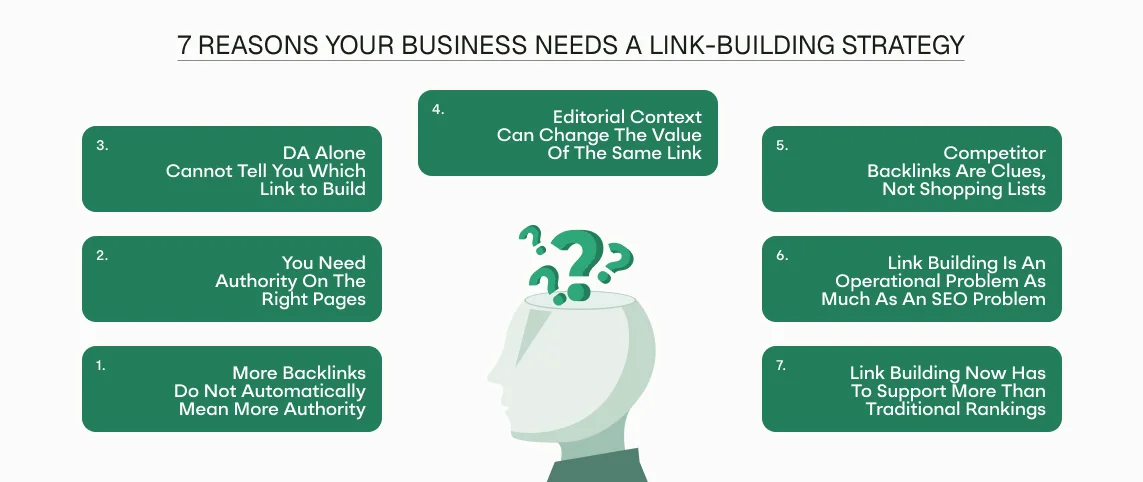
7 Reasons Your Business Needs A Link-Building Strategy
Before you build your next backlink, here’s why you need to have a robust strategy behind it:
1. More Backlinks Do Not Automatically Mean More Authority
The most common link-building mistake is treating volume as the main KPI. 100 backlinks sounds better than 20. But backlinks are not interchangeable.
| Campaign A | Campaign B |
| 50 general websites | 18 niche-relevant publishers |
| Links mainly to homepage | Links to priority pages |
| DA-led selection | Relevance + quality + metrics |
| Repeated commercial anchors | Natural contextual anchors |
| No topic plan | Supports topical clusters |
| Monthly quota reached | Specific authority gap addressed |
If you look closely at this example, Campaign A wins on quantity. Meanwhile, Campaign B has the stronger logic.
This is also why website authority should not be reduced to backlink count. Authority comes from a wider combination of relevance, content quality, structure, trust, and external validation.
So before asking: “How many backlinks do we need?”, you need to ask:
What exactly are we doing to make backlinking more authoritative?
2. You Need Authority On The Right Pages
Many businesses do not have a backlink shortage. They have a distribution problem.
The homepage may have hundreds of referring domains. While the product page or comparison page that actually needs support has almost none.
That is why a link-building strategy should map authority to URLs. A simple priority model can be:
- Priority 1: Near-Win Pages: Pages already ranking between positions 5 and 20.
- Priority 2: Commercial Pages: Pages tied directly to leads, sales, or revenue.
- Priority 3: Linkable Assets: Research, tools, statistics, guides, or resources that can naturally attract citations.
- Priority 4: Supporting Topic Pages: Content that reinforces the wider cluster around a commercial priority.
This explains why and how link building and internal linking should work together. External links strengthen individual pages. Internal links, on the other hand, help move that authority around the site.
3. DA Alone Cannot Tell You Which Link to Build
Domain Authority is useful. But it shouldn't drive the entire buying decision.
Here is a common workflow that most people follow:
DA 60?
Yes.
Traffic above minimum?
Yes.
Price fits?
Yes.
Buy.
By following this logic cycle, they ignore other important parameters like relevance, editorial quality, audience fit, link context, and domain health.
Our guide to what is Domain Authority explains the metric and its limitations in more detail.
For link building, the practical rule is: to use DA as a filter, not as the strategy. Based on our analysis, here is a better publisher evaluation order:
- Topical relevance
- Editorial quality
- Real traffic and audience
- Page-level context
- Domain health
- Authority metrics
- Cost
You need Blogger Outreach's platform here as we let you filter publishers by factors such as niche, authority, traffic, and cost rather than DA alone.
4. Editorial Context Can Change The Value Of The Same Link
Imagine the same link appearing in two different places.
| Link A Inside a detailed article that directly discusses your topic. | Link B Inside a weak paragraph where the anchor was clearly added only because a client paid for it. |
Technically, both are backlinks. Meanwhile. strategically, they are different assets.
This is where editorial authority matters. A useful link should make editorial sense. So here is an important question that you should ask in this context:
Would an editor reasonably reference this page here if SEO metrics were not visible?
If the answer is no, the placement is weak.
That is also why our analysis of guest post backlinks focuses on relevance, context, and link placement rather than the domain metric alone.
A high-authority site cannot rescue a badly positioned link. The page, paragraph, anchor, destination, and topic should all make sense together.
5. Competitor Backlinks Are Clues, Not Shopping Lists
Competitor backlink analysis is often reduced to only:
Which sites link to them?
But our analysts at Blogger Outreach feel that is too shallow. Our take is that a stronger strategy asks:
- Which competitor pages attract links?
- Which topics get cited most often?
- Which publishers appear repeatedly?
Are competitors winning links because of research, tools, statistics, or thought leadership?
Which opportunities are replicable?
Which gaps require us to create something better first?
For example, if competitors repeatedly earn links to original research, your problem may not be outreach. It may be the absence of a linkable asset. That leads to a useful rule:
| “Outreach cannot compensate for an asset nobody has a reason to reference.” - Ejaz Ahmed, Head Of Business And Operations @BloggerOutreach |
Use competitor analysis to create three buckets:
| Gap | Action |
| Replicable publisher opportunity | Outreach |
| Missing content asset | Create first |
| Weak topic authority | Build cluster + links |
| Weak commercial page | Improve page first |
| Competitor cited more often | Broader authority campaign |
Our guide to link acquisition strategies covers the tactical options once you know which gap matters.
6. Link Building Is An Operational Problem As Much As An SEO Problem
Most businesses can theoretically do link building internally. The hard part is doing it consistently. A proper campaign can involve:
- Prospecting
- publisher vetting
- Outreach
- Follow-ups
- Negotiations
- topic ideation
- content writing
- Editing
- anchor planning
- Revisions
- Publishing
- Reporting
- link checks
- replacement management
However that means you have to have an internal team managing a massive workload. Especially, when you manage several clients or campaigns.
This is where Blogger Outreach becomes useful. If you are approaching us, treat us not merely as a backlink vendor, but as an execution layer.
Blogger Outreach’s current service stack includes Blogger Outreach, Link Building, Guest Posting, and Content Writing. Along with dashboard visibility and white-label reporting for agencies.
The key point is:
| Keep the SEO thinking where your expertise fits. Outsource the operational bottlenecks that stop the strategy from becoming live placements. - Kasmira, Global Sales Lead @BloggerOutreach |
7. Link Building Now Has To Support More Than Traditional Rankings
Previously, we used to ask: Will this link help our client rank? Yes, that still matters. But in 2026 brands increasingly need to ask: Does this placement strengthen our wider authority and visibility?
That is where brand authority becomes relevant. Brand authority is shaped by more than direct backlinks. It is reinforced through:
third-party mentions,
- editorial references,
- searches,
- recognition,
- reputation,
- industry association.
Blogger Outreach has also expanded beyond conventional link building into services such as AI-Powered Link Building and GEO.
That does not mean every company needs every service. Instead, it means the authority question is broader now.
That’s why one common question that we ask clients during the free consultation session is:
What kind of authority does our brand currently lack?
Link Building Is An Authority Portfolio In Reality
For Image:
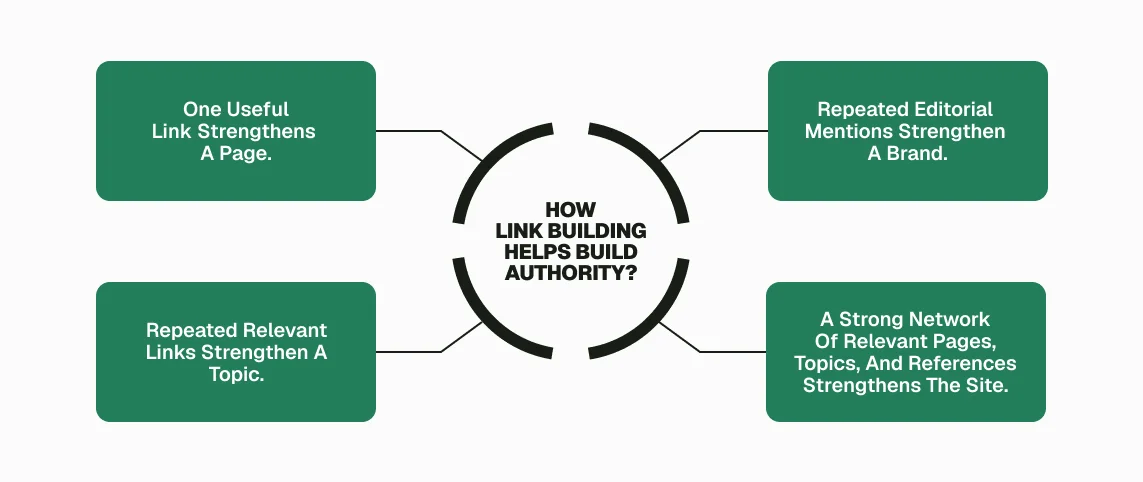
How Link Building Helps Build Authority?
1. One useful link strengthens a page.
2. Repeated relevant links strengthen a topic.
3. Repeated editorial mentions strengthen a brand.
4. A strong network of relevant pages, topics, and references strengthens the site.
A useful way to think about modern link building is as authority architecture. Your website does not have one universal authority score. It has several overlapping forms of authority.
Domain Authority: Domain Authority gives you a useful third-party comparison of backlink strength.
Website Authority: Website authority reflects broader site-level credibility, structure, content depth, and external trust.
Editorial Authority: Editorial authority reflects the credibility of the publishing environment itself.
Brand Authority: Brand authority reflects recognition, mentions, trust, and broader market visibility.
That is why the future of link building is less about accumulating backlinks and more about engineering authority.
What Should A Link-Building Strategy Include?
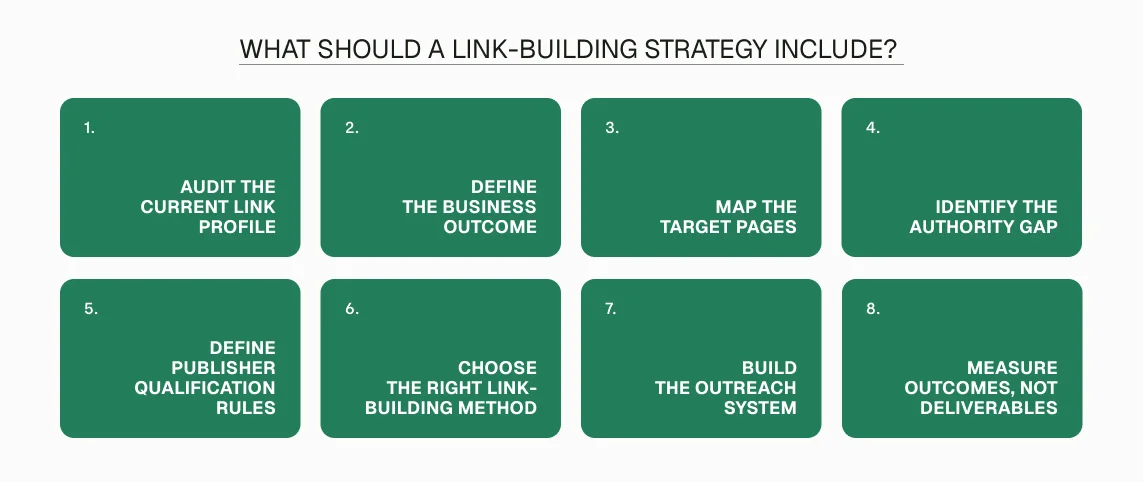
You can build a practical strategy in eight steps.
1. Audit The Current Link Profile
Check:
- referring domains,
- linked pages,
- anchor distribution,
- lost links,
- suspicious patterns,
- underlinked priority pages,
- competitor gaps.
Do not start with: What links should we buy? Instead, start with:
What does the current profile fail to support?
2. Define The Business Outcome
Examples:
Move an important page from positions 11–20 into the top 10.
- Build authority around a new category.
- Strengthen a money page.
- Close a competitor backlink gap.
- Increase editorial mentions around a topic.
A campaign without a clear outcome becomes an endless monthly quota.
3. Map The Target Pages
Prioritize URLs based on:
Business value × ranking opportunity × content quality × authority gap
If a page is weak, fix the page first. Don't spend links on something that isn't ready to rank.
4. Identify The Authority Gap
Ask what the page lacks.
It could be a page authority gap. That means the URL itself has too few relevant referring domains.
Again, for a topic gap, the site lacks supporting content around the subject.
The next crucial problem is an editorial gap. In this case, the brand rarely appears in credible niche publications.
Again, for a brand gap, the competitors are mentioned or cited far more often. To sum up, the kind of gap determines the tactic.
5. Define Publisher Qualification Rules
A simple framework:
Required
- genuine topical relevance,
- real editorial content,
- acceptable domain health,
- appropriate audience,
- contextual placement opportunity.
Secondary filters
- DA,
- DR,
- traffic,
- referring domains,
- cost.
The mature question is not: Is DA high enough? It is:
Does this placement make strategic sense?
6. Choose The Right Link-Building Method
Different gaps need different tactics.
Blogger Outreach
Useful when the priority is publisher relationships and niche-relevant placements.
Guest Posting
Useful when you need more control over topic and editorial context. Our guest posting strategy guide covers this in more depth.
Link Insertions
Useful when an existing article already offers the right contextual environment. See our comparison of link insertions vs guest posts.
Linkable-Asset Outreach
Best for research, data, calculators, statistics, and tools.
Digital PR
Useful when the objective is broader brand visibility rather than individual page links.
The key principal here is that the tactic should follow the gap.
7. Build The Outreach System
Once publishers are identified, execution begins. Effective link-building outreach requires:
- relevant prospecting,
- good pitching,
- follow-ups,
- relationship management,
- content coordination,
- editorial handling.
This is where many teams lose time. Sending more emails is not automatically better. In reality, you need to reach the right publications.
8. Measure Outcomes, Not Deliverables
A live backlink is an output. It is not always the outcome. So here is something that you need to actually track:
| Metric | What It Tells You |
| New referring domains | Is your authority footprint expanding? |
| Relevant referring domains | Is growth happening in the right niche? |
| Target-page rankings | Are priority URLs improving? |
| Organic visibility | Are more relevant keywords improving? |
| Referral traffic | Are real visitors arriving? |
| Link retention | Are placements staying live? |
| Competitor gap | Are you closing the right gaps? |
| Brand mentions | Is wider recognition increasing? |
If strong backlinks are not producing movement, do not automatically buy more. Rather, you need to investigate:
- search intent,
- content quality,
- internal linking,
- technical SEO,
- topical coverage,
- competitor improvements,
- brand signals.
We have explored those issues in "why Google rankings drop despite strong backlinks”.
What A Link-Building Strategy Needs VS What Blogger Outreach Provides
The comparison below focuses on practical workflow differences rather than vague claims.
| Strategy Need | Blogger Outreach Offers | Many Traditional Providers Offer |
| Niche-relevant discovery | Publisher marketplace and niche filtering | Fixed provider shortlist |
| More than DA filtering | Filters for niche, authority, traffic, and cost | Package tiers based mainly on DA/DR |
| Publisher vetting | Manually reviewed network | Quality controls vary |
| Context planning | Anchor and surrounding-content strategy | Often URL + anchor only |
| Manual outreach | Managed publisher outreach | Frequently scaled via automation |
| Content production | Publication-ready content support | Often client supplied or extra |
| Editorial revisions | Managed during fulfilment | Client may need to coordinate |
| Publisher choice | Searchable marketplace | Provider often selects placement |
| Campaign visibility | Dashboard access | Spreadsheet or final report |
| Agency scalability | White-label reporting | Varies |
| Multiple execution models | Outreach, link building, guest posting, content | Often one core service |
| AI-era authority support | AI-Powered Link Building and GEO | Often separate vendor |
The important distinction is not simply that Blogger Outreach has more services. It is that several parts of the workflow can operate in one system:
Publisher discovery → outreach → content → editorial handling → placement → reporting
That reduces the need for additional or manual coordination. And coordination is one of the hidden costs of link building.
Where Blogger Outreach Fits Best
Blogger Outreach makes the most sense when the strategy is already clear but execution is slowing the campaign down.
If finding enough relevant publishers is the bottleneck, our Blogger Outreach Services can support publisher discovery and relationship-driven outreach.
When you already know which pages need authority but cannot scale acquisition internally, Link Building Services can handle the execution.
If you need greater control over the topic, content, and editorial context surrounding a placement, Guest Posting Services are a better fit.
Again, while writing becomes the bottleneck, Content Writing Services can keep campaigns moving without adding pressure to your internal content team.
For agencies, Blogger Outreach also provides white-label reporting and campaign infrastructure that can support fulfilment while the agency retains control of strategy and client relationships.
And the authority-building scope now extends beyond conventional search: businesses exploring AI discovery can use AI-Powered Link Building and GEO Services where those channels fit the wider business objective.
The better way to use Blogger Outreach, therefore, is not to say, “Please get us 50 links.” Rather, tell us: “Here is the authority gap, target page, niche, quality threshold, and campaign objective. Help us execute it.”
A 10-Minute Link-Building Strategy Test
Before approving your next campaign, answer these questions:
- Which URLs are we trying to improve?
- Why those pages?
- What exactly are they missing?
- Which competitors are outperforming us?
- Which publications genuinely matter to the niche?
- What quality thresholds matter beyond DA?
- Why should an editor link to us?
- How should links be distributed?
- How will success be measured?
- What result would make us change direction?
If your team cannot answer most of these questions, you probably do not have a link-building strategy. Simply put what you are following till now is a backlink purchasing plan.
Frequently Asked Questions
What is a link-building strategy?
A link-building strategy is a planned system for acquiring relevant backlinks that support specific pages, topics, and SEO goals.
Why does a business need one?
Because backlink quantity alone does not tell you whether links are strengthening the pages and authority gaps that matter.
Is Domain Authority important?
Yes, but it should be one publisher metric rather than the sole decision factor. Read our Domain Authority guide for the full explanation.
Is one strong backlink better than many weak backlinks?
It can be. Relevance, context, editorial quality, audience fit, and target-page alignment may make one strong placement more useful than many low-value links.
How many backlinks should a business build each month?
There is no universal number. The right pace depends on competition, existing authority, target pages, opportunities, and business goals.
Can backlinks fix every ranking problem?
No. Weak content, poor intent alignment, technical SEO, internal linking, topical coverage, and brand authority can all limit rankings.
What makes Blogger Outreach useful?
It combines publisher discovery, outreach, guest posting, link building, content production, reporting, and agency-oriented fulfillment in one ecosystem.
Read Also:




