


An editor at a mid-sized SaaS blog told me she gets around 40 guest post pitches a week. She accepts maybe two. Wait, don’t get the impression that the remaining ones are not good in quality.
They sound good, use refined vocabulary, and use the right tone. However, they have 0 takeaways.
That's the real problem with most outreach in 2026. The real problem isn't a lack of effort. It's the genericness. Publishers are drowning in AI-assisted pitches that all sound the same. In fact, the pitches that get a reply are human-written and clearly show objective, specific intent.
Every day, a lot of marketers put the same search query on Google: how to write a perfect guest post pitch. But the honest answer is that no single pitch suits every situation.
There are several, and the right one depends on:
- What you're offering
- Who the editor is
- What their site actually needs
This guide walks through seven pitch angles that usually get responses. Also check out the ready-to-adapt template for each one.
Why A Single Pitch Template Never Works Twice
What do most people do? They search for the best guest post pitch template on GPT or Google. Then they include their website name and send the same to 300 editors.
But that is where they fail. They need to know editors see these templates almost every day. In fact, they will know you have merged the mail to send it to 300 recipients. Therefore, they won’t even bother to read the next line of it.
Most people search for "the perfect guest post pitch template," copy it, swap in a website name, and blast it to 200 editors. Editors have seen this exact template a hundred times. They can spot the mail-merge pattern before they finish the first line.
Now let’s get down to how you can write a good guest post pitch. First, I can’t guarantee a reply. However, I can certainly help you in improving the quality.
Start by doing a detailed checking of the publications you are approaching. After you see a blog, check its strengths and weaknesses. Ask yourself: What value can I still add?
After the last 3 Google updates, editors are having a hard time protecting their site's credibility. Since 2024, Google has focused on preserving content depth and genuine topical authority. More importantly, answer engines like GPT and OpenAI also pull up data from the sources they trust the most.
As a result, all editors try to be trustworthy and well-established. If they don’t have editorial authority, they will become irrelevant in the market soon! That’s why a detailed, in-depth approach matters for outreach.
Here are some templates that usually get the highest response. However, I don’t encourage following the same syntax or leaving out your own take in the pitch. So I encourage all readers to modify the templates to make them personal before sending!
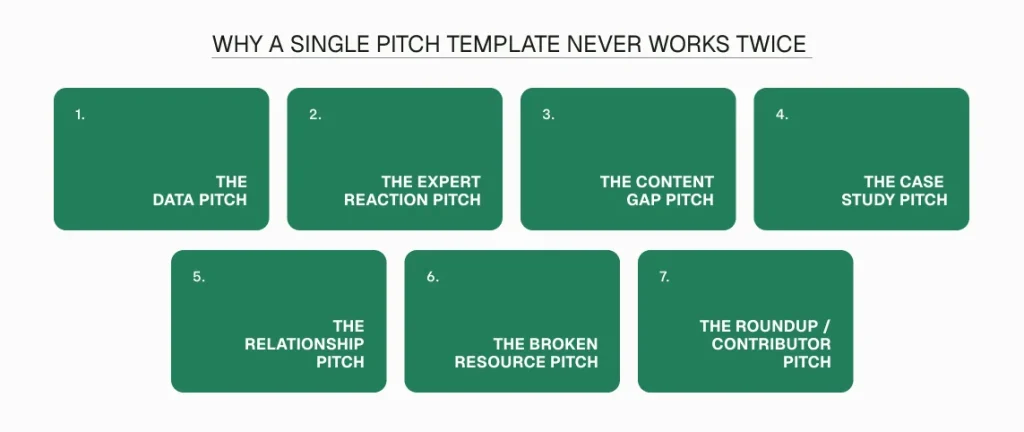
1. The Data Pitch
If you or your company have run a survey, analyzed a dataset, or pulled numbers nobody else has published, lead with that. Editors want content their competitors can't easily replicate. Meanwhile, original data is one of the few things that's genuinely hard to copy.
This pitch works best when the data connects to a trend the publication already covers. Not when you're forcing a tangential stat into their niche.
| Template: Subject: A data point your readers on [topic] probably haven't seen Hi [Name], I ran across your piece on [specific article title] and noticed you touched on [specific point]. We recently pulled data from [source/sample size] that adds a layer to that. Specifically, [one-sentence summary of the finding]. I'd like to write this up as an original piece for [Publication Name], built around what the data actually shows rather than a generic overview. Happy to share the raw numbers first so you can judge if it's a fit. Would this be useful for your editorial calendar over the next few weeks? [Name] |
2. The Expert Reaction Pitch
When something changes in your industry, your publications need a fast, informed step. The change could be anything from a platform update to a regulatory shift to a major product launch.
This is one of the quickest ways to learn how to write a perfect guest post pitch. Especially when the pitch needs to land inside a tight news window. Remember, the timing is the most crucial component here.
The catch: you actually need relevant experience to back the opinion. Editors can tell when someone is reacting to news they read that morning versus commenting from real hands-on knowledge.
| Template: Subject: Quick take on [recent industry event] for [Publication Name] Hi [Name], With [recent development] happening this week, I imagine your readers have questions about what it actually changes day to day. I've worked directly with [relevant context, for ex: clients, products, systems] and have a specific angle on [particular implication] that I haven't seen covered elsewhere yet. I can turn around a draft within [timeframe] if you're planning to cover this. Let me know if that's useful, and I'll send an outline first. [Name] |
3. The Content Gap Pitch
Every well-established blog has holes in its coverage. Notably, there are topics adjacent to what they already rank for. But that they haven't written about yet.
Spotting these gaps and proposing to fill them shows an editor you've actually studied their site. Already there are a lot of people who just outreach after reading contact forms.
| Template: Subject: A gap I noticed in your [topic] coverage Hi [Name], I've been reading through your archive on [topic area]. Your piece on [specific article] was especially good. One thing I noticed missing is anything on [specific subtopic], which comes up a lot when [context: client conversations, forum threads, search trends]. I'd like to pitch a piece covering [proposed angle], written specifically for your audience rather than repurposed from somewhere else. I can share a working outline if that helps you evaluate the fit. I'm open to feedback on the angle or structure before I start writing. [Name] |
4. The Case Study Pitch
Numbers and outcomes carry weight that opinion pieces don't. If you've solved a real problem, for a client, for your own company, or for a project, turn it into a case study pitch. You can present it as B2B and SaaS blogs where readers want proof, not theory.
This is also one of the better formats if you're building toward a placement that supports long-term authority rather than a single link.
Publishers pursuing sustained topical depth and brands trying to recover after a Google rankings drop, tend to favor this kind of contribution. To clarify, it demonstrates real expertise instead of surface-level advice.
| Template: Subject: A case study from [Project/Client] that might fit [Publication Name] Hi [Name], We recently worked through [specific problem] with [client/project], and the results were [one concrete metric or outcome]. I think it would make a useful case study for your readers dealing with the same issue. I can walk through what we tried, what didn't work, and what moved the needle, with real numbers, not vague claims. Would a piece like this fit your upcoming content plans? [Name] |
5. The Relationship Pitch
You can use previous hooks to build relevance. Maybe you commented on previous publications. Or you may have worked with an editor on other occasions.
You can use that connection. While writing your guest post pitch, talk about that too. For you, it is not a cold signal anymore. And that will certainly work in your favor.
| Template: Subject: Following up. Another idea for [Publication Name] Hi [Name], It's been a while since [previous contribution/interaction], and I wanted to check in with a new idea. I've noticed you've been covering more on [current theme], and I have a piece in mind around [specific angle] that would build on that. Let me know if you're taking pitches on this topic right now, and I'll put together a short outline. [Name] |
6. The Broken Resource Pitch
If you think you can actually be useful to someone, use this broken resource pitch. What is that? Suppose you were screening an editor’s site or publication and came across problematic areas like:
2. An old stat
3. A resource page that links a site that is already pulled down
Simply mention those issues in your pitch. At the same time, mention what the alternative content will offer. Here you have to show how the new piece will add further value. I would like to go forward with the pitch like this:
| Template: Subject: A dead link on your [resource page/article title] Hi [Name], While reading through [page URL], I noticed the link to [dead resource] no longer works. Thought you'd want to know, since it might be affecting the page's usefulness. Separately, I put together [replacement resource/article idea] that covers similar ground and is current for 2026. Happy to send it over if you'd like a replacement, no obligation either way. [Name] |
7. The Roundup / Contributor Pitch
Did you find any best-tool pitch or contributor roundtables? You can flag an issue there, spot on. Again, that's an easy way to get your website placed. Do that first. Later, you can pitch for content on your own.
| Template: Subject: Contributor for your [topic] roundup Hi [Name], I saw your roundup on [topic] and wanted to offer a perspective from [your relevant background]. Specifically, I could add a point on [narrow, specific angle] that I haven't seen covered in the current version. Happy to keep it to [word count] and format it however fits best. Let me know if you're still accepting contributions. [Name] |
What Actually Separates A Reply From A Rejection
Your template will fail if you are just copying from a template. Whether that’s from these 7 or something you found online. However, my templates are designed so you have to share your original research results or insights to complete them.
Mostly, editors reject pitches because senders don't address a real problem. Unless you read the website well, you won’t understand what to pitch.
In the same vein, do not pitch the same problem to the other 100 editors. Dedicate your time and make a niche-specific pitch.
Building A Repeatable Pitching Process
A few habits make all seven templates above work better in practice. If you still want to know how to write a perfect guest post pitch:
- Read at least three articles on the target site before writing anything. Skimming the homepage isn't research.
- Name something specific from the site in your first two sentences. It's the fastest way to prove you're not mail-merging.
- Keep the ask small. You're pitching an idea, not demanding a yes.
- Track what gets replies. Over a few dozen pitches, a pattern will emerge. Based on that, find out which angles work for which niches, and which subject lines get opened.
- Follow up once, politely, after a week or so. Editors are busy, and a single follow-up rarely hurts.
Read Also: