


A guest post can be published, indexed, and linked to your website. Well, it can still deliver nothing useful. That happens more often than marketers admit.
Take this scenario for instance. The publisher had an impressive Domain Authority. The article contained the agreed anchor text. Above all, the link appeared exactly where it was supposed to. On the campaign spreadsheet, everything was finally marked “done.”
Three months later, however, the target page had barely moved. Referral traffic was negligible, and no qualified leads could be connected to the placement.
The problem was not necessarily the guest post. It was the job assigned to it.
A digital marketing guest post should not exist simply to generate another live URL. It should strengthen a specific page, reach a defined audience, establish expertise, support a conversion path, or create a valuable publisher relationship.
Ideally, it will achieve several of those outcomes. But one must be the primary objective.
That is the difference between collecting guest posts and using them as part of a digital marketing strategy.
What Is A Digital Marketing Guest Post?
A digital marketing guest post is an expert article published on a third-party website to reach its audience and support a marketing objective.
Depending on the campaign, that objective might be:
- Increasing relevant search visibility.
- Reaching potential customers.
- Building brand credibility.
- Generating referral traffic.
- Supporting a product or service page.
- Developing publisher relationships.
- Expanding the brand’s presence across search and AI discovery platforms.
Guest posting is therefore not only a link-building activity. It is a form of borrowed distribution.
Instead of waiting for an audience to discover your website, you contribute useful content to a publication that already has the readers, reputation, and visibility your brand wants to reach.
The benefit, however, depends entirely on:
1. Where the post appears
2. What it discusses
3. Which page it supports
4. What readers can do after encountering your brand
Before Discussing The Benefits, Decide What The Guest Post Must Do
One guest post cannot be expected to solve every marketing problem.
A post designed to influence search rankings may need a different publisher from one intended to generate product enquiries. Similarly, a publication that provides strong brand recognition may not always generate measurable referral traffic.
Start by assigning every placement one primary job.
| Primary Job | What The Publisher Must Offer | Best Page To Support | Primary KPI |
| Improve search visibility | Topical relevance, editorial standards and genuine organic visibility | An important resource or target page | Rankings and organic clicks |
| Generate qualified traffic | Strong audience overlap and visible content distribution | A relevant landing page or lead magnet | Engaged referral sessions |
| Build brand credibility | Recognition and trust within the target industry | Research, expert content or an author page | Branded searches and mentions |
| Support demand generation | Readers matching the ideal customer profile | A case study, comparison page or solution guide | Assisted leads and conversions |
| Expand brand discovery | Search-visible content that remains useful over time | Evidence-rich brand resources | Mentions, citations and discovery traffic |
A placement can produce secondary benefits. A search-focused guest post might also generate leads, while a thought-leadership contribution may earn links from other publications.
But defining the primary objective tells you which publisher, topic, destination page, and measurement method to choose.
How Guest Posting Supports A Wider Digital Marketing Strategy
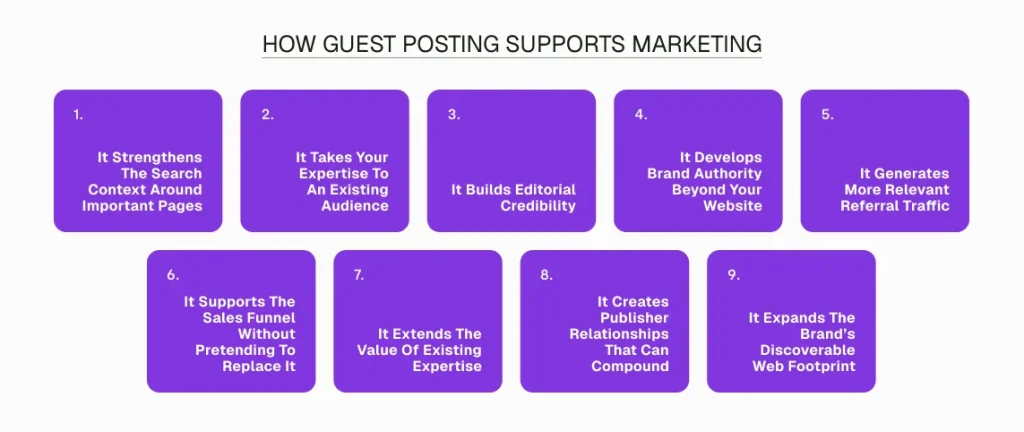
The usual explanation of guest posting begins and ends with backlinks. That leaves most of its potential value unexplored.
A well-planned placement can influence several stages of the customer journey, from the first encounter with a brand to the final trust check before a purchase.
It Strengthens The Search Context Around Important Pages
Google uses links to discover pages and understand relationships between online resources. However, the value of a link cannot be reduced to the authority score of the linking domain.
Consider two placements:
| Placement 1 A DA 75 general website publishes an unrelated article containing your link | Placement 2 A DA 48 industry publication links to your specialist guide inside a closely related discussion. |
The first placement looks more impressive in an SEO report. The second may provide clearer topical context, reach more relevant readers, and appear more editorially natural.
This is why Domain Authority should be treated as a comparison metric, not as Google’s final judgment on a publisher.
A link is most useful when three elements align:
- The publisher covers a topic relevant to your business.
- The article gives readers a legitimate reason to follow the link.
- The destination page satisfies the intent created by the article.
For example, a project-management SaaS company may benefit more from a placement about reducing operational bottlenecks on a respected productivity publication than from an unrelated “top software tools” article on a larger general website.
The link is not an isolated entity. The publisher, article, anchor, destination page, and surrounding topic form one connected context.
It Takes Your Expertise To An Existing Audience
Publishing on your own website is essential. But the people reading your blog are usually those who already know your brand or have discovered it through search.
Guest posting introduces your expertise to an audience someone else has already built. This is particularly valuable for:
- Startups entering established markets.
- SaaS companies competing with better-known platforms.
- Consultants who need to demonstrate expertise.
- Ecommerce brands expanding into adjacent customer segments.
- Agencies entering a new niche or location.
The objective is not simply to reach a larger audience. It is to reach the right audience.
Ten thousand readers who have no need for your product are less valuable than five hundred professionals facing the exact problem your business solves.
Publisher selection must therefore consider audience alignment alongside traffic and authority metrics.
| “Blogger Outreach’s guest-posting process allows clients to evaluate publishers by niche, authority, traffic, geography, audience, and budget before moving forward with a placement.” - - Ejaz Ahmed, Head of Business & Ops @BloggerOutreach |
That provides more control than selecting websites based on a single DA or DR threshold.
It Builds Editorial Credibility
Your website can call your company experienced, reliable, or innovative. Readers expect that language because it comes from the company itself.
An appearance on a credible third-party publication works differently.
The publication is allowing your expertise to appear in front of its audience. Even when the article is clearly identified as a contribution, the publisher’s editorial process provides a degree of external validation.
That value depends on the publication’s standards.
A website that accepts every submission has little credibility to share. A publication that checks expertise, edits articles, rejects poor pitches, and protects its topical focus provides a much stronger environment.
This distinction is explored further in Blogger Outreach’s guide to editorial authority. Editorial authority cannot be understood through traffic or DA alone. It comes from the publisher’s history of making selective and trustworthy content decisions.
That is why a difficult placement can be more valuable than an easy one.
The editor who questions a claim, requests a stronger source, or rejects an unsuitable anchor is not creating an inconvenience. They are protecting the standards that make the publication worth appearing on.
It Develops Brand Authority Beyond Your Website
Website owners often assume authority can be created entirely through content published on their own domain.
That is only part of the picture.
If a company claims expertise in cybersecurity, finance, ecommerce, or digital marketing, the wider web should eventually contain evidence supporting that position.
Relevant publications should mention the company. At the same time, industry writers should reference its insights. Even readers should encounter the brand during research.
Guest posting can contribute to this external evidence.
One appearance will rarely transform how a market perceives a business. But a consistent series of relevant, useful contributions can gradually connect the brand with a specific area of expertise.
This is how brand authority begins to compound. The brand is not merely repeating its own claims. Other websites, editors, readers, and industry communities encounter and validate its knowledge.
This matters especially in markets with long consideration cycles. A B2B buyer may request a demonstration only when they:
- encounter a company in an industry article
- see it mentioned again during research
- visit its website weeks later
The guest post did not create a direct sale. It contributed to the trust sequence that made the sale possible.
It Generates More Relevant Referral Traffic
Referral traffic is often listed as a guest-posting benefit without an important qualification: not all referral traffic is useful.
A hundred visitors who immediately leave the destination page add little value. Twenty visitors who read a case study, download a guide, or view a product comparison may be far more important.
That said, the quality of referral traffic depends on:
- How closely the publisher’s audience matches your customers.
- Whether the guest-post topic creates the right next question.
- Where the link appears in the article.
- Whether the destination continues the reader’s journey.
- How effectively the destination page converts interest into action.
Semrush provides an instructive example in its guide to guest posting. A guest contribution published on Buffer reportedly generated nearly 400 email subscribers for its author over 11 months.
The key result wasn't the backlink alone. The article, audience, destination, and conversion offer worked together.
Marketers can track permitted referral links with UTM campaign parameters. Google Analytics explains how campaign parameters identify the sources that send visitors to a website in its URL Builder documentation.
A simple tracking structure could include:
- utm_source: publisher name
- utm_medium: referral
- utm_campaign: guest-post campaign
- utm_content: article or link identifier
This makes it easier to separate useful placements from those that merely produced a live link.
It Supports The Sales Funnel Without Pretending To Replace It
Guest posts rarely close sales on their own. If you think it’s a limitation, that’s not true. In reality, a guest post is not done with the intention of closing another sales deal. You need to understand the strategic importance of guest post on a site!
Most placements operate near the awareness, research, and trust-building stages of the funnel. They introduce a problem, demonstrate expertise, and give interested readers a reason to investigate the brand.
Your website must handle what happens next. Depending on the reader and topic, the link might lead to:
- An original research report.
- A detailed guide.
- A downloadable framework.
- A comparison page.
- A case study.
- A newsletter.
- A consultation or strategy session.
Sending every guest-post visitor to the homepage wastes much of the context created by the article.
Suppose an ecommerce consultancy publishes an article about reducing cart abandonment. Linking readers to a general homepage forces them to restart their research. Linking to a cart-abandonment audit, case study, or practical checklist continues the conversation.
The guest post creates interest. The destination page turns that interest into a measurable marketing action.
It Extends The Value Of Existing Expertise
A strong guest post should not require inventing an entirely new area of expertise. The most effective topics are often built from knowledge the company already has:
- Customer questions.
- Internal research.
- Campaign observations.
- Product usage patterns.
- Original surveys.
- Anonymized client lessons.
- Expert interviews.
- Industry data.
Guest posting gives that knowledge another distribution channel. In addition, the underlying research can later support:
- LinkedIn posts.
- Newsletter content.
- Sales presentations.
- Webinar discussions.
- Short videos.
- Internal training.
- Follow-up articles.
- Digital PR pitches.
This changes the campaign economics. The company is no longer paying or allocating time for one article and one link. It is creating an expert asset that can support several marketing and sales activities.
However, repurposing should not mean duplicating the same article across different websites. Each version must be adapted to the audience, format, and editorial expectations of the channel.
It Creates Publisher Relationships That Can Compound
A spreadsheet of publisher URLs is not the same as a network of publisher relationships. The difference becomes visible when the next campaign begins.
A brand that has previously delivered useful, carefully sourced content may receive faster responses, better topic access, and invitations to contribute again.
It may also be approached for expert quotes, surveys, podcasts, collaborative content, or industry commentary.
These opportunities are difficult to produce through automated mass outreach.
Blogger outreach and guest posting are related, but they are not identical. Guest posting focuses on securing a particular article placement.
Blogger outreach builds relationships that can lead to reviews, contributions, collaborations, and repeat editorial opportunities.
Blogger Outreach combines these areas by maintaining publisher relationships while managing prospecting, content creation, editorial communication, placement, and reporting for clients.
That matters when the company’s internal team understands the strategy but does not have the time to manage hundreds of publisher conversations.
It Expands The Brand’s Discoverable Web Footprint
Search is no longer limited to a list of traditional blue links.
Potential customers may discover brands through Google results, AI Overviews, ChatGPT, Perplexity, social platforms, industry newsletters, and publisher websites.
Relevant third-party mentions create more places where a brand and its expertise can be discovered.
This does not mean that one guest post guarantees a citation in an AI-generated answer. No responsible provider can promise that. AI systems use different retrieval methods, sources, and ranking processes.
However, useful mentions on credible, accessible, and topically relevant pages can strengthen the wider information environment surrounding a brand.
The objective should be to make the company easier to identify and verify. Not to manufacture artificial mentions for an algorithm.
That broader evidence contributes to what Blogger Outreach describes as website authority: the collection of signals that helps demonstrate a website’s relevance, usefulness, expertise, and trustworthiness.
Which Businesses Benefit Most From Guest Posting?
Guest posting is not equally valuable for every company at every stage.
Its usefulness depends on the business model, competitive situation, internal resources, and pages that need support.
| Business Type | Main Opportunity | Recommended Guest-Post Approach |
| SEO and digital marketing agencies | Scale client fulfilment without expanding the internal outreach team | White-label campaigns with clear publisher approval and reporting |
| SaaS companies | Build authority around competitive problem and solution categories | Expert articles supporting topic clusters, research and comparison content |
| B2B service providers | Establish expertise during a long buying cycle | Thought-leadership placements on publications read by decision-makers |
| Ecommerce brands | Support category visibility and reach relevant lifestyle audiences | Educational content linked to guides, collections or buying resources |
| Startups | Build an initial external reputation | Fewer, highly relevant placements instead of high-volume link acquisition |
| Established websites | Close relevance gaps against competitors | Page-level campaigns based on competitor and backlink analysis |
| Regulated businesses | Strengthen trust without compromising accuracy | Expert-reviewed content and publishers with visible editorial standards |
Guest posting may be a lower priority when:
- The website has serious technical SEO problems.
- The target page does not satisfy search intent.
- The company lacks credible expertise to contribute.
- The offer or conversion journey is still unclear.
- The only objective is to increase DA quickly.
- The campaign depends on exact-match anchors at scale.
If rankings have declined despite continued link acquisition, adding more placements may deepen the problem. First investigate relevance, content quality, search intent, technical issues, and link patterns.
Blogger Outreach’s guide explains several reasons Google rankings can drop even when a website has backlinks.
Why Some Guest Posts Produce No Marketing Benefit
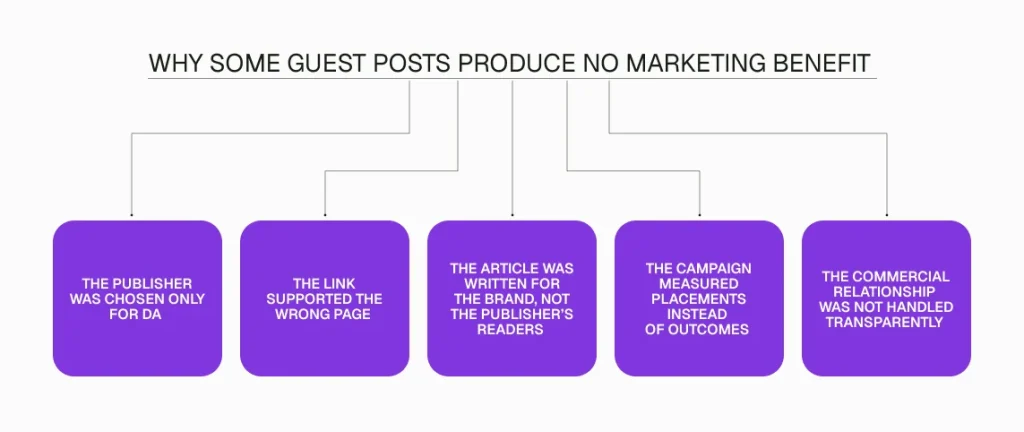
Guest posting usually fails through a chain of small strategic errors rather than one obvious mistake.
The Publisher Was Chosen Only For DA
DA, DR, and Authority Score can help compare websites. None of them can confirm that a publisher has a real audience, maintains editorial standards, or is relevant to the target topic.
Blogger Outreach documented this problem in its high-DA backlink case study.
FinanceReference.com already had more than 120 referring domains and several high-authority backlinks, but its main target keyword remained at position 17.
After the campaign shifted toward relevance, target-page quality, and contextual placements, the keyword moved to position 4. The number of pages ranking in Google’s top 10 increased from 23 to 61.
The lesson is not that DA has no value.
The lesson is that DA cannot compensate for weak relevance.
The Link Supported The Wrong Page
A publisher may be relevant and the content may be excellent, but the campaign can still underperform if every link points to the homepage.
Choose the destination according to the purpose of the article.
A post about fixing cash-flow forecasting should link to a genuinely useful forecasting resource, not an unrelated pricing page.
A post about choosing warehouse software should support a comparison, guide, or solution page that continues the reader’s research.
The Article Was Written For The Brand, Not The Publisher’s Readers
Editors do not need another article explaining why a company is excellent. They need content that helps their audience.
A strong guest post begins with the publisher’s editorial gap and the reader’s problem. The brand enters the article only where its expertise, data, example, or resource improves the answer.
This reader-first approach also gives the article a better chance of earning engagement, secondary links, and long-term visibility.
The Campaign Measured Placements Instead Of Outcomes
“Ten links delivered” is a fulfillment metric. It does not reveal whether the campaign improved anything. A useful report should connect placements to:
- Target pages.
- Topic clusters.
- Referral engagement.
- Rankings.
- Conversions.
- Brand mentions.
- Link retention.
- Publisher quality.
- Campaign cost.
This is particularly important for agencies. Clients eventually ask what changed in the links. A branded spreadsheet containing URLs and authority scores will not answer that question.
The Commercial Relationship Was Not Handled Transparently
Google does not discourage guest articles that inform users, educate another website’s audience, or raise awareness of a company.
It does object to large-scale article campaigns created primarily to manipulate ranking signals. Google specifically identifies practices such as keyword-rich links, repeated low-value articles, and content written by people without appropriate subject knowledge in its guidance on large-scale guest-post campaigns.
If compensation is provided for a link or placement, Google instructs publishers to qualify the link with rel="sponsored" or rel="nofollow". Its outbound-link documentation explains the appropriate attributes.
Paying a provider for legitimate research, outreach, content creation, or campaign management does not automatically mean the publisher was paid for a link. The important questions are:
- Was compensation given to secure the link?
- Did the publisher exercise genuine editorial judgment?
- Was publication guaranteed regardless of quality?
- Has the relationship been disclosed appropriately?
A sustainable guest-posting strategy should be capable of answering those questions honestly.
Managing Guest Posting Internally VS Using A Service
A company can manage guest posting internally.
It needs people to:
- Research suitable publishers.
- Verify traffic and relevance.
- Identify editorial gaps.
- Find the correct contacts.
- Develop article ideas.
- Pitch editors.
- Negotiate requirements.
- Write and edit content.
- Manage feedback.
- Confirm publication.
- Monitor links.
- Report campaign results.
The difficulty is rarely understanding these steps. It is completing them consistently while the same team manages SEO, content, clients, reporting, and other marketing channels.
This is where different guest-posting providers offer different operating models.
Blogger Outreach Vs Outreach Monks, FATJOE And Adsy
There is no universal “best” guest-posting provider. The right option depends on how much control, fulfilment support, reporting, and internal work the buyer wants.
The following comparison is based on the services publicly presented by each provider at the time of writing.
| Provider | Service Model | Publicly Advertised Features | Best Suited To |
| Blogger Outreach | Managed execution with publisher-selection controls | Filtering by niche, authority, traffic, geography and price; content creation; approval workflow; campaign dashboard and white-label reporting | Agencies and brands that want strategic control without managing execution |
| Outreach Monks | Managed per-placement service | Domain approval, manual outreach, traffic verification, a 750-word article, live reporting and a six-month replacement policy | Teams wanting standardized per-placement fulfillment |
| FATJOE | Productized managed outreach | DR and traffic tiers, content writing, unbranded reports and a lifetime link guarantee; its website states that placements cannot be pre-approved | Agencies prioritizing straightforward ordering and link guarantees |
| Adsy | Primarily self-service marketplace | More than 150,000 listed sites, 20-plus filters and direct order monitoring | Experienced teams prepared to manage more publisher selection and quality control internally |
Results From The Comparison
Compared with Adsy, Blogger Outreach reduces the amount of publisher management and campaign coordination the client must handle.
Compared with FATJOE, Blogger Outreach provides greater pre-placement visibility through publisher filtering, shortlisting, and approval.
Outreach Monks is the closest comparison as a managed service with publisher approval. Blogger Outreach differentiates itself through its combination of a publisher marketplace, managed execution, client dashboard, content production, and white-label infrastructure.
Blogger Outreach makes the most sense when the client already understands:
- Which pages need support.
- Which audiences matter.
- Which niches are relevant.
- What quality threshold must be maintained.
- What the campaign should achieve.
Blogger Outreach’s team can then manage publisher discovery, evaluation, outreach, content creation, editorial coordination, placement, and reporting.
So what would we call a better brief? Certainly not something like: “Please build 50 links.” Instead you can include this in the brief:
“Here is the audience we need to reach, the page we need to strengthen, the topics we need to own, and the quality threshold we will not compromise.”
A 90-Day Guest-Post Measurement Framework
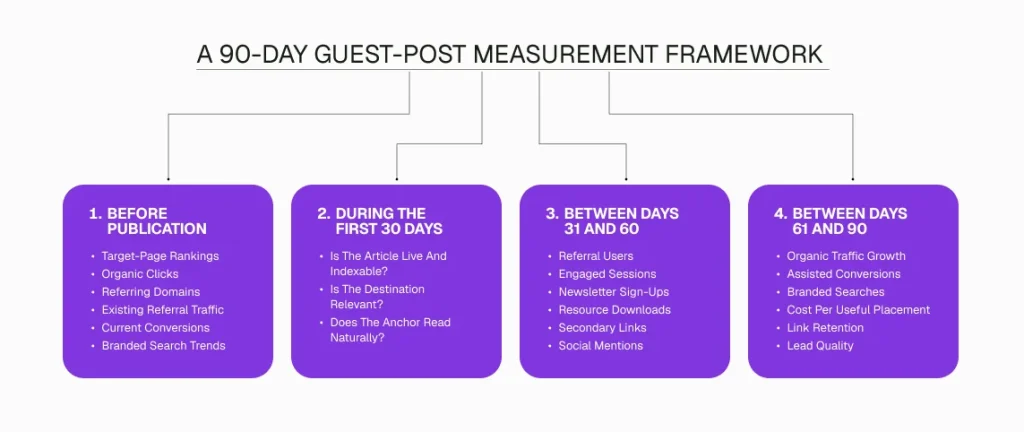
Guest-post performance should be measured in stages. Expecting an immediate ranking or conversion change can lead to poor decisions.
Before Publication
Record the baseline:
- Target-page rankings.
- Organic clicks.
- Referring domains.
- Existing referral traffic.
- Current conversions.
- Branded search trends.
- Competitor authority gaps.
Also confirm the primary purpose of the placement.
During The First 30 Days
Check execution quality:
- Is the article live and indexable?
- Is the link correct?
- Does the anchor read naturally?
- Is the destination relevant?
- Has the publication distributed the article?
- Is UTM tracking working where permitted?
- Does the surrounding content accurately represent the brand?
Between Days 31 And 60
Look for early engagement:
- Referral users.
- Engaged sessions.
- Newsletter sign-ups.
- Resource downloads.
- Secondary links.
- Social mentions.
- Initial ranking movement.
- Publisher engagement.
A lack of movement does not automatically mean failure. Search impact can take longer, particularly for competitive keywords.
Between Days 61 And 90
Evaluate business contribution:
- Target-page ranking changes.
- Organic traffic growth.
- Assisted conversions.
- Branded searches.
- Lead quality.
- New publisher opportunities.
- Link retention.
- Cost per useful placement.
The phrase “useful placement” is important.
A live URL that produces no relevant signal, audience interaction, authority, or business value should not be treated as equal to a placement that supports several campaign objectives.
Stop Counting Guest Posts. Start Measuring Their Work
Guest posting still belongs in a digital marketing strategy. But the traditional model of selecting a DA tier, inserting an anchor, and counting the resulting URL is no longer enough.
| A successful digital marketing guest post must connect four things: 1. The right audience. 2. The right publisher. 3. The right destination page. 4. The right business objective. |
When those elements align, guest posting can support search visibility, referral traffic, brand recognition, editorial credibility, content distribution, and long-term publisher relationships.
When they do not, even an impressive-looking placement can become another row in a report that nobody can connect to growth.
Blogger Outreach helps agencies and brands manage the execution behind that alignment.
Our services expand from publisher research and manual outreach to content creation, client approval, placement tracking, and white-label reporting.
The objective is not to publish everywhere. It is to appear where the placement has a clear job to do.
Frequently Asked Questions
What Are The Main Benefits Of Guest Posting In Digital Marketing?
Guest posting can support relevant backlinks, referral traffic, brand exposure, editorial credibility, thought leadership, publisher relationships, and demand generation. The results depend on publisher relevance, content quality, the destination page, and how the campaign is measured.
Is Guest Posting Still Effective For SEO?
Guest posting can support SEO when the content is useful, the publisher is relevant, and the link exists naturally within the editorial context. Large-scale campaigns built primarily to manipulate rankings can violate Google’s spam policies.
Which Businesses Benefit Most From Guest Posting?
SEO agencies, SaaS companies, B2B service providers, ecommerce brands, consultants, and startups can benefit when they have useful expertise and clear target pages. It is less effective when technical SEO, content quality, or conversion problems remain unresolved.
How Should Guest-Post ROI Be Measured?
Measure target-page rankings, organic clicks, referral engagement, assisted conversions, branded searches, new referring domains, link retention, and publisher relationships. Do not evaluate the campaign only by the number of links published.
Is A High-DA Website Always The Best Place For A Guest Post?
No. DA is a third-party comparison metric. Topical relevance, genuine traffic, editorial standards, audience alignment, link context, and destination-page quality can be more important than the highest available DA score.
Can Guest Posting Help A Brand Appear In AI Search Results?
Relevant third-party mentions can expand the brand’s discoverable web footprint, but no guest post can guarantee an AI citation. Focus on useful content, credible publishers, accurate information, and consistent topical recognition.
How Does Blogger Outreach Help With Guest Posting?
Blogger Outreach helps clients research and select publishers, manage manual outreach, create content, coordinate editorial approval, track placements, and generate reports. Agencies can also use its dashboard and white-label reporting while keeping their client strategy in-house.