

According to a Pew Research study, when AI overviews are present in search results, users click traditional search links only 8% of the time, compared with 15% when no AI summaries appear.
In the modern SEO landscape, this data signals a major change that no one should ignore. Search is no longer a race for the top spot on the SERP (search engine results page). It has transitioned into a visibility fight, one that occurs beyond traditional search engines like Google.
People are now using agentic AI platforms like ChatGPT, Gemini, and Perplexity to find answers, compare options, and make a buying decision. And this is where the AI citations SEO start to matter. It is the process of making your brand easier to understand and refer to when AI platforms generate answers.
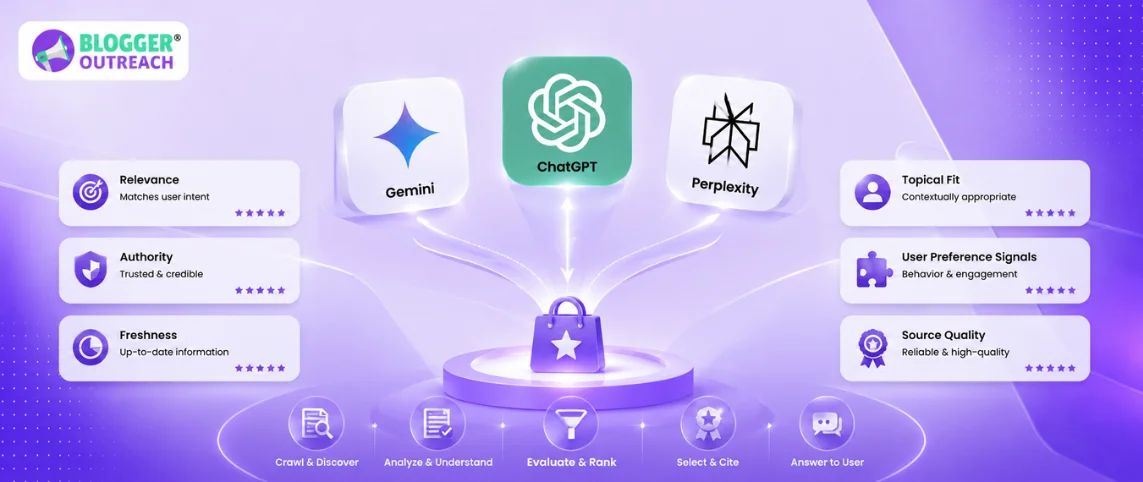
But the tricky part is that ChatGPT, Gemini, and Perplexity do not choose the brands to refer to in the same way. They use different retrieval patterns, sources, and citation transparency. So, when your goal is real AI search visibility, you need to think beyond ranking and look into how answer engines build trust.
What are AI Citations And Brand Mentions?
AI citations SEO refer to the sources, links, and references that AI systems use to support the answers they generate. Now, in Perplexity, these citations will appear after the answer ends in a clickable listicle format. The same is also applicable to Gemini and ChatGPT, but in these two platforms, sometimes the sources don't appear depending on the question and answer format.
Brand mentions are slightly different. It refers to instances where AI search engines mention your brand in their responses, even if they don’t link directly to your website. This mention can be descriptive, neutral, comparative, or even recommendation-based.
| Visibility Type | What it Means | Why it Matters |
| Citation | Your content is used as a source material | Builds authority and can drive referral traffic |
| Mention | Your brand is named in the answer | Improves recall and category association |
| Recomendation | Your brand is suggested as a solution | Influences high-intent buying decisions |
The Core Signals AI Tools Use To Choose Brands
AI tools do not cite or mention brands at random; they follow a process that evaluates each company’s digital presence against a few defined parameters. These are:
(i) Clarity On Brand Entity
The first point to mention here is the clarity of the brand entity. The system has to know who you are, and even though it may sound very basic, many brands struggle to establish their identities. For instance, a cybersecurity brand is referred to as a cloud service provider on one of its social media profiles, or regarded as an antivirus company in a series of third-party mentions. This inconsistency confuses the AI models.
Now, clarity of entity, often referred to as entity SEO, means that your brand name, category, audience, product description, and main use cases remain consistent across the web. Your website, schema markup, LinkedIn profile, directories, review platforms, author bios, and press mentions should not sound like five different companies. If AI systems cannot confidently map your brand to a category, your chances of being mentioned will reduce.
(ii) Topical Authority
The next area to focus on is topical authority. The AI systems consistently look for brand expertise. It wants to see whether your brand shows up repeatedly around a topic with depth, usefulness, and consistency. If the cybersecurity firm publishes a single content piece on cloud security and then mostly writes generic trend posts, it is harder to associate that brand with cloud security expertise.
The best way to resolve this is to create a content cluster around a particular topic. Here, you cover topics such as definitions, comparisons, use cases, implementation guides, FAQs, buyer guides, and opinion pieces. This complete content ecosystem is where generative engine optimization overlaps with the classic content marketing strategy. Here, you are not just optimizing one page but teaching the machine what your brand is credible enough to talk about.
(iii) Third-party Validation
The content on your website is important, but in the modern AI SEO landscape, third-party validation from credible sources is more important. Here, third-party validation refers to mentions or references from other publications, preferably from industry leaders and reputable sources.
Third-party validation can come from review platforms, independent blogs, analyst pages, digital PR, niche directories, podcasts, expert roundups, case study mentions, and community discussions. This is especially important for ChatGPT SEO, where broad web consensus often matters more than a perfectly optimized service page. A brand that is discussed across trusted sources becomes easier to retrieve and summarize, and, more importantly, to trust.
(iv) Content Extractibility
The extractibility of the content is another crucial factor. The AI systems prefer content that they can lift cleanly. When a section directly answers the question, it is easier to refer to than one that starts with a lengthy introduction. Also, a clean comparison table is more effective than vague marketing copy.
However, this doesn’t mean that every page should sound robotic. The content structure must make sense with proper H2S and H3s, placing the answer near the top, breaking down comparisons, including practical examples, and adding FAQs where they actually help.
(v) Content Freshness And Accuracy
The next signals that AI models consider are content freshness and accuracy. Content freshness is important, but not in every segment. It matters a lot in fast-moving niches like technology, finance, AI, and compliance. Since these sectors are rapidly and constantly evolving, if your content is not updated at least once a year, it will not remain reliable enough for AI platforms, even if it ranks highly on the SERP.
Content accuracy, on the other hand, is extremely important. AI tools always cross-check the pattern across sources. It means if your website says one thing, and review platforms, directories, or product documentation say another, that inconsistency can weaken your visibility. In AI search optimization, old content is not just a missed ranking opportunity. It can become a trust problem.
Where ChatGPT, Gemini, And Perplexity Get Their Information
Understanding how AI platforms retrieve information helps explain why certain brands appear more often than others.
| Platform | Primary Information Sources |
| ChatGPT | Web content, trusted third-party sources, Bing-powered retrieval, model knowledge |
| Gemini | Google Search, Knowledge Graph, Google Business Profile, structured data |
| Perplexity | Live web results, publisher websites, citations, recent content |
This difference explains why a brand may be highly visible in Gemini but rarely appear in ChatGPT, or vice versa. AI citation optimization works best when brands build authority across multiple information ecosystems rather than relying on a single platform.
How To Measure AI Search Visibility?
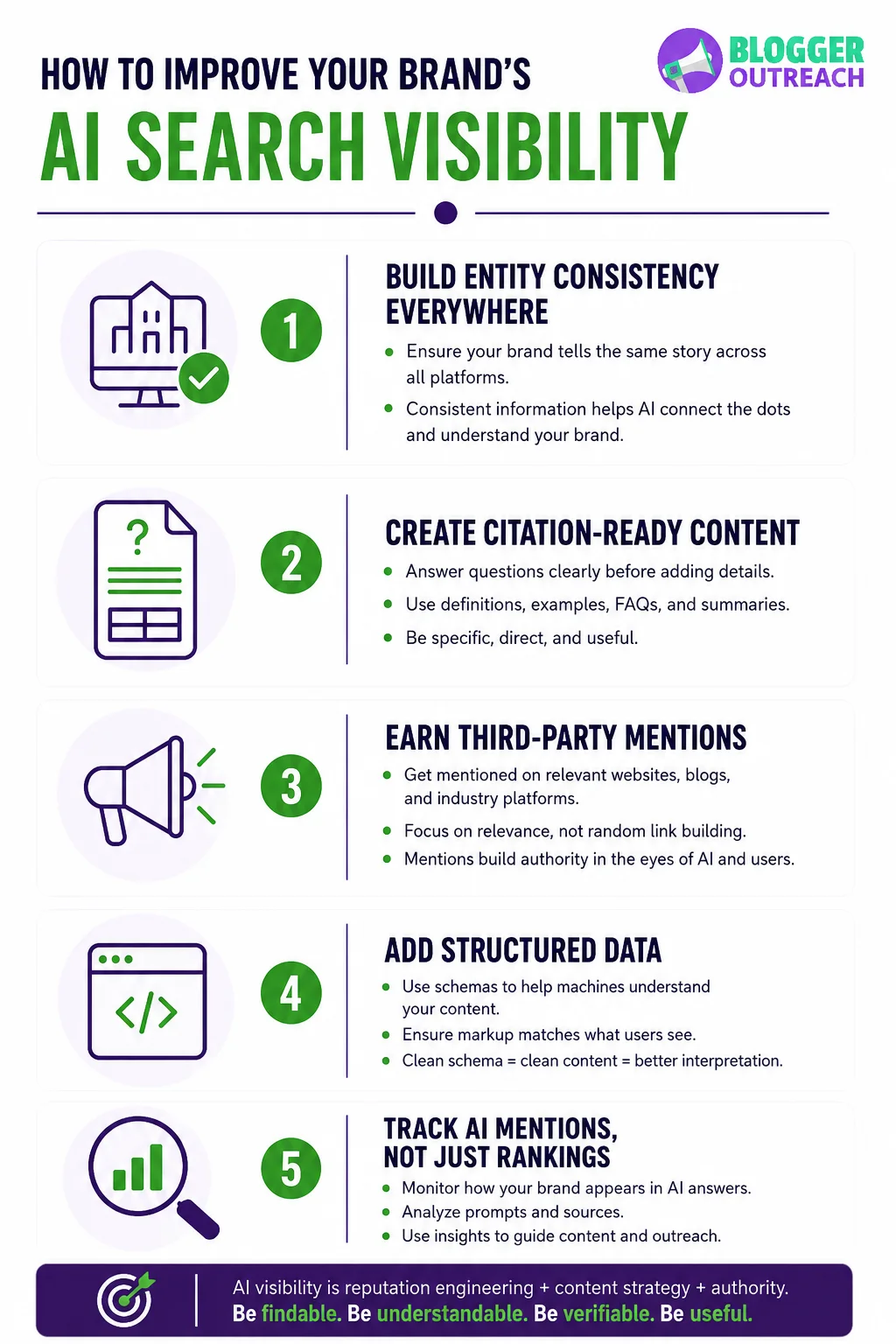
Improving AI search visibility is only half the challenge. The other half is understanding whether AI platforms are actually mentioning your brand. Unlike traditional SEO, where rankings and traffic are easy to track, AI visibility requires monitoring citations, mentions, and share of voice across multiple answer engines.
Some Useful Metrics Include:
- Brand mentions in ChatGPT responses.
- Citation frequency in Perplexity.
- AI share of voice against competitors.
- Sentiment of AI-generated recommendations.
- Referral traffic from AI search platforms.
Several tools now help track these signals, including Profound, Peec AI, Semrush AI Toolkit, Ahrefs Brand Radar, and Scrunch AI. Monitoring these metrics helps brands understand whether their GEO and AI search optimization efforts are producing measurable results.
How ChatGPT Choose Which Brands To Mention?
ChatGPT is not a search engine with a fixed answering pattern. Its behavior changes depending on whether the user is using a browsing-enabled experience, a search-integrated product, a custom GPT, or a general chat flow.
Based on that, ChatGPT sometimes draws on model knowledge, retrieves information from the current web, and relies on sources made available in the chat. This makes brand visibility less predictable and highly difficult to measure.
Even amid this unpredictability, patterns still show up from time to time. ChatGPT tends to mention brands with strong entity recognition, broad web presence, and consistent third-party validation. Therefore, for brands, having a strong and consistent brand story is more important than a single ‘perfect’ landing page. If multiple credible sources describe you in the same way, compare you in the same category, and associate you with the same problem, then ChatGPT gains confidence.
Therefore, when it comes to ChatGPT SEO, the actual work becomes part content and part reputation management.
It Means:
- Website pages should answer real buyer questions directly.
- Off-site presence should confirm the same positioning.
- The product category should be obvious.
- The brand should appear in comparison posts, review platforms, thought leadership pieces, and industry resources.
Having Said That, A Small Working Checklist Would Look Like:
- Keeping brand descriptions consistent across major profiles and directories.
- Publishing answer-style content around buyer questions, not just keywords.
- Earning mentions in comparison articles, roundups, interviews, and industry blogs.
- Making sure important pages are crawlable and technically clean.
- Building topical depth instead of chasing disconnected search terms.
Which Queries Trigger AI Brand Mentions Most Often?
Not every search prompt creates equal opportunities for brand visibility. AI systems are more likely to recommend, cite, or mention brands during specific query types.
Informational Queries
Examples:
- What is AI search optimization?
- What is GEO?
Comparison Queries
Examples:
- Semrush vs Ahrefs
- ChatGPT vs Gemini
Commercial Investigation Queries
Examples:
- Best SEO agencies
- Top link building services
Solution-Focused Queries
Examples:
- Best AI search optimization company
- Recommended cybersecurity vendors
Brands that consistently appear within these query categories typically have stronger topical authority, entity recognition, and third-party validation.
How Does Gemini Choose Which Brands To Mention?
When it comes to Gemini, things get a little interesting. Since this AI tool sits within Google’s own ecosystem, it remains closer to the old foundation. So, if Google cannot clearly understand your brand entity, properly crawl your website, align your content with search intent, or parse structured data, Gemini doesn’t have much to work with.
As a result, technical SEO, schema, internal links, local signals, product pages, and structured content suddenly become highly important factors.
Gemini is more likely to understand brands with clear brand assets. Therefore, your business website must explain what the company does, who it serves, how the product works, and why it is relevant to specific questions.
Therefore, for brands with local, SaaS, ecommerce, or service-based models, the basics become strategies.
Which Include:
- Keeping the Google Business Profile data accurate and relevant.
- Using the right schema (Organization, Product, Article, FAQ, Review, and LocalBusiness ) as it is applicable.
- Creating topic clusters on your own domain.
- Ensuring the comparison and alternative pages have thin content.
Gemini’s answer engine optimization is probably the least glamorous of the three. It rewards clean site structure, entity signals, strong content architecture, updated pages, and good internal linking.
How Perplexity Chooses Which Brands To Cite?
When it comes to AI citations SEO, Perplexity is the most forward of the three. It behaves less like a chatbot with occasional links and more like an answer engine built around sourced responses. That makes it attractive for marketers because you can often see which pages are being used. Now, it is neither perfect nor consistent, but it is far more transparent than many other AI systems
Perplexity usually favors content that is current, direct, specific, and easy to extract. If a user asks a question, Perplexity looks for sources that can support the answer quickly. A page that leads with the answer has an advantage over a page that spends 500 words warming up.
Well-structured comparisons, expert insights, original research, and references from trusted sources such as Wikipedia can help reinforce topical relevance and credibility. In many cases, a concise, data-backed article may outperform a broader high-authority page that lacks clear answers.
This is where smaller brands can sometimes punch above their weight by creating focused content that directly satisfies user intent.
A key point to understand here is that the writing style that works for Perplexity is almost editorially blunt. All you have to do is answer the question, add context, support the claim, and move on.
Here, question-style headings work well because they mirror how users ask prompts. Along with that short summary, tables, recent updates, and author credibility help particularly in technical or high-risk categories.
Perplexity also makes weak content more obvious. If your page is generic, outdated, promotional, or hard to scan, it is unlikely to become a preferred source. For answer engine optimization, this is a useful lesson. The best AI-ready content is not keyword-stuffed; it is clear enough to be quoted, specific enough to be trusted, and structured enough to be retrieved.
The Role Of Knowledge Graphs In AI Search Visibility
Knowledge Graphs play a growing role in how AI systems understand brands. When a business has strong entity associations across the web, AI platforms can more confidently identify who the company is, what it does, and how it relates to specific topics.
Some Common Entity-building Sources Include:
- Google Business Profile
- LinkedIn Company Pages
- Crunchbase Profiles
- Wikidata Entries
- Industry Directories
- Author Profiles
- Organization Schema
Strong Knowledge Graph signals improve brand clarity and increase the likelihood of appearing in AI-generated recommendations, citations, and answer summaries.
ChatGPT Vs. Gemini Vs. Perplexity: Key Differences For AI Citations SEO
The biggest mistake that everyone makes is treating all AI engines like a single giant machine. Even though they overlap, their underlying behavior differs enough to ensure that a one-size-fits-all strategy will not work here.
While one brand surfaces in Gemini because its own site is strong, it may disappear in ChatGPT due to the lack of third-party validation.
| Platform | What it Often Rewards | Best Optimization Focus |
| ChatGPT | Web consensus, entity recognition, and trusted third-party mentions | Brand consistency, digital PR, review presence, and answer-style content |
| Gemini | Google-aligned signals, structured owned content, crawlable pages | Technical SEO, schema, Google visibility, topic clusters |
| Perplexity | Fresh, direct, citable passages from web sources | Updated content, question headings, concise answers, source-rich pages |
Therefore, the practical answer today is not to choose one platform and ignore the others, but to build a foundation in each. This helps build better AI citations for SEO and a sturdier visibility profile.
AI Citation Optimization Checklist
| Optimization Area | Why It Matters For AI Visibility |
| Consistent Brand Descriptions | Helps ChatGPT, Gemini, and Perplexity understand and categorize your brand correctly across the web. |
| Organization Schema | Provides structured entity data that improves machine understanding of your business. |
| Active Google Business Profile | Strengthens local entity signals and supports Gemini visibility. |
| Topic Clusters | Demonstrates topical authority and expertise around core subjects. |
| High-Quality Third-Party Mentions | Builds trust through independent validation from authoritative sources. |
| Guest Posts on Industry Publications | Expands brand presence and creates additional citation opportunities. |
| Updated Content | Ensures information remains accurate, trustworthy, and relevant for AI retrieval systems. |
| Author Profiles & Expertise Signals | Strengthens E-E-A-T (Experience, Expertise, Authoritativeness, Trustworthiness). |
| FAQ Sections | Creates answer-ready content that AI tools can easily extract and cite. |
| Strong Internal Linking | Helps search engines and AI systems understand content relationships and topic hierarchy. |
| Knowledge Graph Presence | Improves entity recognition through sources like Wikidata, Crunchbase, and LinkedIn. |
| Review Platform Visibility | Provides third-party trust signals that influence AI recommendations. |
| Digital PR Coverage | Increases authoritative brand mentions across trusted publications. |
| Comparison & Alternative Pages | Helps AI associate your brand with relevant product or service categories. |
| Consistent NAP Information | Reinforces business identity across directories and citation sources. |
| Social Profile Consistency | Strengthens entity validation through LinkedIn, X, Facebook, and other platforms. |
| Industry Directory Listings | Expands discoverability and provides additional entity references. |
| Fresh Case Studies & Testimonials | Adds credibility and proof of expertise that AI systems can reference. |
| Technical SEO Health | Ensures AI crawlers can access, understand, and retrieve website content efficiently. |
| AI Visibility Monitoring | Tracks mentions, citations, and share of voice across AI search platforms. |
AI Engines Mention The Brands They Can Understand, Verify, And Trust
ChatGPT, Gemini, and Perplexity choose brands through different paths, but their underlying idea remains the same. They prefer brands that are clear, consistent, well-supported, and useful in context.
That is why AI citations SEO must not remain in a separate box away from content, SEO, PR, and outreach. Instead, it must connect all of them to create a stronger owned presence and off-site reputation, which helps it become a part of the AI answers.
Now, to build off-page credibility, brands need a trusted partner, one that will help create relevant and plausible brand mentions across the web and not just links for the sake of it. Steps in Blogger Outreach. With our AI-based link-building, Wikipedia, and Grokipedia services, we will help your brand achieve maximum visibility and deliver tangible outcomes.
Visit Blogger Outreach and explore how strategic outreach can support your next stage of AI search growth.
Frequently Asked Questions:
A: Yes, ChatGPT SEO is different from traditional SEO because it focuses on inclusion within generated answers, not just on ranking and clicks. Traditional SEO focuses on optimizing pages for search results, but the former prioritize building entity clarity, third-party validation, answer-ready content, and consistent brand signals so the model can understand, trust, and mention you.
A: Yes, schema helps with AI search visibility by making your content easier for the machines to interpret. It helps clarify entities, products, reviews, FAQs, locations, authors, and relationships. Even if the schema doesn’t guarantee citations, it lowers the ambiguity and supports AI systems that rely on structured signals to understand brand relevance.
A: Yes, it is possible to track the brand’s visibility within AI chat tools. Platforms like Profound, Peec AI, Scrunch AI, HubSpot AEO, Semrush AI Toolkit, and Ahrefs Brand Radar consistently monitor mentions, citations, sentiment, share of voice, competitor visibility, and prompt-level performance across AI search environments over time.
A: A good Google SEO strategy can actually influence Gemini’s results more than the paid ads. The reason being Gemini is closely tied to Google’s search and entity ecosystem. It means that strong crawlability, schema, topical authority, reviews, and Google Business Profile data actively contribute to improving a brand's AI visibility on Gemini.
A: To increase AI visibility, focus on building a clear brand entity, publishing topic-focused content clusters, earning mentions from trusted third-party websites, implementing structured data, maintaining accurate business profiles, and regularly updating content. AI systems are more likely to recommend brands they can clearly understand, verify, and trust.