

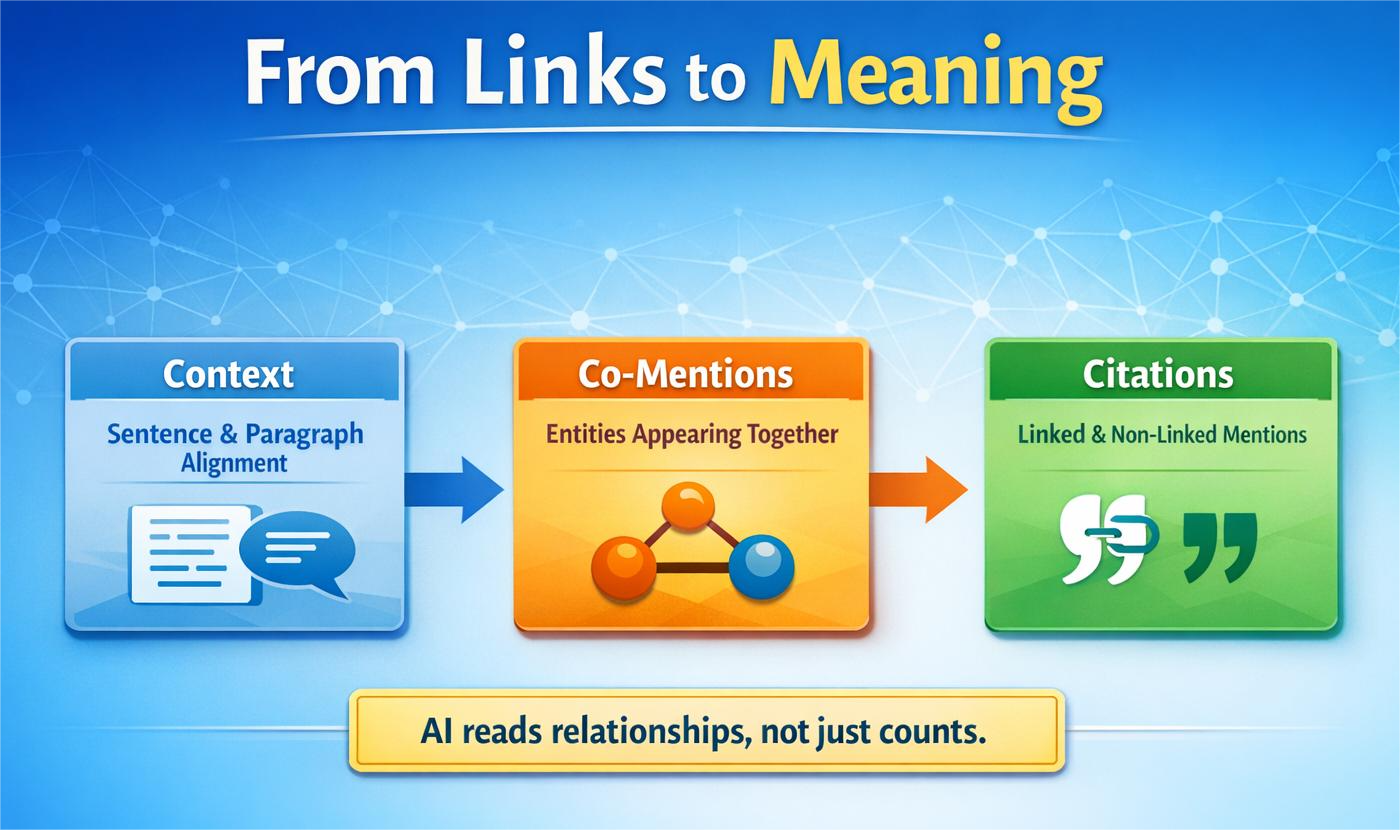
Search has become smarter, as it is less about counting links and more about reading them. Now, machines parse signals within paragraphs, entities dancing together, citations echoing across sources. In fact, AI Search Engines read backlinks through context, co‑mentions, and the shape of citations across the web.
With machine learning pushing retrieval closer to reasoning, backlinks have become semantic cues rather than numerical tokens. This shift demands that SEOs understand how context, co‑occurrence patterns, and citation frequency shape authority within engines that interpret the web through models rather than mechanical scoring systems.
How AI Search Engines Evolved Beyond Traditional Link Metrics?
Engines no longer statically evaluate backlinks. Now, the evaluation is more dynamic, as engines consider the relationships among entities, sentences, sources, and user actions. Traditional link analysis still sits in the background like a fading blueprint, yet the modern stack reads far deeper.
1. Limitations of Legacy Link Evaluation Models
Old models leaned hard on PageRank‑like math. It was about domain strength, link quantity, and anchor text precision. Hence, manipulation grew, and networks distorted the landscape.
The biggest gap was the absence of context and entity meaning. In fact, a page could pass authority without discussing the topic. For modern AI search engine optimization, the failure mode is clear. Pure quantity does not equal credibility. The fix required language understanding and relational modeling.
2. Machine Learning And Semantic Understanding In Link Analysis
In general, neural models read text at scale. They learn which words co‑occur, which entities cluster, and which claims repeat across credible sources. That learning bleeds into how links are scored.
AI-powered search engines can assess whether an anchor fits the surrounding paragraph, whether the landing page actually provides what the anchor promises, and whether the origin site is part of a coherent topical neighborhood.
In practice, that shifts weight away from domain metrics toward contextual signals. It introduces AI search ranking factors tied to semantics and user validation.
3. Transformer Models Interpret Relationship Signals Between Pages
Transformers build embeddings for content. In fact, they locate pages in semantic space. A backlink becomes a bridge between two points. If the bridge connects distant, unrelated topics, it passes less value. However, if it ties tightly aligned nodes with consistent entities and claims, it passes more.
In AI search SEO, this alignment is the game. Here, anchors, sentences, sections, and page frames must harmonize. That harmony reads as relevance, which, in turn, leads to better retrieval, more confident summaries, and a stable ranking presence over time.
Contextual Relevance In Backlink Interpretation
The contextual relevance in backlink interpretation depends on the following aspects:
1. Semantic Proximity And Topic Alignment
Context starts small, with sentence‑level meaning, and then expands into paragraph, section, page, and site. Topic clusters form when multiple pages surround the same idea. Links inside those clusters amplify authority.
In fact, AI-powered search engines identify semantic proximity and value links that stitch together closely aligned content. Throwing anchors into generic listicles or unrelated news blunts impact.
2. Paragraph‑Level vs. Page‑Level Contextual Weighting
Placement matters a lot in context. A link inside a relevant paragraph carries more weight than the same link in a boilerplate footer. Although page‑level signals help, paragraph‑level coherence is where engines read intent.
For answer engine optimization, you need the exact claim‑to‑link alignment. The promise in the sentence should match the destination’s content. If the sentence says tutorial, the landing page must teach. However, if the sentence says benchmark, the destination should show data.
3. Identifying Relevance Through Entity Detection And Topic Clustering
Entities are anchors for meaning, and include people, brands, tools, and places. Models detect them and measure co‑occurrence patterns. When your brand appears with relevant entities in neutral or positive contexts, your topical authority grows.
On the link side, the entity match between source and destination becomes a trust signal. This is one reason Google AI search continues to favor pages that demonstrate clear expertise within a topic cluster. In fact, coherent entity networks read as credibility.
The Growing Importance Of Co‑Mentions In AI‑Driven Search
A co‑mention is when your brand or page is referenced alongside related entities or concepts. Over time, those co‑mentions shape how models interpret your place in a topic.
A backlink embedded near strong co‑mentions signals relevance. It hints that your content belongs to the conversation. For generative AI search, these signals help determine which sources are safe to synthesize.
Entity Association And Brand Relationship Mapping
AI maps relationships in the following manner:
- Who appears with whom?
- Which claims travel together?
- Which brands co‑exist in tutorials and case studies?
When links appear within these relationship maps, they earn context weight. If your tool consistently appears near authoritative peers, your backlinks carry more weight.
Co‑Occurrences Strengthen Or Dilute Backlink Credibility
Credible sites mention you in accurate contexts. Your pages get referenced for what they actually provide. Meanwhile, off‑topic mentions, mismatched anchors, and vague claims might scatter things. Credibility dilutes when links land in thin content with noisy entity mixes.
For AI-powered search engines, these patterns signal quality or manipulation. So, keep anchors natural, and contexts tight.
How Citations Influence Authority Signals In AI Search Models?
The following are the major ways in which citations influence authority signals in AI search models:
1. Distinguishing Between Backlinks And Non‑Linked Citations
A backlink is clickable, but a citation can be a plain mention. In this case, engines read both. Essentially, non‑linked citations from trusted sources still contribute to the shaping of authority. They inform entity graphs and support claim verification.
For AI search SEO, you want both. So, earn the link when possible, and the citation when the publisher’s policy resists linking.
2. Citation Frequency And Trusted Source Recognition
Multiple citations from reputable publications work as credibility echoes.
Here, AI Systems Weigh Mentions By Source Trust:
- A niche journal might count more than a generic directory.
- A respected analyst brief can outweigh five thin blogs.
So, build relationships with sources your audience trusts. In AI search ranking factors, this shows up as durable confidence in retrieval and summarization.
3. AI Cross‑Verifies Credibility Through Repeated Mentions
To verify, models check whether claims about your page or product appear across independent sources. Also, backlinks inside verified contexts gain extra reliability. For AI-powered search engines, the collective voice of citations helps determine which sources appear in answers, not just lists.
How AI Scores Link Quality Using Behavioral And Engagement Signals?
AI uses behavioral and engagement signals to assess link quality. It does so in the following manner:
1. Dwell Time, Engagement Paths, And User Validation Loops
Behavior is feedback for link quality. For instance, users click a backlink, stay, interact, and do something useful. Those traces form validation loops. If a link drives pogo‑sticking back to the SERP (Search Engine Results Pages), it loses strength.
However, if it drives sustained engagement or task completion, it gains. For AI Search Engines, this behavioral read complements semantic signals.
2. Identifying Manipulative Patterns Using Anomaly Detection
AI is good at spotting abnormal behavior.
These Include:
- Sudden spikes in low‑quality links.
- Unnatural anchor distributions.
- Network footprints that repeat across sites.
In fact, anomaly detection downgrades manipulative patterns. So, keep your profiles balanced, rotate anchors, and avoid synthetic networks. In AI search engine optimization, sustainability beats short‑term spikes.
3. Multimodal Analysis: Text, Layout, And UX Context
Models do not stop at words. Rather, they consider layout, ad density, internal linking, and UX friction. In fact, a clean article with clear headings and logical flow supports link credibility. Meanwhile, a cluttered page with heavy ads and weak content undermines it.
Apart from that, quality is holistic and links live inside experiences. Optimizing that experience helps the link read as useful rather than perfunctory.
Comparing Traditional vs. AI‑Driven Backlink Evaluation
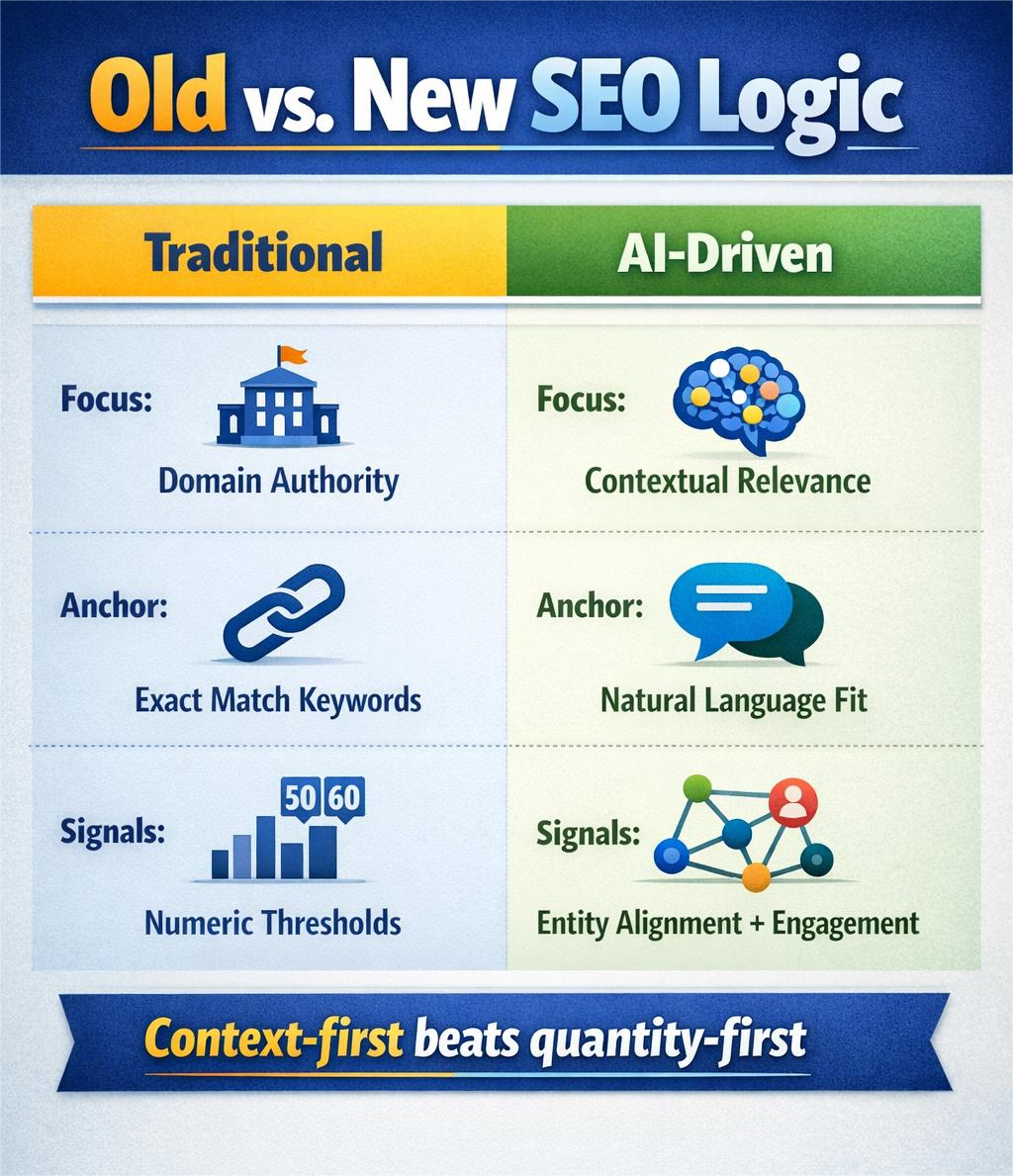
The following are the major differences between traditional and AI-based backlink evaluation:
| Dimension | Traditional Evaluation | AI‑Driven Evaluation |
| Primary Signal | Domain/Page authority metrics | Contextual relevance and entity alignment |
| Anchor Handling | Keyword match emphasis | Natural language fit and sentence semantics |
| Link Velocity | Numeric thresholds | Pattern health and anomaly detection |
| Non‑Linked Mentions | Largely ignored | Incorporated into entity graphs and credibility |
| User Behavior | Indirect | Direct feedback loops and engagement weighting |
Traditional models are authority-first, while AI‑driven models are context-first, then again authority. In fact, the strongest outcomes combine both. However, authority without context is noisy and context without authority is fragile. So, balance is the target.
Practical Strategies To Optimize Backlinks For AI‑Driven Search
If you want to optimize backlinks for AI-based search, implement the following strategies:
1. Building Contextually‑Rich Link Placements
To put AI search engine optimization into practice, and to build contextually-rich link placements:
- Write for the sentence hosting your link.
- Make the claim clear.
- Align the destination content with that claim.
- Avoid generic anchors.
- Place links where they solve the reader’s micro‑need.
2. Strengthening Topic Clusters Through Co‑Mentions
You can strengthen topic clusters through co-mentions in the following manner:
- Plan co‑mentions.
- Collaborate with credible brands.
- Publish comparison guides, integration docs, and joint webinars.
- Encourage mentions that place your entity alongside recognized peers.
In fact, co‑mentions shape networks, while networks move rankings. For Google AI search, those clusters help engines trust your summaries and feature your pages.
3. Encouraging Non‑Linked Citations From Authoritative Sources
Not every publisher links, and many still cite. So, pursue analyst briefs, conference notes, academic references, and industry newsletters. Also, ask for accurate naming, product descriptors, and context. The citation helps your entity footprint. In AI search SEO, clean citations are crucial.
Action Checklist For AI‑First Backlink Optimization
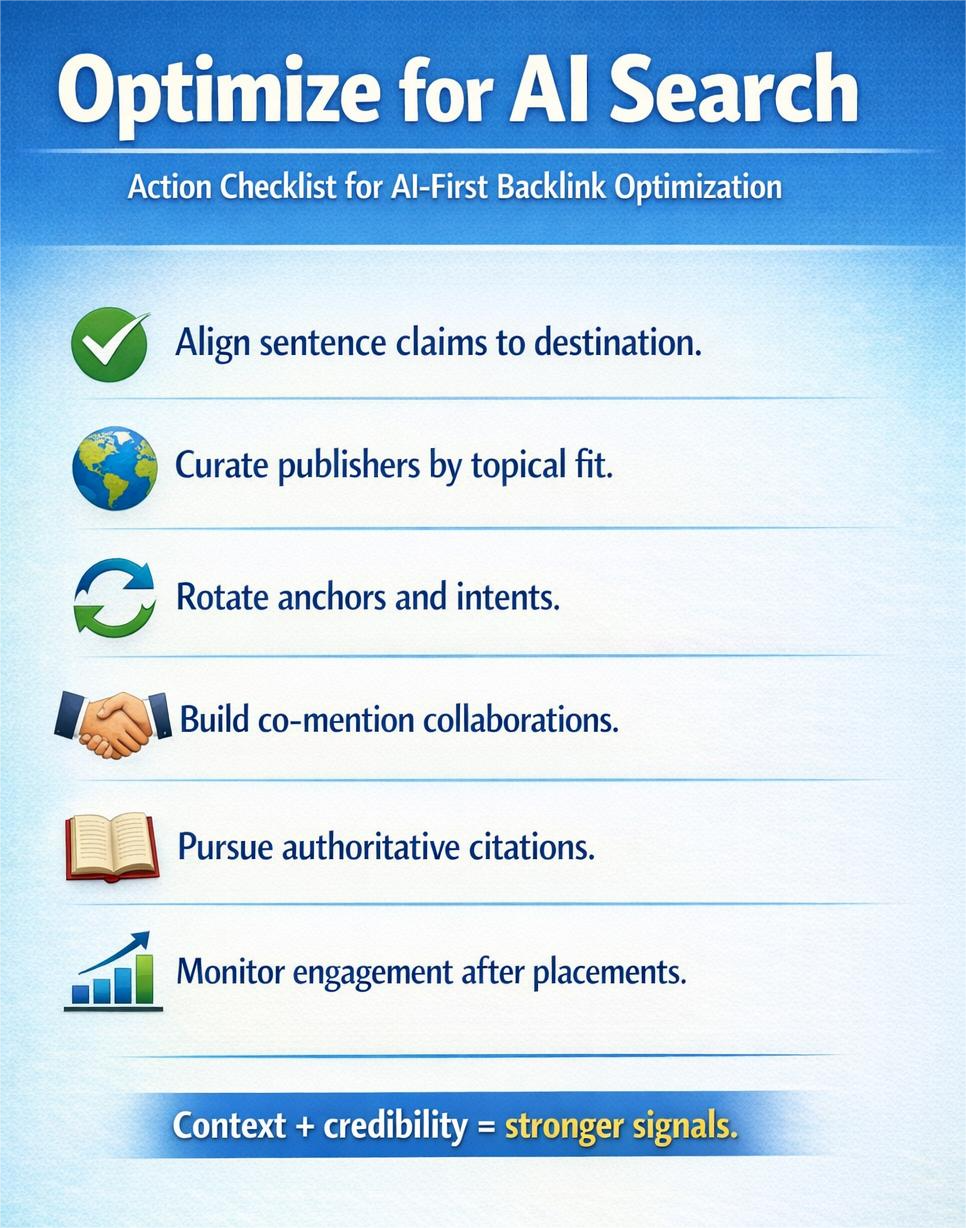
If you want to perform AI-first backlink optimization, perform the following actions:
| Action | Why It Matters |
| Align sentence claims to the destination | Maximizes contextual relevance and trust |
| Curate publishers by topical fit | Reduces noise and improves semantic proximity |
| Rotate anchors and intents | Prevents anomaly flags and enhances diversity |
| Build co‑mention collaborations | Strengthens entity associations and topic clusters |
| Pursue authoritative citations | Expands credibility beyond clickable links |
| Monitor engagement after placements | Validates quality through user behavior |
Future Of AI‑First Backlink Interpretation
The future of AI-first backlink interpretation will look like the following:
1. Predictive Link Scoring and Real‑Time Relevance Assessment
Models will predict link impact before crawlers fully cycle. They will assess relevance in near real‑time using embeddings and historical performance. Moreover, planning will become more data‑guided. This way, placement choices will feel less like guesswork and more like a simulation.
2. Rise Of Author Identity, Source Credibility, And Topical Authority
At the outset, who wrote the page matters. In fact, author identity, publication history, and topical contributions add weight. If your authors consistently publish high‑quality work, your links benefit. Also, authority becomes personal and institutional.
3. Decline Of Pure Quantity‑Based Link Building Models
The programs that survive will prioritize content quality, entity clarity, and audience outcomes. Basically, links will be earned through usefulness, not manufactured through repetition. Also, AI Search Engines will continue to push the field in this direction.
Final Takeaway For SEOs Navigating AI‑Driven Search Engines
The game changed as AI search engines interpret backlinks through semantics, entities, and verification signals shaped by citations and behavior. Although traditional authority remains a pillar, it sits alongside context quality and user validation.
So, optimize placements where the sentence and the destination align. Also, strengthen co‑mentions and non‑linked citations to round out your entity profile. Moreover, respect anomaly detection and invest in experiences that make clickthroughs productive.