

Ask ten SEOs why one site outranks another, and you’ll get two camps. Half say it’s domain authority. The other half say it’s content depth.
Honestly, both camps are partly right, and the argument between them really comes down to the difference between Topical Authority and website authority.
If you work in link building or content, getting this distinction straight changes how you spend your budget. So let’s sort it out.
What Is Topical Authority?
Topical Authority is how much a search engine trusts you on one particular subject. Not your whole site. One subject.
You earn it by covering that subject properly. One decent article doesn’t do it. You need the main explainer, the follow-up questions, the “X vs Y” comparisons, the beginner basics, and the awkward edge cases, all connected to each other.
Picture a single nutrition blog post next to a full library covering every corner of it. The library wins, and Google can tell.
The catch is that it doesn’t travel. A site with serious Topical Authority in personal finance has none in pet care, even if it’s the same domain.
What Is Website Authority?
Website authority is a domain's overall ranking strength. Tools turn it into a number: Moz calls it Domain Authority, Ahrefs uses Domain Rating, Semrush has Authority Score. All of them lean heavily on backlinks.
Here’s the thing people forget. Google doesn’t use those scores. They’re outside estimates, useful as a rough guide but easy to over-trust.
Blogger Outreach digs into this in What Does Google Mean By Website Authority?, and it’s a good read if you’ve ever treated “DA 70” as a guarantee.
Topical Authority VS Website Authority: The Real Difference
Website authority says “this domain is generally trusted.” Topical Authority says “this domain is the right place for this exact subject.” One is about reputation, the other is about relevance.
That’s why a small, focused site can beat a giant on a narrow query. The giant has the stronger domain. The small site simply knows the topic better and has covered more of it. Inside a niche, relevance often beats raw strength.
Speed is another difference. Website authority will improve slowly, link by link, over months and years. Topical Authority can pay off faster because you control most of it.
In other words, you decide what to publish and how to connect it. The weak spot is the flip side of its strength. It does nothing for pages outside your niche, while website authority gives everything a small lift.
How Topical Clusters Work?
Clusters are how most people actually build Topical Authority, and the idea is simple.
You pick a broad subject and write one big pillar page on it, say “email marketing.” Then you write narrower pages around it:
- subject line testing
- deliverability basics
- list hygiene, etc.
The pillar links out to each of those pages, each page links back to the pillar, and related pages link to each other where it makes sense.
What you end up with is a web of content that shows a crawler you’ve covered the ground. And it compounds. The tenth page in a cluster tends to rank quicker than the first, because the nine around it have already vouched for the topic.
Before writing anything, make a topical map. List the questions, comparisons and use cases around your subject. The gaps in that list are your next articles.
Why Niche Expertise Matters
Anyone can now generate a passable overview of almost any topic in seconds. So generic content has stopped being a differentiator. What stands out is specifics: real examples, first-hand experience, a point of view.
That’s hard to fake across twenty unrelated topics. It’s much easier when you stick to one. A narrow focus gets you to full coverage sooner, readers come back because they trust you, and other writers start linking to you because you’re clearly the person who knows this stuff.
It matters for AI search, too. Research from Wellows reported that topical depth tracked with AI citations more closely than Domain Authority did. Take it as a direction, not a law. But it fits what we keep seeing: sites that own a subject get mentioned more.
The Role of Internal Linking
A cluster without internal links is just a folder of articles. The links are what make Topical Authority visible.
They show a crawler how your pages relate. They also pass authority from strong pages, like the homepage or an article that earned great backlinks, to newer pages that need a push. And they help real people move from beginner stuff to advanced stuff without hitting a dead end.
Keep it practical. Use anchor text that says what the target page is about, link only where it helps the reader, and check that no important page is sitting there with nothing pointing to it.
How Backlinks Reinforce Topical Authority
Content and structure build your authority from the inside. Backlinks are the outside confirmation.
When a trusted blog in your niche links to you, it’s a vote that you know your subject. That’s the point where the two kinds of authority overlap. Any decent link adds to website authority, but a relevant one also backs up your topical signals.
So relevance counts for as much as the metric. Imagine a DA 78 link from an unrelated site with almost no real readers, against a DA 40 link from a respected blog in your field.
The second one often does more. Blogger Outreach covers the reasoning in Link Authority VS Domain Authority: Why A High-DA Link Can Still Fail. Meanwhile, the next blog Editorial Authority: Why Trust Matters More Than Link Quantity explains why trust should decide which links you chase in the first place.
Real-World Examples Of Topical Authority
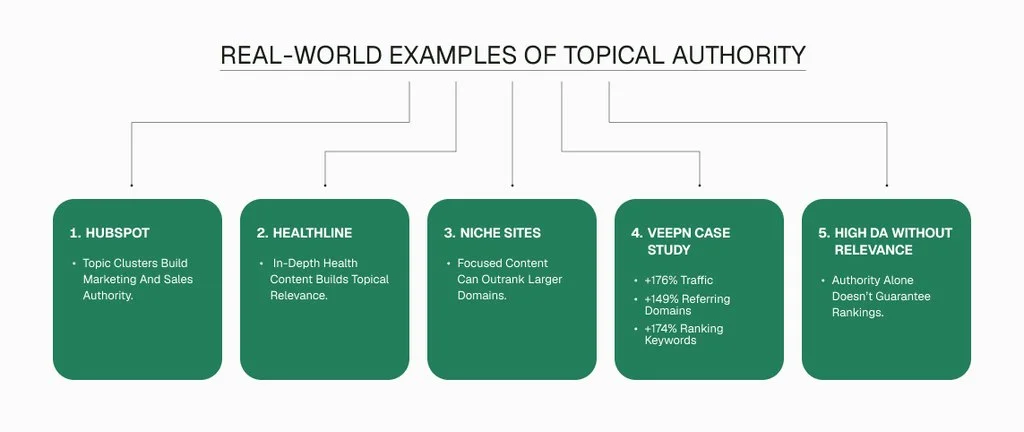
HubSpot is the textbook case. It helped popularize the pillar-and-cluster model, building deep hubs on marketing, sales, and customer service until it became the default source for those subjects.
Health publishers like Healthline work in a similar way, covering conditions, treatments and related questions in depth rather than posting one-offs.
You also see it with small niche sites. Many narrow review blogs and software sites outrank much bigger domains on specific queries simply because they’ve covered one subject thoroughly. Their DA is often lower than the general publishers they beat. That tells you something.
On the link side, Blogger Outreach’s VeePN case study in cybersecurity reports a 176% traffic increase, 149% more referring domains and 174% more ranking keywords. Those are the agency’s own numbers, so read them with that in mind, but it’s a good picture of niche-relevant links working on a site with real topical depth. And for the opposite lesson, their write-up Why A High DA Link Didn’t Improve Rankings shows what happens when you get authority without relevance.
Which One Should You Build First?
Depends where you’re standing.
If your site is new or small, start with Topical Authority. Pick a niche, map it, publish a tight cluster, and link it together. You can compete for specific queries without waiting years to build domain strength.
If you’ve got plenty of content but it’s thin, audit it. Merge the weak pages, fill the gaps, and build clusters around the topics that make you money.
If your content is strong but nobody links to it, outreach is where it pays off. Relevant backlinks will confirm the expertise you’ve already built.
Most of the time you want both, and they feed each other.
Topical Or Website Authority: What Does Blogger Outreach Focus On?
Actually, there is no debate here. The primary focus of Blogger Outreach is on off-page. When you book Blogger Outreach, you get backlink profile creation, a full guest post suite, and smarter editorial placements that drive better reach.
Therefore, the primary goal of Blogger Outreach is to boost the website’s authority quotient. So the obvious question you may have is: How is Blogger Outreach different then?
In reality, the differentiator is the search-authority-building process Blogger Outreach follows. For instance, we focus on niche-oriented placements and hand-pick sites from our 17,000+ site inventory to ensure authority and reach.
For us, metrics like DA and DR are secondary. The primary focus is always niche relevance. At the same time, we also check that we don’t select sites that have a DA lower than 30. Most sites have a DA range of 30 to 80.
But there is another part we haven't focused on so far. Simply put, the strong emphasis on niche also helps your topical authority grow. Just be clear about what your links are being connected to. In a nutshell, here’s what the service pipeline of Blogger Outreach looks like:
- Blogger outreach services earn editorial links from niche-relevant blogs, which is the closest fit for topical reinforcement.
- Guest posting services put your thought leadership on authority sites in your field.
- Link building services cover scalable, white-hat in-content backlinks, with white-label options for agencies.
- Content writing services supply SEO articles for your cluster pages or the guest posts themselves.
- AI-powered link building and GEO services target brands that want visibility in ChatGPT, Perplexity, and similar tools.
Not sure what's holding you back? There’s a free SEO audit that compares your authority to competitors, flags toxic links, and lets you check pricing before you commit.
Mistakes Worth Avoiding
Chasing DA on its own is the big one. A shiny score on an irrelevant site rarely moves anything.
Publishing without a plan is next. Random posts don’t build Topical Authority; structured clusters do. Next is ignoring internal links, which wastes good content.
Spreading too wide also hurts, since covering a dozen unrelated topics thinly weakens all of them. And don’t let old pages rot. Outdated content can drag down an entire cluster.
So, Which Is The Winner?
One thing should be clear at the end of the blog. Website and topical authority aren't two entities at opposite ends of the spectrum. If you are a struggling domain, website authority will give you a great boost. After that, you can easily shift the focus to topical authority.
The latter helps you actually revamp your search visibility. Soon you will see your content ranking well for the most sought-after keywords. After that, you can create a better cluster and improve your linking game.
However, you can easily leave the most important part to us. What’s that? It’s backing your placements with niche-oriented backlinks. So topical authority and website authority complement each other.