

This shift in search in recent years has been quite evident. While the transition began as a limited integration of AI for ease of use, it has now emerged as a transformative force redefining the entire medium.
The result: People are no longer satisfied with just a list of blue links; they demand clear, concise answers that address their queries by understanding the context, comparing ideas, and pointing to something useful.
This is where Grokipedia enters the conversation. Built by xAI and launched in October 2025, Grokipedia is being positioned as an AI-generated encyclopedia and a potential rival to Wikipedia, with reports noting that it had roughly 885,000 articles at launch.
Grokipedia services are also a part of the larger shift towards the AI search engine experience, where discovery is less about matching keywords and more about understanding meaning.
What Is Grokipedia?
‘Wikipedia with AI’: this is often the compliment that Grokipedia gets, which is not entirely false, but doesn't tell the whole story.
So, what is Grokipedia?
Grokipedia is an AI-generated online encyclopedia operated by xAI, the company behind Grok. Instead of relying mainly on volunteer editors who manually write and revise pages, Grokipedia uses Grok, xAI’s large language model, to generate, refine, and review informational entries.
Now, users can suggest corrections, but by default, the system is designed around AI mediation rather than the traditional human-editor model.
Now, this distinction is critical. Because this makes Grokipedia not just any reference site but an early sign of how the knowledge platforms will work in the generative search era. It means the page is no longer a distinction; it is a structured knowledge layer.
The platform takes a topic, assembles an explanation, and presents it in a way that feels closer to a synthesized answer than a regular search result. And this is one of the major reasons why Grokipedia AI search has become a serious topic of discussion among SEO teams, researchers, content strategists, and people who watch the messy future of information.
Advantages Of Grokipedia For AI Search Users
Here are some of the notable advantages of Grokipedia:
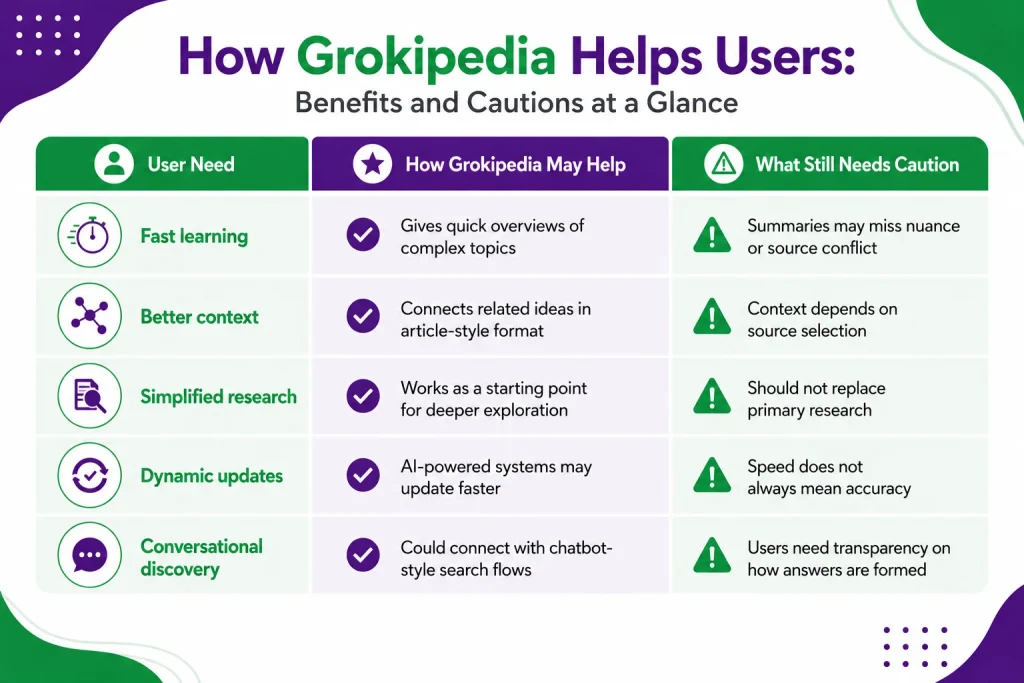
- Quicker Topic Orientation: Users land on Grokipedia to learn the basics of a subject quickly. Without opening a host of tabs and websites, they can get a simpler, well-structured answer that serves their purpose.
- Easier First-pass Learning: An AI-backed encyclopedia like this makes complex subjects feel less scattered. It may not give the whole truth in one go, but it can offer a usable first pass that helps people understand the shape of a topic before they dig deeper.
- Better Contextual Discovery: Grokipedia can connect related ideas, entities, categories, and background details in a more structured way. That is where semantic search AI becomes useful. It does not only chase the exact phrase a user typed. It tries to understand what the user probably meant and what related context belongs nearby.
- Excellent Starting For Topical Discovery: Grokipedia also helps reduce the friction users face during the early research phase. For instance, if you are a student and want to prepare a paper on the effects of greenhouse gases, then Grokipedia can help you get a starting point, on which you can then build and explore the topic in depth.
Limitations And Trust Challenges of Grokipedia
Like any other generative AI model, Grokipedia has its challenges and limitations. Here are some of the prominent ones:
(i) Quality Of Citation
One of the biggest concerns is citation quality. Early reviews have noted that some Grokipedia entries appear thinly sourced compared with Wikipedia pages on the same topics. That is a problem because citations are not decoration. They are the scaffolding beneath public knowledge, especially when users are dealing with politics, science, health, history, or anything with real-world consequences.
(ii) AI Hallucinations
The next ‘elepahnt in the room’ that needs addressing is AI hallucination. An AI search engine can produce an answer that sounds confident, organized, and even elegantly written, while still being factually incorrect. This is a major red flag. For Grokipedia, this issue will only be resolved by its capability to detect unsupported claims, outdated information, fabricated connections, and overconfident summaries before users mistake them for verified knowledge.
(iii) Bias and Selection of Sources
Bias is another major issue with these generative AI models. This is never as loud as it enters mostly through the choice of source, framing, exclusions, and emphasis. A 2026 study by researchers at Trinity College Dublin and TU Dublin compared 18,000+ Grokipedia and Wikipedia articles and found that most Grokipedia articles closely resemble the Wikipedia entries.
Also, 66% of the analyzed Grokipedia articles were extensively rewritten, became more complex and longer, and used fewer references. They also found a shift towards more right-leaning sources in politically and culturally influenced areas like religion, history, literature, and art.
(iv) Transparency
Transparency is another major area of limitation for generative AI models like Grokipedia. Today, users are aware and always want to know the source of information, and for Grokipedia to become the trusted AI-powered search platform, it has to make its evidence trail easier to follow.
Why Grokipedia Matters In The Rise Of AI Search Engines?
Generative search engines are the future, and there is no doubt about that. Today, users are no longer pondering which link to click for the right information; they read the synthesized answer the search engine delivers and then decide whether it is enough. While this brings convenience, it also shifts power from publishers and search result pages toward the systems that summarize them.
Grokipedia matters here because it sits at the intersection of three big movements: the move from links to answers, the rise of AI-generated knowledge repositories, and the growth of semantic search AI that interprets concepts rather than just keywords.
Its encyclopedia-style structure helps AI search optimization through a more organized body of information to work from. Since the future of search quality will depend heavily on the quality of source material, if this layer remains weak, the response will be unreliable, and vice versa.
This is one of the major reasons to watch Grokipedia, as it is a live experiment in how AI may package public knowledge.
How Grokipedia AI Search Differs From Traditional Search?
Grokipedia-styled AI search and traditional search are solving the same problem, but in a different way. While the former focuses on producing readable knowledge, the latter focuses on finding the most relevant pages.
While this sounds like a subtle shift, it is not. It changes user behavior, content, and marketing strategy.
| Search Model | Core Mechanism | User Experience | Main Risk |
| Traditional search | Crawling, indexing, and ranking | User compares multiple links | Information overload |
| Wikipedia-styled encyclopedia | Human-written and edited articles | User reads a stable reference page | Editorial conflict or slow updates |
| Grokipedia-styled AI search | AI-generated knowledge synthesis | Users receive structured explanations quickly | Bias, hallucinations, and source gaps |
| Generative Search Engines | Conversational answers from multiple sources | Users get direct summaries and follow-ups | Overreliance on the answer layer |
Grokipedia Vs. Wikipedia Vs. Generative Search Engines
Grokipedia, Wikipedia, and generative search engines each represent a different way of organizing knowledge. While Grokipedia remains AI-generated and model-centered, Wikipedia focuses on human-written and edited content, and the generative engine, sitting on the other end, uses multiple sources to provide the best possible answer based on the user’s query.
Together, these platforms influence how entities are understood across the web, helping shape brand authority, AI search visibility, and, in some cases, the signals that contribute to a stronger google knowledge panel presence.
Here is how three stacks against each other:
| Platform type | Strength | Weaknesses | Best use case |
| Wikipedia | Strong public edit history, broad subject coverage, and citation culture | Can be slow, contested, and uneven by topic | Reference checks and general research |
| Grokipedia | Quick AI-generated explanations and structured topical coverage | Requires stronger transparency and citation confidence | Quick orientation and AI knowledge analysis |
| Generative Search Engine | Conversational, contextual, and follow-up friendly | Could blend sources without enough visibility | Exploratory search and synthesized answers |
What Grokipedia Means For SEO And Content Strategy
The effect of Grokipedia on SEO and content strategy going forward is expected to be profound, to say the least. Why? Because the evolution of search has made one thing clear: ranking for a keyword will not be enough; the content has to carry context and value that machines can summarize, classify, compare, and explain.
This signals content that offers clear definition, strong structure, entity-rich writing, original insights, expert opinion, and no vague claims.
Therefore, a useful content writing strategy will now ask:
- Is the topic clearly defined in the first few paragraphs?
- Are entities, products, people, and concepts connected in a logical way?
- Does the content answer the searcher’s real intent, not just the keyword?
- Are claims supported by credible sources, examples, or original expertise?
- Can an AI system summarize this page without distorting the meaning?
Now, for SEO teams, the approach shifts from solely focusing on page rankings to being cited, summarized, and accurately represented by AI-powered search platforms. This is where digital PR, structured content, and credible third-party mentions start to overlap. A brand’s footprint becomes part of the answer ecosystem.
Grokipedia Shows Search Is Becoming A Knowledge Game
Grokipedia is getting popular as users are constantly looking for faster, smarter, and more contextual discovery. It reflects a clear shift from keyword research to semantic, generative, and AI-powered knowledge experiences. However, its credibility will continue to depend on better sourcing, clearer verification, and better safeguards against AI errors.
Now, for marketers and brands, Grokipedia represents a vision of the future for AI search engines.
So, if you want to secure your brand's future visibility, contact us at Blogger Outreach. We will help build a credible digital presence ecosystem that AI understands. Contact us to strengthen your brand authority today.
Frequently Asked Questions:
A: Grokipedia handles search terms with multiple meanings by using contextual interpretation rather than just keyword matching. It tries to decode the intended meaning from the topic, related entities, and common usage patterns and then serves an answer.
A: Yes, Grokipedia integrates real-time web data like standard Grok Search, but it operates differently. Unlike Grok, which acts as a dynamic chatbot that crawls the web in real time for information, Grokipedia uses the same capability to generate well-structured, long-form content in an encyclopedia format.
A: Yes, you can use the standard Boolean Operators on Grokipedia to narrow down or expand your search results.
A: The Grok AI system itself reviews the articles on Grokipedia. However, users can always leave suggestions via the dedicated form regarding required changes, but the final decision again lies with the chatbot.
A: Currently, there is no timeline for when Grokipedia will be rebranded as Encyclopedia Galactica. However, Elon Musk wants the platform’s AI models to be ‘good enough’ before making this shift.