

You type your brand name into Google search and expect the search engine to return a neat panel with your company details, logo, social links, etc. Instead, it comes back with your website link, social media profile links, and maybe a few directory listings that seem like was last touched in 2020.
You are left disappointed, and rightly so. The brand exists, has real clients, churning revenue, yet Google is not recognizing it.
While it may seem messy and confusing, appearing in the Google Knowledge Graph was never about being present online; it was always about being understood.
The search engine, Google, in this case, has to understand your brand as a distinct entity, connect it with verified facts, reconcile those facts across reliable sources, and trust the pattern to surface it. Now, in any of these layer cracks, your brand remains invisible as an entity even when your page ranks for a few keywords.
What The Google Knowledge Graph Actually Means For Businesses
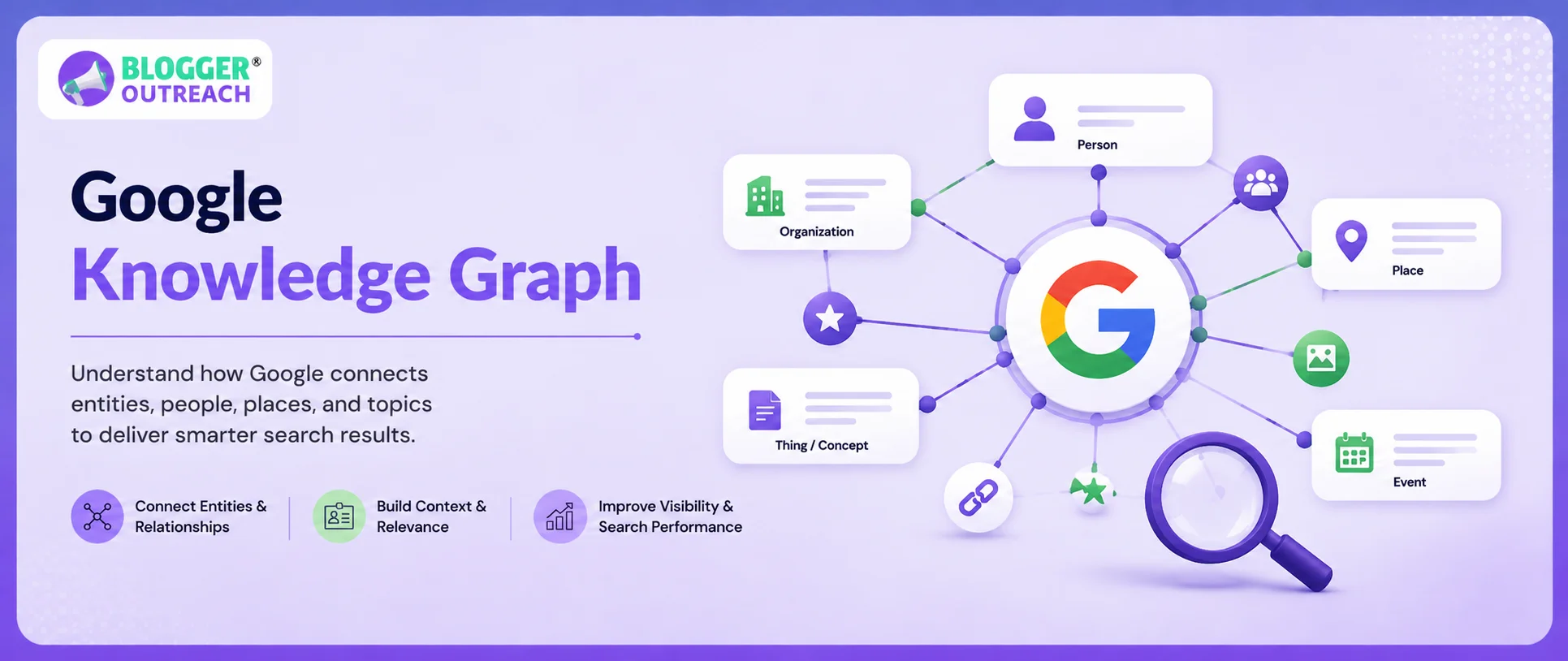
The Google Knowledge Graph is not a badge that you can apply for. It is Google’s internal process to understand entities and their relationships. Here, an entity can be a person, place, product, event, book, or organization.
When Google understands enough about an entity, it may show that understanding through a Knowledge Panel, rich brand result, or entity-style search experience.
Now, this distinction matters. A Knowledge Panel is what you see, and the Knowledge Graph is the underlying system. A lot of teams fail to understand this difference and start chasing the panel directly.
This is the wrong approach; the real work is not ‘getting the panel’ but making the brand legible enough for Google entity indexing, so the search engine can say with some confidence, ‘Yes, this is a known organization, and these are the facts connected to it.’
| Area | What It Means | Why It Matters |
| Google Knowledge Graph | Google’s entity database and relationship system | Helps Google understand brands beyond keywords |
| Knowledge Panel | A visible SERP feature generated from entity data | Creates trust and branded search visibility |
| Google Business Profile | A business listing for local and service-area businesses | Useful for maps and local discovery, but not the same as Knowledge Graph visibility |
| Organization schema | Structured data that defines company details | Helps disambiguate the brand and reduce entity confusion |
Why Your Brand Is Not In The Google Knowledge Graph
The importance of Google Knowledge Graph for businesses cannot be overstressed. So, it is important to understand what is blocking your chances of appearing here to remove the necessary obstacle and improve the visibility of your brand:
(i) Your Brand Identity Is Not Clear Enough
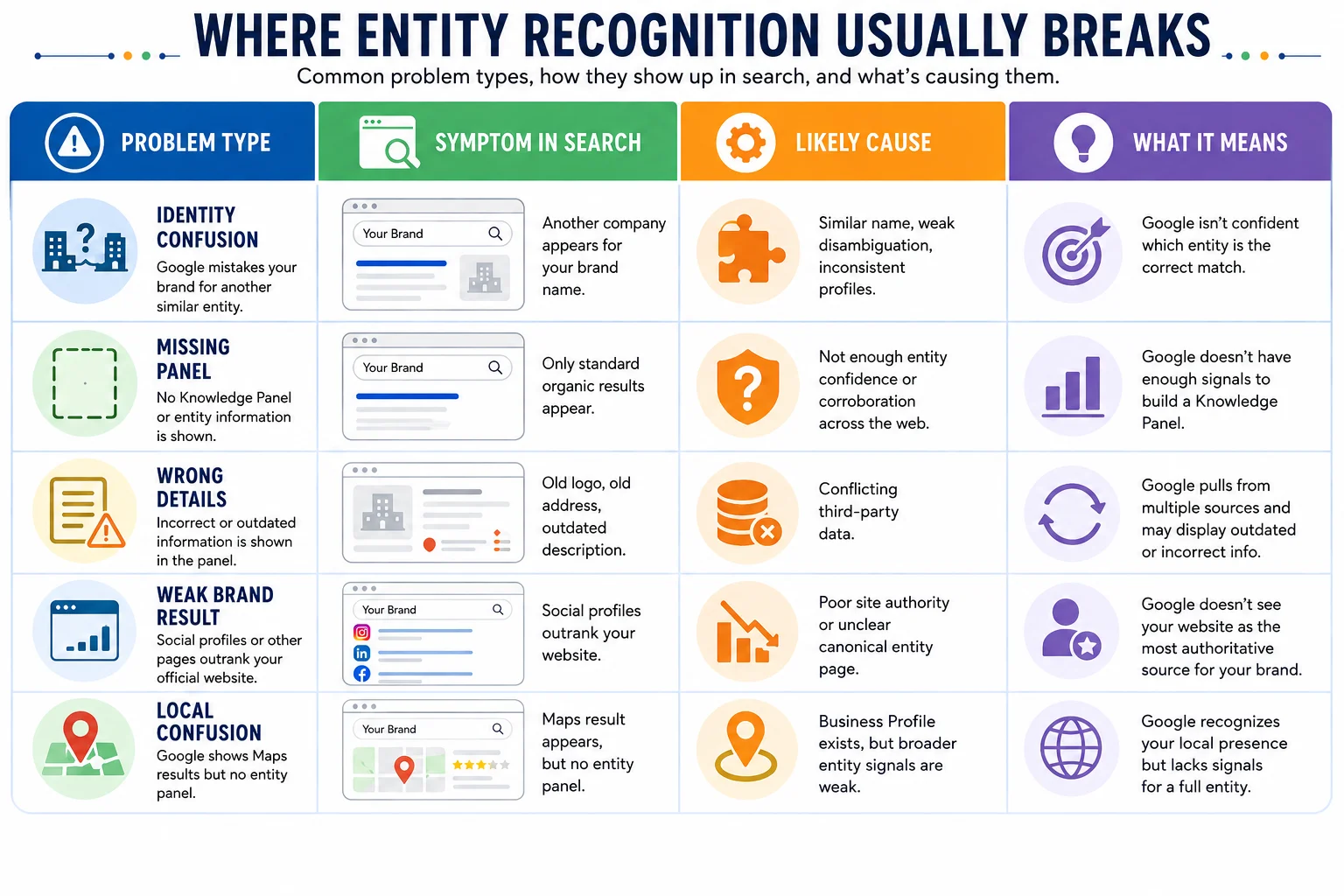
This is one of the biggest yet most overlooked reasons your brand gets ignored by Google. The search engine fails to understand whether your brand is a company, a product line, a local branch, a founder-led consultancy, or just a website publishing content.
Now, human beings can draw this conclusion on their own, but search engines need repeated, clean signals.
For instance, your homepage says you are a digital marketing agency, but your LinkedIn profile focuses on branding and promotions, and your industry listing says you are an advertising agency. While all these services coincide at one point, they are distinct specialties, and to Google, that is confusing. That is where entity recognition problems begin.
(ii) The Website Reads Like A Brochure And Not An Entity Source
The next mistake brands make is designing a website that focuses on selling rather than informing. For instance, your business website says that ‘we empower digital transformation through innovative solutions’. It is a fair proposition, but what does it mean? Are you a SaaS company, a cybersecurity provider, a consulting firm, a managed service provider, or a platform? If Google cannot extract a stable identity from your own site, it will look elsewhere.
This is why the ‘About the Company’ page should be given the attention it deserves. Instead of filling it with vague content and no critical company information, make it a repository of your brand's information, and avoid potential knowledge graph SEO issues that arise when your own domain can't exude authority.
(iii) Missing Or Shallow Structured Data
The next area to focus on is the structured data. Even though there is no magical element that can propel your brand into the Knowledge Graph, it is still one of the clearest ways to state who you are in a machine-readable format. Without it, Google has to infer everything from visible copy, links, and third-party references. That can work for famous brands, but for the emerging ones, it is risky.
Additionally, the missing schema and the lazy schema create issues for the brand. Brands often just add the company name, URL, and logo as their schema and then stop, but that is lazy work. The stronger schema practice includes adding the official name, alternate names where relevant, a description, a logo, contact details, the founder or parent organization, if applicable, the location, and sameAs links to verified profiles.
This helps search engines and AI systems better understand your entity, improving both Knowledge Graph eligibility and LLM visibility.
| Schema Element | Common Mistakes | Better Approach |
| Name | Using a short or inconsistent brand name | Using the official brand name across all profiles |
| Url | Linking to a campaign or regional page | Link to the canonical home page |
| Logo | Using a low-quality or temporary logo file | Using a stable, crawlable, and high-resolution logo URL |
| SameAS | Adding every random directory profile | Adding only the official and trusted profiles |
| Description | Writing vague marketing copies | Describing the company category and core offerings clearly |
(iv) External Brand Signals Are Not Agreeing With Each Other
Google verifies your brand information against other sources on the web, and this is a key point brands often overlook. Therefore, if your website says one thing and your Crunchbase profile says another, the discrepancy is where trust breaks down.
As a result, this emerges as one of the main reasons why a brand is not in the knowledge graph. Now, one thing that must be clarified here is that this is a reputational issue. Google always seeks to corroborate across web sources, and when it encounters a conflict, it decides not to commit.
(v) There Is Not Enough Independent Validation
For brands, a website and a few social handles are not enough to get a place in the knowledge graph. And this is particularly true in segments where hundreds of brands compete and use the same language.
If no credible sources are referring to a brand, Google also has no reason to trust it as an entity. While it sounds harsh, it is true. Today, entity recognition depends heavily on external confirmation.
This does not mean you need a Wikipedia page tomorrow. In fact, forcing one without notability can backfire. But you do need a broader footprint, which includes industry publications, partner pages, business review platforms, event speaker bios, customer stories, association listings, etc. Now, these are not just PR assets; they are entity confirmation points.
How To Fix Knowledge Graph Visibility
The mistakes are already identified; now it's time to fix them. Here are some tips to rectify these issues and find a place in the Google Knowledge Graph:
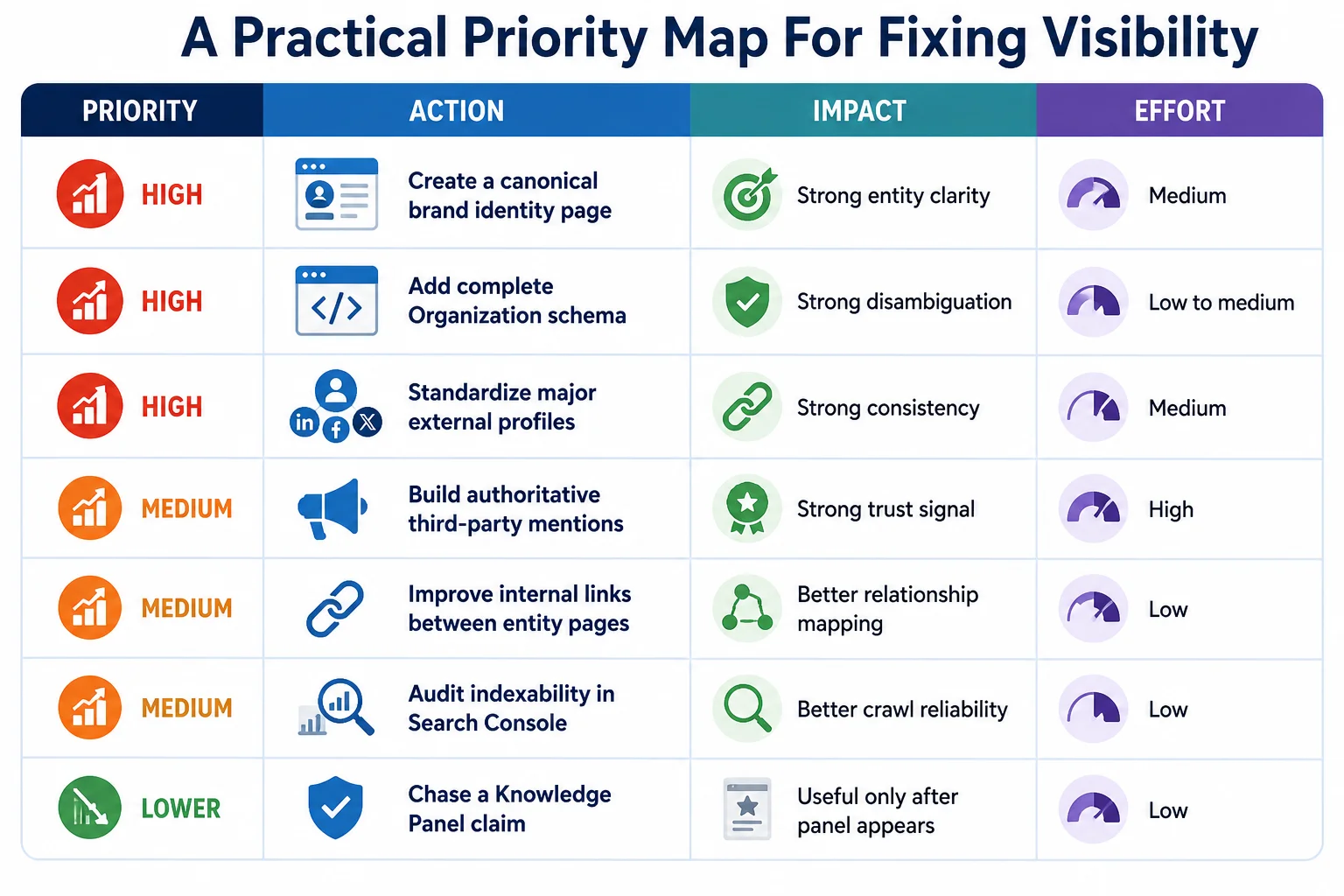
(i) Build One Canonical Entity Home
The first step in rectification is building a single canonical-entity home, starting with the pages you control. About the company, home page, and other such areas can be a great starting point. These pages should clearly state the company name, what the company does, who it serves, where it operates, and which official profiles represent it.
This page should become the stable source of truth. Even if your brand description changes every year due to marketing requirements, the core vision must remain intact. Because no one trusts a brand that cannot explain itself in two clean sentences.
(ii) Improves Organizational Schema
The next step is improving the schema. Start by adding the organization schema to the canonical pages and make sure it reflects the visible content. Also, do not hide facts in the schema that are not supported on the page.
After implementation, validate the markup and inspect the page in Google Search Console. Many teams publish schema and never check whether Google can actually crawl the page, render the content, or index the correct version. Then they wonder why nothing changes. The machine cannot use what it cannot access.
(iii) Standardize The Brand Across The Web
Next, you need to focus on ensuring brand standardization across the web. Create a document that contains the official brand name, short description, long description, logo URL, founding year, headquarters, website URL, founder or leadership details, social links, and category terms. Then update every major profile against that source.
Because Consistency is one of the strongest fixes for knowledge graph SEO issues because it reduces uncertainty at scale.
(iv) Earn The Right Third-Party Mentions
Getting third-party mentions may not be a big hassle, but not every citation holds real value. Featuring in random directories and business listings does more harm than good. For instance, a cybersecurity brand getting featured on a sports website doesn’t really make sense and doesn't build any entity for the brand.
Instead, if it gets mentioned on related platforms, it improves brand authority and credibility. An important point to remember is that you should not aim for volume to fix Knowledge Graph visibility; instead, focus on corroboration. If five credible sources describe your company in roughly the same way, Google has a cleaner pattern to work with, strengthening both entity recognition and brand authority.
(v) Make Entity Pages Crawlable And Internally Connected
Lastly, the entity focuses on pages of your website that must not sit in isolation. These pages should be internally linked without fail, as this helps the search engine better understand the brand.
Also, the technical health of the pages and the site matters. The important pages must not be blocked by robots.txt, hidden behind scripts, canonicalized to irrelevant URLs, or mistakenly marked noindex. As a result, even if a brand has the right entity information, Google never gets a clean crawl path to process it.
Make The Brand Easy To Recognize, Then Easy To Trust
If your brand is not in the Google Knowledge Graph, the problem is usually weak entity clarity, not just weak SEO. Google needs consistent facts, credible mentions, and clean signals before it can understand a brand with confidence.
Blogger Outreach can support that process through strategic guest posting, expert outreach, content writing, and link-building services that strengthen third-party validation. Build the facts first, then build authority around them.
Explore Blogger Outreach to create a cleaner, more credible search footprint for your brand.
Frequently Asked Questions:
A: A Google Business Profile helps with local visibility, but a Knowledge Panel appears only when Google recognizes your brand as a distinct entity. Even with a verified GBP, you may need stronger entity signals, structured data, authoritative mentions, and consistent brand information to earn a Knowledge Panel.
A: A Knowledge Panel may disappear if Google loses confidence in your entity signals due to website changes, removed schema, inconsistent third-party data, or algorithm updates. In some cases, it may still appear for certain searches, locations, or devices.
A: This usually happens because of entity confusion. If another company has a similar name, stronger authority, more consistent citations, or better-known public data, Google may associate the query with that entity instead of yours. To fix this, strengthen your brand disambiguation through a clear About page, Organization schema, consistent social profiles, and third-party mentions that connect your exact brand name to your website.
A: Yes. Wikipedia and Wikidata can help, but they are not mandatory. Google can use many sources to understand entities, including your website, structured data, business databases, review platforms, social profiles, news coverage, and other trusted references. The key is not having one specific source. The key is having enough reliable, consistent information across the web.
A: There is no fixed number. One strong, authoritative source can matter more than dozens of weak directory listings. Google looks for consistency, credibility, relevance, and corroboration. A good practical target is to build a clean footprint across trusted profiles, niche publications, partner pages, review sites, and media mentions rather than chasing citation volume alone.