

Imagine two SaaS companies launching within weeks of each other.
SEO is their primary area of investment. Both companies create utility blogs, optimize pages for SEO, and create backlinks from authority sites.
Their products are similar. The two websites are also equally good. Above all, their content uses the same keywords.
Within 10 months, one company’s content appears on Google SERP #4. Journalists quote from the article. AI tools cite it as a source too.
Strangely, the other company struggles to reach Google’s top 10 pages. But why? The latter stuck to basic backlinking and keyword optimization only. They never focused on building brand authority.
In 2026, search engines don’t crawl based on keywords alone. Notably, Google checks topical authority and content quality and validates the source of information.
Similarly, Google AI Overview, ChatGPT, Perplexity, Claude, and similar platforms also rely only on reliable, authoritative sources!
Google still doesn’t claim that brand authority is a ranking factor. However, Google’s content policy emphasizes EEAT, YMYL, and helpful content as authority benchmarks.
This shift has fundamentally changed how businesses should think about SEO.
What Is Brand Authority?
Brand authority reflects how credible, trustworthy, and recognized your business is. Again, it is not measured by ratings like Domain Authority (DA) or Domain Rating (DR).
Google tracks multiple signals to understand brand authority. Mainly, it catches trust signals from people and other trusted sources. It checks what others are actually saying about your business.
These signals include:
- People searching specifically for your brand.
- Editorial mentions from reputable publications.
- High-quality backlinks.
- Positive customer reviews.
- Expert-authored content.
- Industry recognition.
- Original research and thought leadership.
- Consistent references across the web.
Google has never published a metric called Brand Authority. However, Google’s guidelines clearly outline the above-mentioned qualities. The ranking system checks for all of these. Check out Google Search Central for further reference.
Investing In Only Backlinks Is Redundant In 2026
For years, SEO discussions revolved around one question:
"How many backlinks does your website have?"
Google still prioritizes backlinks. But search in 2026 has become much more advanced. Consider the following example. Company A follows the easy route and accepts backlinks from unrelated sources.
Company B is different. It is mentioned in popular industrial publications, publishes original research-based content, and has good organic reviews online. Journalists cite them as a source too.
To sum up, their level of authority differs from Google’s POV. Most importantly, Company B has much higher brand authority.
Google also says the same in the article titled "How Google Fights Disinformation." The main argument of the article is that authority depends on who searches for your brand on Google.
| Choose Where Your Brand Should Be Seen With BloggerOutreach Editorial mentions, Digital PR, thought leadership, high-quality content, and strategic outreach complement one another. Backlinks are only a small component of that authority-building process. |
Why Brand Authority Matters The Most?
In 2026, the search engines don’t work the same way anymore. The transition is more apparent than ever before.
Firstly, search engines like Google are extracting AI summaries from content. Meanwhile, the AI assistants use a different algorithm to extract data from content sources. So, one thing is visible here.
Nobody relies solely on keyword-based content. The search systems prioritize reliable and well-established sources. If your content is widely referenced, that’s surely a trust signal Google will catch!
Google's Growing Focus On Helpful And Reliable Content
Google’s helpful Content Policy emphasizes one thing:
Create content for people, not for search engines.
Google requests all publishers to use only original data, real knowledge, and expertise. Next, Google urges them to understand reader intent and deliver content that addresses their concerns. On the other hand, Google despises content created solely for rankings!
So, as a publisher, how do you know you are on the right track?
If you are sourcing content from actual experts, get recognized by other high-authority sources, and have positive user/reader reviews, your trust signals are strong. That’s the best that publishers can do.
Pro Tip: You cannot develop these signals in a day. Keep making valuable contributions to earn trust!
AI Search Rewards Trusted Sources
In 2026, Generative AI has introduced a new challenge for businesses. You can survive by ranking on Google. Most brands today want to be referenced by the AI engines.
If ChatGPT thinks your content is reliable and authentic, it will source information from your content to answer search queries. Perplexity, Claude, and similar engines also do the same!
Let’s see what ChatGPT says! Their Search system retrieves information from web search providers. AI engines also present answers using cited sources where appropriate.
What Does It Mean For Businesses?
As a business, you need to do only 3 simple things:
- Gain reputation as a trusted publication
- Use expert resources
- Build authoritative websites
I will be honest here. This doesn't guarantee citations. But it significantly strengthens the ecosystem of trust surrounding your business.
Trust Compounds Over Time
One of the most common questions that brands ask is how does authority compounds. Well, people mostly want quick results and overlook the biggest characteristic of brand authority: it compounds over time.
Every guest post takes your brand to a new set of audience. Again, when you receive positive feedback from a customer, it signals trust to search engines.
Similarly, expert posts, original research, and digital PR help your brand grow. On one hand, you attract more credible citations. On the other hand, Google begins to acknowledge your authority.
Marketing researcher Professor Byron Sharp, author of How Brands Grow that the success of a brand rests on one pivotal element. Can you make the customer think of your brand when they are in buying situations?
I know that’s unrelated to SEO. However, it explains why the more visible, recognized brands are also recognized by Google and AI.
How Search Engines Evaluate Brand Authority
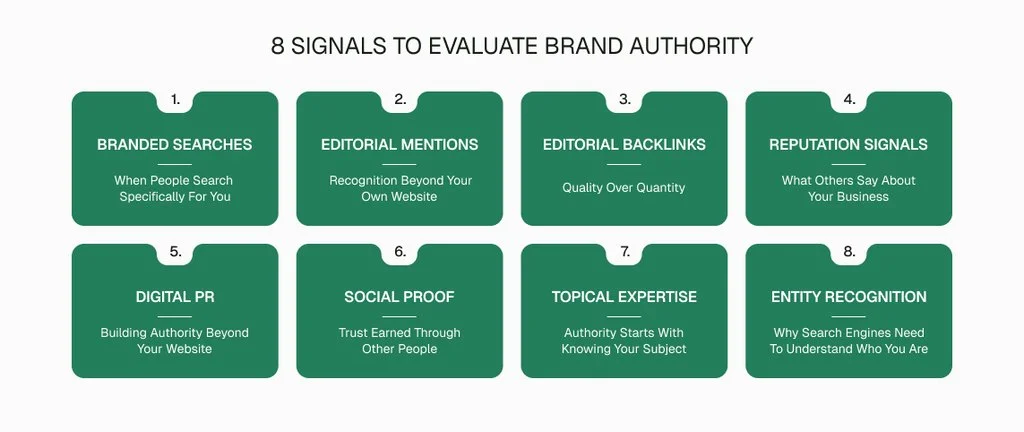
Image title - Search Engines uses these 8 signals to Evaluate Brand Authority
A website isn't evaluated only by what it says about itself. It's also evaluated by what the wider web says about it.
Let's look at the signals that contribute to that picture.
1. Branded Searches: When People Search Specifically For You
Do people search for you by your name on Google? That is a potential signal of brand authority. Examples include searches such as:
- BloggerOutreach
- BloggerOutreach reviews
- HubSpot CRM
- Canva pricing
- Ahrefs blog
SparkToro founder Rand Fishkin said something in this regard. He emphasized the simple logic that strong brands can foster greater user trust and, in turn, enjoy higher click-through rates. People recognize their content even before reading the first line.
What This Means For SEO?
Branded search is not meant to boost your traffic only. What’s most important is that people learn about your brand and its offerings.
That’s why all companies should heavily invest in creating good content, strengthening PR, and boost customer’s digital experience by indulging in thought leadership.
Over time, people will particularly search for your brand online. That’s one of the main takeaways of authority-focused SEO.
2. Editorial Mentions: Recognition Beyond Your Own Website
Let’s consider 2 software agencies. Agency A publishes content only on its own website. Agency B is mentioned frequently in important publications. Their experts get called for podcasts, and journalists mention them and their work.
Now you can easily differentiate between the two. Agency B has more credibility.
If you check Google’s Search Quality Rater Guidelines, the instructions are simple. Google wants the human evaluators to investigate independent information about a website or content creator.
But what qualifies as independent information sources? The obvious sources are news articles, reviews, references, recommendations, and discussions from reputable third-party sources.
But don’t treat them as guidelines to rank on Google. However, they clearly show the types of reputation signals Google's systems aim to reward.
Mentions Without Links Still Matter
A common misconception is that an editorial mention has no SEO value. Unless it includes a backlink.
That's an oversimplification.
While backlinks remain one of Google's confirmed ranking signals, many SEO researchers believe that consistent brand mentions contribute to entity recognition.
In return, that helps search engines understand relationships between brands, topics, authors, and organizations. Google's Knowledge Graph was built specifically to understand entities rather than simply matching keywords.
As Google explains:
"The Knowledge Graph enables you to search for things, people or places that Google knows about."
Source: Google
BloggerOutreach Insight
Strong backlinks send clear signals that another website is linked to you. However, editorial mentions further boost your brand.
It tells Google that the brand is part of ongoing online conversation threads.
A 360-degree campaign helps you earn both and build brand authority faster!
3. Editorial Backlinks: Quality Over Quantity
Google's original PageRank algorithm updated search by treating links as votes of confidence between webpages.
Since then, Google’s ranking parameters have also evolved. However, links are still important for searching reliable content and for checking how one page links to another.
But you cannot convince Google by increasing your backlink count. When a popular website in your niche mentions you, that’s more credible than 50 unrelated and low-authority sources citing you.
In fact, Google also warns publishers against manipulative linking for a rank boost in its spam policy.
But not all backlinks carry equal weight.
A contextual mention from a respected publication in your industry is usually far more valuable than dozens of links from unrelated websites built solely for SEO purposes.
Google's spam policies explicitly warn against manipulative link schemes intended to artificially influence rankings.
What Makes An Editorial Backlink Valuable?
The best backlinks usually share these characteristics:
- They appear naturally within editorial content.
- They're relevant to your niche.
- They provide value to readers.
- They come from websites with genuine audiences.
- They are earned because the content deserves to be referenced.
- They are not bought exclusively for PageRank.
That’s why BloggerOutreach warns all clients against volume-based link acquisition in favor of relationship-driven publisher outreach.
We urge businesses to invest in long-term relationships with journalists, editors, bloggers, and publishers. Those relationships create opportunities for recurring editorial visibility, not just isolated backlinks.
4. Reputation Signals: What Others Say About Your Business
You can tell people your company is trustworthy.
It's far more convincing when your customers do it.
Google's Search Quality Rater Guidelines repeatedly emphasize that independent reputation information plays an important role in evaluating websites, especially for topics where trust is essential.
Review platforms, professional recommendations, awards, customer testimonials, and media coverage all contribute to a broader picture of your reputation.
The same principle applies in the real world.
When choosing a doctor, lawyer, software platform, or financial advisor, most people don't rely solely on the company's website.
They look for independent validation. Search engines increasingly do the same.
According to the BrightLocal Local Consumer Review Survey, consumers continue to rely heavily on online reviews when evaluating businesses, with authenticity and recency influencing trust more than ever.
For brands, this means reputation management isn't just a customer service function.
It's an authority-building strategy.
Businesses that consistently deliver positive experiences generate reviews, testimonials, referrals, and recommendations that reinforce trust across the wider web.
5. Digital PR: Building Authority Beyond Your Website
A common misconception in SEO is that authority is built entirely on your own website. In reality, some of the strongest trust signals originate elsewhere.
For instance, what does Google register when a journalist highlights your CEO’s journey? Or a popular blog draws from your original research?
Google accepts the credibility of your brand. But that is not limited to your website or your content.
Now you see why you need good Digital PR to build organic authority in the industry.
Bloggeroutreach In Practice
Why do most businesses not earn editorial mentions? The answer is simple. They create promotional content only. You will rarely find any useful story in their content calendar.
Blogger Outreach solves this problem for clients by targeting relationship-driven outreach. We also place content in relevant, editorially managed publications. In addition, we don’t depend on automated link-building tactics. And the results after that are pretty clear.
For example, Joeri De Turck, CTO of Brandslane, one of BloggerOutreach's clients, confirmed:
- 176% growth in organic traffic
- 149% increase in referring domains
- 174% increase in ranking keywords
While SEO performance is influenced by many factors, the campaign illustrates how sustained editorial visibility and high-quality outreach can contribute to broader authority-building efforts.
6. Social Proof: Trust Earned Through Other People
Now let’s take the example of two project management platforms.
Both have similar pricing and advertise impressive features.
One has five testimonials on its homepage. The other has:
- thousands of verified customer reviews
- recommendations from industry experts
- positive discussions on LinkedIn, and
- case studies published by independent organizations
Which company would you trust?
Most people instinctively choose the second.
Psychologists refer to this phenomenon as social proof. It’s the tendency to look to other people's experiences when making decisions.
Professor Robert Cialdini, in his landmark book Influence, identified social proof as one of the most powerful principles of persuasion.
When people see others trusting a product or service, they are more likely to trust it themselves.
Sure, Google doesn't use the term "social proof" in its ranking documentation. Yet many forms of social proof overlap with reputation signals. Google's Search Quality Rater Guidelines also encourage evaluators to investigate those signals.
Examples include:
- Independent customer reviews
- Expert recommendations
- Professional awards
- Industry recognition
- Third-party testimonials
- Media coverage
These aren't just marketing assets. On the contrary, they indicate that others consider your business credible.
Trust Is Increasingly A Business Advantage
According to the 2025 Edelman Trust Barometer, trust remains one of the strongest drivers of consumer decision-making. Particularly when evaluating organizations and brands.
So, what is the takeaway for marketers here? First of all, SEO can help in increasing the number of visitors.
However, trust plays a more significant role here. It helps in converting visitors into leads and sales.
7. Topical Expertise: Authority Starts With Knowing Your Subject
Take this instance. You want actionable advice on cloud security. Now, would you onboard or reach out to a brand that publishes 1 or 2 pieces of content per year on casual tech topics? I don’t think so!
I think you would prefer to trust a brand that consistently publishes content on cybersecurity, data protection, compliance, zero trust, threat intelligence, and so on.
If you like the second one, know that you're in the majority here. In fact, search engines also make their decisions in the same way.
If you check Google's Helpful Content guidance, it says the same. Google always encourages publishers to talk more about first hand expertise.
The policy also urges creators to share real and meaningful information, rather than staged scenarios and casual narratives.
In SEO, this is commonly referred to as topical authority. In simpler terms, it refers to the level of expertise a website demonstrates in covering a niche subject.
Blogger Outreach helps growing businesses to establish topical authority.
- Step 1 is the creation of comprehensive, interconnected resources around a subject.
- Step 2 is leveraging them to help search engines better understand your expertise.
Authority Is Built Through Consistency
One good article cannot earn you stable authority. You have to write at least fifty genuinely useful cluster articles covering different aspects of the same pillar.
For BloggerOutreach, this means publishing not just about link building. Rather, we try to create a broader ecosystem to establish digital authority.
For instance, take a look at the pillars we are covering for our website:
- Brand authority
- Editorial backlinks
- Editorial Authority
- Digital PR
- Entity SEO
- Online reputation
- Brand mentions
- E-E-A-T
- AI search optimization
- Blogger outreach
- Publisher relationships
Together, these resources demonstrate expertise far more effectively than isolated articles targeting unrelated keywords.
This strategy also aligns with Google's recommendation. Google prefers content that serves a clear purpose and reflects genuine expertise, rather than content published solely to attract search traffic.
8. Entity Recognition: Why Search Engines Need To Understand Who You Are
Today, search engines do not track keywords only. Instead, they check the whole entity before making decisions. But what is an entity in this connection?
It is an exclusive idea, concept, place, product, or organization that you portray through the content.
In 2012, Google introduced the Knowledge Graph, which helps the crawler understand how content relates to an entity.
Before that, the crawler only matched the words to read a page. As a result, high keyword density and semantic keyword positioning helped content grow.
But that has changed now. Let us take an example to understand better.
Let’s say you have a digital marketing company. So how would you endorse it? Google won’t be satisfied with your website being built solely around “Digital Marketing”.
Instead, the search algorithm will try to learn:
- Who your organization is.
- What topics you're known for.
- Who your authors are.
- Which companies reference you.
- Which publications mention you.
- Whether your information aligns with other trusted sources.
Every significant web mention if your brand strengthen your brand authority. In other words, your goal should not be only to rank your webpage. Instead, you need to spread the authority even across the entire website.
Brand Authority VS. Domain Authority VS. Topical Authority VS. Brand Popularity
I have often seen these aspects discussed or quoted interchangeably in SEO-related conversations. However, the concepts actually differ from one another.
As a brand trying to establish brand authority, you need to know these differences. The following table will tell you why:
| Factor | What It Measures | Who Defines It? | Why It Matters |
|---|---|---|---|
| Brand Authority | How trusted, recognized, and credible a brand appears across the web | Industry concept based on multiple trust signals | Influences how users, publishers, search engines, and AI systems perceive your business |
| Domain Authority (DA) | The likelihood of a domain ranking based on its backlink profile | Moz | Useful for competitive benchmarking, but not used by Google |
| Topical Authority | The depth of expertise a website demonstrates on a subject | SEO concept | Helps search engines understand subject-matter expertise through comprehensive coverage |
| Brand Popularity | How well-known a brand is among consumers | Marketing concept | Drives awareness but doesn't automatically translate into trust |
Always remember that you can easily create social media impressions. For that, you do not need to be an entity with high brand authority. However, you will find multiple B2B agencies with fewer public posts online.
Yet they have high authority, as they receive mentions on social media from other credible sources, such as popular media, industry experts, analysts, and real customers.
David Aaker, a pioneer of brand equity, also agrees with this. He says that a strong brand is built with trust, associations, and loyalty. To clarify, Google also values the same parameters over anything else.
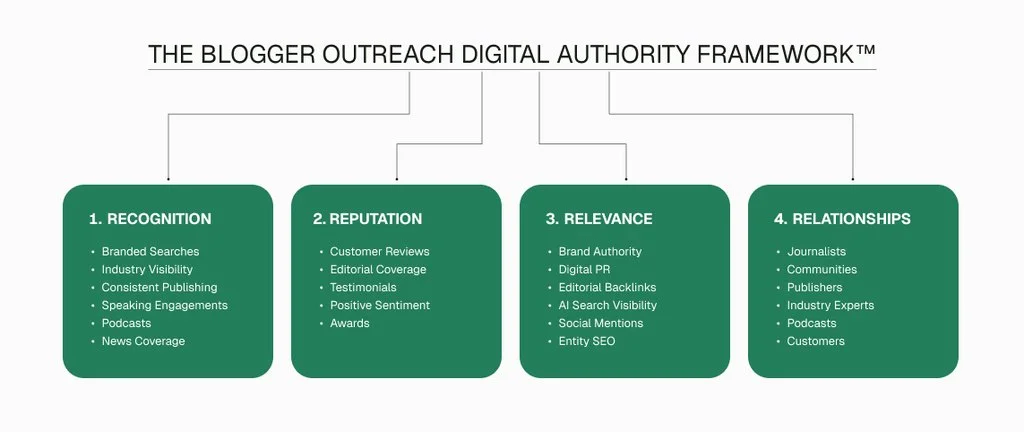
The BloggerOutreach Digital Authority Framework™
After examining Google's documentation, marketing research, and hundreds of successful outreach campaigns, one pattern becomes clear:
Brand authority is rarely created by one tactic. You need multiple trust signals working your way to reinforce how trustworthy, reliable, and effective your brand/products/services are.
At BloggerOutreach, we help clients establish that through four interconnected pillars.
1. Recognition
People can't trust a brand they've never heard of. Recognition comes from:
- Branded searches
- Industry visibility
- Consistent publishing
- Speaking engagements
- Podcasts
- News coverage
The more frequently your brand appears in relevant conversations, the more likely customers and publishers are to remember it.
Research from Page One Power found that 59% of Americans are more likely to click a brand they already know in Google's search results, highlighting the commercial value of brand familiarity.
2. Reputation
Recognition attracts attention and trust. To build recognition, Blogger Outreach ensures that clients get:
- Customer reviews
- Editorial coverage
- Testimonials
- Awards
- Independent recommendations
- Positive sentiment
3. Relevance
Authority must also be relevant.
Publishing excellent content about unrelated topics doesn't establish expertise within your niche. In other words, if you are a digital marketing brand, at Blogger Outreach, we will target areas like the following for you:
- Brand Authority
- Digital PR
- Editorial Backlinks
- AI Search Visibility
- Social mentions
- Entity SEO
- Topical Authority
4. Relationships
This final pillar is often overlooked. Simply put, authority grows through relationships. That’s why Blogger Outreach believes in networking with:
- Journalists
- Publishers
- Industry experts
- Customers
- Partners
- Communities
Relationship-driven outreach consistently produces stronger long-term results than transactional link acquisition. At Blogger Outreach, we do that for every client.
Again, that helps your clients earn recurring opportunities for collaboration, editorial mentions, and trusted recommendations.
Moreover, we don’t treat publishers as link sources. We rather build successful campaigns and treat them as long-term partners in building industry visibility.
How To Build Brand Authority: An Eight-Step Framework
This framework reinforces the practices that will compound your authority over time:
1. Publish Original, Experience-Driven Content
2. Earn Editorial Mentions
3. Invest in Digital PR
4. Strengthen Your Reputation
5. Build Topic Clusters
6. Develop Recognizable Experts
7. Build Consistent Brand Entities
8. Think Beyond Rankings
Frequently Asked Questions (FAQs)
The most common client doubts that we encounter daily at Blogger Outreach are summed here:
No. Google has never confirmed "Brand Authority" as an official ranking factor. However, concepts like expertise, reputation, trustworthiness, and helpful content are primary to Google. SEO professionals often use "brand authority" as a convenient way to describe this broader trust paradigm that Google refers to.
Domain Authority (DA) is a proprietary metric developed by Moz to estimate a website's ranking potential.
Brand Authority is a broader marketing and SEO concept that reflects how trusted and recognized a business is across the web.
Google does not use Moz's Domain Authority in its ranking systems.
Absolutely. Brand authority isn't reserved for global companies.
There isn't a fixed timeline. Don’t chase quick wins. Brand authority is a long-term asset. Let us first check your industry competition, content quality, customer reputation, media visibility, and the consistency of your marketing efforts.
Digital PR can strengthen many of the signals associated with brand authority, including editorial mentions, media coverage, backlinks, and industry recognition.
While Google doesn't state that Digital PR directly improves rankings, these activities often support broader visibility, reputation, and trust.
How Does BloggerOutreach Help Businesses Build Brand Authority?
BloggerOutreach focuses on earning visibility through manual outreach, editorial relationships, and placements on relevant publications rather than relying on automated link acquisition.
The goal isn't simply to increase the number of backlinks.
It's to help brands become recognized, trusted sources within their industries through sustained editorial exposure and relationship-driven outreach.
The published case studies on BloggerOutreach's website demonstrate measurable improvements in organic traffic, keyword visibility, and the number of referring domains across multiple campaigns.
Visit: https://www.bloggeroutreach.io/seo-case-studies
References
- https://developers.google.com/search/docs/fundamentals/creating-helpful-content
- https://developers.google.com/search/docs/fundamentals/ranking-results
- https://developers.google.com/search/docs/essentials/spam-policies
- https://static.googleusercontent.com/media/guidelines.raterhub.com/en//searchqualityevaluatorguidelines.pdf
- https://blog.google/products/search/introducing-knowledge-graph-things-not/
- https://www.google.com/search/howsearchworks/
- https://openai.com/index/introducing-chatgpt-search/
- https://www.brightlocal.com/research/local-consumer-review-survey/
- https://www.edelman.com/trust/trust-barometer
- https://global.oup.com/academic/product/how-brands-grow-9780195573561
- https://www.influenceatwork.com/book/
- https://www.bloggeroutreach.io/seo-case-studies