


Remember the two SaaS companies I mentioned in my last article?
Those 2 companies launched respective link-building campaigns in the same quarter. They were also targeting the same keyword difficulty, in the same competitive niche.
Company A bought 80 links in six weeks. There were guest posts on sites they'd never heard of, spun content, exact-match anchors, and a spreadsheet full of "DA 40+" domains.
As a result, the rankings twitched upward for about a month. After that, it slid back. In fact, some pages were worse off than before.
In comparison, Company B earned 12 placements in the same period. It sent out fewer links.
However company B ensured that all links were on sites with a real editorial team, a real audience, and a history of turning down pitches that didn't fit.
Expectedly, after 6 months, Company B's rankings improved and gradually stabilized.
So what can we take away from this incident? The difference in the number of links did not make a real difference at all.
Rather, Company B got better results since they targeted the links selectively. To sum up, the team carefully selected each link to ensure it provided real value to readers.
This is not fictional. In real life, clients that make a difference actually prioritize editorial authority. Today, the search engines and AI are becoming smarter than ever.
Therefore, your link-building campaign should evolve as well. It's time to stop focusing only on the number of links and start paying attention to their quality.
What Is Editorial Authority?
Editorial authority is the credibility a publication earns by consistently exercising independent editorial judgment.
In simpler words, you must take time to decide what to publish, who to cite, and what to link to, based on value to its audience rather than payment from an advertiser.
It's a property of the publisher, not the link. A single link doesn't have editorial authority.
However a publication has that authority. When the publisher links to something, it shares that authority.
In reality, these three things build editorial authority over time:
- Selectivity: for instance, the publication says no to more pitches than it accepts.
- A track record: its coverage has been accurate and useful long enough that readers, and other publishers, trust it by default.
- Independence from the transaction: editorial decisions aren't determined by who's paying.
However this authority is different from domain authority, link quantity, or traffic volume. To clarify these usual metrics describe a site's technical footprint.
But in reality they reveal nothing about whether relevant sources like journalists, editors and other such credible sources link to the content.
To clarify a site can have a high third-party authority score and close to zero editorial authority, if every "article" on it exists purely to sell placements.
We'll come back to that distinction, because it's the root of most confusion around this topic.
Editorial Links vs. Paid Links: What Actually Separates Them
Not every backlink is created the same way. Meanwhile, Google has been explicit that it wants site owners to be honest about which is which.
Editorial Link
An editorial link is one an editor or writer adds because it genuinely supports the content. For example. It offers a source, a data point, and a relevant resource for readers.
It isn't guaranteed, requested for payment, or contractually obligated. To clarify, it exists because someone with editorial judgment decided it belonged there.
Paid Link
A paid link is any link that exists because money, product, services, or another form of compensation changed hands to secure it. The list inclues most sponsored posts and many guest posts.
Again, this isn't inherently against the rules. Google's own developer documentation walks through exactly how to run compensated placements without causing problems.
First off, Google says label them. Use rel="sponsored" for paid links and rel="nofollow" or rel="ugc" where appropriate. As a result, the relationship is transparent rather than disguised as an organic endorsement.
Google frames the issue plainly. Google doesn't have a problem with natural links. The problem starts when people create links to manipulate rankings and try to make them look organic.
On the contrary, the existence of a commercial relationship is never the problem.
| Editorial Link | Paid Link (undisclosed) | |
| Origin | Editor's independent judgment | Commercial agreement |
| Disclosure | Not required (no transaction to disclose) | Required (rel="sponsored") |
| Publisher risk | None | Site may be devalued or penalized if pattern is detected |
| Signal to Google/AI systems | Genuine endorsement | Weak or discounted signal |
| Durability | Tends to stay live; publisher has no reason to remove it | Often removed once the contract or campaign ends |
| Trust transfer | High (publisher's credibility extends to the linked brand) | Low to none |
The Takeaway
The practical consequence is that two links can look identical in a backlink checker. That means they can have the same anchor text, same destination, and same referring domain.
Yet the same two links can carry completely different weight. The reason is that one represents a publisher's endorsement, and the other represents a transaction the publisher had to disclose.
To sum up, editorial authority is what determines which bucket a link falls into.
Why Publisher Reputation Matters More Than Publisher Size?
Every publisher eyes the top ten spot, so far as quality is concerned. But reputation is built from a track record. And a track record can't be faked by inflating a metric.
Here's the reputational logic, in plain terms:
When a publication with genuine editorial standards links to a brand, it is putting its own credibility on the line.
Readers who trust that publication now extend a fraction of that trust to whatever it just linked to. That transfer only works because the publication has spent years being selective about what it vouches for.
This idea isn't just about SEO. Research shows that people tend to trust editorial content more than traditional ads.
In Nielsen's global trust survey, about two-thirds of respondents said they trust content published by news outlets and websites more than most paid advertising formats.
That's why earning a genuine editorial mention can be so valuable. It gives brands credibility that ads alone often can't provide.
Publisher size doesn't guarantee any of this. A mid-sized industry blog with 20,000 monthly readers and a genuinely engaged niche audience can carry more real-world influence, and more editorial authority.
In comparison, a bloated "authority site" that will publish almost anything for a fee won’t even come near in terms of trust and acceptability. Reputation is about consistency of judgment, not traffic volume.
Editorial Standards As A Trust Signal
Editorial standards are the visible evidence that a publication is exercising judgment rather than just accepting submissions.
They're also one of the clearest, most checkable trust signals available to anyone evaluating a potential placement.
A publication with real editorial standards typically shows some combination of:
- A visible editorial process, that includes bylines, author bios, an editorial or "about" page describing how content decisions are made
- Content rejection, which provides evidence that not every pitch gets published (inconsistent posting cadence from guest contributors, editorial notes, visible gatekeeping)
- Topical focus ensuring that coverage stays within a defined subject area rather than publishing about anything for anyone
- A real, engaged readership involving comments, shares, and return visitors. Not just raw traffic that could be purchased or bot-driven
- Longevity, that proves that the site has existed and published consistently for years, not spun up shortly before being listed on a "link marketplace"
These are the same underlying qualities Google asks its human Quality Raters to evaluate when assessing content, formalized within the E-E-A-T framework (Experience, Expertise, Authoritativeness, and Trustworthiness).
Google's own Search Central documentation is direct about the hierarchy inside that framework:
"Of these aspects, trust is the most important... the other aspects contribute to trust but don't necessarily stand on their own" (Google Search Central, Creating Helpful, Reliable, People-First Content).
A publisher that can't demonstrate independent editorial standards struggles to demonstrate trustworthiness. Meanwhile, a link from that publisher inherits the same weakness.
How Does Editorial Authority Strengthen Search Authority?
A link from a trusted publisher can be more valuable than getting lots of links from less trusted sites.
It Survives Algorithm Updates Better
Google's spam-detection systems, most recently strengthened through 2025's SpamBrain upgrade, are explicitly built to analyze relational patterns:
which domains link to which
how anchor text is distributed, and
whether a site's linking behavior looks like genuine editorial curation or coordinated placement
Links sitting on genuinely independent editorial sites don't display the coordinated patterns these systems are hunting for.
The reason is that they weren't coordinated. Rather, they were earned one editorial decision at a time.
It Reinforces Topical Relevance Signals
An editorially placed link almost always sits inside content that's actually about the subject. To clarify, an editor chose to include it there, in that context, for that reason.
To sum up, contextual relevance is one of the harder signals to fake convincingly at scale across paid placements.
It Extends Beyond Links Entirely.
Editorial authority also shows up as unlinked brand mentions, quotes, and citations. Simply put, these signals increasingly matter for how AI-driven answer engines like ChatGPT, Perplexity, and Google's AI Overviews decide which brands to reference.
These systems tend to pull from sources that already carry independent credibility, not primarily from sites optimized purely to sell outbound links.
It Compounds Instead Of Decaying
A paid placement is often removed once a contract ends. A genuine editorial mention tends to stay live indefinitely. In fact, the publisher has no reason to take it down. Actually, it was never a transaction to unwind in the first place.
This is the mechanism behind a pattern that you can see repeatedly in link-building case studies:
“campaigns built on fewer, more editorially credible placements tend to hold their ranking gains longer than campaigns built on higher volumes of weaker links.”
BloggerOutreach ran a link-building campaign for VPN provider VeePN in the cybersecurity space.
Instead of focusing on volume, the campaign targeted relevant and authoritative publishers.
During the campaign, VeePN's organic traffic grew by 176%. Its number of referring domains also increased by 149%.
BloggerOutreach also applied this approach to Freshessays, an essay-writing platform operating in a niche where editorial placements are difficult to secure. As a result, the campaign generated a 133% increase in traffic.
Correlation isn't the same as proof of causation in either case. To clarify, the results vary by niche, competition, and starting point.
But the pattern is consistent with what the underlying mechanics of editorial authority would predict.
Examples Of Strong Editorial Placements
It's easier to recognize editorial authority in practice than in the abstract. A few patterns that distinguish a strong editorial placement from a weak one:
- A journalist citing a company's original research or data study, because the data itself was newsworthy. Again, not because the company pitched a guest post. The link exists to support a claim the journalist is making, on the journalist's terms.
- A niche industry publication running a genuine expert byline, where the contributor was invited (or selected) specifically because of subject-matter credibility, and the piece goes through the same editorial review as staff-written content.
- A product being included in an independently reported "best of" roundup, based on the publication's own testing or research criteria, rather than a paid inclusion fee.
- A trade publication interviewing a founder or executive as a source for a story the publication was already planning to write, with the resulting link appearing naturally in context.
All four examples share one thing. The publisher had a real reason to run the story. The story, data, or expert insight is primary here. The link was simply a result of that value.
Guest posting can fall into this category. But only when the receiving publication maintains real standards. For instance, they conduct proper topic review, make content edits, reject pitches that don't fit, and offer no guarantee of placement regardless of payment.
BloggerOutreach's guest posting model, for example, is built around exactly this constraint. Publishers review content to ensure it fits their editorial niche and meets their standards before publication. The process is not automated.
Common Misconceptions About Editorial Authority
A lot of websites/brands don’t perform because they still hold some common misconceptions about editorial authority. Let’s check out these misconceptions and resolve them:
"A high Domain Authority (or DR, or Authority Score) means the site is editorially trustworthy."
This is one of the most persistent myths in link building, and it's worth being precise about it. Domain Authority is a third-party metric created by Moz, calculated from backlink data.
It is not a Google ranking factor, and it says nothing about whether a site exercises genuine editorial judgment.
A site can accumulate a high DA score primarily through link-selling activity. However, it is not actually building real editorial authority.
"More Links Always Means More Authority."
Volume without editorial credibility doesn't grow or scale. It eitherplummets or stays the same.
In cases where a site's link profile appears artificially inflated, it will be hit by pattern-based spam alerts. After that, it won’t matter even of it’s web pages or articles keep ranking on Google.
"Nofollow Or Unlinked Mentions Have No Value."
A nofollow or sponsored tag limits direct link-equity transfer. But it doesn't erase the trust or brand-visibility value of appearing on a credible, editorially independent site.
As AI answer engines increasingly cite sources based on topical credibility rather than link attribute alone, unlinked editorial mentions are gaining relevance, not losing it.
"Any Guest Post Is A Paid Link In Disguise."
Not accurate. A guest post becomes a disclosure issue only when compensation was involved and undisclosed, or when the receiving site accepts content with no editorial review.
A guest contribution that goes through genuine editorial selection, on a publication with a real audience, is functionally editorial. In other words, the format doesn't determine the category; the process does.
"Editorial Authority Is Permanent & Once Earned."
It isn't. A publication that starts accepting undisclosed paid placements at scale can erode its own editorial authority over time.
Both in the eyes of its readers and, increasingly, in the pattern-detection systems that search engines use to flag exactly this kind of drift.
A Simple Framework: The Four Pillars Of Editorial Authority
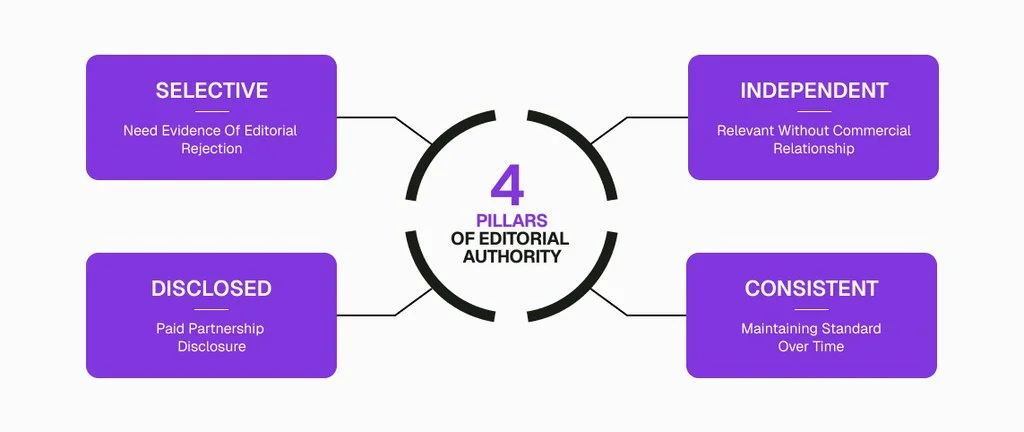
Rather than relying on a single metric, it's more reliable to evaluate a potential placement, or a publisher relationship, against four independent questions:
- Selective: Does this publication turn down more pitches than it accepts? Is there evidence of editorial rejection?
- Independent: Would this content exist, in roughly this form, even without a commercial relationship attached?
- Disclosed: If compensation is involved, is that relationship labeled honestly (sponsored, paid partnership, rel="sponsored"), or just presented as an organic editorial choice?
- Consistent: Has this publication maintained the same standard over time, or does quality vary depending on who's paying?
So What Does This Mean In Practice?
The brands that build durable search visibility over the next several years won't necessarily be the ones that accumulate the most backlinks.
They'll be the ones who consistently earn placements from publishers with a genuine reason. Not just payment to feature them.
That's a slower, less linear process than buying volume. It also happens to be the version of link building which is least vulnerable to the next algorithm update.
That approach also gives AI systems more reasons to cite the brand when answering customer questions.
Editorial authority isn't a metric you can shortcut into existence. It's a track record, built one earned placement at a time. Again, that is precisely why it's so hard to fake, and why it delivers authority when a large number of paid links don't.
Frequently Asked Questions (FAQs)
No. DA is a third-party metric that estimates a site's link-based ranking potential. Editorial authority is a qualitative measure of a publisher's exercise of independent editorial judgment. A site can have either, but not both.
Yes, if the receiving publisher conducts genuine editorial review, doesn't guarantee placement in exchange for payment, and appropriately discloses the commercial relationship. The compensation itself isn't disqualifying. However, the problem is the absence of independent judgment and disclosure.
They can contribute to a brand's broader reputation and entity recognition, particularly for AI-driven search, even though they don't pass conventional link equity.
Check for a visible editorial process, evidence of rejected pitches or content-review standards, topical consistency, genuine reader engagement, and a track record that predates any outreach campaign. You can also follow the four pillars outlined above.
References
- A reminder on qualifying links and our link spam update
- Creating Helpful, Reliable, People-First Content
- Under the Influence: Consumer Trust In Advertising
- Google's Backlink Policy in 2026: What the Guidelines Actually Say
- What Domain Authority Is (and Isn't), and How to Increase It
- VeePN Case Study
- Freshessays Case Study
- Guest Posting Services