

Google’s original algorithm introduced a revolutionary change, but multiple updates and improvements over the years have since reshaped the search landscape. The keyword-first model that defined SEO for over two decades is now giving way to an entity‑first paradigm.
Where search engines no longer retrieve pages based on keywords exclusively. But exhibit reasoning regarding real‑world concepts, brands, people, and relationships.
Large language models (LLMs), generative answers, and knowledge graph–based retrieval drive this shift. In 2026, these technologies are fundamentally redefining how brands earn visibility, build authority, and establish trust.
At the epicenter of this transformation is Entity SEO. Which establishes, clarifies, and reinforces an entity’s legitimacy and contextual relevance across the web. This is as opposed to optimizing individual pages to rank for isolated queries, as used to be the case earlier.
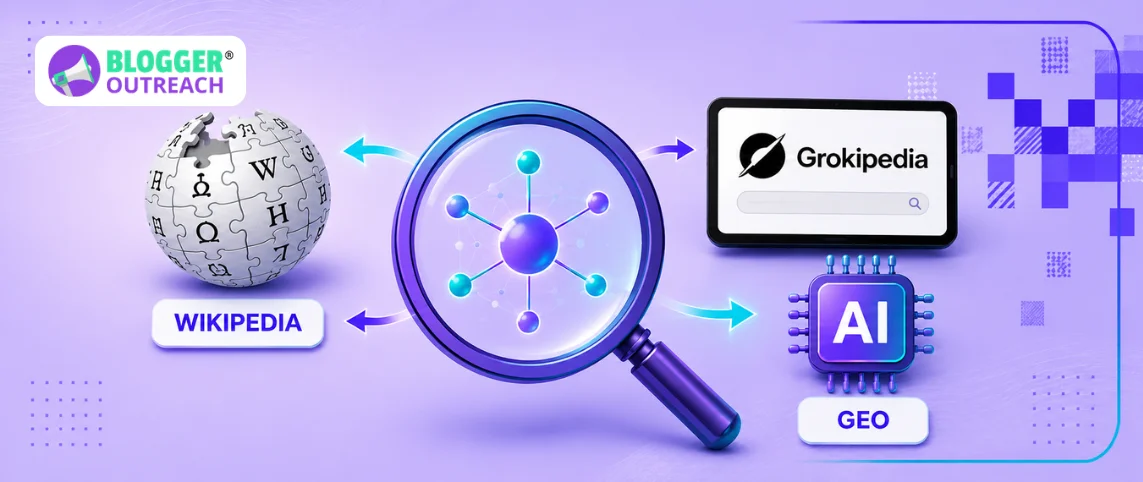
We are seeing modern search systems increasingly rely on Wikipedia‑esque knowledge infrastructures. These include Wikipedia, Wikidata, emerging repositories such as Grokipedia, and proprietary brand and entity graphs maintained by search engines. And AI platforms. These act as a trust layer to validate. Which entities are authoritative enough to cite, summarize, or recommend in generative responses?
As a result, keyword density and backlink volume alone no longer determine discoverability. But depends on entity legitimacy and relational context across multiple corroborating sources. This is not to say that brands that lack a clear, well‑defined entity footprint won’t “rank” at all by earlier standards. But AI Overviews, conversational search engines, and generative recommendation systems increasingly exclude them, even as these platforms shape the future of search.
This whitepaper explains the “how” and “why” of this shift and what it means for modern SEO strategy. Readers should gain a clear understanding of what Entity SEO actually means today and how it subsumes traditional semantic SEO approaches. The paper will also clarify why Generative Engine Optimization (GEO) and Answer Engine Optimization (AEO) are not replacements for SEO.
Most importantly, this paper also provides practical frameworks for building entity authority that go beyond rankings. Helping organizations move from chasing clicks to becoming trusted, recallable entities within the knowledge systems that now power search.
The Search Paradigm Shift: From Keywords To Entities
Search has transitioned from simply retrieving to reasoning. What once functioned as a system for matching strings of text has evolved into a networked intelligence layer. This is capable of understanding real‑world objects, concepts, and the relationships between them.
Naturally, such a transformation has rendered many traditional SEO assumptions increasingly fragile.
Why Traditional SEO Models Are Breaking
The rollout of AI overviews in the recent past was followed by a visible breakdown in keyword‑first SEO in the form of volatility of rankings and traffic. Multiple independent studies confirm that AI Overviews inevitably reduce organic clicks to external websites, despite “great rankings.”
An experiment conducted by researchers at Carnegie Mellon University and the Indian School of Business revealed that AI Overviews reduced organic clicks by 38%, while increasing zero‑click searches from 54% to 72% on affected queries (Search Engine Journal, 2026).
This decline is getting more and more evident by the plummeting relevance of blue‑link placements in content. With modern SERPs increasingly dominated by:
- AI summaries
- Knowledge panels
- Entity-driven features
Even when pages rank in the top three positions, their visibility and influence are generally superseded by generative answers that synthesize the necessary information directly within the interface, negating the need to click through to a site/webpage (Pick, 2026).
As a result, zero‑click behavior has become a defining characteristic of modern search. In fact, Bain & Company (2025) reports that approximately 60% of searches now end without any click to the open web because AI‑generated summaries offer instant answers.
Search Engines as Knowledge Engines
This shift is symbolic of a deliberate architectural evolution, with Google formally signaling this transition in its 2012 “Things, not strings” announcement. It introduced the Knowledge Graph as a mechanism for understanding entities rather than keywords, containing billions of entities and trillions of relationships, which is the factual backbone for AI Overviews (Barnard, 2025).
Emulating the tech giant, other platforms have followed the same trajectory, with Bing, OpenAI, Perplexity, and xAI all operating as answer engines, designed to synthesize responses rather than retrieve documents.
These systems heavily rely on retrieval‑augmented generation (RAG) architectures, whose purpose is to retrieve trusted knowledge before generating output (Retrieval-Augmented Generation: A Comprehensive Survey of Architectures, Enhancements, and Robustness Frontiers, n.d.) They favor sources with clear entity definitions and consistent attributes.
| Modern search engines are no longer asking, “Which page matches this query?” but “Which entities do we trust to answer this question?” |
Research claims that as RAG systems are aware of entities, they significantly improve factual accuracy by validating information through entity linking (Granata, Poggi, & Mongiovì, 2026). Wikidata and other structured knowledge bases are often used for this purpose.
Defining the New Unit Of Search: Entities
In modern search systems, an entity is any uniquely identifiable and distinguishable brand, person, product, organization, location, or abstract concept. They can also be described as singular, well‑defined concepts that can be recognized independent of language or phrasing (Warren, 2023).
Unlike webpages, once recognized, they remain part of the search engine’s knowledge model, further enriched by attributes and corroborating sources. This persistence allows AI systems to reason across documents, sources, and formats without relying on any single page.
While keywords can be easily inserted or repeated, entity recognition depends on consistent mentions, authoritative citations, structured data alignment, and cross‑source agreement. These are external validation that makes entity‑based systems more resistant to spam, yet more aligned with real‑world credibility.
What Is Entity SEO?
Entity SEO has emerged as the foundational discipline for modern search visibility. It has been so ever since search has transformed from matching text to comprehending reality.
Rather than focusing solely on pages and keywords. Entity SEO ensures that an entity’s identity, attributes, and relationships are consistently represented across:
- Knowledge graphs, such as Google’s Knowledge Graph and Bing’s entity systems.
- Trusted public databases, including Wikipedia and Wikidata, serve as validation layers for AI models.
- Web content, where entities are reinforced through structured context and authoritative coverage.
- AI training and retrieval sources increasingly prioritize well‑defined entities during citation and answer generation.
In simple terms, Entity SEO teaches machines what something is, what it’s known for, and how it relates to other concepts (Clark, 2025).
Entity SEO vs Traditional SEO
| Traditional SEO | Entity SEO | |
| Primary Optimization Unit | Keywords and keyword variations | Brands, people, products, concepts and their relationships |
| Search Engine Model Assumed | Document retrieval | Knowledge representation and reasoning |
| Content Structure | Pages optimized around target keywords | Entity‑centric content supporting a canonical entity |
| Authority Signals | Backlinks and anchor text | Mentions, citations, entity associations, corroboration |
| Measurement of Success | Rankings, clicks, and organic traffic | Entity recognition, AI citations, recall, and inclusion in answers |
| SERP Appearance | Blue links and featured snippets | Knowledge panels, AI Overviews, and conversational answers |
| Tolerance for Manipulation | Relatively high, where keywords can be inserted or repeated | Low, as it requires third‑party validation and consistency |
| Longevity of Impact | Short-to-mid-term as it is algorithm‑sensitive | Long-term that compounds via knowledge graphs |
| Role in AI Search (AEO / GEO) | Indirect and often insufficient | Foundational; required for visibility |
In other words, Entity SEO asks whether an entity is:
- Recognized
- Correctly defined
- Contextually associated with problems and solutions
This is the perfect explanation as to why some brands appear consistently in AI answers despite modest rankings.
Entity SEO vs Semantic SEO
As the name suggests, Semantic SEO focuses on meaning within content. It uses related terms, context, and topical depth to help search engines interpret relevance (DeMott, 2023). Entity SEO goes one layer deeper, addressing existence, identity, and trust, along with the meaning of the content.
Although Semantic SEO supports Entity SEO by introducing context, it cannot replace it. Even semantically rich content may fail to be cited or recalled by AI systems without entity recognition. Therefore, semantic understanding without entity authority results in content that cannot be trusted.
The Role Of Knowledge Graphs In Modern Search
Modern search and AI systems comprise knowledge graphs that help large language models (LLMs) to move toward reasoning, validation, and synthesis.
How Google’s Knowledge Graph Works
At a foundational level, Google’s Knowledge Graph represents the web as a network of entity nodes. Each of these nodes corresponds to a uniquely identifiable real‑world “entity,” which could be a person, organization, product, or concept. There is also a set of attributes that help distinguish it from similar or ambiguous entities (Warren, 2023).
These Include:
- Name
- Description
- Date Of Founding
- Founder
- Category
Entities are connected through explicitly modeled relationships, such as founder of or located in, and do not exist in isolation. Search engines use such relationships to infer context and meaning at a systems level, instead of relying on individual pages.
| Understanding that an individual is the founder of a company, for instance, creates a reusable factual link applicable across countless queries. |
Crucially, Google applies confidence scoring through corroboration. Facts and relationships are given prominence when they are confirmed by multiple independent and trusted sources, such as Wikipedia, Wikidata, or authoritative news outlets, among others (Barnard, 2025).
Alternatively, entities or even attributes that lack sufficient corroboration may be ignored or removed entirely from the Knowledge Graph. There is evidence of this from when Google’s large‑scale Knowledge Graph “clarity” updates focused on reducing ambiguity and low‑confidence entities.
Beyond Google: The Multi-Graph Reality
While Google’s Knowledge Graph is the most visible, it is not the only option, with modern search operating in a multi‑graph environment.
As per Lauragra (n.d.), Microsoft maintains its own graph, which informs Bing Search, Copilot, and downstream AI experiences, while Wikidata has emerged as a central, open, and structured entity backbone used by search engines, virtual assistants, and AI research communities to validate facts and resolve entity identity. All of these rely on similar entity‑relationship principles but with different data sources and weighting systems.
Also, LLM providers operate proprietary knowledge layers built from a mix of licensed data, public sources, and curated structured datasets (Granata et al, 2026). These internal graphs are used during retrieval‑augmented generation (RAG) to keep answers grounded in verifiable entities rather than raw text. Additionally, healthcare, finance, and SaaS apply stricter validation rules and domain‑specific schemas, reflecting the higher risk associated with factual errors in regulated fields.
Why Knowledge Graph Inclusion Determines AI Visibility?
In AI‑driven search, knowledge graph inclusion has become a prerequisite for visibility, where LLMs consistently prefer structured, validated, and widely corroborated entities to reduce uncertainty during response generation. To that end, academic research on entity‑aware RAG systems shows that entity linking dramatically improves factual accuracy compared to purely semantic retrieval (Granata et al, 2026).
Unknown or poorly defined brands represent a “hallucination risk.” If an entity lacks a stable node, attributes, or trusted references. AI systems are more likely to exclude it than risk generating unverified claims. (Retrieval-Augmented Generation: A Comprehensive Survey of Architectures, Enhancements, and Robustness Frontiers, n.d.) This means that entity recognition, instead of page ranking alone, now determines whether a brand is eligible to be named or cited in generative answers.
Wikipedia, Wikidata, And The Trust Layer Of The Internet
Where knowledge graphs are the structure of modern search, Wikipedia and others form a critical trust layer that cannot be overstated.
Why Wikipedia Still Matters In 2026
Wikipedia remains one of the most trusted sources on the open web. Its credibility stems from human‑moderated neutrality that is enforced through strict editorial guidelines. These require verifiability, reliable sourcing, and a neutral point of view, unlike algorithmically aggregated content. Continuous review by human editors reduces the likelihood of unchecked misinformation.
Equally important is Wikipedia’s citational process; claims must be supported by independent, third‑party sources that are typically authoritative news outlets or academic publications.
Such rigorous requirements lead to Wikipedia gaining persistent machine trust. In fact, Google’s Knowledge Graph, voice assistants, and AI Overviews routinely reference Wikipedia either directly or indirectly via Wikidata.
Wikipedia vs Wikidata vs Commons
While often conflated, Wikimedia projects serve distinct functions. This is evident in that while Wikipedia provides human‑readable explanations that contextualize an entity’s significance. Wikidata, by contrast, functions as a structured entity backbone, storing facts as machine‑readable statements and defining attributes and relationships with precision. Wikimedia Commons adds verified media that reinforces entity recognition but plays a secondary role in search reasoning. Search engines and LLMs use these assets differently.
Wikipedia SEO Strategy
A modern Wikipedia SEO strategy prohibits promotional editing, conflict‑of‑interest contributions, and paid advocacy (Wikipedia contributors, n.d.). Any attempt to “game” the platform often results in deletion or long‑term reputational harm. Ethical alignment focuses on establishing notability through third‑party coverage. Brands earn Wikipedia eligibility by being written about by authoritative publications.
From an Entity SEO perspective, Wikipedia is a confirmation layer that validates an entity that already has real‑world recognition; it is not a growth channel.
Grokipedia & Emerging Knowledge Repositories
In addition to Wikipedia, platform‑native knowledge repositories, such as Grokipedia‑style systems and internal LLM wikis, have emerged in the field of AI reasoning (How Similar Are Grokipedia and Wikipedia? A Multi-Dimensional Textual and Structural Comparison, n.d.) These are often AI‑maintained entity databases that continuously update facts and relationships.
This is a structural shift for brands as entity legitimacy must extend beyond Wikipedia. Visibility in 2026 depends on consistent presence across multiple knowledge systems. Both public and proprietary, each reinforcing the same core entity identity. While Wikipedia remains foundational, it is now one node within a broader trust network defining modern search.
Generative Engine Optimization (GEO): The Entity Layer of AI Search
The rise of Generative Engine Optimization (GEO) was a response to a fundamental change in how search engines work today. Generative systems operate under the principle that visibility is no longer granted exclusively by rankings but by whether an entity is considered trustworthy.
What is GEO and What It Is Not?
GEO is not a form of prompt manipulation, where content is optimized to ensure brand mentions inside AI responses. This is incorrect and strategically unstable, as modern generative engines do not select sources based on prompt phrasing only but rely on pre-validated knowledge structures that operate independently of such content tricks.
In practice, GEO focuses on increasing the likelihood that a brand, product, or organization is recognized as a legitimate entity within generative systems. Academic research on retrieval‑augmented generation consistently shows that LLMs prefer entities that are already validated through knowledge graphs and trusted databases (Graph Retrieval-Augmented Generation: A Survey, n.d.)
In other words, GEO does not attempt to manipulate outputs; instead, it aligns entity signals so that AI systems naturally cite the brand or product whenever relevant.
How Generative Engines Choose Which Brands To Mention?
Generative engines select brands through a combination of training exposure, retrieval‑time trust, and entity coherence.
| First, entities that appear consistently across authoritative sources, such as major publications, are more likely to be encoded with stable attributes and associations (Retrieval-Augmented Generation: A Comprehensive Survey of Architectures, Enhancements, and Robustness Frontiers, n.d.) But frequency alone is insufficient if signals are inconsistent or ambiguous. | Second, AI systems rely heavily on retrieval‑time trust sources during inference. RAG architectures retrieve information from curated, high‑confidence sources before generating an answer. Retrieval grounded in Wikidata, Wikipedia, and other trusted knowledge bases significantly improves factual accuracy. | Third, if a brand is consistently associated with the same category, problems, and solutions across multiple sources, it is selected as a safe reference. This is important because a lack of coherence leads models to often default to better‑defined competitors, or omit brands entirely from responses. |
Entity Consistency As A GEO Multiplier
Entity consistency acts as a multiplier for GEO performance. When a brand’s identity, positioning, and value proposition align across web content and third‑party references, AI systems encounter less uncertainty when deciding whether to include it.
Reduced ambiguity directly correlates with increased inclusion in generative answers, but poorly defined entities are treated as hallucination risks. GEO success, therefore, is not driven by the volume of content but by clarity and corroboration. A principle that ties GEO directly back to Entity SEO.
AI Search Optimization (AEO) And Entity SEO
GEO addresses underlying entity inclusion, but AI Search Optimization (AEO) focuses on how information is surfaced.
AEO Defined
AEO is all about content and data optimization that is to be directly consumed and summarized by AI‑powered search interfaces. This includes AI Overviews, voice assistants, chat‑based search tools, and productivity copilots within Google, Bing, and Microsoft Copilot. AEO does not aim to drive clicks but shapes what the AI says when answering a question. Often without any user interaction.
How Does Entity SEO Power AEO?
AEO is fundamentally dependent on Entity SEO; answer engines do not pull from pages in isolation; they pull from entities and their attributes, using pages as supporting evidence. Research on modern search systems confirms that structured facts and clearly defined entity relationships outperform sheer content volume when generating answers (Aggarwal et al., 2024).
This explains why brands with modest traffic but strong entity signals appear frequently in AI Overviews, to the detriment of high‑traffic sites without a clear entity definition that are simply summarized or omitted.
Why AEO Fails Without An Entity Foundation
Content that lacks entity authority is often ignored or rewritten without attribution. This is because the AI system lacks confidence in the source’s legitimacy. Here, brands may influence answers indirectly but remain invisible otherwise. This is a massive change in how brands function in AI search. Without entity grounding, brands become interchangeable sources rather than recognized authorities.
Strong entity foundations can help brands transition from destinations for clicks to trusted references within AI‑mediated decision‑making. This is a prerequisite for durable visibility in the future of search.
Building An Entity SEO Strategy In 2026
Entity SEO in 2026 is the operational foundation of modern SEO strategy. With search engines and AI systems reasoning over entities instead of pages, optimization must shift from content production to entities and their validation.
Step 1: Entity Audit
The first step in an Entity SEO strategy is a comprehensive entity audit that identifies all relevant entities associated with a business, including:
- Brand entities (company, sub-brands).
- People entities (founders, executives, subject-matter experts).
- Product or service entities.
- Concept entities (core topics, methodologies, industries).
Search engine models assign attributes and relationships to each of these entities. Problems arise when attributes are missing or inconsistent across sources, such as mismatched founding dates, unclear category definitions, or descriptions that are in conflict with each other.
When it comes to Google’s Knowledge Graph evolution. It is clear that inconsistent entity attributes reduce confidence scores and, in some cases, lead to partial or total entity exclusion. An effective audit maps how machines currently interpret each entity, rather than how the organization thinks they should—a critical distinction.
Step 2: Entity Source Mapping
Following entity identification, the next step is source mapping, which involves cataloging the sources that define, reference, and validate each entity.
| The Primary Sources Of Entity Validation • Wikipedia and Wikidata, which serve as primary trust and disambiguation layers for search engines and LLMs. • Authoritative news databases, which establish notability along with third‑party corroboration. • Industry directories and registries that reinforce category and operational legitimacy. • Knowledge panels and public APIs; these reveal how entities are currently represented in major search systems. |
Search engines derive confidence through cross‑source agreement. Naturally, when attributes align across multiple trusted databases, entity confidence increases, but otherwise, AI systems may suppress or reinterpret the entity to minimize hallucination.
Step 3: Content As Entity Reinforcement
In an Entity SEO strategy, content exists to reinforce entity understanding. This calls for an entity‑first content architecture where each core entity has a clearly defined hub.
Top organizations don’t focus on publishing high volumes of interchangeable blog posts. On the contrary, they go for canonical explanations, comprising definitive resources that explain what an entity is, how it relates to other concepts, and why it is authoritative. It is evident that structured explanations aligned to entities outperform generic content volume.
Of course, blog content still has a role, but mostly in a supportive capacity rather than as the primary vehicle of authority.
Step 4: Industry Validation
The final and often most decisive step is industry validation, where entity authority cannot be self‑declared but externally corroborated.
The key validation mechanisms are PR and earned media coverage, expert citations and co‑mentions, and references in authoritative industry publications. These signals form third‑party corroboration loops, where each independent mention reinforces entity legitimacy across knowledge graphs. When trusted sources repeatedly mention entities, generative systems are significantly more likely to retrieve, ground, and cite them.
| KPIs Beyond Rankings • Knowledge panel presence and accuracy • Mentions in AI‑generated answers, including AI Overviews and conversational search outputs • Brand recall in chat‑based search, where entities are named |
Diagnostic Signals
Diagnostic signals reveal weaknesses in entity understanding. Entity disambiguation errors often occur when search engines or AI systems confuse a brand with a similarly named entity. Incorrect associations, such as misplaced categories or relationships, and omitted attributes that create incomplete or low-confidence entity profiles also signal areas that require attention.
Google’s documented Knowledge Graph maintenance practices reveal that such errors typically precede suppression or correction events. This makes them early warning indicators for Entity SEO risks.
It Is About Time We Leverage The Change
The rise of Entity SEO marks a structural turning point in how search engines evaluate relevance and how brands earn visibility. In 2026, keywords, pages, and traffic alone no longer determine success. Instead, search engines and AI systems rely on clearly defined, validated, and trusted entities across interconnected knowledge networks.
Knowledge sources such as Wikipedia, Wikidata, Grokpedia-style repositories, and proprietary AI graphs now create a shared trust layer that influences which brands AI platforms cite, summarize, and remember.
Generative search is inevitably replacing traditional discovery paths, and organizations must transition from optimizing for clicks to building durable entity authority, because visibility leads to understanding, which, in turn, leads to trust.