

Search engine results have changed quite a bit since I first wrote an article on this topic in 2023. Now it’s time to revisit it.
A Google search is no longer simply a list of ten blue links. Depending on the query, the results page may contain organic listings, ads, images, videos, local results, and featured snippets.
It may also have shopping results, news, knowledge panels, and AI-generated search experiences.
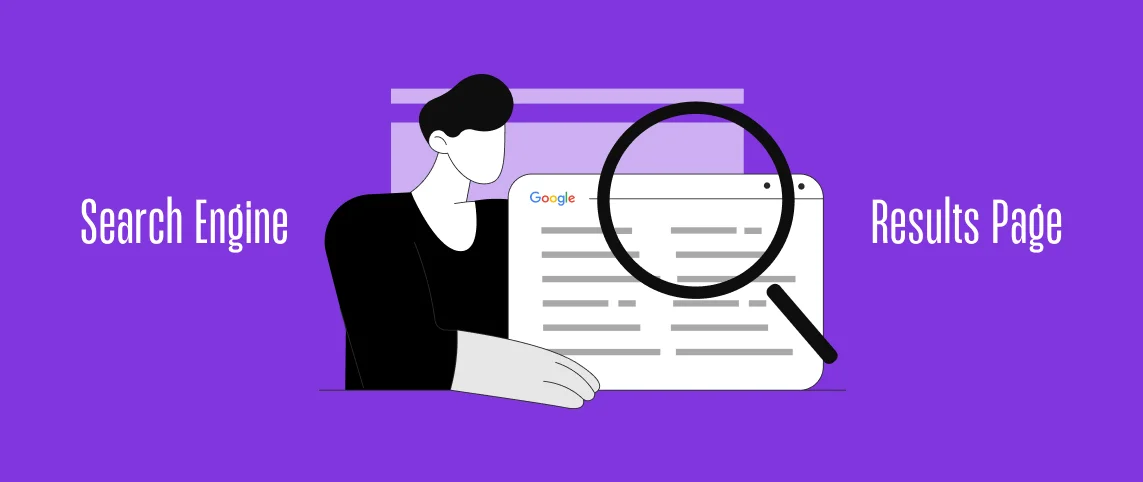
That page is called the SERP, short for Search Engine Results Page.
For SEO teams, the SERP is more than the place where rankings are displayed. It is a source of information about:
- what Google thinks a searcher wants
- which formats satisfy that intent
- which competitors currently own the visibility
- where an opportunity exists for your website
And that makes SERP analysis an important part of modern SEO.
What Is SERP?
A SERP, an acronym for Search Engine Results Page, is the web view that Google or any other similar search platform displays when you search something. Usually, it appears at the top of the page.
For example, search for “best CRM for small businesses.” You may see advertisements, organic results, comparison pages, reviews, videos, and other search features.
Again, when you search for “weather in Kolkata,” the page may look completely different. There is no universal SERP layout.
The results depend on the query, its intent, location, language, device, and the types of information Google believes will best answer the search.
So there is a more useful way to think about SERPs: A SERP is not just a ranking report. It is evidence of what Google believes satisfies a particular search.
What Can Appear On SERP?
A modern SERP can contain several different types of results.
Organic Search Results
These are unpaid listings that Google considers relevant to the searcher's query.
An organic result typically includes a page title, site information, and a snippet. Other elements may also appear depending on the page and query.
Organic visibility remains central to SEO. But it is only one part of the modern search experience.
Paid Search Ads
Paid advertisements can appear above or alongside organic results. They are not organic rankings. Paying for advertising does not buy a higher organic position.
That distinction is important when analyzing a SERP because an advertiser occupying the first screen does not necessarily represent your organic SEO competition.
Featured Snippets
For some searches, Google may display a highlighted answer from a webpage.
This can happen for questions such as:
- What is domain authority?
- How does link building work?
- What is search intent?
A featured snippet creates another visibility opportunity beyond the conventional organic listing.
Images And Videos
Some searches are inherently visual.
A query such as “how to change a tire” may produce videos, while “modern kitchen design” may produce image results.
That suggests the searcher's preferred format.
If the SERP is dominated by videos, producing another text-only article may not be the strongest way to compete.
Local Results
A query such as “wound care center near me” has a different intent from “what is wound care?”
The first indicates local or transactional intent. The second is informational. In short, the SERP reflects this difference.
AI Search Features
AI-generated search experiences have added another layer to SERP analysis.
Google has introduced AI Overviews and AI Mode, and in 2026 began rolling out Search Console reporting for visibility in these generative search experiences.
That does not mean traditional SEO fundamentals have disappeared.
It means visibility now has more surfaces.
The practical question for SEOs is no longer only: “Where does my page rank?”
Rather, the best question that you should ask in 2026 is:
“Where is my brand or content being surfaced when people search for this topic?”
Read The SERP Before You Read The Keyword
Pick the situation that best describes your keyword.
A. The SERP is mostly guides and explanations
→ Likely informational intent
B. The SERP is dominated by comparisons and reviews
→ Likely commercial investigation
C. Product pages and shopping results dominate
→ Likely transactional intent
D. Maps and local businesses dominate
→ Likely local intent
E. One brand or website dominates the results
→ Likely navigational or strong brand intent
Takeaway: Don't decide what to publish from the keyword alone. Let the SERP show you what kind of answer Google is currently rewarding.
Why Are SERPs Important For SEO?
The SERP gives you something that keyword tools cannot provide on their own. It shows you what is actually winning visibility for a specific query.
Keyword research may tell you that “link building” has substantial search demand.
The SERP tells you whether Google is currently favoring guides, service pages, studies, lists, videos, or something else.
That makes SERP analysis useful at almost every stage of SEO.
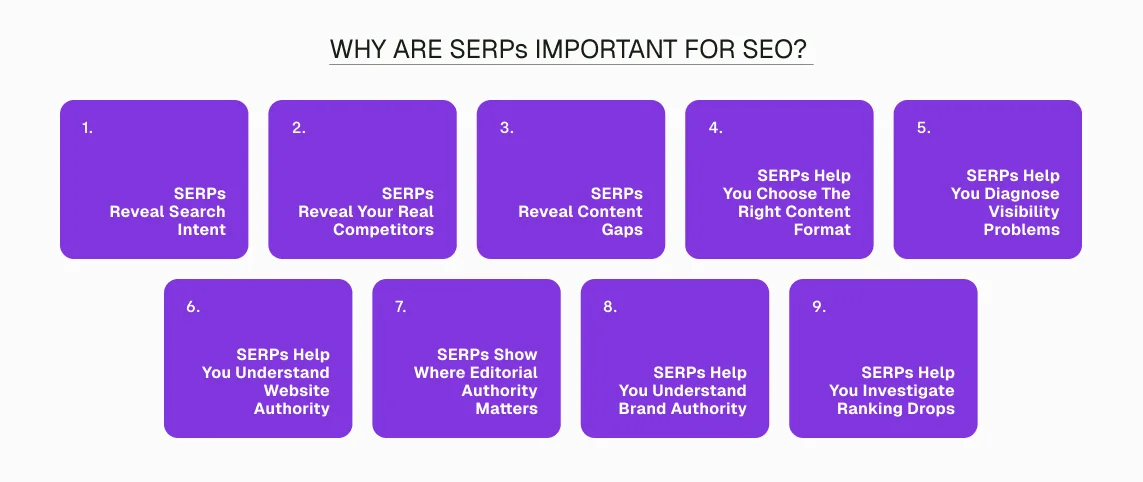
1. SERPs Reveal Search Intent
Search intent is one of the first things to investigate before creating or optimizing a page.
Suppose you want to rank for “email marketing.” Now look at the current results.
If most pages are beginner guides and educational resources, the query has a strong informational component.
Now search “best email marketing software.”
The SERP may be dominated by comparisons, reviews, software roundups, and product pages. That tells you something important:
The same topic can produce completely different SERPs depending on the searcher's intent.
This is why creating content around a keyword without studying the SERP first can waste considerable effort.
Blogger Outreach's SEO strategy approach follows the same principle: understand the search opportunity first, then decide what the page needs to accomplish.
2. SERPs Reveal Your Real Competitors
Your biggest SEO competitor isn't necessarily your biggest business competitor.
Your SEO competitor is the page competing for the same visibility.
That distinction matters.
A SaaS company might compete with another SaaS company commercially. But find that its actual SERP competitors are publishers, review sites, directories, or specialist blogs.
So when performing a SERP analysis, ask:
- Who owns the top positions?
- What type of websites are they?
- What type of pages are ranking?
- How comprehensive are those pages?
- What topics do they cover?
- What questions do they answer?
- What links point toward them?
- How strong is their brand presence?
This gives you a much more useful competitor set than a conventional business competitor analysis.
3. SERPs Reveal Content Gaps
A SERP can tell you what the current results cover, and what they don't.
Imagine the top-ranking pages all explain what link building is. But none of them explain how to judge whether a backlink is actually relevant.
That missing explanation could become your differentiation. Here, the goal isn't to produce a longer version of the same article. It is to produce something that earns its place in the SERP.
That might mean original research, examples, expert commentary, first-hand observations, a better framework, or simply an explanation that solves the reader's problem more effectively.
The “Would This Improve the SERP?” Test
Before adding another 500 words to an article, ask: Does this addition provide something the current results don't?
| If you're adding... | Ask yourself... |
| Another definition | Does the reader really need it? |
| More statistics | Are they current and relevant? |
| Another keyword | Does it improve clarity? |
| More paragraphs | Do they answer a real question? |
| An example | Does it make the concept easier to apply? |
| Original data | Does it reveal something competitors don't? |
| Expert insight | Does it add experience or interpretation? |
If the answer is “no” repeatedly, you probably need a better angle rather than more words.
4. SERPs Help You Choose The Right Content Format
The best format isn't always a 2,000-word blog post. Look at the results first. If Google consistently shows:
- Product pages → build or improve a product page
- Comparisons → create a comparison
- Tutorials → create a practical guide
- Videos → consider video content
- Local listings → strengthen local SEO
- Research → consider original research
The SERP is effectively giving you a brief. Follow it. But don't copy it. To clarify, your job is to understand the format users expect and then create a better resource within that format.
5. SERPs Help You Diagnose Visibility Problems
A ranking report tells you that a page moved from position 5 to position 13. A SERP analysis helps explain why that movement might have happened.
Perhaps:
- A competitor published a stronger resource.
- Search intent changed.
- The SERP gained new features.
- Your content became outdated.
- Your page no longer covers the topic as comprehensively.
- Competitors built stronger topical relevance.
- Your page has authority but lacks contextual relevance.
This is where metrics such as domain authority can be useful. But only as third-party SEO benchmarks.
Domain Authority is a predictive metric created by Moz. It is not a Google ranking factor.
So don't look at SERP and conclude: “That site has DA 80, so it must rank higher because of DA.” Instead ask:
“What combination of relevance, content quality, authority, links, brand signals, and page-level signals is helping this result compete?”
That is a much more useful SEO question.
6. SERPs Help You Understand Website Authority
There is another distinction worth making.
- A strong domain does not automatically make every page on that domain the best result for every query.
- A website can have a strong reputation while a particular page remains poorly aligned with the search intent.
That is why website authority should be considered as part of a broader picture rather than treated as a shortcut to rankings. Think of authority in layers:
| Website authority → topical relevance → page quality → contextual signals → search intent |
The strongest SEO strategies connect these pieces instead of obsessing over one score.
7. SERPs Show Where Editorial Authority Matters
Backlinks become more interesting when you stop counting them and start studying their context.
Suppose two pages have similar numbers of referring domains. One page has links from unrelated websites. Meanwhile, the other has mentions from respected publications that regularly cover the same subject.
Those backlink profiles are not equivalent. The second page has something that raw link counts don't capture well: editorial context.
This is why editorial authority deserves attention when analyzing competitive SERPs. So it is better to ask:
- Is the referring publication relevant?
- Is the link surrounded by relevant content?
- Does the publication have a genuine audience?
- Is the link editorially placed?
- Does the mention make sense to a reader?
- Does the source have credibility within the topic?
The Link Quality Filter
Imagine you have two potential backlinks. Which would you choose?
| Link A DA: 78 Topic relevance: Low Traffic: Unclear Placement: Generic guest post Context: Weak | Link B DA: 54 Topic relevance: High Traffic: Genuine niche audience Placement: Editorial article Context: Strong |
| My Honest Answer: Don't automatically choose Link A. A metric can help you shortlist a publisher. But it should not replace editorial judgment. On that note, you have to find out which link makes more sense as a genuine recommendation within the web. That is the difference between link acquisition and authority building. |
8. SERPs Help You Understand Brand Authority
Search visibility isn't only about individual URLs. Over time, users should begin associating your brand with the subjects you want to own.
That is where brand authority becomes relevant.
Imagine two websites publish equally good articles about “enterprise link building.” One is an unknown site with little recognition.
The other is a brand consistently mentioned, cited, reviewed, and discussed across relevant industry publications.
The second brand has an advantage that cannot be reduced to a single DA number. This is why modern SEO should think beyond: Keyword → URL → Ranking
The better thought pipeline should be:
| Topic → Content → Links → Mentions → Brand → Authority |
The SERP is one place where the result of that broader ecosystem becomes visible.
9. SERPs Help You Investigate Ranking Drops
A ranking drop shouldn't automatically trigger a link-building campaign. First, diagnose it. Check:
- Which URLs lost visibility?
- Which queries have declined?
- Did impressions fall?
- Did clicks fall?
- Did CTR change?
- Did competitors replace your page?
- Did the SERP format change?
- Did search intent shift?
- Did the content become outdated?
- Did your internal linking or site architecture change?
If several pages lost rankings at once, investigate the broader site before assuming the problem is a single backlink or keyword.
For a deeper troubleshooting framework, see our guide on why Google rankings drop.
The important lesson is simple:
Don't prescribe links before diagnosing the problem.
SERP VS. SEO: What's The Difference?
The two terms are related, but they aren't interchangeable.
| SERP | SEO |
| The search results page | The process of improving search visibility |
| Shows results for a query | Influences how your pages can perform |
| Changes from query to query | Requires ongoing work |
| Contains organic and other search features | Includes content, technical SEO, internal links, authority and more |
| Can be analyzed for opportunities | Uses those insights to improve performance |
Think of it this way:
SEO is the work. The SERP is where much of the outcome becomes visible.
Does SERP Ranking Still Matter In 2026?
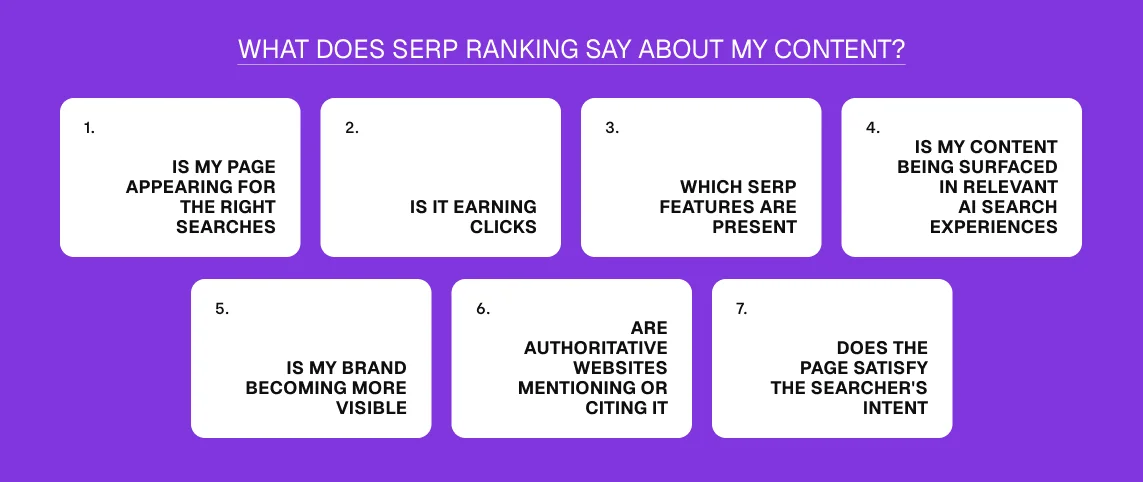
Absolutely. But “ranking” needs a broader definition. The old SEO conversation often focused on: What position is my page in?
In 2026, that question is still useful, but incomplete. So, you need to also ask:
- Is my page appearing for the right searches?
- Is it earning clicks?
- Which SERP features are present?
- Is my content being surfaced in relevant AI search experiences?
- Are authoritative websites mentioning or citing it?
- Does the page satisfy the searcher's intent?
Google Search Console provides useful evidence through impressions, clicks, CTR, and position data. However, these metrics become much more meaningful when combined with what you can actually see on the SERP.
What Does This Mean For Link Building?
This is where SERP analysis should change your link-building strategy. Suppose your commercial page is sitting at position 15. The instinct might be:
“We need 20 more backlinks.”
But that's not a strategy. That's a quota. First, study the pages occupying positions 1–10. Look for patterns. Do they have:
- Better topical coverage?
- Stronger internal linking?
- More relevant referring domains?
- More editorial mentions?
- Stronger brand recognition?
- Better alignment with search intent?
- More useful original information?
Only then decide where link acquisition can help. And this is where one of Blogger Outreach's case studies provides a useful lesson.
In our case study on high-DA backlinks that didn't improve rankings, the central lesson was that authority on paper isn't necessarily enough.
A strong backlink can still underperform when the surrounding strategy doesn't address relevance, context, and topical authority.
That distinction matters because it challenges one of the most persistent assumptions in link building: A higher authority metric does not automatically mean a better SEO outcome.
The better question is: Does this placement strengthen the page's position within its topic? That is a much harder question. And a much more valuable one.
The SERP Decision Tree
Your target page is stuck at #14. What do you do first?
Step 1: Check intent
Does your page match what the current SERP is rewarding?
No → Fix the content and format first.
Yes → Continue.
↓
Step 2: Check quality
Does your page provide something genuinely better or different?
No → Strengthen the resource.
Yes → Continue.
↓
Step 3: Check internal authority
Does the rest of your website adequately support this topic?
No → Build relevant supporting content and internal links.
Yes → Continue.
↓
Step 4: Check external authority
Do relevant, credible websites reference your content?
No → Consider a targeted editorial outreach campaign.
Yes → Continue.
↓
Step 5: Check the SERP again
If the page still isn't moving, reassess the competitive landscape rather than blindly increasing link volume.
| The principle you need to follow here: diagnose → improve → strengthen → measure. |
Common SERP Mistakes To Avoid
- Chasing Position #1 at Any Cost
The first result isn't automatically the best business outcome.
A page ranking fourth for a highly relevant commercial query may generate more valuable leads than a page ranking first for a broad informational keyword.
- Ignoring Search Intent
If Google consistently ranks comparison pages and you publish a generic definition, you're fighting the SERP rather than learning from it.
- Treating All Backlinks Equally
A hundred irrelevant links are not automatically better than a smaller number of relevant editorial references.
- Obsessing Over One Metric
DA, DR, traffic, referring domains, and rankings can all provide useful information.
None of them should become the entire strategy.
- Obsessing Over One Keyword
A page can rank for hundreds of related queries. Look at the whole query set in Search Console instead of judging a page on one phrase alone.
- Ignoring Non-Organic SERP Features
If images, videos, local results, AI features, or other elements dominate the page, a conventional organic listing is only one part of the visibility opportunity.
A Practical SERP Analysis Framework For 2026
Before publishing or optimizing an important page, record five things:
| Question | What to record |
| Intent | Informational, commercial, transactional, navigational or local |
| Format | Guide, comparison, product page, video, list, etc. |
| Competition | Who currently owns the SERP? |
| Authority | What makes those pages credible? |
| Opportunity | What can your page do better? |
Then make one final decision. Ask yourself: Can we create something that deserves to be there?
If yes, build it. If no, don't rush into content production simply because a keyword has search volume.
That is one of the biggest differences between keyword-driven SEO and SERP-driven SEO.
Primary Takeaways For SEO Experts In 2026
A SERP is no longer just a scoreboard showing who ranks first.
It is a snapshot of how a search engine interprets a query and what it believes will satisfy the person behind it.
For SEO professionals, that makes the SERP one of the most useful research tools available.
- Study it before creating a page.
- Study it when a page refuses to rank.
- Study it when competitors overtake you.
- And study it when search behavior changes.
- Most importantly, don't optimize only for a position.
- Optimize for relevance, usefulness, visibility, and trust.
That mindset also changes how you think about authority.
| The domain authority is a benchmark. Website authority is broader. Editorial authority is contextual. Brand authority is cumulative. Rankings are a visible outcome. But none of these concepts should be treated as a shortcut. |
The real SEO question is always:
Why should Google, and the searcher, choose this page over the alternatives? If you can answer that convincingly, your SERP strategy becomes a winning move.
Read Also: