


There was a time when link building alone could move almost any page to the first page of Google.
Today, that strategy rarely works for long. Still, many brands that work with Blogger Outreach want to invest thousands of dollars to earn quality backlinks.
However, the traffic they gain lasts only for weeks or months and then Google rankings drop. But why?
Especially when our publishers ensure that the links stay there, DR stays stable, and referring domains keep growing?
That is actually a major SEO loophole that we have tried to fix. What we do is shift our focus towards overall authority, not just a temporarily inflated authority gained through backlinks!
And that’s what Google endorses in 2026.
What Does Google Evaluate?
In 2026, Google asks questions like:
- Does this website genuinely deserve to rank?
- Is it the best resource for this topic?
- Is this brand consistently trusted across the web?
- Do users actually engage with this content?
- Does the backlink profile make editorial sense?
That shift has fundamentally changed modern SEO. Today, authority is built from dozens of interconnected signals.
This guide explains why rankings fluctuate even when backlinks appear strong. We will also focus on how Blogger Outreach helps businesses recover by combining digital PR, editorial authority, topical relevance, and strategic content, rather than chasing links alone.
The Biggest SEO Myth: "More Backlinks Equal Higher Rankings"
Backlinks remain one of Google's strongest ranking signals. But they're no longer enough.
Think of backlinks as recommendations. For starters, a recommendation gets you noticed. However, it doesn't guarantee you'll get the job.
Google evaluates whether those recommendations match everything else it sees.
| “If a website earns hundreds of backlinks but publishes shallow content, targets mismatched search intent, has weak internal architecture, or lacks brand credibility, those backlinks lose much of their influence.” ∼ Barsha, Creative Head, Search Engine Magazine |
That's why companies often experience a sudden Google rankings drop even after successful link-building campaigns.
The problem isn't necessarily the backlinks. It's everything surrounding them.
Why Google Rankings Drop Even With Quality Backlinks
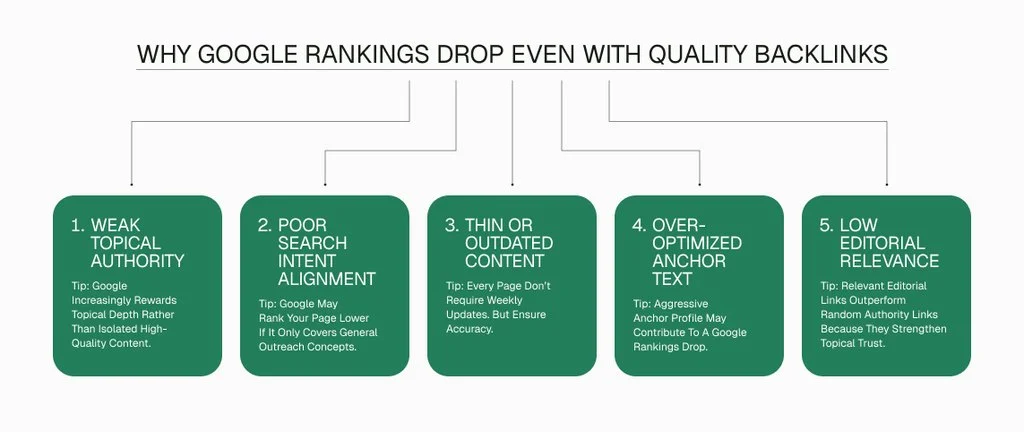
Several authority signals work together. When one becomes weak, rankings can fall despite a healthy backlink profile.
Weak Topical Authority
Years ago, publishing one excellent article could rank for competitive keywords. Now Google wants evidence that your website genuinely understands an entire subject.
For example: A website publishes one excellent article on Blogger Outreach. Meanwhile, a competitor publishes:
- Digital PR
- Link earning
- Editorial outreach
- Brand mentions
- HARO alternatives
- Authority building
- Content promotion
- Anchor text strategy
- EEAT
- Search intent
- SEO campaigns
Which site appears more authoritative?
Usually the second. Google increasingly rewards topical depth rather than isolated high-quality content.
What This Looks Like?
You rank well initially. But gradually, the competitors expand. Google gradually shifts authority toward websites demonstrating broader expertise.
How does Blogger Outreach address this?
Rather than building links toward isolated landing pages, Blogger Outreach helps clients strengthen entire topical clusters.
Editorial placements are planned to support content ecosystems rather than individual keywords, helping reinforce topical authority over time.
Poor Search Intent Alignment
Sometimes rankings fall because the page no longer satisfies what Google believes users want.
For instance, the search intent changes. Often, competitors improve. But recently, what’s happening the most is that user expectations are evolving.
Imagine someone searching:
"best blogger outreach services"
Google might now expect:
- pricing
- case studies
- comparison tables
- campaign process
- FAQs
- turnaround times
If your page discusses only general outreach concepts, Google may decide it no longer deserves a top position.
In other words, backlinks cannot compensate for poor relevance.
Signs search intent has shifted
The following table sums up what happens as search intent has shifted:
| Signal | What it means |
| CTR declines | Your title no longer matches expectations |
| Bounce rate increases | Users don't find what they expected |
| Competitors change format | Google is rewarding different content |
| Rankings slowly decline | Intent mismatch is growing |
Thin or Outdated Content
Google prefers freshness when topics evolve. This doesn't mean every page requires weekly updates. Rather, it means pages should remain accurate.
For instance: A guide about blogger outreach published in 2022 may still discuss:
- obsolete outreach tools
- outdated Google guidance
- discontinued platforms
- old pricing
- retired tactics
Even with excellent backlinks, Google may begin favoring newer resources.
Refreshing Content Is Better Than Replacing It
Authority grows when existing pages evolve. In the same vein, you can try useful updates like:
- new examples
- current screenshots
- industry statistics
- recent case studies
- revised strategies
- updated FAQs
Many businesses recover lost rankings without creating new URLs simply by improving existing content.
Over-Optimized Anchor Text
Anchor text still matters. But too much optimization has become redundant. Years ago, marketers aggressively targeted exact-match anchors like:
- blogger outreach services
- buy backlinks
- SEO outreach
Today that pattern looks unnatural. Google expects diversity. That said, healthy backlink profiles naturally include:
- brand mentions
- naked URLs
- partial match anchors
- generic anchors
- contextual references
An aggressive anchor profile may contribute to a Google rankings drop, particularly when combined with other authority issues.
Editorial-first outreach creates healthier link profiles
Because Blogger Outreach focuses on genuine editorial placements rather than manufactured link schemes, anchor text develops more naturally across campaigns.
That lowers optimization risk while improving contextual relevance.
Low Editorial Relevance
Not every backlink carries equal authority. Here’s a simple example to help readers understand the distinction. Consider two links.
One comes from: a respected marketing publication discussing digital PR. Another comes from: a general coupon website.
Both are dofollow. Both have similar authority metrics. So, which one helps more?
Usually the first.
Google increasingly evaluates context. Relevant editorial links outperform random authority links because they strengthen topical trust.
That is why outreach quality matters as much as quantity.
Brand Trust and Entity Signals Matter More Than Ever
Google doesn't only rank websites. It evaluates brands. Strong entity signals include:
- consistent business information
- editorial mentions
- expert citations
- author credibility
- branded searches
- digital PR
- reviews
- knowledge graph associations
- trusted references
These collectively help Google understand that a business exists beyond its own website. Brands investing only in backlinks often overlook these broader authority signals.
By contrast, outreach campaigns that earn genuine editorial coverage help reinforce brand recognition alongside SEO performance.
Weak Internal Linking Can Waste Link Equity
Many companies invest heavily in external links while ignoring their own websites.
Imagine earning links to one article.
If that article barely connects to related resources, much of its authority ends there. Strategic internal linking helps distribute authority toward:
- commercial pages
- service pages
- topical hubs
- supporting guides
Think of backlinks as electricity entering a building.
Internal links determine where that electricity flows. Without them, valuable authority never reaches the pages that need it most.
A Simple Internal Linking Framework
| Content Type | Links To |
| Industry guides | Service pages |
| Blog posts | Related educational articles |
| Case studies | Relevant solutions |
| Resource hubs | Supporting content clusters |
| Service pages | Proof assets and FAQs |
Technical SEO Can Quietly Undermine Great Backlinks
Sometimes nothing is wrong with your links. The issue lies elsewhere. Common technical problems include:
- slow Core Web Vitals
- crawling inefficiencies
- duplicate pages
- poor canonical implementation
- broken redirects
- indexing problems
- mobile usability issues
If Google struggles to crawl or interpret your pages, backlinks cannot deliver their full value. Authority and technical health work together.
Why Rankings Naturally Fluctuate
Not every ranking change signals a crisis. Google updates constantly. Normal fluctuations happen because of:
- algorithm refinements
- competitor improvements
- seasonal demand
- content freshness
- user behavior
- SERP layout changes
So, now the key question isn't: "Did rankings move?" It's: "Are they consistently declining over time?"
To sum up, sustained downward trends deserve investigation. Single-day fluctuations usually do not.
How To Diagnose A Google Rankings Drop
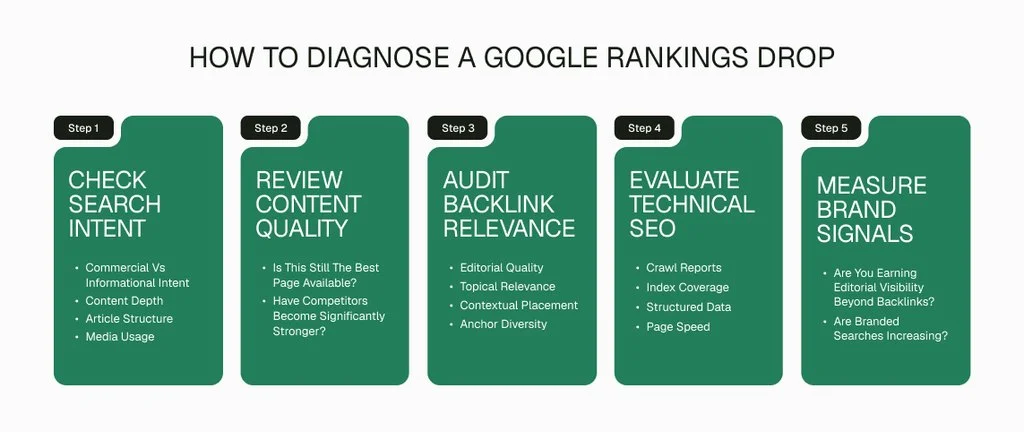
Rather than assuming backlinks are the issue, work through a structured review.
Step 1: Check Search Intent
Has Google changed what it ranks? Compare the current top ten results. Look for changes in:
- content depth
- media usage
- article structure
- commercial vs informational intent
Step 2: Review Content Quality
Ask:
- Is this still the best page available?
- Does it answer every major question?
- Have competitors become significantly stronger?
Step 3: Audit Backlink Relevance
Don't just count links. Evaluate:
- topical relevance
- editorial quality
- contextual placement
- anchor diversity
A smaller number of highly relevant editorial placements often contributes more than hundreds of loosely related links.
Step 4: Evaluate Technical SEO
Review:
- crawl reports
- index coverage
- page speed
- structured data
- mobile usability
- internal linking
Step 5: Measure Brand Signals
Search your brand.
Ask:
- Are people mentioning you?
- Do authoritative publications reference your business?
- Are branded searches increasing?
- Are you earning editorial visibility beyond backlinks?
These indicators increasingly contribute to long-term authority.
Recovery Strategies That Actually Work
Recovering from a Google rankings drop usually requires strengthening authority across multiple areas simultaneously.
Refresh Existing Content
Improve pages with:
- updated research
- better visuals
- practical examples
- expert insights
- expanded FAQs
Build Topical Clusters
Instead of publishing isolated articles, create connected resources covering every stage of a topic.
This strengthens topical authority while improving internal linking opportunities.
Prioritize Editorial Relevance Over Link Volume
A handful of genuinely relevant editorial placements can outperform dozens of unrelated backlinks.
That is why modern outreach increasingly focuses on publisher fit, audience alignment, and contextual placement rather than sheer numbers.
Diversify Anchor Text Naturally
Avoid forcing exact-match keywords into every campaign.
A healthier profile blends:
- branded anchors
- natural phrases
- partial matches
- URLs
- contextual mentions
Invest In Brand Visibility
Authority extends beyond SEO.
Editorial mentions, digital PR campaigns, expert commentary, and trusted publications all reinforce Google's understanding of your business.
The strongest backlink strategies increasingly function as brand-building strategies.
The Cost of Chasing Links Instead of Building Authority
Many businesses still purchase links individually.
That often leads to:
- inconsistent quality
- duplicate outreach
- agency markups
- fragmented campaigns
- little long-term authority
A more integrated approach combines:
- editorial outreach
- authority content
- topical strategy
- publisher relationships
- digital PR
- performance reporting
Because multiple objectives are addressed within the same campaign, businesses frequently reduce redundant spending while producing assets that continue supporting rankings long after the initial outreach ends.
Rather than paying separately for content creation, prospecting, publisher outreach, and relationship management, companies that work with integrated outreach partners often consolidate these efforts into a single strategy.
Depending on campaign scope and internal resources, that can translate into meaningful cost efficiencies while improving consistency and measurable outcomes.
Why Modern Authority Building Is Different
Authority today isn't built on a single ranking factor. It's built through alignment. That said, Google wants to see consistency between:
- excellent content
- relevant backlinks
- trusted brands
- editorial mentions
- topical expertise
- technical quality
- positive user experience
When those signals reinforce each other, rankings become significantly more resilient.
That is also why many Blogger Outreach campaigns today extend beyond acquiring links.
They are designed to earn relevant editorial coverage, strengthen topical authority, improve brand visibility, and support long-term organic growth.
All from a coordinated strategy rather than isolated SEO activities.
Take The Right Step Today
A Google rankings drop is rarely caused by backlinks alone. More often, it reflects a broader authority gap.
The websites that recover fastest are those that stop viewing SEO as a link-building exercise and start treating it as authority building.
They align search intent with comprehensive content, earn editorially relevant mentions, strengthen internal architecture, invest in brand trust, and maintain technically sound websites.
For organizations looking to build sustainable organic visibility, that shift is where the greatest returns come from.
When outreach, content, digital PR, and technical SEO work together instead of operating in silos, rankings become more stable, authority compounds over time, and marketing spend works harder.
The goal isn't simply to regain lost positions. It's to build the kind of authority that makes future fluctuations in rankings less disruptive. And much easier to recover from.