



| Case Study At A Glance | |||
| Metric | Before Blogger Outreach | After Blogger Outreach | Change |
| Primary keyword ranking | #17 | #4 | ↑ 13 positions |
| Organic traffic | 188 | 2,164 | ↑ 1,051% |
| Top 10 keywords | 23 | 61 | ↑ 165% |
| Referring domains | 120+ | — | Already strong |
| High-DR backlinks | 15+ | — | Authority wasn’t the issue |
| Strategy | DA-focused | Relevance-focused | Major shift |
A strong backlink profile does not always translate into strong rankings. FinanceReference.com had 120+ referring domains and multiple high DA backlinks. Yet its primary keyword was still stuck at #17.
The site already had a solid SEO foundation, with a DA of 60 and 188 estimated organic visits. But the issue was not a lack of authority. It was where that authority came from and how relevant it was to the page we wanted to rank.
That’s where Blogger Outreach changed the strategy: less focus on DA and more focus on relevance, context, and topical authority.
The result was a clear turnaround. The target keyword moved from #17 to #4, while the number of pages ranking in the Top 10 increased from 23 to 61.
And this was not unique to FinanceReference.com. We saw similar opportunities across established clients such as SmallBusinessCoach.org (DA 70) and GraphicSprings.com (DA 63).
Here’s how we changed the strategy. We will also take a deep dive into what other brands with strong backlink profiles can learn from it.
The Problem With A High DA Link
High DA backlinks can appear to be a strong SEO asset. But domain authority alone does not tell you how valuable a link is for a specific page.
For FinanceReference.com, the target page already had 120+ referring domains, including 15+ high-DR links.
Yet the primary keyword remained at #17. Competitors with fewer referring domains were ranking higher. The gap was not authority. It was relevance.
A Strong Link On Paper
A site with DA 90 is supposed to be ideal, right? In a conventional link-building report, it could have been a clear differentiator. But there is one problem: the linking website had little topical connection to the target page.
The link added domain-level authority. But it did not necessarily strengthen the page’s relevance to the search query we were targeting.
And this was exactly the kind of distinction Blogger Outreach had to start making across established campaigns.
A site such as SmallBusinessCoach.org already had a DA of 70 and an estimated traffic of 581.
Simply adding more high DA backlinks would not necessarily address a ranking gap if the new placement had little connection to the targeted topic.
The question was becoming less about how authoritative the linking website was and more about whether its authority was relevant to the page receiving the link.
But Rankings Barely Moved
The rankings made the problem harder to ignore.
FinanceReference.com had 120+ referring domains and high DA backlinks. Yet the primary keyword stayed at #17.
More links were not solving the problem either. Adding another high-authority domain without improving relevance was producing increasingly smaller gains.
This was not simply a FinanceReference.com problem.
We encountered the same strategic question while working with established sites such as GraphicSprings.com (DA 63, 331 traffic) and TheTechPortal.com (DA 58, 300 traffic).
Their domain-level metrics already showed that authority was present. The bigger opportunity was understanding whether the authority being built was connected to the topics and pages that mattered most.
Therefore, the question we should be asking is no longer “How can we get more authoritative links?”
Instead, it’s time to ask:
“Are we building the right kind of authority?”
The Challenges Of Growing From A Strong SEO Baseline
FinanceReference.com did not need a basic link-building campaign. The site already had the links, authority, and SEO foundation that many brands spend years building.
For Blogger Outreach, the challenge was different: we had to identify what was missing rather than simply adding more of what the site already had.
And this was an important distinction because the same situation appeared across several established sites in the Blogger Outreach portfolio.
A strong SEO baseline changes the nature of link building. When a site already has dozens or hundreds of referring domains, simply increasing the number of links is unlikely to address every ranking problem.
1. A Strong Backlink Profile Wasn’t Translating Into Rankings
The first challenge was understanding why FinanceReference.com’s already strong backlink profile was not producing stronger rankings.
The target page had 120+ referring domains, including 15+ high DA backlinks. Again, there were links earned through previous outreach campaigns.
At first glance, adding more referring domains seemed like the obvious next step. But the ranking data suggested otherwise. New links were not producing the same movement they might have delivered earlier in the page’s growth.
For Blogger Outreach, this meant looking beyond the number of referring domains. We had to understand:
- Which links were helping
- Which were not contributing
- What kind of authority the page was still missing
The same principle applied when assessing other established sites. Noobpreneur.com, for example, already had a DA of 54 and an estimated 301 in traffic. CabMotors.com had a DA of 61 and 367 in traffic.
The point was not that these sites lacked backlinks. The challenge was determining whether the links being built were contributing to the pages and topics that needed greater visibility.
The goal was no longer to build more links. Rather, the objective was to find the links that could make a meaningful difference.
2. Authority Was Being Measured Too Broadly
The second challenge was how authority was being evaluated. Metrics such as DA and DR made it easy to compare websites.
But they did not tell us whether a particular placement would strengthen the target page.
A DA 90 website could be highly authoritative and still have little connection to the topic. Meanwhile, a lower-DA website with strong topical relevance could provide a more useful contextual signal.
Blogger Outreach, therefore, had to move from domain-level authority to page-level relevance.
We needed to evaluate the publication’s topic, the surrounding content, the placement context, and its relationship to the target page.
This made prospecting more selective.
The challenge was not finding websites with high metrics. It was finding websites where authority and relevance worked together.
This distinction mattered across the broader client base too.
For example, TravelDailyNews.asia had a DA of 51, while FinanceReference.com had a DA of 60. But the difference in DA alone did not tell us which publication would be more valuable for a particular target page.
The relevant question was always: Does this website, this page, and this placement make sense for the topic we are trying to strengthen?
3. Competitors Were Building More Relevant Authority
The third challenge became clear when we compared FinanceReference.com’s backlink profile with the pages ranking above it.
Competitors did not necessarily have dramatically stronger backlink profiles.
Instead, many of their links were more closely connected to the topics they were trying to rank for.
Their placements appeared across relevant publications, topic-specific articles, and surrounding content that naturally supported the subject of their target pages.
That gave Blogger Outreach a different benchmark to work with.
We could not simply compete on the number of links or the highest DA available. Rather, we had to understand where competitors were earning relevant authority and what those links had in common.
This was also why a site like Blog.PenelopeTrunk.com, with a DA of 62 and an estimated traffic of 553, could be useful as a reference point.
The metric itself was not the strategy. The value came from understanding the type of authority, the topical environment, and the contextual relevance available in a publication.
This shifted the campaign from broad link acquisition to a more focused question:
What kind of authority does this page need to compete?
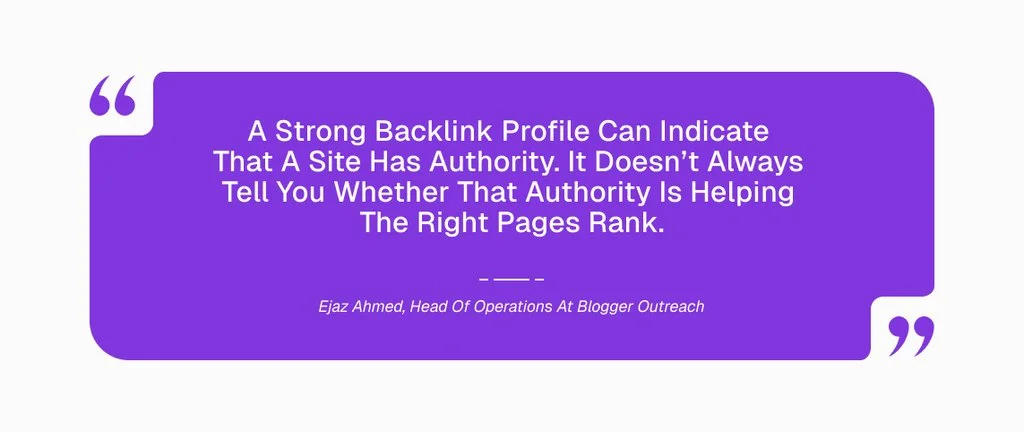
He further emphasized:
“We had to look more closely at the relevance of each link and how it supported the target page.”
From High DA To High Relevance: The New Link-Building Strategy
Instead of continuing the same outreach process and hoping that more high-DA links would eventually improve rankings, Blogger Outreach rebuilt FinanceReference.com’s campaign around five areas:
- Identifying which existing links were actually helping
- Finding more relevant prospects
- Improving the context of each placement
- Strengthening the target page
- Building topical authority around it
The turnaround did not result from a single large change. Instead, it came from making several smaller changes that worked together.
1. Audit the Links That Were Already Working
Before building new links for FinanceReference.com, Blogger Outreach reviewed the site’s existing links.
The objective was simple: understand what was working before deciding what to build next.
The target page had 120+ referring domains. However, not every link was equally useful.
We grouped existing links based on:
- Domain Authority
- Topical Relevance
- Placement Type
- Surrounding Content
- The Relationship Between the Linking Page and the Target Page
Finding The Useful Patterns
The audit showed that some of FinanceReference.com’s high DA backlinks came from pages closely related to the target topic.
These placements were not always from the websites with the highest DA. However, they had stronger topical connections and more natural contextual relationships with the target page.
At the same time, several high-DR links had produced little visible movement.
That gave us an important direction:
Stop Treating Every Referring Domain As Equal.
This became an important principle beyond FinanceReference.com as well.
When reviewing established sites such as SmallBusinessCoach.org, GraphicSprings.com, and TheTechPortal.com, the same question became useful: which existing links were actually supporting the pages that mattered?
What Changed?
We used these findings to set clearer link-building criteria.
Instead of asking whether a website had a high DA or DR, we asked a simpler question:
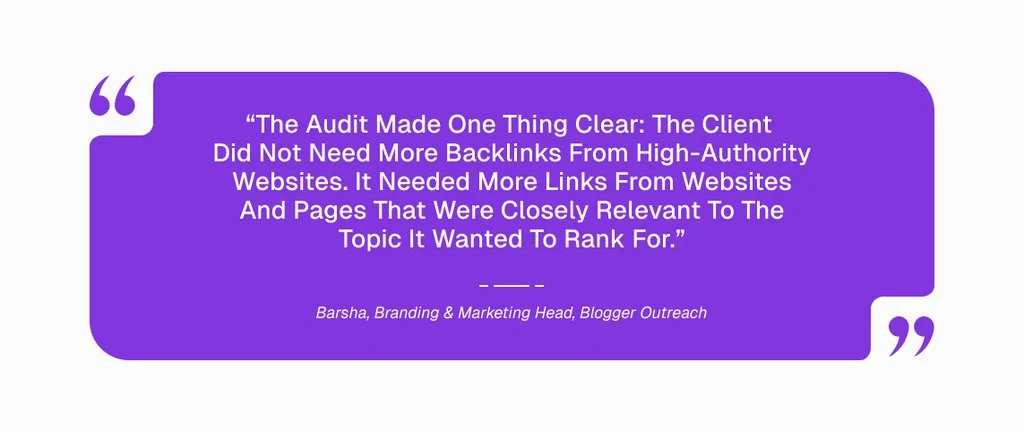
“Would a link from this website be relevant to the target page?”
This also helped us avoid repeating the same type of placements that had already delivered limited results.
Result: The campaign moved from a volume-led approach to a relevance-led one, giving the outreach team a much clearer definition of a valuable prospect.
2. Rebuild Prospecting Around Relevance
Once the existing links had been audited, the next challenge was to find websites that met the new benchmark.
Previously, a prospect could qualify largely because of strong domain metrics. But now, relevance became a primary qualification criterion.
Building A New Prospecting Framework
Blogger Outreach reviewed potential websites based on several factors:
- How closely the website’s main topic matched the target page
- Whether it regularly published content around the client’s subject
- The relevance of the specific page where the link could appear
- Whether the target page could be referenced naturally
- The overall quality and credibility of the publication
This immediately reduced the size of the prospect pool.
That was a problem at first.
A relevance-first approach meant that many websites with attractive DA/DR numbers were no longer suitable.
The team had fewer prospects to work with. And outreach could not simply compensate by sending more pitches.
The Solution
Instead of expanding the criteria again, we expanded the search depth.
The team looked for niche publications, industry blogs, specialist websites, and topic-specific content that had stronger connections to the target page.
Prospects were also evaluated at the page level rather than only at the domain level. The result was a smaller but more qualified prospect list.
This approach also gave Blogger Outreach a repeatable framework for other established clients.
A site like Noobpreneur.com, with a DA of 54 and 301 in traffic, did not need to qualify prospects simply because they had a higher DA than the site itself.
The focus was on whether the placement could meaningfully contribute to the target topic.
Result: Outreach became more selective, and each prospect had a clearer reason for inclusion. This improved the quality of opportunities available for the campaign.
3. Prioritize Contextual Editorial Placements
Finding a relevant website was only half the challenge.
The next question was how the backlink would appear on that website.
A relevant website could still provide a weak placement if the link was forced into unrelated content or placed where it had little contextual value.
Moving Beyond “A Link On A Relevant Website”
Blogger Outreach therefore prioritized editorial placements where the target page could be referenced naturally within the main content.
Instead of creating an article solely because it could include the FinanceReference.com link, the team looked for topics where the target page could genuinely add value for the reader.
For example, if a prospect was publishing an article closely related to the client’s subject, the outreach team looked for a relevant section where the client’s page could support, expand, or substantiate the discussion.
This also influenced anchor-text selection.
Anchors were chosen to fit the sentence and surrounding topic, rather than forcing exact-match keywords into every placement.
A Challenge We Encountered
The relevance-first approach meant that some publishers were harder to secure.
Highly relevant websites were often more selective about the content they accepted and the external resources they referenced.
That created a practical challenge for the campaign: the best prospects were not necessarily the easiest prospects to acquire.
The solution was to focus on editorial fit rather than link insertion.
Content pitches were built around what would genuinely benefit the publication and its readers.
This also made the strategy more sustainable for other Blogger Outreach clients. Whether the site was CabMotors.com with a DA of 61 or TheTechPortal.com with a DA of 58, the objective remained the same. Earn placements where the link made sense within the content.
Result: The campaign began producing placements where relevance existed at three levels: the website, the article, and the specific context of the link.
4. Strengthen The Page Before Scaling Outreach
While improving the backlink strategy, Blogger Outreach also identified another issue:
More relevant links would have limited impact if the target page itself was not strong enough to compete.
The page already had authority. What it needed was stronger alignment with the search intent and topic it was targeting.
Improving The Target Page
Before significantly increasing outreach volume, the team reviewed the FinanceReference.com page against the search results and competing pages.
The review focused on:
- Did the page directly address the search intent?
- How many important subtopics were covered?
- Did the content have enough depth compared with competitors?
- Were relevant supporting terms and concepts naturally covered?
- Did internal links support the page’s importance within the site?
The objective was not to add content simply to make the page longer.
It was to make the page more complete and more useful for the query.
Why Was This Step Important?
This also solved an operational problem.
If outreach was scaled too early, we would have been sending stronger authority to a page that was still leaving ranking opportunities on the table.
So, rather than immediately increasing the number of placements, we first strengthened the page, then resumed outreach.
This created a stronger foundation for the remaining link-building work.
Moreover, it helped prevent outreach from becoming a standalone activity disconnected from on-page SEO.
Result: The target page was better positioned to leverage the new authority, giving the relevance-focused outreach a stronger page to support.
5. Build Topical Authority Around The Target Page
The final step was to move beyond the target page itself.
FinanceReference.com had already built substantial domain authority. Yet the ranking challenge showed that authority needed to be more closely connected to the targeted topic.
Creating A Topical Support System
Blogger Outreach identified related topics surrounding the primary keyword and mapped opportunities to build authority across that broader subject area.
Instead of treating the target page as an isolated URL, we looked at the surrounding topic:
- What related questions were users searching for?
- Which subtopics were competitors covering?
- What supporting pages already existed on the client’s site?
- Which pages could naturally link back to the target page?
- Where could external authority strengthen the broader topic?
This allowed the campaign to support the target page from multiple directions.
From One Page To A Topic
The outreach strategy was then aligned with this topical structure.
Relevant external placements supported not just the primary keyword but the wider subject area around it. This was particularly important because FinanceReference.com was already strong at the domain level.
Building another disconnected high DA backlinks would add to an existing strength. On the contrary, building relevant authority around the target topic addressed the actual gap we had identified.
And this was the broader lesson we were seeing across other established Blogger Outreach clients.
For example, Blog.PenelopeTrunk.com had a DA of 62 and 553 in traffic. While SmallBusinessCoach.org had a DA of 70 and 581 in traffic. Their domain-level authority gave them a strong foundation. The opportunity was to make the authority they built more useful for the specific topics and pages they wanted to grow.
Result: The campaign developed a more connected authority profile around the target page. Combined with the improved page and relevance-focused placements, this helped the primary keyword move from #17 to #4. Meanwhile, the number of pages ranking in the Top 10 increased from 23 to 61.
What Happened When We Changed The Strategy?
The biggest change was not simply the number of links FinanceReference.com acquired. It was the quality and relevance of the authority being built around the target page.
The campaign moved away from treating DA as the primary measure of a valuable backlink and toward evaluating the relevance of the website, page, content, and placement.
That shift produced a measurable difference.
| Metric | Before | After |
| Primary keyword | #17 | #4 |
| Organic traffic | 188* | 2164 |
| Top 10 keywords | 23 | 61 |
| Top 5 keywords | X | X |
*Estimated organic traffic baseline from the verified SEMrush traffic checker figure supplied for FinanceReference.com.
More importantly, FinanceReference.com was not the only site where this thinking became relevant.
Across the broader Blogger Outreach client portfolio, established sites such as SmallBusinessCoach.org (DA 70), Blog.PenelopeTrunk.com (DA 62), GraphicSprings.com (DA 63), CabMotors.com (DA 61), and TheTechPortal.com (DA 58) demonstrate the same underlying reality.
Therefore, we can conclude that having authority is not the same as directing that authority toward the pages and topics that need to rank. That is where a relevance-first approach creates a different opportunity.
Our Solution: What Actually Makes A Backlink Powerful?
FinanceReference.com did not have a backlink problem in the traditional sense.
It had 120+ referring domains, multiple high-DR, and high DA backlinks. What it lacked was a strong enough connection between that authority and the topic it wanted to rank for.
The turnaround came from changing the way we evaluated backlinks.
A powerful backlink is not simply one that comes from a website with a high DA. It is one that comes from a relevant website, points to relevant content, fits naturally within the surrounding context, and supports a page that is strong enough to compete.
That shift took FinanceReference.com from #17 to #4.
And it is the same principle Blogger Outreach can apply when working with established sites that already have a strong backlink profile. If you are also not getting the rankings you expect, contact us today!
The Results
Here’s what the new strategy delivered.
| Metrics | Before | After |
|---|---|---|
| Top 10 Keywords | 23 | 61 |
| Link-Building Strategy | DA-focused | Relevance-focused |
The key takeaway is that a strong backlink profile does not always lead to better rankings. For FinanceReference.com, shifting the focus from high DA to relevant, contextual links helped create a stronger connection between the backlinks and target pages. The lesson is simple: link quality is not just about authority; it is about relevance and context.