

Imagine this scenario. A buyer once searched for “best CRM,” opened several tabs, checked reviews, and searched again for pricing. After that, the same buyer can give this whole brief to Google AI Mode:
| “Compare three CRMs for a 15-person B2B agency. We need email automation, simple reporting and a monthly plan below $500. Show the trade-offs and use current prices.” |
AI Mode can split that request into smaller searches and combine the findings. For website owners, ranking for “best CRM” may no longer be enough. A brand must also answer hidden questions about price, integrations, limitations, and trust.
This is why we see AI Mode as more than a new search layout. It questions can Google find, understand, and confidently use your brand’s evidence while building an answer?
What Is AI Mode?
AI Mode is Google’s conversational, AI-powered search experience for complex and multi-part questions. It can:
- divide one prompt into subtopics
- search those topics at the same time
- generate a combined response
- provide links for further reading
Users can then ask follow-up questions while keeping the earlier context. Google calls it its “most powerful AI search experience.”
It also warns that generated answers can make mistakes, misread content or miss context. Google’s AI Mode help page provides current availability and operating guidance.
By May 2026, Google reported one billion monthly AI Mode users. Moreover, Google said query volume had more than doubled each quarter since launch. Sure, these are Google’s figures. But they show this is no small experiment.
| AI Mode In 30 Seconds Handles questions that once required several searches. Accepts text, voice, images, files and URLs where supported. Uses query fan-out to explore related subtopics. Provides a generated response with web links and follow-ups. May personalize answers when the user enables relevant settings. |
How To Access And Use AI Mode
Google currently lists three common access routes:
- Visit google.com/ai.
- Run a Google search and select the AI Mode tab.
- Open the Google app and tap AI Mode on the home screen.
However, note that availability varies by country, language, account, age and feature. Check Google’s live list rather than a copied country list.
Once inside, type or speak a question. You can also upload an image or file, or ask about a page by pasting its URL.
You can also use follow-ups to add constraints. Each refinement can change the information Google needs and the sources it selects.
How Does Google AI Mode Work?
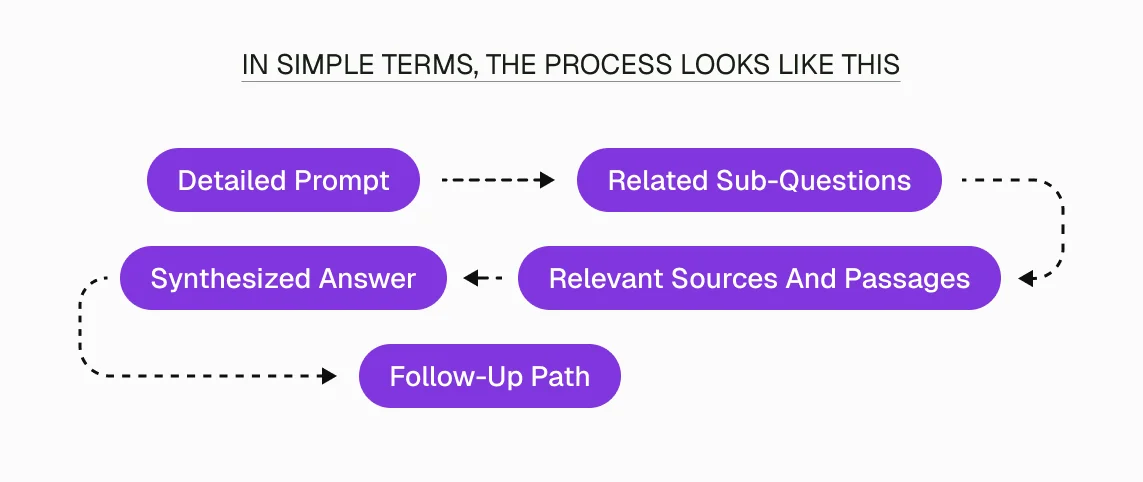
The most important confirmed mechanism is query fan-out.
As Google describes it, AI Mode breaks down a question into subtopics and runs multiple searches for each one. And it does that simultaneously across several data sources. It then combines the findings into a response.
For deeper research, Google says Deep Search can extend the process across hundreds of searches. Google’s 2025 AI Mode update describes its reasoning, multimodal, Deep Search and agentic features.
For instance, the CRM prompt (“best CRM”) may create searches around:
- CRM pricing for 15 users;
- email automation limits;
- reporting and contract limits;
- agency use cases and customer reviews;
- migration or onboarding.
Several pages can therefore support different parts of one answer. A page outside the top results for the broad phrase may be relevant to a fan-out query.
Conversely, the top-ranking page may not support a specific price, risk, or use-case question.
However, Google does not publish the exact fan-out queries or a complete list of citation-selection signals. So, treat tools that estimate them as research aids, not a view into Google’s final process.
AI Mode VS AI Overviews VS Traditional Search
| Point | Traditional Search | AI Overview | AI Mode |
| Main experience | Results page with links and search features | Generated summary within a standard results page | Conversational AI search experience |
| Best suited to | Navigation and research | A quick explanation or starting point | Complex comparisons, planning and multi-step questions |
| Follow-ups | Usually require another query | Can lead into deeper AI interaction | Central to the experience |
| Inputs | Mostly text, voice and visual search features | Based on the search query | Text, voice, images, files and URLs where supported |
| Source opportunity | Rank as a result | Support the summary with a link | Support one or more parts of a generated response |
| Main business risk | Lower organic position | A quick answer may satisfy the user | More of the research journey may remain inside Google |
An AI Overview adds an answer to traditional Search. AI Mode makes the conversation the main workspace.
Does AI Mode Reduce Website Traffic?
It can reduce clicks when Google answers the question completely. But in reality, it is hard to address every query or format.
According to a recent analysis by the Pew Research Center, precisely 68,879 Google searches were collected in 2025.
The report also found that most people get answers by clicking the AI summary. In fact, after checking the AI mode, users clicked a traditional result in 8% of visits, compared with 15% when there was no summary.
A source inside the summary received a click in only 1% of visits. Meanwhile, this study examined AI summaries, not the full 2026 AI Mode experience. So its numbers should not be presented as an AI Mode CTR benchmark. Read Pew’s methodology and findings.
Google offers a different view. It says total organic click volume has remained relatively stable and describes clicks from AI search as higher quality. In other words, the visitors are less likely to return immediately to the results. Google explains its position here.
It depends on what the page offers. A basic definition page might lose the click. To clarify, if the answer fits in two sentences, people don't need to visit.
But pages with real depth still pull visitors in. The main elements of attraction include detailed comparisons, original research, tools, or actual products and services people need to see, use, or buy.
The Point Other AI Mode Guides Miss: Authority Must Work As A System
Many guides stop at just saying “write clear content and cover more questions.” That is incomplete.
AI Mode can use several sources while handling one decision. Therefore, the page, topic, publisher references, and brand identity must support one another.
This connects directly with the authority model we have been building at BloggerOutreach.
| Authority layer | Its job in AI-powered Search | Failure pattern |
| Website authority | Makes the site technically accessible, understandable, and trustworthy | The page is blocked, unindexed, slow, or poorly connected |
| Content and topical authority | Supplies accurate answers across the user’s main question and related needs | One thin page targets the keyword but misses the decision |
| Editorial authority | Provides independent judgment from credible publications | Mentions appear on sites that publish anything for anyone |
| Link authority | Creates a relevant handoff from a particular source page to the right destination | A high-DA domain links from a weak page or to the wrong URL |
| Brand and entity authority | Helps systems connect the business, people, products and claims consistently | Conflicting descriptions or little third-party corroboration |
Our explanation of what Google means by website authority makes the key distinction evident:
- Authority is not a public Google score.
- Domain Authority is Moz’s comparative metric.
- However, it is not a guarantee of rankings or AI citations.
The same applies to external placements. Our Link Authority vs Domain Authority analysis shows why a domain score cannot judge the connection between one source page, placement, and destination.
That connection can often matter more than link equity. A relevant article gives Google another independent source that associates a brand with a subject.
An accurate unlinked mention may support recognition. Although it does not pass link equity like a crawlable link.
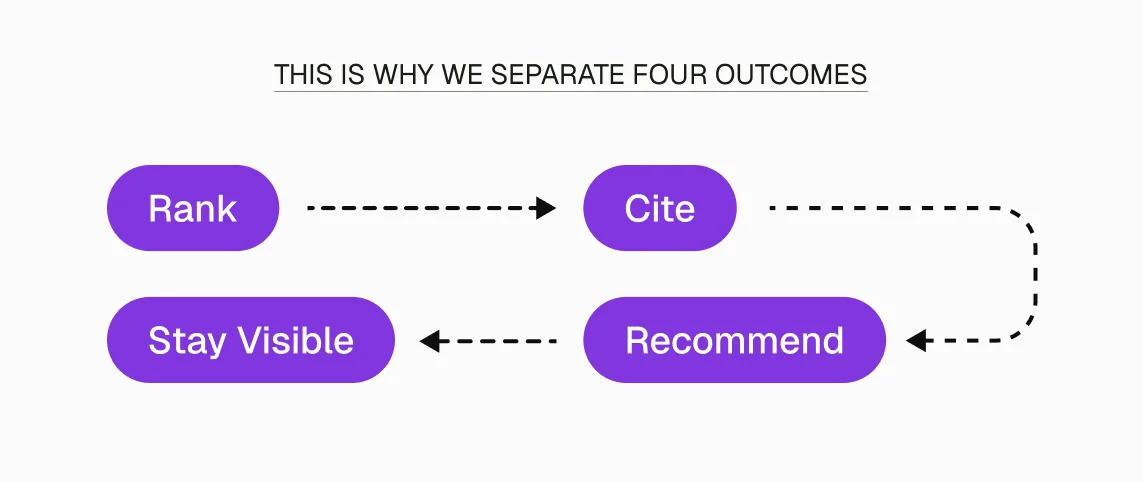
This is why we separate four outcomes:
Our Takeaways:
A page can rank without appearing in an answer. Meanwhile, a brand can be mentioned without a citation, or cited without being recommended.
An appearance may also change with the prompt, context, or available sources.
To sum up, Search Authority is the evidence system behind those outcomes. It does not collapse them into one score.
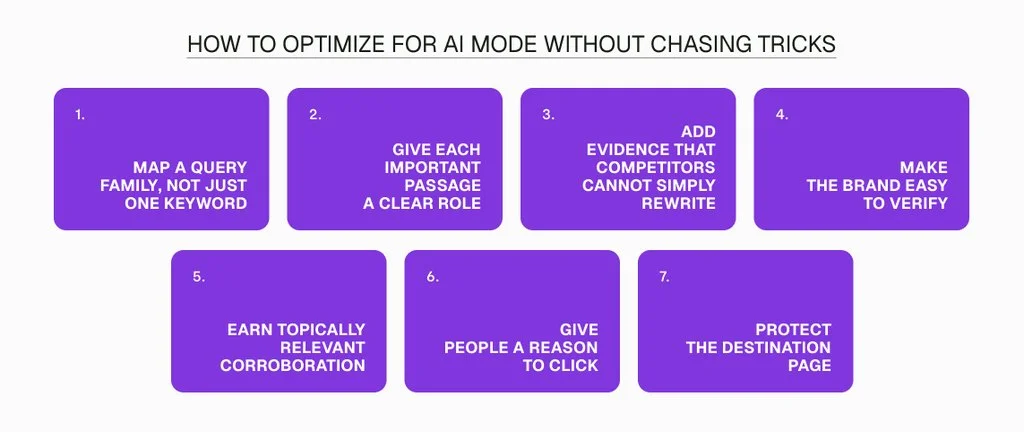
How To Optimize For AI Mode Without Chasing Tricks
Google’s official guidance is reassuringly unexciting. A supporting page must be indexed and eligible to appear in Search with a snippet.
There are no extra technical requirements, no special AI schema, and no required “LLM file.” At the same time, the existing SEO fundamentals still apply. Google Search Central’s AI features guidance confirms this.
To appear in the AI overview, you need to incorporate those fundamentals at the level AI Mode now demands.
1. Map A Query Family, Not Just One Keyword
Start with a real customer decision. List the definitions, comparisons, constraints, objections, risks, and next steps within it.
Build a main resource and supporting articles where deeper treatment helps. Also, note that descriptive internal links show users and Google how the ideas relate.
2. Give Each Important Passage A Clear Role
A section should answer one recognizable question without depending on five earlier paragraphs. Simply, use descriptive headings, direct openings, short explanations, useful tables, and concrete examples.
To sum up, your content needs to be extractable. Meanwhile, “Extractable” does not mean robotic. So the tip is to write for a person first. Then remove vague wording that hides the answer.
3. Add Evidence That Competitors Cannot Simply Rewrite
Original value may come from:
- First-Party Data With A Sample, Date And Method;
- An Expert’s Named Observation;
- Genuine Test With Screenshots;
- A Real Case Study;
- Specific Decision Framework;
- Any Useful Calculator Or Template;
- An Honest Account Of Where An Approach Failed.
| Pro Tip: Label company data, client-reported results, interpretation, and prediction correctly. At the same time, you need to establish E-E-A-T. That said, E-E-A-T is the proof behind the claims, not an author-box decoration. |
4. Make The Brand Easy To Verify
Keep company, service, and leadership details consistent across the site and credible profiles. Then, identify the writer or reviewer, cite primary evidence, and date material updates.
The key takeaway here is that strong brand authority grows when the business’s own information and independent references tell the same story.
5. Earn Topically Relevant Corroboration
Do not begin outreach with “we need 20 DA 60 links.” Instead, begin with the claim, topic or resource that deserves outside attention.
A specialist cybersecurity publication discussing a security tool can provide cleaner context than a general website with a larger third-party metric. The publication’s standards also matter.
Our guide to editorial authority explains why selectivity and topical focus are more meaningful than link volume alone. Disclose and qualify paid placements correctly. Lastly, never present outreach as a guaranteed route into an AI answer.
6. Give People A Reason To Click
If a page's full value fits inside Google’s summary, the user may not need it.
So content developers should offer depth the answer cannot carry alone. For instance, a full dataset, tool, detailed comparison, current inventory, original media, template or expert diagnosis.
7. Protect The Destination Page
Authority cannot compensate indefinitely for outdated content, changed intent, technical faults, or a poor user experience. These are among the reasons Google rankings drop despite strong backlinks.
Refresh the destination and confirm that it still matches the searcher’s need before scaling outreach.
The AI Mode Search Authority Check
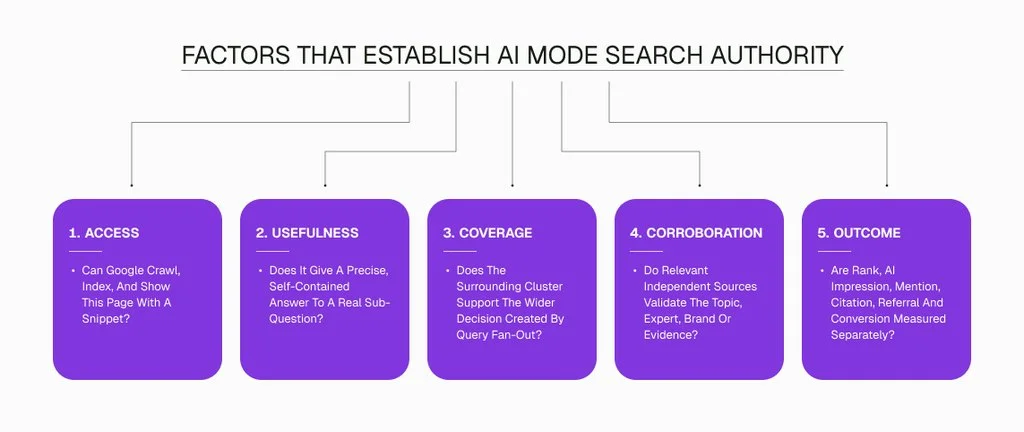
Use these five questions before approving a page or campaign if you want your content to appear in the AI overview section:
Factors That Establish AI Mode Search Authority:
- Access: Can Google crawl, index, and show this page with a snippet?
- Usefulness: Does it give a precise, self-contained answer to a real sub-question?
- Coverage: Does the surrounding cluster support the wider decision created by query fan-out?
- Corroboration: Do relevant independent sources validate the topic, expert, brand or evidence?
- Outcome: Are rank, AI impression, mention, citation, referral and conversion measured separately?
If Access fails, fix the site. If Usefulness or Coverage fails, improve the content. Again, if Corroboration fails, build editorial relationships. Lastly, when Outcome fails, repair the measurement plan.
Also, this order of things is important. Outreach can amplify a page that deserves attention. However, it cannot turn weak content into strong evidence.
How To Measure AI Mode Visibility In 2026
Google completed the worldwide rollout of its Generative AI performance report in Search Console on August 31, 2026. It reports impressions from AI Overviews and AI Mode and lets site owners analyze pages, countries, dates, and devices.
This closes part of the reporting gap. But the report does not list every prompt, passage or citation.
| Measure | What it tells you | Limitation |
| Organic rank | Whether a page competes for a tracked query | Does not prove AI inclusion |
| Generative AI impression | Whether a site link appeared in a supported Google AI feature | Does not equal a visit |
| Brand mention | Whether the response names the brand | May be unlinked or neutral |
| Citation | Whether a response links to a specific page | Can vary by prompt and time |
| Referral visit | Whether someone reached the site | Attribution can remain incomplete |
| Conversion | Whether the visit produced a useful action | Requires analytics and CRM context |
| Stability | Whether visibility persists across related prompts | Needs repeated, controlled checks |
Create a fixed prompt sample for each audience and buying stage. Also, record the date, country, device, cited URL and whether the brand was mentioned or recommended. Recheck consistently.
Common AI Mode Mistakes
- Copying a definition: it satisfies only the shallowest intent.
- Stuffing an FAQ: query coverage needs useful answers, not headings.
- Scoring E-E-A-T: show experience and sources instead.
- Testing one prompt: responses vary with wording, context and time.
- Buying unrelated authority: high DA cannot repair weak topical fit.
- Calling impressions leads: visibility and commercial action are different stages.
- Ignoring freshness: changing facts need visible maintenance.
Frequently Asked Questions (FAQs)
Is AI Mode Free?
Standard access is available in supported locations. Advanced models or experiments may require sign-in, a subscription or have usage limits. Check Google’s help page for your account.
Is AI Mode The Same As Gemini?
No. Gemini is Google’s family of AI models and a separate assistant product. AI Mode is an experience inside Google Search that combines AI capabilities with Google’s search systems and web sources.
Does AI Mode Replace Traditional Google Search?
No. Traditional results, AI Overviews and AI Mode currently coexist. Users can move between the standard results and AI experience.
Can I Turn Off AI Mode Or Delete Its History?
You can turn off the experimental version through Search Labs. This may not remove Google’s standard AI features. You can delete saved searches through AI Mode history or My Activity, while personalized recommendations are controlled separately.
Can A Website Rank In AI Mode?
“Rank” is not always the most precise term. A page can appear as a supporting link or citation within a generated response. Google still uses Search eligibility and relevance, but an AI response does not behave like a fixed list of ten universal positions.
Does AI Mode Require Special Schema?
No. Google says no special AI schema or machine-readable file is required. Existing structured data should match the visible page content.
Do Backlinks Help A Page Appear?
Relevant links can support discovery, conventional ranking signals and independent contextual validation. However, no backlink guarantees an AI citation. Evaluate the publisher, source page, placement, destination, and durability together.
Can I Track AI Mode In Google Search Console?
Yes, partially. The Generative AI performance report shows impressions from AI Overviews and AI Mode. It does not yet provide a full prompt-level citation history.
The Shortcut To AI Mode
The final take from our article is that AI Mode does not make SEO obsolete. In reality, it exposes where an SEO strategy is incomplete.
A healthy site can lack evidence. Again, a strong article can lack topical support. In the same vein, a recognizable brand can point to the wrong destination. Similarly, a high-DA link can fail to reach its target page.
That said, the goal is no longer just to rank for one phrase. It is to add genuine value through the full article. And also to ensure that the content is credible beyond your own website and measurable across four different outcomes:
Rank. Cite. Recommend. Stay visible.
AI Mode is where website, content, topical, editorial, link, and brand authority must work together in real time.
BloggerOutreach helps brands build the external side of that system through relevant publisher discovery, content-led outreach, guest posting, link building, and GEO services.
So, the sensible starting point is not creating a volume of links only.
You should rather focus on improving your page and perform an authority audit that identifies what evidence the brand already has. And what the wider web still needs to confirm.