

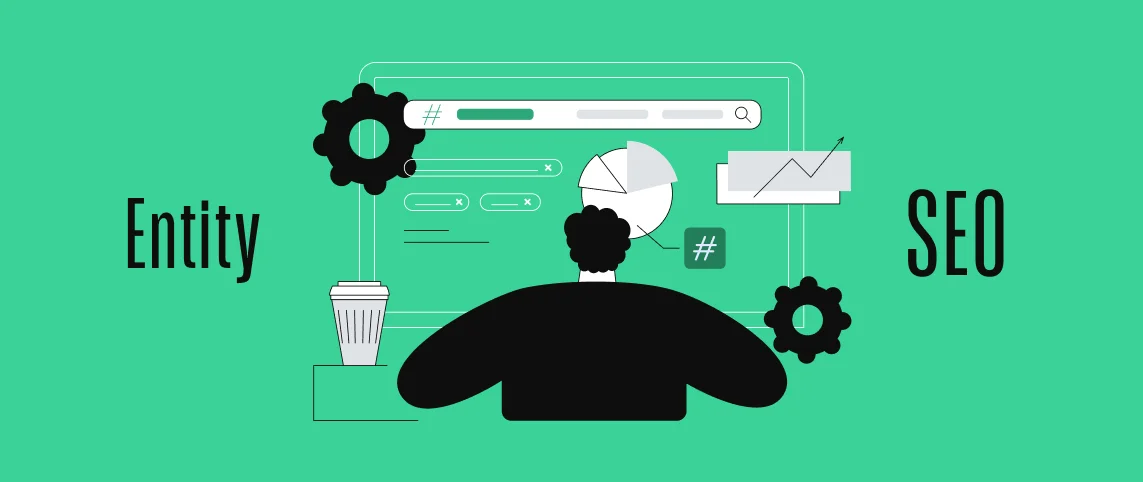
Search engines and AI assistants no longer just match words. They decide what exists and what deserves a name.
This guide explains how that decision is shaped, where BloggerOutreach (BO) fits, and where the sales pitch deserves a raised eyebrow.
A Practical Example
Nila runs a small cybersecurity startup. Her blog ranks for a handful of terms. Her backlink report looks respectable.
Yet when a prospect asks an AI assistant for good tools in her niche, the answer names four competitors and never mentions her. She asks her agency what went wrong. Nobody has an answer that fits inside a DA number.
Indeed, Nila’s character is not real. However, the problem she faces is almost everyone’s story in 2026. Simply put, she has developed a good website. In other words, her website has all the utility functions, call buttons, and explainer pages.
However, the distinct problem is that her page does not have a very distinct identity that is supposed to make Nila stand out from the rest of the business owners in her niche.
As a result, when you open her website, you won’t clearly understand what problem Nila’s business solves or why you should associate with her brand.
What An Entity Is, And Why Authority Attaches To It
Google search shows that an entity is something that you can distinctly recognize. It doesn't have to be tangible, but it must be recognizable. In simpler words, it has to be something like an organization, or any new product in the market.
In this connection, Google introduced its Knowledge Graph in 2012. The campaign tagline was “things, not strings,” so how do you sync these different entities to create an altogether brand identity?
Platforms like Wikidata let you sync data in a machine-readable way. That way, you can get your record and profile up and running.
As a result, entity authority is now an important brand parameter. All brands have to sync their topics, brand vibes, and brand trust. However, there are two major problems here that a lot of brands have still not been able to address successfully:
- It is not an official Google term, so anyone selling it as a measurable score is selling a model.
- It is built from evidence outside your own website, because a claim only counts once somebody independent repeats it.
The Authority Ladder
BO's own content frames authority as a chain that runs from domain level to brand level. Adding the entity layer gives six rungs.
| Rung | What it means | Read more on BloggerOutreach.io |
| Domain | A site-wide score from a third-party tool such as DA or DR. A rough proxy that Google does not use. It cannot tell you whether one link helps one page. | Website authority |
| Website | Reputation built across content, topical coverage, mentions, and links. Google publishes no site score, so this is a reading of evidence, not a number. | Website authority |
| Link | The likelihood that one crawlable, relevant, editorially justified link helps a well-matched destination page. BO notes there is no universal score for it. | Link authority |
| Editorial | The credibility a publication earns by exercising independent judgment. A mid-sized niche blog with a real audience can carry more of it than a bigger site that publishes anything. | Editorial authority |
| Brand | How credible, trusted, and recognized a business is. Mentions, with or without links, feed it, but raw mention counts do not equal authority. | Brand authority |
| Entity | The settled identity machines hold for you: who you are, what topic you belong to, and who corroborates it. The rung the others accumulate into. | Wikidata and entity platforms |
The useful lesson is in the ordering. A domain score describes a whole site. A link describes one relationship. Editorial judgment explains why the relationship exists. Brand recognition accumulates when many such judgments align.
The entity is the stable identity they all attach to. BO's piece on editorial mentions versus backlinks lays out the same domain-to-brand chain.
An Illustrative Entity Scorecard
Use this to think, not to report to a client. It is my own teaching heuristic with my own weights, not a Google metric.
| Signal | Weight (out of 100) |
| Editorial mentions on relevant publishers | 20 |
| Contextual links | 15 |
| Wikidata record | 15 |
| Consistent name everywhere | 10 |
| Schema with sameAs links | 10 |
| Notable third-party coverage | 10 |
| Topic content cluster | 10 |
| Branded search and reviews | 10 |
Rough reading: below 25, you are mostly just a website. Around 50, machines can connect your name to a topic. Around 75, you are likely to be named when the topic comes up. Above 90, identity, coverage, and links all agree.
Where BloggerOutreach's elements fit
BloggerOutreach.io sells link building, guest posting and content writing, plus newer AI-visibility services: AI-powered link building, GEO, Wikipedia and entity setup, and Grokipedia. Seen through the entity lens, each feeds a different part of the map.
| Service | Entity role | Question to ask the vendor |
| Blogger outreach | Builds independent mentions in the right topical neighbourhood. | Which publishers, and can I see their traffic history? |
| Guest posting | Attaches your name to expert content on DA 30-80+ sites. | Who edits, and is the byline a real expert? |
| Link building | Supplies the link layer and context for discovery. | How is relevance judged beyond DA? |
| Content writing | Your own topic cluster, which gives mentions something consistent to point at. | Who checks facts? |
| AI link building and GEO | The most direct attempt to influence AI answers. | What is measured, and how often? |
| Wikipedia and Grokipedia | The formal identity record. | What exactly is delivered, and how are notability and disclosure rules handled? |
So what can the vendor do here? According to the link authority post on our platform: any high-DA link can still fail to perform when the publisher, context, or destination page does not sync at all.
To build entity authority, you have to improve your link building game:
- Check out our case studies.
- Next, see our link building guide.
Critical analysis: claim, reading, question
A guide that only praises its subject is an advert. Here is how I would read BO's public claims if I were buying.
| Claim | Reading | Ask the vendor |
| "AI tools cite the editorial sources we place on." | The direction is plausible, since AI answers draw on web content. But no public evidence shows that any vendor can control which sources a model cites, and outputs vary by model and prompt. | Can you show repeated citation tests, with dates, before and after a campaign? |
| "Zero PBNs. Every publisher manually vetted." | A promise about process that outsiders cannot audit from the homepage. Vetting quality is the whole product. | Will you share a sample publisher list with traffic trends and outbound-link patterns? |
| Wikipedia and Grokipedia services | Wikipedia pages depend on independent notability and carry conflict-of-interest and paid-editing disclosure norms. You can't simply buy a page. Wikidata and schema work is more realistic. | Which deliverable is guaranteed: a live page, a Wikidata record, or a submission? |
| Case studies: VeePN +176%, Engleish.com +241% | Single before-and-after stories. Link building, content, seasonality and algorithm updates all overlap, so causality is unproven. | Was anything else changing at the same time, and is there a comparison group? |
| Delivery speed | The homepage mentions 24-48 hours in some places, while the FAQ says 7-21 business days. Both may be true for different products, but the page does not say which is which. | What is the realistic timeline for my order type, in writing? |
| The authority framework itself | A helpful teaching model, but it is the vendor's own framework, not an industry standard. Entity authority has no official definition. | Which of these signals do you measure, and with what tool? |
None of this makes the service bad. It means the evidence presented is the kind a vendor naturally publishes.
Ask for the kind a skeptic would want: publisher lists, traffic history before and after, and a campaign that included a control.
A playbook you can start this week
Entity building rewards consistency more than cleverness.
- Write one plain sentence describing what you are and who you serve, and use it everywhere.
- Make your name, address, and profile details identical across your site and listings.
- Add Organization schema with same as links to your real profiles.
- Create or update a Wikidata record if you meet its requirements.
- Publish three or more connected articles on one core topic.
- Earn two relevant editorial mentions before chasing volume.
- Check each target publisher for real traffic and independent editing.
- Search your brand in two AI tools monthly and log what appears.
Notice that only two of those items involve buying anything. The rest is housekeeping and patience, which a service page rarely emphasizes and that almost always makes the paid work stick.
How Nila's Story Ends
Six months later, Nila's company has a Wikidata record, consistent profiles, a short run of relevant mentions on niche security publications, and a page that states plainly what it does.
No single piece did the work. When she asks the assistant again, her brand appears third out of five on the list. She screenshots it, then goes back to the checklist. She has learned that entity authority is maintained rather than finished.