



A brand can be mentioned on a respected industry publication without receiving a link. Another brand can receive a backlink from a website that nobody in its market reads.
Both are technically references. But they do not create the same kind of value. That is why Editorial Mentions deserve a closer look when evaluating authority.
A backlink gives search engines a crawlable path from one website to another. An editorial mention can put your brand, product, research, or expertise in a relevant publishing environment, even without a clickable link.
This distinction matters more as search expands beyond traditional blue links. AI-generated answers can cite web pages as sources, while search systems increasingly need to understand organizations, people, products, and the relationships between them.
So, should you choose editorial mentions over backlinks? Not exactly. Instead, you should now ask:
“What kind of reference does your brand need, and what authority gap are you trying to address?”
What Is An Editorial Mention?
An editorial mention is a reference to a brand, organization, product, person, study, or resource within independently published content. For example:
"According to Blogger Outreach, publisher relevance should be evaluated alongside traditional authority metrics."
If "Blogger Outreach" links to its website, this is a linked editorial mention. If the publication writes:
"Blogger Outreach has published research on publisher relevance."
but doesn't include a hyperlink, it is an unlinked editorial mention. Both references place the brand in an editorial context. The difference is that only one provides a direct clickable link.
This distinction matters because editorial context can communicate more than the URL itself.
A relevant publication can associate your brand with a topic, category, product, person, or idea. Over time, those associations can contribute to how people discover and understand your brand.
That does not mean every unlinked mention is automatically a Google ranking factor. Google does not publish a rule saying that an unlinked brand mention directly increases rankings.
Instead, view editorial mentions as part of a broader authority-building strategy.
Editorial Mentions VS. Backlinks: What Is The Difference?
At the simplest level:
| Editorial Mentions | Backlinks |
| Reference a brand, product, person, or resource | Link one webpage to another |
| Can be linked as well as unlinked | Always contain a link |
| Can strengthen brand visibility and associations | Can support discovery and link-based authority signals |
| May occur naturally through PR, research, commentary, or coverage | Can come from editorial content, resources, partnerships, and other pages |
| Can be valuable even without referral traffic | Can generate referral traffic as well as SEO value |
The two aren't competing assets. In other words, a backlink can also be an editorial mention.
For example, when a publication writes about a company and links to its research, the brand receives both:
- an editorial reference
- a backlink
- potential referral traffic
- contextual association with the subject being discussed
That combination can be more useful than treating "link" and "mention" as separate boxes to tick.
What Is Domain Authority?
Domain Authority is a third-party metric that estimates a website's ranking strength based on its backlink profile and other signals included in the metric's methodology.
It helps compare websites during publisher research, but it should not be confused with a Google ranking factor.
This distinction matters when evaluating editorial opportunities.
A publisher with a high Domain Authority score is not automatically the best publication for every campaign.
Relevance, editorial quality, audience, traffic, topical coverage, and placement context can matter just as much for the campaign objective.
That is why authority building should never become a simple exercise in collecting links from websites with the highest available metric.
If you're evaluating the broader concept rather than a single third-party score, it is also useful to understand Website Authority.
It offers a wider view of a site's credibility, visibility, and strength within its search environment.
Website Authority Is Broader Than One Metric
Website Authority describes a website's broader ability to establish credibility and visibility within its subject area. It can involve many factors, including:
- Relevant and useful content
- Strong topical coverage
- Quality backlinks
- Editorial references
- Brand recognition
- Internal linking
- Publisher relationships
- Search visibility
- Overall content quality
This is why DA, DR, and similar metrics should be treated as evaluation tools, not definitions of authority. A website can have a strong third-party metric and still be poorly aligned with your campaign.
Likewise, a more specialized publication with a smaller metric may provide valuable context if it genuinely matters to your market.
Linked Mentions: When The Mention Also Includes A Backlink
A linked mention is often the most obvious form of editorial coverage. Imagine an article about enterprise SEO that says: "A recent authority study from Blogger Outreach found..." and links the phrase "authority study" to the relevant report.
The publication is doing two things:
- Referencing the brand or its work.
- Providing a crawlable link to the source.
The link gives readers a direct path to the referenced resource. Search engines can also crawl that relationship.
Google's documentation distinguishes legitimate editorial links from manipulative link schemes.
Google specifically defines link spam as creating links primarily to manipulate search rankings, which is why the purpose and editorial context of a link matter.
This distinction matters for link building. Here your objective shouldn't simply be to "Get a link." Instead, it should be to "Earn a relevant reference where the link makes sense for the reader."
That changes how you evaluate publishers.
A relevant industry publication discussing your business's exact subject can provide stronger contextual value than a random website with an impressive third-party metric.
Unlinked Mentions: Does A Brand Need A Link To Benefit?
Here the conversation becomes more nuanced. An unlinked mention doesn't give the reader a clickable path to your website. It also doesn't pass link-based signals in the same way as a crawlable backlink.
But the mention can still have practical value. Consider a publication that writes: "Blogger Outreach helps marketers build editorial placements across relevant publishers."
Even without a link, someone reading that sentence may:
- recognize the brand
- search for it later
- remember it when comparing providers
- associate it with link building and authority
- mention it elsewhere
- encounter it again through another channel
Those effects are difficult to reduce to a single SEO metric. That's precisely why unlinked mentions shouldn't be treated as "worthless backlinks."
They are simply different assets. So it's wrong to claim that every unlinked mention directly improves Google rankings. You don't need to make that claim.
A stronger authority strategy recognizes that visibility, recognition, links, citations, and brand associations can work together without being identical signals.
Brand Mentions And Brand Authority
A brand can be referenced in many ways:
- Company name
- Product name
- Founder or executive
- Research report
- Original study
- Data point
- Proprietary methodology
- Expert commentary
- Customer story
- Industry contribution
Not all of these need to link back to the homepage. This is where Brand Mentions become relevant to a broader discussion of Brand Authority.
Suppose a cybersecurity company publishes an annual threat report. In this connection, a technology publication may write: "The latest threat report from [Company] shows a rise in..."
That sentence links the company to cybersecurity research. Another publication might reference the same company when discussing:
- threat intelligence
- ransomware
- enterprise security
- security research
The important development isn't simply that the company has been mentioned several times.
It is that the surrounding context becomes consistent.
That is where editorial mentions can become particularly useful for authority building.
Brand Authority should therefore not be reduced to the number of times a brand appears online. The quality, relevance, and context of those references matter.
Editorial Authority: Why Context Matters
A backlink tells you that one page links to another.
Editorial Authority asks a broader question:
Where is your brand being referenced, and why does that reference matter?
An editorial reference from a publication that regularly covers your subject can place your brand within an established topic ecosystem.
For example, a finance company being discussed by:
- financial publications
- business publications
- investment analysts
- relevant industry associations
- respected financial commentators
creates a different context from the same company being mentioned on unrelated websites.
Editorial Authority is therefore closely connected to publisher trust, topical relevance and editorial context.
It doesn't mean that every mention from a respected publisher directly transfers an authority score to your domain. Instead, it gives your brand opportunities to be:
- discovered
- referenced
- associated with relevant topics
- trusted by readers
- linked to useful resources
- cited as a source
This makes editorial coverage an important part of a broader authority strategy.
Publisher Trust Changes The Value Of A Mention
Not every mention carries the same practical value. A reference from a publication that is:
- relevant to your industry
- read by your target audience
- editorially credible
- selective about what it publishes
- trusted within its niche
- capable of generating real referral traffic
is fundamentally different from a mention placed on an unrelated, low-value website. This is why publisher evaluation should go beyond DA or DR.
Third-party metrics can help with prospecting. But they don't tell you everything about a publisher.
For further clarification, consider two publications:
| Publisher A High third-party authority metric Little topical connection Thin content Minimal audience relevance | Publisher B Lower third-party authority metric Strong topical alignment Established editorial coverage Relevant audience Regularly publishes original industry content |
If your goal is to build authority within a particular market, Publisher B may provide a more meaningful editorial environment. So the question isn't: "Which site has the bigger number?" instead the main query is:
"Which publisher gives my brand the right context?"
Link Authority Is Not The Same As Domain Authority
Another useful distinction is Link Authority. Link Authority focuses on the value and context of links pointing to a page or domain. It is influenced by considerations such as:
- Relevance of the linking page
- Relevance of the linking domain
- Editorial context
- Link placement
- Destination-page relevance
- Overall quality of the referring site
This is different from simply asking what a domain's overall authority metric is.
A website may have thousands of backlinks, but that doesn't mean every link contributes equally. For an authority campaign, it is therefore useful to evaluate:
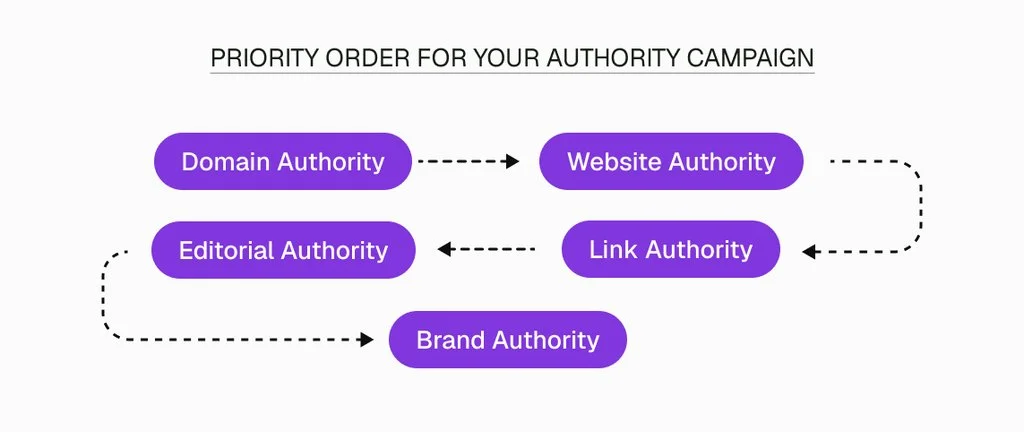
Domain Authority → Website Authority → Link Authority → Editorial Authority → Brand Authority
These concepts overlap, but they describe different parts of the authority ecosystem.
Digital PR And Editorial Mentions
This is where editorial mentions extend beyond conventional link building. Digital PR focuses on earning attention and coverage through things such as:
- Original research
- Industry data
- Expert commentary
- Newsworthy announcements
- Surveys
- Proprietary insights
- Trends
- Studies
- Expert contributions
A successful digital PR campaign may generate dozens of references.
Some publications will link. Some won't. Meanwhile, some may quote an executive. Others may cite a report. Another article may simply mention the company as a source.
If you judge the campaign only by the number of backlinks earned, you miss part of its value. At the same time, digital PR should not be presented as a way to manufacture SEO authority through mentions.
The value comes from earning genuine editorial attention. That distinction matters because search engines actively discourage artificial attempts to manipulate ranking signals through links.
Editorial Mentions and AI Mode
Search is no longer limited to a list of blue links.
Google's AI Mode and other generative search experiences can synthesize information from multiple sources when responding to complex queries.
That makes the information ecosystem around a brand increasingly important. That said, traditional SEO asks: "Where does this page rank?"
AI search adds questions such as: "Which sources are being used to answer this question? And: "How is this brand represented across the sources that AI systems can retrieve?"
An editorial article may mention your company without linking to it. Another page may link to your research. A third may cite your original data.
These pages can play different roles in the wider information ecosystem.
This doesn't mean an unlinked mention guarantees inclusion in AI Mode.
It means brands should think beyond rankings and build clear, credible, and consistent information across the web.
Your own website should clearly explain:
- What your company does
- Who it serves
- What products it offers
- What topics it specializes in
- What original information it can substantiate
External editorial coverage can then provide additional context around those claims.
Editorial Mentions And AI Citations
AI search adds another layer to the discussion. AI systems can cite web pages as sources when generating answers.
Bing, for example, provides an AI Performance report showing which pages are cited in supported AI-generated answers and the queries associated with those citations.
This creates a distinction between being mentioned on the web and having your content cited as a source in an AI answer.
They are related, but they aren't the same thing.
An editorial article may mention your company without linking to it. An AI system may instead retrieve and cite the article itself because that page contains useful information relevant to the question.
For brands, this makes the wider information environment increasingly important. You want authoritative publications to discuss your:
- expertise
- products
- research
- category
- unique data
- viewpoints
- capabilities
But you also need your own website to provide clear, useful, and verifiable information. So don't reduce AI visibility to "Get more backlinks.” The bigger objective is:
Make your brand and expertise easier to understand, verify, and reference across multiple sources
What About Knowledge Graph Implications?
This area requires some caution.
Search engines need to distinguish between entities that share similar names and understand what organizations, products, people and concepts represent.
Google's documentation says that Organization structured data can help Google understand an organization and disambiguate it from other organizations.
Properties such as url and sameAs can help identify the organization and connect it with additional reference pages.
That doesn't mean: "Get 100 unlinked mentions and Google will put your company in the Knowledge Graph."
There is no such formula. Instead, think about entity consistency.
Imagine a company appears across the web as:
- Company X
- Company X's founder
- Company X's research
- Company X's product
- Company X's industry category
- Company X's website
- Company X's social profiles
- Company X's interviews
- Company X's publisher coverage
When these references consistently describe the same organization and its relationship to relevant topics, they create a clearer information environment around that entity.
Editorial coverage can complement that broader ecosystem. But the correct conclusion would be:
Editorial mentions can contribute to an entity's broader web presence. They are not a guaranteed Knowledge Graph input or ranking shortcut.
Can Editorial Mentions Help When Google Rankings Drop?
A Google rankings drop usually has multiple possible causes, including algorithmic changes, technical problems, content issues, search intent mismatches, competition, indexing changes and changes in the wider search results.
Editorial mentions should not be presented as a universal solution.
However, a rankings decline can be a reason to reassess the broader authority profile of the affected site.
If the problem is an authority gap, editorial coverage, relevant backlinks, and stronger content can all be part of the solution.
When Are Editorial Mentions Valuable?
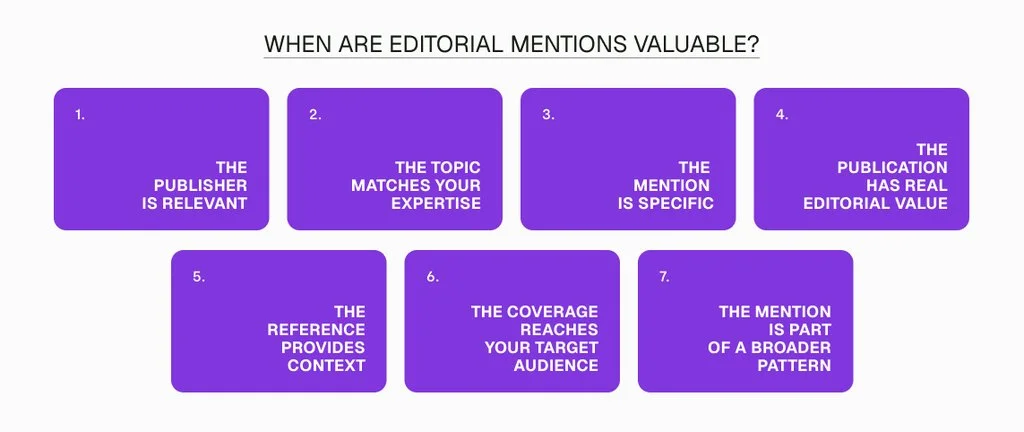
Not every mention deserves the same attention. An editorial mention is particularly useful when several of these conditions are present.
1. The Publisher Is Relevant
A cybersecurity company mentioned by a cybersecurity publication has a stronger contextual relationship than the same company mentioned on an unrelated site.
2. The Topic Matches Your Expertise
A mention should ideally occur in content related to the subject you want to be known for.
3. The Mention Is Specific
Compare:
"Many companies use SEO tools."
with:
"Company X's platform helps enterprises monitor search visibility across..."
The second creates a much clearer association.
4. The Publication Has Real Editorial Value
A genuine publication with an audience, editorial standards and relevant coverage is more meaningful than a page created primarily to host links.
5. The Reference Provides Context
A mention is more useful when readers can understand why the brand is being mentioned. Research, data, commentary, expertise, and original resources all give a mention substance.
6. The Coverage Reaches Your Target Audience
A mention can have value even without direct SEO impact if the right people see it. Brand discovery matters.
7. The Mention Is Part Of A Broader Pattern
One isolated reference tells a limited story.
Consistent coverage across relevant publications can establish a stronger association between the brand and its area of expertise.
When Is a Backlink More Valuable?
There are situations where the link itself is important. A backlink can:
- provide a direct path for users
- generate referral traffic
- help search engines discover URLs
- connect relevant pages
- contribute to the site's broader link profile
But again, quality and relevance matter more than raw volume.
Backlink from a relevant article that naturally references a useful resource differs greatly from a collection of unrelated links created solely to influence rankings.
That is also why you should evaluate link authority in context rather than reduce it to the number of referring domains.
The Most Useful Combination: Mention + Context + Link
When possible, the strongest editorial outcome can combine several elements:
Relevant publisher
↓
Relevant topic
↓
Brand or expertise mentioned
↓
Useful supporting resource
↓
Natural backlink
That creates a meaningful relationship between the publisher, the subject and your brand.
| For example: An SEO publication writes about how brands measure website authority, references your original authority research, explains one of your findings, and links to the full study. |
Where an SEO Agency Fits Into This
For an SEO agency, editorial mentions and backlinks should be treated as complementary parts of an authority strategy rather than isolated deliverables.
An agency managing multiple clients may need to evaluate:
- Which clients have weak publisher coverage
- Which topics lack external references
- Which target pages need relevant links
- Where competitors are earning coverage
- Which publishers fit each client
- Whether a campaign is generating links, mentions, or both
- How those placements support broader SEO goals
This is especially important when authority building needs to scale across several clients.
How To Measure Editorial Mentions
Counting mentions is useful, but it isn't enough. Track the quality and context of the references as well.
Mention volume: How often is the brand being referenced?
Linked vs unlinked: How many references include a backlink?
Publisher relevance: How closely does each publication match your industry or target audience?
Topic relevance: What subjects are associated with the brand?
Brand visibility: Are mentions appearing in publications your target customers actually read?
Referral traffic: Do linked mentions bring relevant visitors?
Link quality: Where applicable, evaluate the linking domain, page context and destination.
AI citations: Where data is available, monitor whether your own content is appearing as a source in AI-generated answers.
Entity consistency: Check whether external references describe your company, products and expertise accurately and consistently.
This creates a more useful authority measurement system than simply counting backlinks.
Editorial Mentions Are Not a Replacement for Backlinks
It would be just as misleading to say that mentions are always better than backlinks. They solve different problems.
A backlink can provide a direct path to your website and contribute to link-based discovery and authority signals.
An unlinked editorial mention can increase brand exposure and reinforce associations without providing that same link.
A linked editorial mention can do both.
Digital PR can generate attention and references that may or may not result in links.
AI systems can cite a page because of the information it contains, regardless of whether the brand received a backlink from that page.
The key point is that authority isn't one signal. It is an ecosystem of signals, relationships, references, content and experiences.
So, Which Should You Prioritize?
If your priority is supporting a specific URL, a relevant editorial backlink may be particularly useful. If your priority is increasing brand recognition within a market, relevant editorial mentions may matter even without a link.
Often, the priority is building credibility around a subject, consistent coverage across authoritative publications can help create stronger associations.
If your priority is AI visibility, your own content needs to be clear, useful, structured and verifiable, while your broader web presence can help establish the context in which your brand and expertise are understood.
And when you can earn both a relevant mention and a natural backlink from the same editorial placement, there is little reason to treat them as competing outcomes.
Build Authority Beyond The Link
Backlinks remain an important part of SEO. But they are only one way a brand becomes visible across its market.
Editorial Mentions add another layer: they put your brand, expertise, research and products into relevant conversations.
Some mentions will include links. Some won't. Others may simply introduce your brand to a new audience.
Some pages may later become sources for AI-generated answers.
And over time, repeated references can contribute to a clearer picture of what your brand does and what topics it is associated with.
The practical takeaway is simple:
Don't build campaigns around links alone. Build campaigns around the authority outcome you want the market, and the wider search ecosystem, to understand.
That means looking at linked mentions, unlinked mentions, brand references, publisher trust, digital PR, AI citations, and entity context together rather than treating each as an isolated SEO tactic.
Because the goal isn't to make your backlink count look bigger.
The goal is to make your brand more credible, more discoverable, and more relevant where your audience and AI systems look for information.