



The Search Authority Report 2026 starts with a problem the SEO industry has made unnecessarily difficult: we keep trying to explain visibility with one number.
That number might be Domain Authority, Domain Rating, referring domains, organic traffic, AI citations, or share of voice. Each can tell us something. None can tell us whether a particular brand will rank, become a cited source, earn a recommendation, or hold its visibility when search changes again.
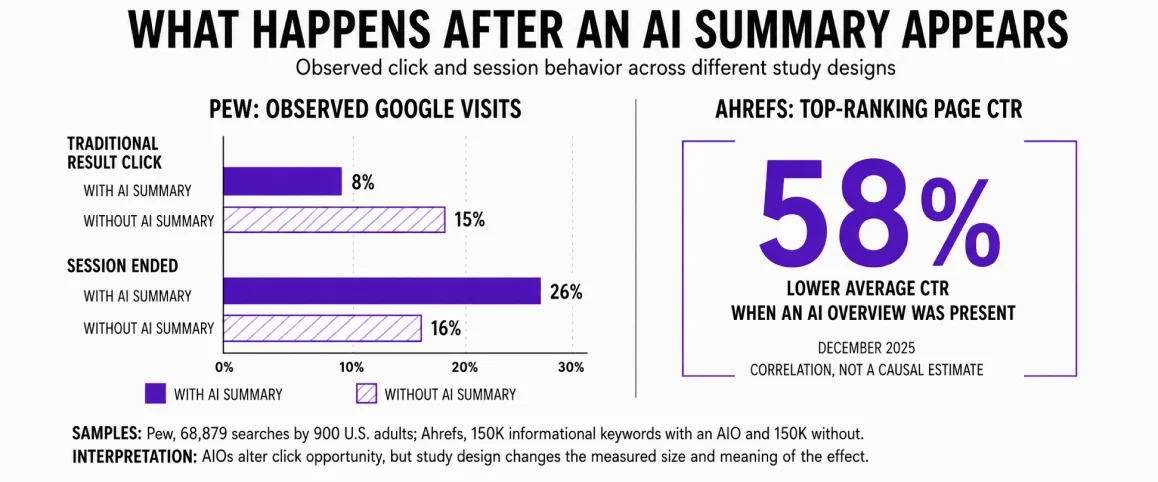
| The Headline Findings • There is no credible market-wide AI Overview percentage. Semrush found AI Overviews on 15.69% of its 10-million-plus keyword set in November 2025. Conductor reported 34% coverage in February 2026 after a 47% January peak. BrightEdge reported about 48% across its tracked queries in February 2026. The figures describe different keyword universes, not three versions of the same benchmark. • Ranking and citation are separate competitions. BrightEdge found that only about 17% of sources cited in AI Overviews also ranked in the organic top 10. The overlap ranged from 24.0% in healthcare to 9.3% in restaurants. • A top ranking can produce less traffic than it once did. Ahrefs’ matched-keyword analysis associated AI Overviews with a 58% lower average desktop click-through rate for the top-ranking page in December 2025. • Observed user behavior points in the same direction, but not with the same method. Pew Research Center tracked 68,879 Google searches by 900 U.S. adults. Users clicked a traditional result in 8% of visits with an AI summary, compared with 15% without one. They clicked a source inside the summary in only 1% of visits. • AI referral traffic is growing quickly from a small base. Similarweb estimated 1.13 billion AI-platform referrals in June 2025, up 357% year over year, versus 191 billion referrals from Google Search. • Brand visibility appears more strongly associated with distributed recognition than raw link volume. An Ahrefs study of 75,000 brands found branded web mentions correlated 0.66–0.71 with AI visibility across the platforms studied. Backlink counts and page counts showed much weaker relationships. • Editorial validation is heavily represented in cited sources. Muck Rack’s May 2026 analysis of more than 25 million cited links across ChatGPT, Claude, and Gemini classified 84% as earned media, 27% as journalism, and just 0.3% as paid or advertorial content. • Domain strength still matters, but it does not transfer automatically to every page Google’s current ranking-systems guide says its systems work primarily at page level, while also using site-wide signals. Strong site-wide signals do not guarantee that every page will rank. |
Research Sample Card
| ELEMENT | SCOPE USED IN THIS REPORT |
| Official sources | Google Search Central guidance on ranking systems, AI features, links, people-first content, and spam policies |
| Large public datasets | Nine first-party industry studies, including 118M keywords, 75K brands, 25M AI citations, 68,879 observed searches, and multi-billion-session/referral analyses |
| Search surfaces | Traditional Google results, Google AI Overviews, Google AI Mode, ChatGPT, Claude, Gemini, Perplexity, and other AI-referral sources that a study grouped together |
| Core outcomes | Organic ranking, click-through, AI mention, AI citation, recommendation, referral traffic, and stability |
| BO evidence | One published FinanceReference.com case observation, treated as an example rather than a general causal estimate |
| Cutoff | Sources available by August 27, 2026 |
**Important: Dataset sizes are not added together. The studies overlap in unknown ways, use different keyword sets, and answer different questions.
BO research view: A high-authority domain can still have a low-authority page, an invisible brand, a weak topic cluster, or a citation problem. “Authority” becomes useful only when we identify where the evidence is strong and where the handoff breaks.
Executive Summary
Search did not abandon authority in 2026. It made authority harder to fake, harder to reduce to one score, and harder to measure through traffic alone.
Traditional search still matters. Similarweb estimated that Google Search sent roughly 169 times as many referrals as AI platforms in June 2025. Conductor’s financial-services benchmark placed organic Google traffic at 17.42% of site traffic, while AI referrals accounted for 0.48%. Those are not signs of a dead channel.
Yet the experience above the organic result has changed. AI Overviews can occupy more than a full desktop viewport. Searchers may receive a synthesized answer before seeing the first blue link. A business can therefore hold its ranking while losing some clicks. It can also appear in the answer without receiving a click. Or it can be recommended through a third-party source even when its own page is not cited.
That Creates Four Distinct Questions:
- Does the brand rank?
- Does the brand get cited?
- Does the brand get recommended?
- Does the visibility remain stable?
Domain Authority and Domain Rating do not answer those questions. They remain useful comparative tools. Moz’s DA estimates ranking potential, while Ahrefs defines DR as the strength of a site’s backlink profile on a logarithmic scale.
They are vendor metrics, not Google’s internal view of a website. Blogger Outreach’s guide to what Domain Authority really measures makes the same distinction: use DA as a filter and comparison point, not as a placement guarantee.
The report therefore defines search authority as follows:
Search authority is a brand or website’s demonstrated ability to earn sustained visibility, citations, and trust across organic and AI-powered search through relevant links, topical coverage, editorial credibility, and third-party brand validation.
Five components support it: website authority, topical authority, link authority, editorial authority, and brand authority. Technical accessibility is an enabling condition. Rankings, citations, mentions, recommendations, traffic, and conversions are outcomes.
This separation matters because the data shows partial overlap, not equivalence, between traditional and AI visibility. BrightEdge found only about 17% overlap between AI Overview citations and the organic top 10. Ahrefs found stronger correlations between AI visibility and distributed brand mentions than between AI visibility and backlink volume. Muck Rack found that earned media dominated the links cited by three major AI platforms.
None of those results proves that a mention causes a citation, an editorial placement causes a ranking, or an AI citation causes revenue. They do show why an authority strategy built only around domain scores and link counts is incomplete.
The practical move for 2026 is not to replace SEO with GEO. It is to stop treating them as disconnected systems. Build pages that deserve to rank.
Connect them into a coherent subject. Earn relevant third-party references. Make claims easy to verify. Establish the brand in the places that Search Engines and AI systems use for corroboration. Then measure the result across more than one surface.
That is Search authority.
Authority Is No Longer One Number
The SEO industry did not start using domain-level scores because it was careless. Teams needed a fast way to compare websites, qualify prospects, and track movement. A 0–100 number travels neatly through a spreadsheet.
“This publisher has real expertise, a relevant audience, strong pages, independent editorial standards, and a durable history” does not.
The problem begins when the shortcut becomes the strategy.
Ahrefs describes Domain Rating as a proprietary measure of backlink-profile strength. It applies across the domain. Google, by contrast, says its ranking systems are designed to work at page level, though site-wide signals and classifiers also contribute.
Its documentation adds a decisive warning: good site-wide signals do not mean every page on the site will rank well.
That distinction explains a familiar situation. A publisher may have an impressive DR because thousands of websites link to its strongest sections. The specific article carrying a new link may be recently published, weakly connected internally, off topic for the publisher, unseen by its audience, or eventually removed. A domain score cannot resolve those page-level questions.
Website authority is broader than any one vendor metric. It includes accumulated evidence around a site: its history, useful content, search footprint, link profile, topical coherence, user experience, and reputation. Even then, the site is the environment, not the final unit of value.
The Five Components Of Search Authority
| Component | What it asks | Useful evidence | What it cannot prove alone |
| Website authority | Is the site a credible and functioning environment? | History, organic footprint, relevant referring domains, technical quality, real audience | That every page deserves visibility |
| Topical authority | Does the site cover this subject with depth and consistency? | Complete clusters, expert contribution, internal connections, coverage of related intents | That a specific claim is correct or externally validated |
| Link authority | Is this particular link likely to help users and search systems understand or discover the destination? | Relevance, crawlability, placement, anchor, linking-page quality, retention | That rankings will rise |
| Editorial authority | Was the claim or placement supported by genuine editorial judgment? | Named authors, primary sources, expert review, corrections, transparent updates | That the publisher is unbiased or the link passes ranking value |
| Brand authority | Is the brand repeatedly recognized and associated with the topic across independent sources? | Branded search, mentions, branded anchors, reviews, citations, expert visibility | That recognition is positive, accurate, or commercially valuable |
Technical access sits underneath all five. A blocked, unindexed, broken, or unrenderable page cannot fully realize the authority around it. But perfect crawlability does not create expertise, trust, or demand.
Rankings and citations sit above the five. They are results produced by specific systems for specific queries. They should not be smuggled back into the definition as if visibility proved authority in every other context.
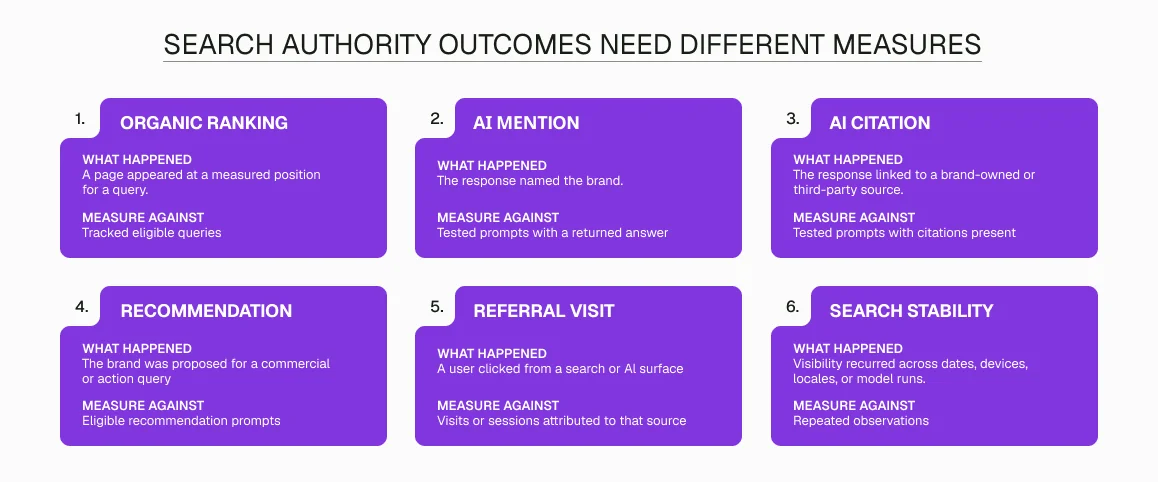
Rankings, Citations, Mentions, And Recommendations Are Different
| Outcome | What happened | A suitable denominator |
| Organic ranking | A page appeared at a measured position for a query | Tracked eligible queries |
| AI mention | The response named the brand | Tested prompts with a returned answer |
| AI citation | The response linked to a brand-owned or third-party source | Tested prompts with citations enabled/present |
| Recommendation | The brand was proposed as an option for a commercial or action query | Eligible recommendation prompts |
| Referral visit | A user clicked from a search or AI surface | Visits or sessions attributed to that source |
| Search stability | Visibility recurred across dates, devices, locales, or model runs | Repeated observations |
This is the first major conclusion of the Search Authority Report 2026: authority is an evidence system, while visibility is a set of query-level outcomes.
How We Conducted The Research
This edition is a structured review of current public evidence. It is not presented as a statistical analysis of 1,000 BO clients, because no such dataset was supplied for this draft. That boundary is important. A report loses authority the moment its sample is implied rather than disclosed.
Source Selection
We prioritized four evidence levels:
- Official documentation: current Google Search Central pages describing ranking systems, links, AI search features, crawlability, people-first content, and spam policies.
- First-party industry studies: research published by the company that collected or analyzed the data, with a stated sample, period, or methodology.
- Blogger Outreach case evidence: a published campaign observation used to illustrate a mechanism, not to estimate an industry-wide effect.
- Reasoned interpretation and predictions: conclusions drawn by Blogger Outreach and labelled as analysis rather than measured facts.
We excluded unsourced “ranking factor” lists, statistics copied without a traceable origin, one-off screenshots used as market evidence, and claims that converted correlations into causes.
Public datasets included
| Study | Sample Or Scope | Period Used | What It Helps Answer |
| Semrush AI Overviews Study | 10M+ keywords; 200K+ keywords for zero-click analysis; 11K domains | Jan–Nov 2025 | How AIO coverage and intent changed |
| Conductor AIO Analysis | 118M tracked keywords | Apr–Sep 2025, updated May 2026 with 2026 volatility | How coverage varies across a broad enterprise query set |
| BrightEdge one-year AIO analysis | Tracked query set across nine verticals | Feb 2025–Feb 2026 | Citation overlap, AIO presence, and industry differences |
| Pew Research Center | 68,879 Google searches by 900 U.S. adults | March 2025; SERPs recollected April 2025 | What users did after seeing an AI summary |
| Ahrefs CTR update | 300K keywords plus aggregated GSC desktop data | Dec 2023 vs Dec 2025 | Association between AIO presence and top-result CTR |
| Ahrefs brand visibility study | 75K brands and millions of AI responses | Published Dec 2025 | Correlations between off-site, link, brand, and content factors and AI mentions |
| Muck Rack / Generative Pulse | 25M+ cited links, three AI platforms, 17 industries | May 2026 edition | Composition and platform variation of AI citations |
| Similarweb AI referrals | Top 1,000 domains and platform referral estimates | June 2025 | Scale and growth of AI referral traffic |
| Conductor financial benchmark | 13,770 cited domains; 3.5M prompts; 17M responses; 3.3B sessions across broader benchmark | May–Oct 2025 | Search-channel balance in a high-trust industry |
Metric Definitions Used In This Report
- AI mention rate: prompts in which a brand appeared divided by eligible prompts returning an answer.
- AI citation rate: prompts citing a brand-owned URL divided by prompts where citations were present and measurable.
- Recommendation rate: eligible commercial prompts naming the brand as an option divided by all eligible commercial prompts.
- Citation recurrence: repeated prompt runs that cited the same source divided by all repeated runs.
- Organic visibility: an index or count derived from rankings; the exact formula must be disclosed whenever reported.
- Ranking stability: recurrence of a page within a defined position band across multiple dates.
- Relevant referring domain: a distinct linking domain whose site, section, page, audience, or editorial context has a defensible relationship with the destination topic.
- Link retention: live qualifying links at the end of a review window divided by links initially confirmed live.
Limitations Of The method
AI outputs vary by platform, model, date, locale, account state, personalization, search mode, and prompt phrasing. Search results change too. Third-party traffic figures are estimates. Correlation studies can reveal patterns but do not identify the cause.
A July 2026 critical survey of GEO research reached an especially useful conclusion: query-document relevance and context position have strong support, but evidence that GEO interventions durably improve organic discovery is still limited.
It also rejected “GEO increases visibility by 40%” as a general claim; that figure was a relative maximum in a particular experimental configuration, not a universal expectation.
That is the standard used throughout this report: useful evidence, narrow claim.
The State Of Search Authority In 2026
Search authority in 2026 is spread across traditional results and AI-generated answers. However, the scale of this shift depends heavily on the dataset, query type, market, and observation period.
The Market Does Not Have One AI Overview Number
The cleanest example of measurement risk is AI Overview prevalence.
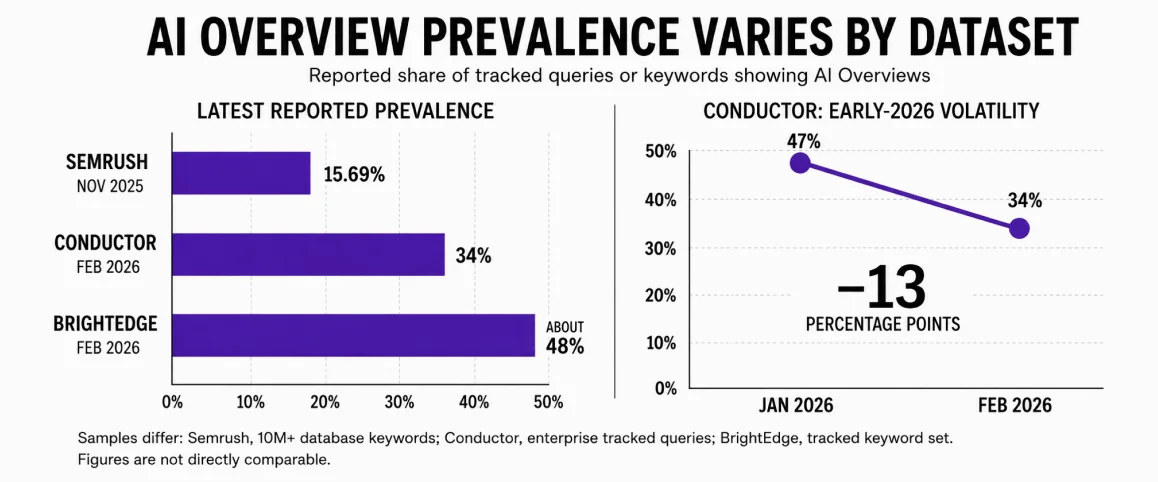
These results should not be averaged. They tell us three things instead.
First, visibility depends on the query universe. A dataset with a higher share of informational, scientific, healthcare, or complex queries will generally find more AI Overviews than one weighted toward shopping, local, or navigational searches.
Second, platform behavior is volatile. Semrush saw its own coverage measure rise to 24.61% in July 2025 before falling to 15.69% in November. Conductor reported a rise from 23% in September 2025 to 47% in January 2026, followed by a correction to 34% in February.
Third, a benchmark without a denominator is decoration. “Our AIO visibility is 22%” means little until the team explains:
- Which prompts were tracked
- Why they were eligible
- How often they were run
- Which market and device were used
Search Authority Now Has Two Visible Layers
BrightEdge’s 12-month analysis found that only about 17% of sources cited in AI Overviews also appeared in the organic top 10. Around 53% ranked somewhere in the top 100 by July 2025, leaving a substantial share outside even that broader organic set.
This does not mean traditional ranking is irrelevant. Google states that its generative search features use core Search ranking and quality systems to retrieve current pages. It means the final citation set is not a copy of page one.
One useful way to read the market is through a two-by-two matrix:
| High AI visibility | Low AI visibility | |
| High organic visibility | Established search leaders: rank and recur as cited or mentioned sources | Ranked but rarely cited: strong classic SEO, weak extraction, corroboration, or prompt coverage |
| Low organic visibility | Emerging AI-visible brands: mentioned or cited through third-party sources or non-page-one URLs | Weak search authority: limited visibility across both layers |
Position Is No Longer A Complete Traffic Forecast
Ahrefs compared 150,000 informational keywords with an AI Overview against 150,000 without one, using aggregated Google Search Console desktop data. It found that AIO presence correlated with a 58% lower average CTR for the top-ranking page in December 2025.
Pew used a different lens: actual browsing activity from 900 U.S. adults. Traditional result clicks occurred in 8% of visits when an AI summary appeared and 15% when it did not. Sessions ended after 26% of AI-summary visits, compared with 16% of visits without one.
Semrush adds an important complication. In its same-keyword before/after analysis, zero-click behavior decreased from 33.75% to 31.53% when those terms began showing AI Overviews. Semrush cautioned that query intent and selection help explain the relationship.
The studies are not mutually exclusive. CTR for the top result can decline while the overall zero-click rate for a changing query set behaves differently. Their disagreement is a lesson in metric design: report the page-level click outcome, the SERP-level click outcome, and the query mix separately.
High Authority, Low Visibility
A domain can look powerful in a prospecting tool and still fail at the page, topic, brand, or outcome layer.
1. The Authority Is Concentrated Somewhere Else
Most domain metrics summarize links across the whole property. But a site’s value may be concentrated in an old tool, homepage, news section, or viral asset. A new article does not inherit the strongest page’s exact link profile.
Google’s documentation supports a page-first view. Its systems use both page-level and site-wide signals, and PageRank remains part of its core ranking systems. That is not a formula for predicting a placement. It is a reason to inspect the linking page and destination instead of stopping at the root domain.
2. The Link Supports The Domain, Not The Target Page
Homepage links can strengthen recognition, referral discovery, and the broader link profile. They may be exactly right for a corporate mention. They do not automatically explain or validate a specialized product page, research report, or category page.
Deep links create a clearer relationship between the external claim and the destination that substantiates it. Internal links then determine whether the rest of the site can find and distribute that support.
3. The Site Covers Too Much And Owns Too Little
Volume is not topical depth. A library of hundreds of loosely related articles can create more URLs without creating a clearer subject association. Google’s query fan-out can issue multiple related searches across subtopics and sources.
That makes connected coverage useful, but it does not justify creating one page for every wording variation. Google’s current AI guidance explicitly warns against scaled pages made mainly to manipulate rankings or generative responses.
4. The Page Offers A Summary When The Market Needs Evidence
AI systems can already summarize common knowledge. So can dozens of competing pages. A page becomes more defensible when it contributes something worth retrieving: original data, a transparent comparison, first-hand experience, expert reasoning, a useful tool, a better explanation, or a primary-source record.
5. The Brand Has Links But No Independent Narrative
A backlink profile can contain many URLs without creating a consistent brand-to-topic association. If different publishers mention the business in unrelated contexts, or never state what it is known for, the web contains weak corroboration.
This is where brand authority changes the diagnosis. The question is not only “Who links?” It is “What do independent sources repeatedly say this brand knows or does?”
A Blogger Outreach Case Observation: When DA Was Not The Missing Input
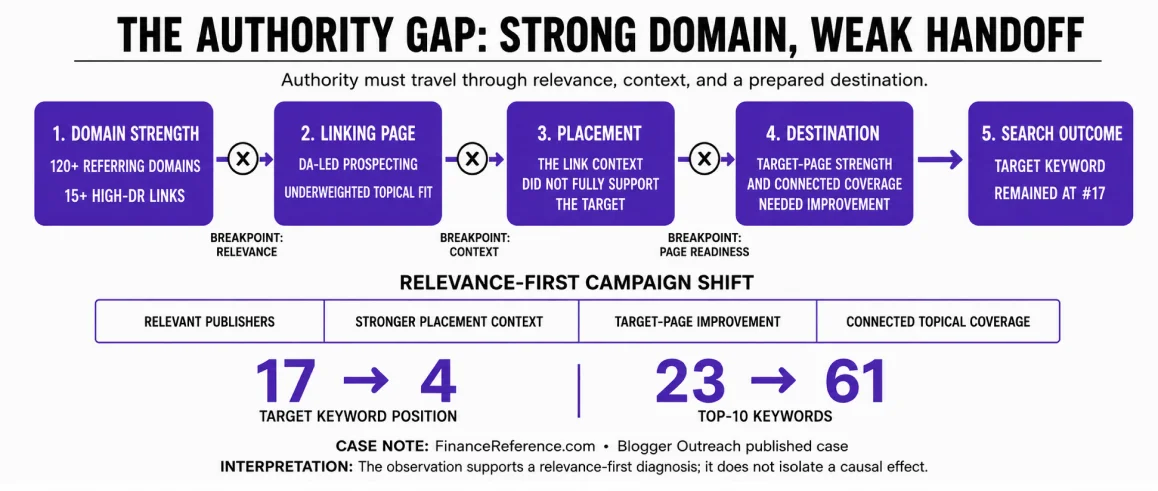
Blogger Outreach’s high-DA backlink case study documents FinanceReference.com with 120+ referring domains and 15+ high-DR links while its target keyword remained at position 17.
The campaign shifted from DA-led prospecting toward relevant publishers, stronger placement context, target-page improvement, and connected topical coverage. The reported target keyword moved to position 4; top-10 keywords increased from 23 to 61.
This is one campaign, not a controlled experiment. Several interventions occurred together, and outside variables cannot be ruled out. Its value is diagnostic: it demonstrates why “build another high-DA link” was an incomplete response to a page whose broader domain already had links.
Marketers seeing a similar pattern should review why rankings can fall or stall despite backlinks before assuming the next placement must simply have a higher score.
Relevance Versus Raw Link Metrics
“Relevance beats authority” sounds appealing because it replaces one simple rule with another. It is also too absolute.
A highly credible national finance publication can offer value to a fintech brand even when the linking article is not part of a narrow software cluster. A small specialist publication may be deeply relevant but have no audience, weak editorial standards, or pages that disappear after six months. The useful question is not which single attribute wins. It is whether the combination supports the destination and the campaign objective.
The five-gate Authority Handoff
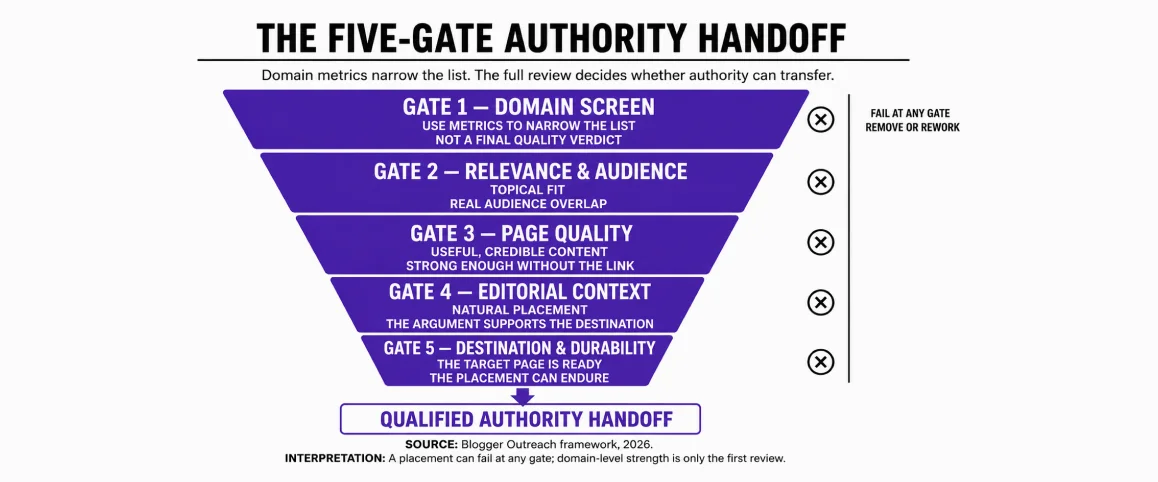
Blogger Outreach evaluates a link through five connected gates:
| Gate | Core question | Evidence to inspect | Common failure |
| Publisher | Is this a credible environment for the subject and audience? | Niche coverage, real traffic, editorial ownership, reputation, site history | Strong score, unrelated site |
| Page | Is the linking page useful and discoverable? | Search visibility, internal links, indexability, freshness, topic | Orphaned or thin placement page |
| Placement | Does the reference make editorial sense? | Surrounding text, link position, anchor, claim-to-source fit | Forced insertion or isolated author-bio link |
| Destination | Is the target page the right and ready resource? | Intent match, evidence, UX, internal links, conversion fit | Link points to a generic homepage or weak page |
| Durability | Is the value likely to persist? | Retention history, update policy, stable URL, disclosure, link status | Page removed, rewritten, deindexed, or link changed |
This is the operating version of link authority: the probable usefulness of a specific, crawlable, contextually relevant, editorially justified link. It is not an alternative 0–100 domain score.
What Google Confirms About Link Context
Google says it uses links to discover pages and as a relevance signal. Its link guidance asks publishers to use descriptive, concise anchor text relevant to both the source and destination. It also says the words surrounding a link matter.
Those statements do not reveal the weight of a placement. They do establish why a natural contextual reference carries more information than a disconnected link chosen only to satisfy an authority threshold.
For paid placements, Google’s rule is equally important: qualify advertising links with rel=”sponsored” or nofollow. A search-authority strategy cannot be built on hiding commercial relationships or treating a follow attribute as proof of editorial endorsement.
Google’s site-reputation-abuse policy also undermines the idea that a host’s strength can be rented without limit. The policy targets third-party pages published mainly to exploit a host site’s established ranking signals.
Content written by outside contributors isn’t automatically a problem. But the page still needs to be genuinely useful to readers and fit the site’s purpose. It shouldn’t exist just to piggyback on the site’s reputation.
A Practical Placement Comparison
| Placement | Domain metric | Topic/page fit | Editorial context | Destination fit | Likely strategic value |
| National business publication cites a SaaS benchmark | High | Medium–high | Strong, evidence-led | Research page | High for brand, referral, citation, and links |
| Specialist SaaS publication explains a workflow and cites the product guide | Medium | High | Strong, instructional | Relevant product/guide page | High for topical and page-level support |
| General guest-post site publishes unrelated copy with an exact-match link | High | Low | Weak | Commercial page | Low and potentially risky |
| Small expert association links to an original dataset | Low–medium | Very high | Strong | Primary research | Potentially high despite lower domain score |
The table is not a ranking prediction. It is a decision framework.
Use domain metrics to narrow a list. Use relevance, page quality, editorial context, audience, destination readiness, and durability to decide.
For teams that already know which pages need support but cannot scale prospecting and fulfilment, BO’s link-building services apply this review at the campaign level. Where the brand needs greater control over the topic and argument, guest-posting services can create the editorial setting. But the content must remain useful enough to stand on its own without the link.
The Editorial Signals Behind Search Authority
Editorial authority is what turns a statement into an accountable statement.
A polished page can still be anonymous, unsupported, stale, derivative, or commercially conflicted. A credible editorial environment makes it possible to inspect:
- who made the claim
- why they are qualified
- which evidence they used
- when the page changed
- whether an independent editor considered it worth publishing
Google’s people-first guidance offers a helpful discipline: ask who created the content, how it was produced, and why it exists. Google states that E-E-A-T is not one specific ranking factor. Its systems use a mix of signals that can identify content demonstrating experience, expertise, authoritativeness, and trustworthiness, with stronger emphasis for YMYL subjects.
That means an author box is not a ranking switch. A medical review label does not rescue inaccurate health advice. A references section filled with circular secondary sources does not create evidence.
Seven Editorial Checks That Matter
- Named responsibility: Is the writer or reviewing expert identified where a reader would expect it?
- Author-topic fit: Does the contributor have relevant experience, qualifications, or a documented body of work?
- Primary evidence: Do important statistics and claims point to the original research, regulation, filing, dataset, or official guidance?
- Original contribution: Does the page add data, experience, analysis, a method, or a clear synthesis rather than paraphrasing the existing SERP?
- Update transparency: Is the date meaningful, and can a reader see what changed when accuracy depends on recency?
- Commercial disclosure: Are sponsorships, affiliate relationships, and paid links handled transparently?
- Correction capacity: Is there a credible route to correct errors and maintain the source?
BO’s full discussion of editorial authority applies the same idea to publishers and backlinks: editorial judgment is a separate quality layer, not something a DA threshold can measure.
2 Main Reasons You Need Original Evidence
Original evidence can improve the page for the reader and make it worth referencing elsewhere. Google says it has systems designed to surface original content and original reporting ahead of pages that merely cite it. AI systems also need extractable claims and supporting sources.
This does not justify manufacturing a survey with a tiny or undisclosed sample. It raises the standard for research pages:
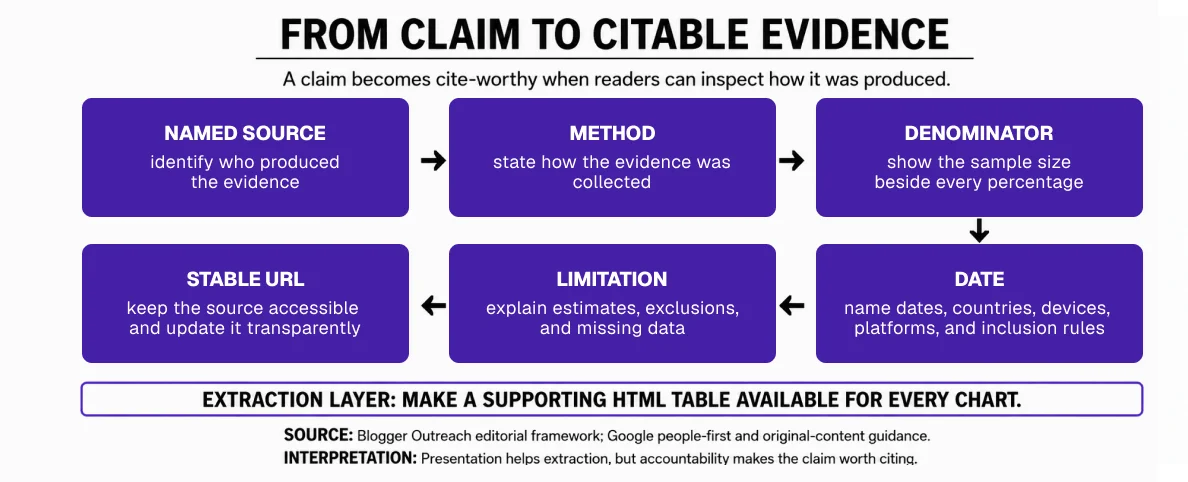
- State the question before presenting the answer.
- Publish the denominator beside the percentage.
- Name the dates, countries, devices, platforms, and inclusion rules.
- Distinguish estimates from observed values.
- Explain missing data and exclusions.
- Make a supporting HTML table available for every chart.
- Keep the source URL stable and update it transparently.
An industry report earns authority when other people can challenge it, cite it, and still understand exactly what was measured.
What Gets A Brand Cited In AI Search?
There is no universal citation formula. ChatGPT, Claude, Gemini, Google AI Mode, AI Overviews, and Perplexity use different retrieval systems, indexes, products, model versions, and interface rules.
Their answers can change between two runs of the same prompt. The public data does, however, reveal recurring patterns.
1. Organic Visibility And AI Visibility Overlap, But Only Partially
Google says AI Overviews and AI Mode use core Search systems for retrieval and may fan out into related queries. BrightEdge’s roughly 17% top-10 citation overlap shows that organic performance does not guarantee citation. Meanwhile, its rise in top-100 overlap suggests the wider organic index still matters.
The correct conclusion is not “rankings do not matter.” It is “ranking position is not the only source-selection layer.”
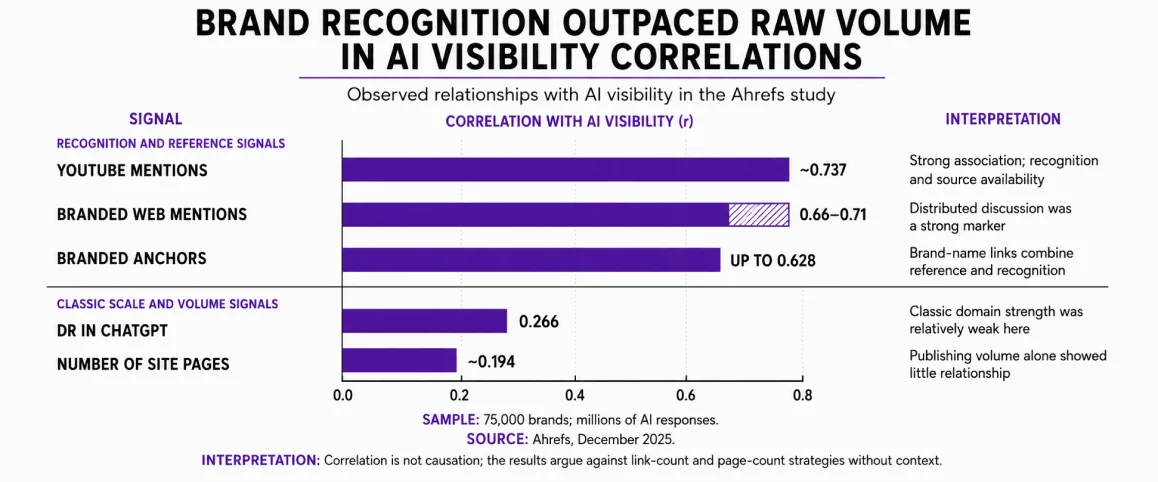
2. Distributed Brand Recognition Is Associated With Visibility
Ahrefs studied 75,000 DR 40+ brands and millions of AI responses. YouTube mentions produced the strongest observed correlation with AI visibility, about 0.737. Branded web mentions correlated between 0.66 and 0.71, depending on the AI surface. Branded anchors also showed meaningful relationships, especially in Google AI Mode.
Traditional volume metrics were weaker. ChatGPT visibility correlated 0.266 with DR, and the number of site pages showed an approximately 0.194 relationship with AI visibility across the study. These associations are from a filtered set of established brands. They do not prove that creating a YouTube mention or an unlinked web mention causes a model to name the brand.
3. Earned Media Is Heavily Represented In Citations
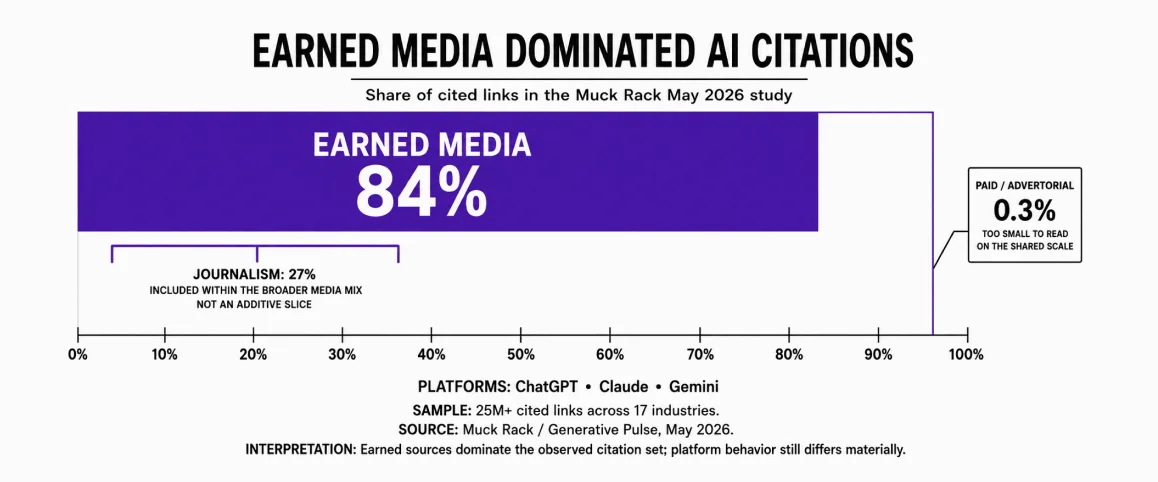
Muck Rack’s May 2026 Generative Pulse edition analyzed more than 25 million links cited by ChatGPT, Claude, and Gemini across 17 industries. It classified 84% as earned media, 27% as journalism, and 0.3% as paid or advertorial content. Across three editions since July 2025, earned media ranged from 82% to 89%.
The platforms behaved differently. Muck Rack reported citations in 96% of sampled ChatGPT responses, 82% of Gemini responses, and 55% of Claude responses. ChatGPT averaged five citations when citing; Gemini averaged eight; Claude averaged 13.
This makes two points. Independent coverage is an important part of the source environment. And an “AI citation rate” that mixes platforms without naming them can hide large product differences.
4. Fresh, Specific, Verifiable Contributions Travel Better Than Commodity Copy
Google’s current AI-search guidance prioritizes unique, valuable, non-commodity content and says no special AI markup is required. It explicitly says Google ignores llms.txt, does not require artificially tiny content chunks, and does not require rewriting content for AI systems.
The guidance fits a simple editorial reality. A model can summarize a generic “ten tips” post from many sources. It has a clearer reason to retrieve the page that owns a current dataset, defines a useful framework, documents a test, publishes expert evidence, or explains a difficult subject better than the alternatives.
5. Mentions, Citations, And Recommendations Need Separate Strategies
A third-party comparison may cause an AI system to recommend a brand without citing the brand’s site. A research page may earn a citation without making the brand a commercial recommendation. A brand may be mentioned in a neutral explanation and receive no link.
Track each event separately:
| Prompt Group | Primary Metric | Supporting Review |
| Informational | Citation rate to owned research/content | Accuracy, recurrence, source diversity |
| Comparison | Brand mention share and citation source | Attributes associated with each brand |
| Commercial investigation | Recommendation rate | Sentiment, position, competitor set |
| Branded | Answer accuracy and entity consistency | Wrong facts, outdated claims, source origin |
| Action/task | Recommended next step or tool | Whether the platform favors an app, page, marketplace, or guide |
For brands building the external source record intentionally, BO’s AI-powered link building and GEO services should be evaluated against those separate outcomes—not sold as a guarantee that one placement will create a citation across every model.
Search Authority By Industry
Industry changes the answer. Query intent, risk, product format, regulation, freshness, local need, and consensus all affect which results and citations make sense.
BrightEdge’s cross-industry analysis offers a useful common benchmark: the share of AI Overview citations that also ranked in Google’s organic top 10.
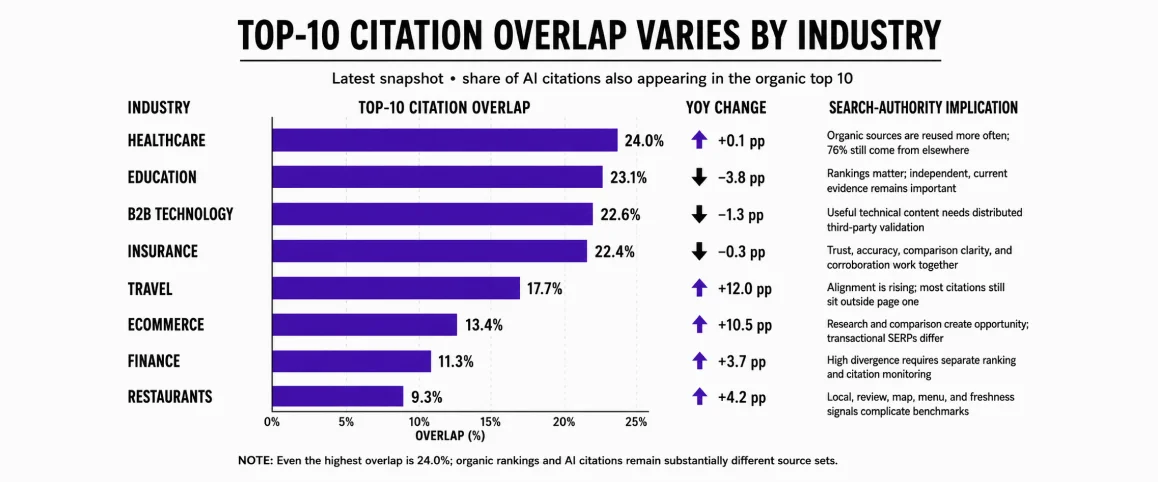
Source and period: BrightEdge AI Catalyst and Generative Parser, February 2025–February 2026. “Overlap” is not citation rate, ranking rate, or traffic share.
Conductor supplies a second finance-specific view. Across its benchmark, AI referrals accounted for 0.48% of financial-site traffic, while organic Google accounted for 17.42%.
Financial services led finance subindustries at 0.61% AI referral share; insurance registered 0.44% and banking 0.16%. Separately, 25.79% of its tracked Financials queries generated an AI Overview.
Those numbers explain why finance brands cannot choose between SEO and AI visibility. Organic remains a much larger traffic source, while the low citation overlap and growing research use case make AI measurement strategically relevant.
What Each Sector Should Prioritize
The data reveals a different search-authority challenge in each industry. Therefore, brands must adjust their content, credibility, and third-party validation strategies to match their sector’s search environment.
SaaS And B2B Technology
Create resources that solve technical and operational questions: original benchmarks, implementation guides, integrations, security documentation, comparison methodology, and expert-led analysis. Earn references from software, productivity, operations, and industry publications. Not only generic marketing sites. Track whether the brand is mentioned as a tool, cited as a source, or recommended for a task.
Finance And Insurance
Accuracy, update discipline, author and reviewer credibility, source quality, and regulatory context are non-negotiable. Citation and ranking sets diverge sharply, so monitor both. Do not interpret one AI mention as trust across YMYL topics. Check the answer, claim, source, jurisdiction, and date.
Ecommerce
Separate product discovery from informational research. Merchant feeds, product data, reviews, availability, media, comparison pages, and third-party buying guides do different jobs. A category page may rank while an independent review supplies the recommendation.
Travel
Freshness and local specificity matter. Build evidence around seasonal access, prices, transport, policies, first-hand experience, maps, and practical constraints. The industry’s rising citation overlap suggests that conventional organic strength is becoming more connected to AIO sourcing, but it remains far from identical.
Healthcare
The highest overlap does not lower the quality bar. Use qualified authors and reviewers, primary medical sources, clear update dates, safe wording, and explicit boundaries. Strong rankings are more often reused than in other sectors. Yet most citations still come from outside the top 10.
Professional Services And Marketing
Generic advice is abundant. Differentiation comes from case evidence, methodology, named expertise, original tools, and clear commercial experience. Build brand-to-problem association through relevant editorial contributions and client-appropriate proof.
Education
Institutional accuracy, admissions and policy updates, author accountability, and direct sources matter. Separate evergreen teaching resources from time-sensitive program, fee, or eligibility information.
Where Search Authority Breaks Down
The most useful report tells a team where to look next. These eight patterns appear repeatedly when strong-looking SEO assets do not produce the expected outcome.
1. High DA, Low Relevance
The prospecting list is sorted by score, while subject fit, audience, linking-page quality, and destination alignment are treated as optional. The resulting profile grows without creating a coherent topic story.
Check: Classify referring domains and placements by topic, section, page, and target-page relationship, not only DA/DR.
2. Strong Content, No Third-Party Validation
The website explains its own expertise well, but few independent sources reference the brand, its data, or its experts.
Check: Compare owned topic coverage with earned mentions, branded anchors, expert citations, reviews, and publisher diversity.
3. Links Stop At The Homepage
The brand has recognition, but priority research, category, product, or service pages lack external and internal support.
Check: Map each relevant referring domain to its destination and business intent. Identify important pages with no deep-link support.
4. Ranking Without Recognition
Pages rank for non-branded queries, but branded search, repeat visitors, independent mentions, and recommendation share remain weak. The business is borrowing demand from topics without building memory around its name.
Check: Track branded demand, named mentions, branded anchors, returning organic visitors, and assisted conversions.
5. Mentions Without Source Ownership
AI systems discuss the brand using old profiles, listicles, forums, or third-party descriptions, while the company’s own current source is absent.
Check: Identify the citation sources behind branded answers. Correct inaccurate entity information and publish a canonical, evidence-rich page for important claims.
6. AI Citation Without Commercial Visibility
A guide or statistic is cited, but the brand never appears when users ask what to buy, use, hire, or compare.
Check: Separate informational citation prompts from comparison and recommendation prompts. Review which attributes competitors own.
7. A Large Library With Weak Internal Connections
The site has enough pages, but priority pages are buried, orphaned, cannibalized, or supported by repetitive articles rather than a clear cluster.
Check: Measure internal-link depth, orphan rate, overlapping intent, cluster coverage, and the share of pages receiving impressions or traffic.
8. Impressive Estimates Hiding Instability
An annual traffic number conceals losses in the commercially important pages, countries, or non-branded queries. A single AI test conceals answer volatility.
Check: Use cohorts. Compare page groups, intent groups, branded/non-branded queries, and repeated prompt runs over time.
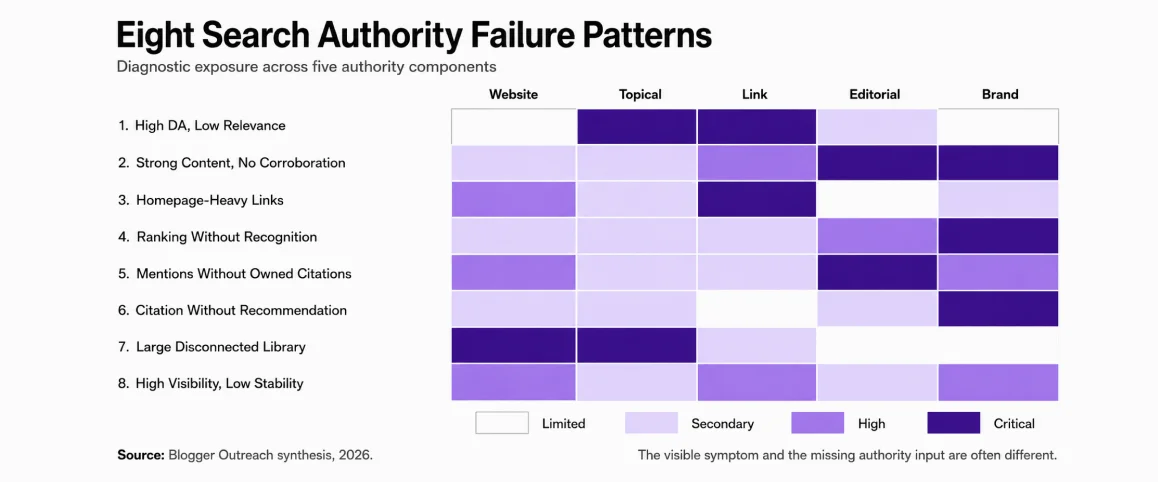
| Failure Pattern | Likely Weak Component | First Corrective Action |
| High DA, low relevance | Link/topical | Reclassify placements by topic and target-page fit |
| Strong content, no corroboration | Brand/editorial | Build independent references around original assets |
| Homepage-heavy links | Link/page | Prioritize defensible deep-link opportunities |
| Ranking without recognition | Brand | Develop named expertise and consistent brand-topic association |
| Mentions without owned citations | Editorial/entity | Publish and maintain canonical evidence pages |
| Citation without recommendation | Brand/commercial | Measure comparison and action prompts separately |
| Large disconnected library | Topical/technical | Consolidate intent and rebuild internal pathways |
| High visibility, low stability | Measurement/durability | Repeat observations and monitor cohorts |
The Blogger Outreach Search Authority Framework
This framework is designed to diagnose, act, and measure without pretending that Google or an AI model publishes a composite authority score.
Stage 1: Establish Four Visibility Baselines
Measure the last 90–180 days where data is available.
| Baseline | Minimum Measures |
| Rank | Top 3/10/20 keywords, non-branded visibility, priority-page positions, SERP features |
| Cite | Owned citation rate, cited third-party sources, citation recurrence, source diversity |
| Recommend | Brand recommendation rate, competitor share, named attributes, sentiment/accuracy |
| Stay visible | Ranking volatility, link retention, repeated-prompt recurrence, branded demand trend |
Do not combine the four into one score. A red/amber/green status is enough to show where the gap sits without creating false mathematical confidence.
Stage 2: Find The Authority Gap
Audit the five components:
- Website: Are priority pages crawlable, indexed, useful, fast enough, and connected?
- Topic: Does the site answer the subject completely without flooding it with duplicates?
- Link: Do relevant sites and pages support the destinations that need authority?
- Editorial: Are claims accountable, sourced, current, original, and reviewed where necessary?
- Brand: Is the name repeatedly and accurately associated with the subject across independent sources?
The gap is the weakest evidence layer relative to the outcome the business needs. To clarify:
- A ranking problem may be a target-page problem
- A citation problem may be a source-diversity problem
- A recommendation problem may be a weak brand-to-category association
Stage 3: Match Authority To The Target Page
Choose the page before choosing the publisher. For every target, document:
- The query and intent it must satisfy.
- The original value the page contributes.
- The internal pages that support it.
- The external evidence it still lacks.
- The audience and publisher categories able to validate it naturally.
- The business action that makes visibility valuable.
This reverses the common workflow in which a team buys an available placement and decides where to point it afterwards.
Stage 4: Build Relevant Third-Party Validation
Use the five-gate Authority Handoff: publisher, page, placement, destination, durability.
Depending on the gap, the work may include digital PR, expert commentary, original research promotion, manual blogger outreach, contributed articles, partner resources, reviews, comparison inclusion, or citation correction. Building authority with guest posts is one route, not the whole system.
The objective is a defensible external record: relevant sources can explain what the brand contributes, the context is natural, and the destination supports the claim.
Stage 5: Strengthen The Owned Source
Before scaling outreach, make the destination worth the reference.
- Replace unsupported figures with primary sources.
- Add original data, examples, or first-hand analysis.
- Clarify the author, reviewer, method, and update date.
- Resolve cannibalization and weak internal links.
- Improve the exact section a citation or reader needs.
- Keep structured data consistent with visible content.
- Confirm the page can be crawled, indexed, and rendered.
Stage 6: Measure The Outcome, Not Just The Delivery
A live-link count is an operations metric. Keep it, but do not mistake it for impact. Review at sensible intervals:
| Window | Useful Review |
| Live date | URL, status, anchor, context, indexability, disclosure, destination analytics annotation |
| 30 days | Crawl/index status, referral visits, initial query movement, prompt baseline changes |
| 90 days | Ranking cohorts, non-branded clicks, new mentions/citations, link retention, assisted actions |
| 6 months | Topic-level visibility, priority-page growth, branded demand, recurring citations, qualified conversions |
| 12 months | Durability, lost-link rate, search stability, cumulative brand/source diversity, commercial contribution |
External causes must be annotated: core updates, migrations, content changes, demand shifts, PR events, and product launches.
Blogger Outreach’s SEO case-study library is most useful when read this way: as campaign evidence with context and a time period, not as a promise that the same percentage will recur elsewhere.
The Dashboard To Use Instead Of One Authority Score
| Dashboard Group | Leading Indicators | Outcome Indicators |
| Website and page | Indexability, internal depth, page readiness | Priority-page visibility and conversions |
| Topic | Coverage gaps, overlap, expert assets | Ranking-page share across the cluster |
| Links | Relevant prospects, placement quality, retention | Target-page rankings, referral engagement, link diversity |
| Editorial | Source quality, author/reviewer coverage, original evidence | Citations, earned references, correction/freshness performance |
| Brand | Mention diversity, branded anchors, entity consistency | Branded demand, recommendation share, accurate AI answers |
What Search Authority Will Mean In 2027
The following are predictions, not measured findings.
1. Ranking And Citation Reporting Will Separate Permanently
The low current overlap between organic top-10 results and AI citations makes a single visibility chart inadequate. Search platforms may become more integrated.
But marketers will still need to know whether a brand ranked, supplied the evidence, received the mention, earned the recommendation, or won the click.
2. The Quality Of The Individual Source Page Will Receive More Attention
Domain scores will remain useful for prospecting. Campaign reviews will increasingly add linking-page traffic, indexability, internal support, topical relationship, original contribution, placement context, and retention.
The industry will move from “Which domain did we win?” to “Which source and destination relationship did we create?”
3. Original Datasets Will Become Valuable And More Heavily Challenged
Research earns links and citations because it contributes something unique. As more brands publish “studies,” readers and systems will face more weak samples, synthetic surveys, and recycled claims. Transparent methods, stable tables, raw or auditable evidence, and correction policies will become competitive advantages.
4. Brand-Entity Validation Will Move Closer To SEO Operations
PR, content, link building, review management, expert positioning, video, and structured business information all shape the external record around a brand. Teams will need shared ownership of the attributes they want independent sources and AI systems to associate with the business.
5. GEO Claims Will Face An Evidence Correction
The market will become less tolerant of universal “citation hacks.” Stronger studies will name the platform, model, mode, locale, date, prompt sample, repetitions, retrieval conditions, and downstream outcome. Citation gains without traffic, accuracy, or commercial value will no longer be presented automatically as success.
6. Search Authority Will Become A Resilience Concept
The most defensible brands will not rely on one keyword, publisher, model, or traffic source. Their authority will be distributed across useful owned resources, relevant editorial references, recognizable experts, accurate brand information, strong pages, and multiple discovery surfaces.
Research Limitations
This report synthesizes public studies with different query sets, platforms, countries, devices, client profiles, and definitions. Their values are not directly comparable unless the report explicitly says so.
Third-party keyword, traffic, backlink, mention, and citation tools estimate or sample reality. They do not expose a search engine’s complete index or ranking logic. AI responses can change between runs. Citation availability differs by product and mode. Brand-name matching can produce false positives or miss aliases.
Correlation does not establish causation. The Ahrefs brand study, for example, shows that brands with more mentions also appear more often in AI answers; it cannot prove the direction or isolate an intervention. The BO FinanceReference.com example contains multiple simultaneous changes and no control group.
The evidence cutoff is August 27, 2026. The report is not a full-calendar-year retrospective. Major product or ranking changes after that date are outside its scope.
Finally, “search authority” is an analytical framework created by Blogger Outreach. It should guide questions and investment decisions, not be marketed as a score used by Google or any AI platform.
Frequently Asked Questions
Search authority is a brand or website’s demonstrated ability to earn sustained rankings, citations, recommendations, and trust through strong pages, topic coverage, relevant links, editorial credibility, and independent brand validation.
No. Domain Authority is a third-party comparative metric. Search authority is BO’s broader evidence framework. It examines page, topic, link, editorial, brand, and visibility outcomes without claiming to reproduce Google’s systems.
Measure five components separately: website, topic, links, editorial quality, and brand recognition. Then track four outcomes: ranking, citation, recommendation, and stability. Do not hide them inside one composite score.
Yes, when they help users and search systems discover, understand, or validate a relevant page. Google confirms that link analysis and PageRank remain part of its systems. Relevance, context, crawlability, destination, and durability matter.
Yes, for a specific topic or query. A focused specialist can have strong pages, expert evidence, relevant links, and brand recognition despite a lower domain metric. DA remains a comparison aid, not a verdict.
The components overlap with patterns associated with AI visibility, including organic retrieval, distributed brand mentions, editorial citations, and useful original sources. No public framework can guarantee inclusion in a changing AI answer.
They do different jobs. A crawlable editorial link connects source and destination directly. A relevant mention can reinforce brand recognition and topic association. Quality, context, source diversity, and the campaign objective determine value.
There is no fixed period. Crawling, competition, page readiness, publisher access, brand maturity, query demand, and industry trust requirements all affect timing. Review early signals at 30–90 days and durability over 6–12 months.
Track priority-page rankings, non-branded visibility, AI mentions and citations, recommendation share, branded demand, relevant referring domains, linking-page quality, link retention, topic coverage, source diversity, referral engagement, and qualified actions.
Find the weakest evidence layer around a priority outcome. Improve the target page, connect the topic cluster, earn relevant third-party validation, strengthen editorial accountability, correct brand information, and measure whether visibility. And not merely the score changes.
Build Your Authority Based On Real Evidence
The Search Authority Report 2026 does not declare Domain Authority dead, backlinks irrelevant, or SEO replaced by GEO.
It reaches a more practical conclusion.
Domain-level metrics remain useful for comparison. Links remain part of Google’s ranking systems. Organic search still sends far more referral traffic than AI platforms. At the same time, AI summaries alter click behavior, AI citations overlap only partially with page-one rankings, and distributed editorial and brand recognition are strongly represented in the public evidence.
The winning unit is no longer “a high-DA link.” It is a coherent handoff:
A credible publisher supports a useful page through an editorially justified placement, pointing to a destination that deserves the reference, and the relationship remains live long enough to contribute.
Build enough of those relationships around strong content and a clear topic, and the brand creates evidence that can travel across systems.
That evidence is what search authority means in 2026.
Build the Signals That Search Engines Trust
Identify the authority gaps holding back your rankings, citations, recommendations, and brand visibility. Blogger Outreach can help connect priority pages with relevant publishers, useful content, and durable editorial placements.

