



Paid authority building through purchased link placements is very common today. However, this market is not consolidated. Besides, most link buyers don’t know how to evaluate a link.
The biggest question is: what problems or challenges surface in the market because of these limitations?
Firstly, link prices vary sharply from one vendor to another. Meanwhile, vendors don’t have strict quality-check parameters when choosing publishers.
In fact, multiple agencies send delivery reports that don’t evaluate link quality based on link survival duration, indexing status, or business impact.
This report analyzed the problem in depth, based on data from BloggerOutreach.io, external database public claims. We did not conduct a data-based audit using real stats for the complete Blogger Outreach placement portfolio.
| Finding | What the evidence supports |
| Guest-post inventory quality is highly uneven | BuzzStream classified 96.2% of its analyzed guest-post sites as low quality under its own combined DR/traffic thresholds. Only 1.37% qualified as high quality or top tier. This is a marketplace-dataset result, not a universal estimate of all websites. |
| Link insertions show a similar quality concentration | BuzzStream found 97.48% of sites offering link insertions in its measured subset fell into its low-quality tier. 143 of 41,783 complete-data sites were high- or top-tier. |
| Price is not a quality guarantee | BuzzStream reported a $461 average vendor guest-post price and $179 average insertion price. Traffic and niche fit need to be examined alongside DR. |
| Google’s paid-link policy is material | Google says paid links intended to manipulate rankings are link spam. Paid placements should be qualified with rel=sponsored or rel=nofollow. BloggerOutreach’s guest-post page currently says it does not add sponsored tags while promoting do-follow placements; this is a material policy and buyer-risk issue. |
| Public BloggerOutreach metrics need reconciliation | The website uses several different figures for campaigns, publishers, customers, placement volumes, and delivery times. The differences may reflect different scopes, but definitions and reporting dates are not consistently provided. |
| Some published case-study percentage labels are arithmetically inaccurate | Several displayed before/after values imply growth materially below the published percentage-increase labels. This report recalculates them and identifies the discrepancy without assuming the underlying source data are false. |
| External customer feedback is mixed and low-volume | In the latest page inspection, Trustpilot showed 3.1/5 from 12 reviews, including detailed complaints about delivery, removed links, and withdrawals, alongside positive reviews. Trustpilot notes that the company has not recently invited reviews and has not replied to negative reviews. |
| AI citation visibility is volatile | AirOps’ 2026 report found only 30% of brands remained visible from one answer to the next and 20% across five consecutive runs. A single AI-answer screenshot is not a robust performance measure. |
The Bottom Line: Link buyers use 2 usual parameters to judge whether they are buying a good placement. High DA and a permanent do-follow link placement. For most people, that’s all that matters.
But our research suggests link buyers should prioritize editorial quality, value for readers, and clear, verifiable delivery.
They also need constant monitoring and regular reporting to understand exactly how a placement is working.
Chapter 1: Scope, Evidence Hierarchy And Methodology
The evidence on which this research is based, research methods, and scope of work are elaborated in this study:
1.1 What This Report Covers
This report is based on a detailed analysis of paid guest blogging, Blogger Outreach’s own placement strategy, and link insertion campaigns.
It offers an introspective interpretation of how Blogger Outreach selects publishers, sets prices, and manages link placements within content. Other key aspects to watch for include whether your content (with niche link placements) is getting indexed and appearing in AI citations.
Eventually, buyer economics also deserves mention. Link buyers must individually inspect whether existing link placements convert into revenue, or whether channels exist that can make it happen.
1.2 Evidence Hierarchy
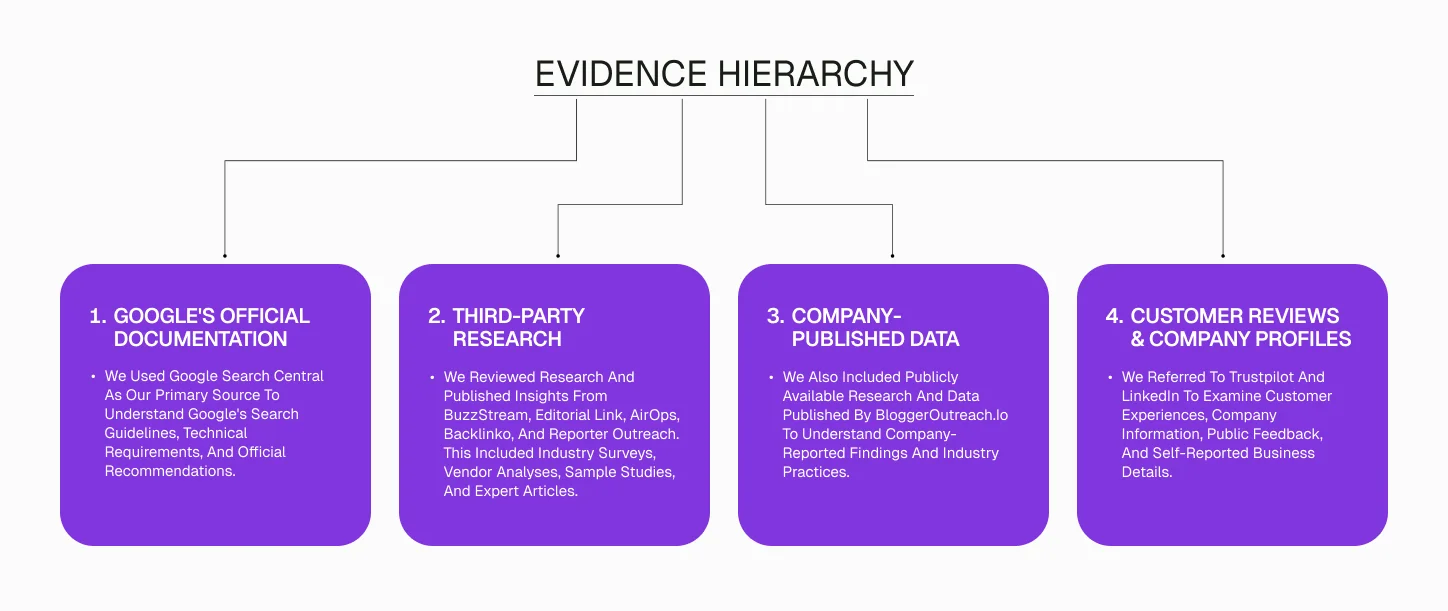
We used evidence in this order for the research:
- Google’s official Documentation: The primary data source is official publications of Google Search Central. We used this source to learn in depth about the technical paid placements on Google.
- Third Party Data: The main third-party sources we used in our report are BuzzStream, Editorial Link, AirOps, Backlinko, and Reporter Outreach. We used their publicly available databases for research. We mainly reviewed their surveys, vendor analyses, sample research, and other published articles.
- Company-published material: This research directly quotes research data from Bloggeroutreach.io. We considered all public data on the website’s pages credible.
- Customer reviews and company profiles: We also sourced neutral third-party and customer feedback from Trustpilot and LinkedIn. The sample, self-attested feeds, and guideline-based assertions make these platforms a good source of unbiased data.
1.3 What Cannot Be Measured Without Internal Data
This research did not use private sampling. Therefore, we did not compare the average prices of Blogger Outreach and competitor platforms.
We will publish an elaborate case study on the pricing and how to get the best price for your link placements.
This research did not consider any private datasets.
Therefore, this report does not calculate BloggerOutreach-specific average prices, publisher rejection rates, 3/6/12-month link survival, indexation rates, rel-attribute distributions, median time to index, client-level ranking lift, campaign ROI, or AI citation lift.
Public case studies and marketing statements are not substitutes for a complete placement-level dataset.
1.4 Statistical Caution
The report does not pool unrelated studies into one market average. The samples differ by vendor, geography, recruitment method, quality definition, period, and unit of analysis.
- Survey findings are self-reported.
- Company case studies are selected examples, not controlled experiments.
- Marketplace datasets can overrepresent sites listed for sale; tool-based traffic is estimated rather than from first-party analytics.
Chapter 2: The Paid Editorial Placement Market In 2026
The market includes several products often sold under the same ‘backlink’ label but with different costs and risks:
- Earned digital PR
- Managed outreach
- A New guest-post article
- A blogger review or mention
- Contextual insertion into an existing article
Pro Tip: Buyers should compare like with like.
2.1 Pricing Benchmarks
| Placement type/benchmark | 2026 published figure | Source and interpretation |
| Guest post via vendor | $461 average | BuzzStream; marketplace dataset with complete DR, traffic, and price data. |
| Guest post direct from publisher | $295 average | BuzzStream estimate; the study says its direct-cost approximation still includes assumptions. |
| Link insertion | $179 average | BuzzStream analysis; 62,916 of 421,259 listed sites offered insertion pricing. |
| Digital PR | 1,250–1,500 per link estimate; 5,000–10,000 per campaign range | BuzzStream pricing guide; campaign economics differ from one-off paid placements. |
| Acceptable high-quality backlink price | $508.95 average response | Editorial.Link survey question answered by 412 participants; willingness-to-pay, not observed market transaction price. |
The $461 guest-post vendor average is approximately 56% higher than the $295 direct-site estimate in BuzzStream’s analysis.
This should not automatically be described as a vendor markup. That said, the vendor may include prospecting, negotiation, content production, account management, quality screening, and delivery assurance.
The study’s direct price is an estimate, not a controlled comparison of identical services.
The $179 average insertion price is about 39% of the $461 guest-post vendor average. That difference is expected in part because an insertion does not require commissioning and publishing an entirely new article.
It does not mean an insertion is better value: the existing page’s relevance, quality, traffic, indexation and editorial context determine whether the opportunity is useful.
2.2 What Buyers Say They Spend
Reporter Outreach’s Q1 2026 survey of 500 SEO professionals found 64% reported monthly link-building budgets of $3,000 or more; 38% reported $6,000 or more.
Seventy-six per cent said they would pay at least $300 for a single high-quality link, while 47% would pay $500 or more. Fifty-eight per cent said their budgets had increased year over year.
Editorial.link did a 2026 survey of 518 professionals and found agencies allocated an average of 32.1% of SEO budgets to link building and in-house teams 36.03%.
It reported that 80.9% expected link building to become harder and more expensive over the next two to three years. These are survey responses, not audited spending records.
2.3 Tactics: Adoption Versus Perceived Performance
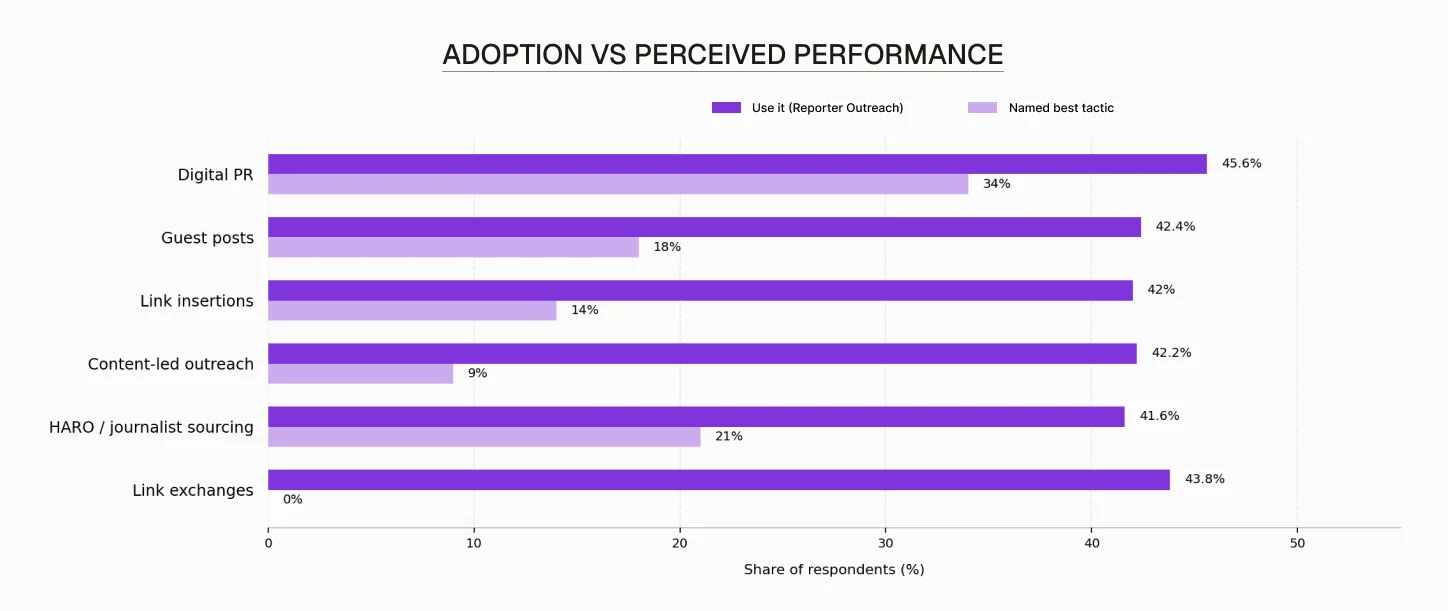
This survey suggests that guest posts and insertions remain widely used, but respondents were more likely to name digital PR or journalist sourcing as their best-performing method.
The survey categories separate proactive digital PR from reactive journalist sourcing, even though the two overlap conceptually. The result is directional, not a randomized comparison of campaign outcomes.
Chapter 3: Publisher Inventory: Quality, Traffic And Relevance
Quality, traffic, and content relevance are the secret sauces that make any link placement successful. How is the market spanning out around these 3 major parameters:
3.1 Guest-Post Marketplace Quality
BuzzStream’s 2026 study expanded its analysis to nearly 500,000 sites. After pruning for reliable data, it used 257,267 sites with complete Ahrefs DR, estimated organic traffic, and price information.
Its tier definitions were:
- Top Tier (DR 81+ and 100,000+ monthly organic traffic)
- High Quality (DR 71–80 and 50,000+ traffic)
- Mid Quality (DR 40–70 and 10,000–49,999 traffic)
- Low Quality (everything else)
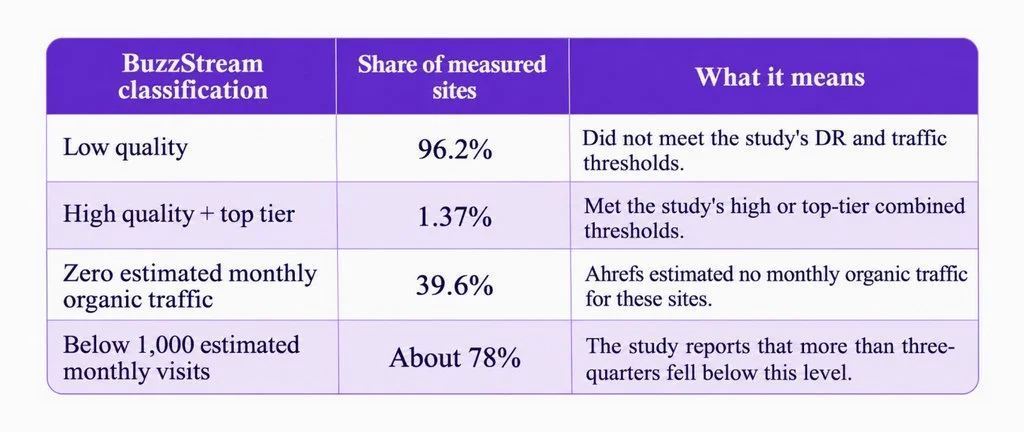
Here, the report considers BuzzStream’s operating niches. Again, these are not generalized parameters. Remember, a niche site with a specialized service charter can have enough editorial credibility. It might be catering to a selective niche of users only.
At the same time, a popular, large platform can have comparatively weaker editorial checks and balances. In fact, such sites can have multiple pages irrelevant to the links they place. So the main finding here is that vendors will often only cite the DR/traffic and such threshold metrics.
As a link buyer, you have to ask them a more valuable question:
“Do you actually have the publishers onboard who will be able to add relevance and value to my brand/business, through the placements?”
3.2 Link Insertion Inventory
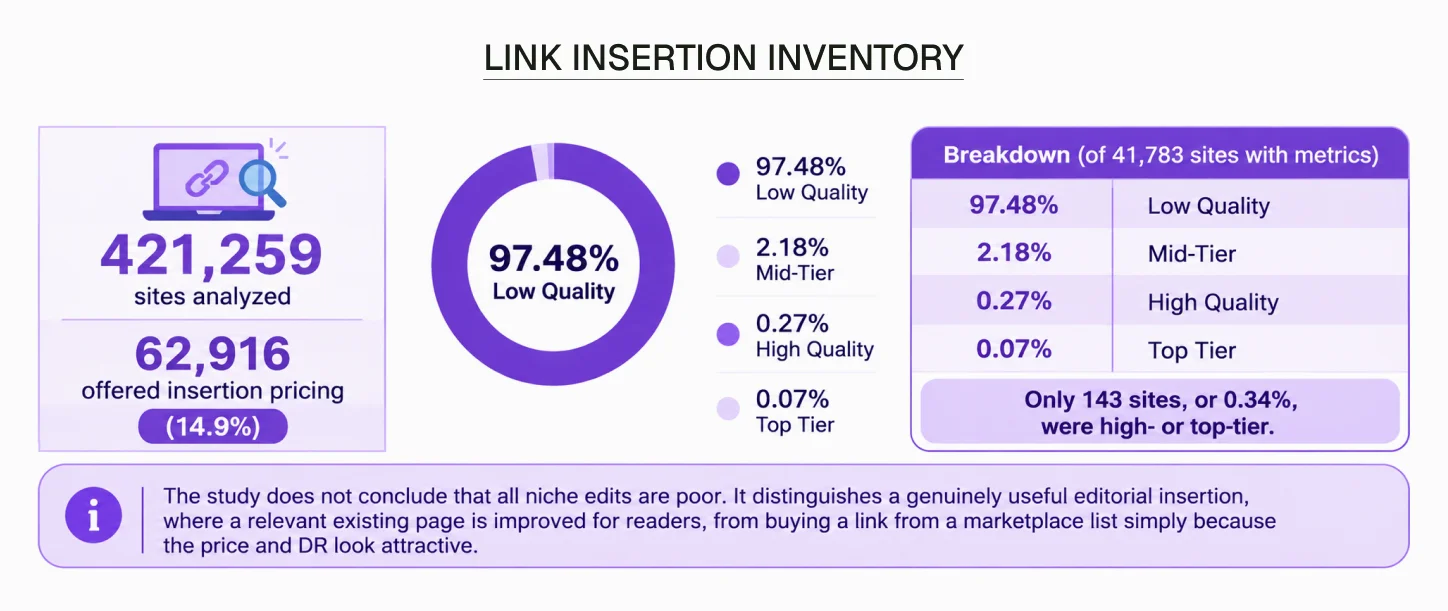
BuzzStream analyzed 421,259 sites and found 62,916 (14.9%) offered insertion pricing. In the subset with complete metrics (41,783 sites):
97.48% were classified as low quality under the same DR/traffic framework
- 910 (2.18%) were mid-tier
- 114 (0.27%) were high quality
- 29 (0.07%) were top tier.
Only 143 sites, or 0.34%, were high- or top-tier.
The study does not conclude that all niche edits are poor. It distinguishes a genuinely useful editorial insertion, where a relevant existing page is improved for readers, from buying a link from a marketplace list simply because the price and DR look attractive.
3.3 A Better Publisher Scorecard
| Dimension | Evidence a buyer should request | Why it matters |
| Audience | First-party audience data where available; traffic trend and geography | A domain metric does not prove that relevant people visit. |
| Topical fit | Publisher’s core subject, article topic, target page relationship | Relevance and reader usefulness are more informative than a generic score. |
| Editorial standards | Named editor, author review, corrections policy, originality | Helps distinguish editorial publication from a link inventory. |
| Outbound-link profile | Recent sample of commercial links, anchors, destinations and rel attributes | Reveals whether the site routinely sells followed links. |
| Organic visibility | Trend across 6–12 months, indexed page sample, ranking footprint | A single traffic estimate can conceal decline or thin content. |
| Page quality | Page-level traffic, internal links, update date, content depth | Domain-level strength does not guarantee page-level value. |
| Ownership and network signals | Ownership, hosting, template, analytics and cross-linking patterns | Can reveal coordinated networks, though no single signal proves a PBN. |
| Disclosure and attributes | Written confirmation of sponsorship disclosure and rel value | Critical for compliance with search-engine policies. |
3.4 DR And DA Are Not Google Scores
Ahrefs states that search engines do not use Domain Rating or similar third-party scores such as Domain Authority as direct ranking factors.
These are vendor-created comparative metrics. They can help compare backlink profiles, but they are not Google metrics and should not be treated as a promise of ranking improvement.
Google’s ranking-systems guide describes multiple page-level systems and link analysis/PageRank, not a public DA or DR threshold.
A publisher’s DR or DA should therefore be treated as one screening variable. It should never replace checks of topical relevance, organic traffic, page-level quality, editorial integrity, and link attributes.
Chapter 4: Paid Links, Editorial Disclosure And Google’s Policies
This is the most consequential policy issue in the report.
Google’s spam policies define link spam to include buying or selling links for ranking purposes, exchanging money for links or posts containing links, and paid advertorials or guest posts that pass ranking credit.
Google also says it recognizes that buying and selling links is a normal part of the web economy for advertising and sponsorship, provided paid links are appropriately qualified.
4.1 The Required Link Attributes
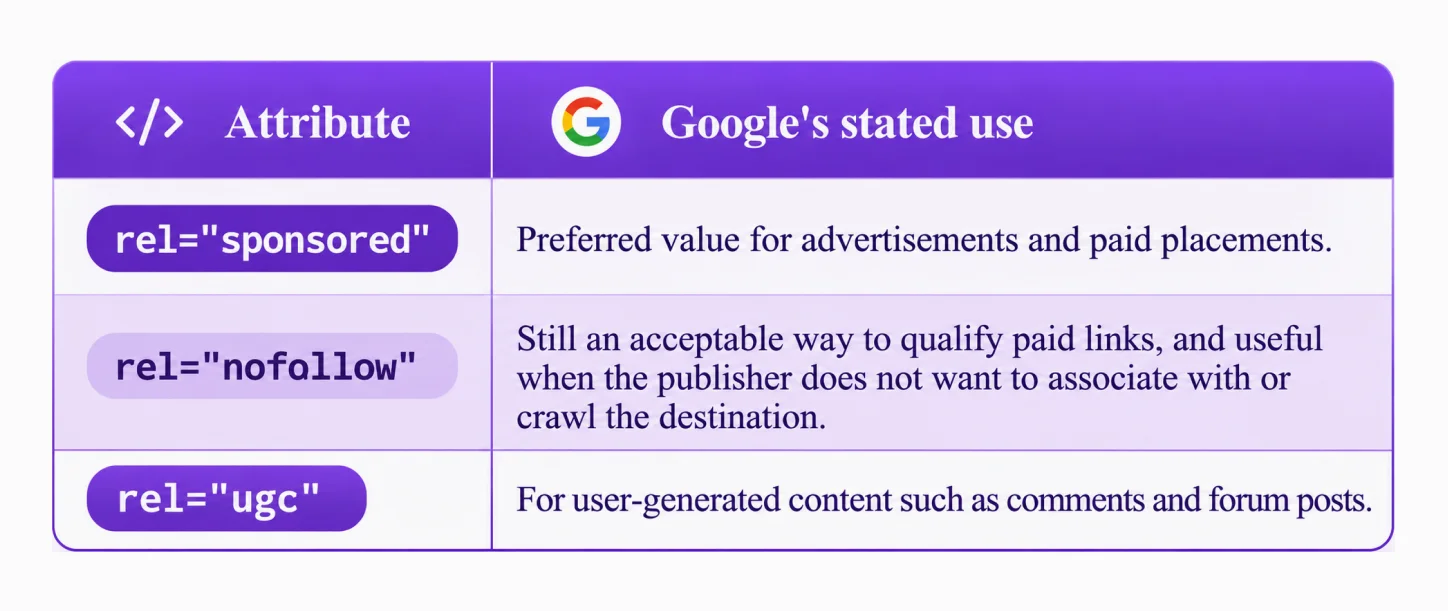
| Attribute | Google’s stated use |
| rel=”sponsored” | Preferred value for advertisements and paid placements. |
| rel=”nofollow” | Still an acceptable way to qualify paid links, and useful when the publisher does not want to associate with or crawl the destination. |
| rel=”ugc” | For user-generated content such as comments and forum posts. |
Google’s outbound-link documentation recommends rel=sponsored for paid placements and says rel=nofollow remains acceptable.
These attributes qualify the relationship; they do not guarantee a placement will be crawled, indexed, or cited.
4.2 Bloggeroutreach’s Public Positioning
At the time of review, BloggerOutreach’s guest-posting page described permanent do-follow links and stated that it does not add author boxes or sponsored tags. The same page promotes guest posting as an SEO service.
The public wording raises a clear question: if a placement is paid and is intended to influence rankings, how does the publisher qualify the link in line with Google’s published guidance?
This report does not inspect every live placement delivered by BloggerOutreach and therefore cannot determine the actual “rel-attribute” distribution across its inventory.
It does identify a mismatch between the public marketing statement and Google’s documented treatment of paid placements. A ‘white-hat’ label does not override Google’s policy.
4.3 Recommended Buyer Standard
• Require the publisher’s written policy for paid content and link attributes before purchase.
• Ask for the exact rel value on the published link and verify it in the page source after publication.
• Separate payment for editorial exposure from any promise of ranking credit.
• Do not treat ‘do-follow’, ‘permanent’ or ‘not labeled sponsored’ as quality guarantees.
• Ask vendors to explain how they handle disclosure laws and platform rules in each target market; this report is not legal advice.
Chapter 5: Indexation, Link Survival And Delivery Guarantees
Publishing a live link is not the main hustle. However, Blogger Outreach takes ownership at each stage to confirm that the post is discoverable and is indexed.
5.1 Live Is Not Indexed
A live URL is not proof that Google has indexed the page. Google’s technical requirements say a page must be accessible to Googlebot, return HTTP 200, and contain indexable content to be eligible, but eligibility does not guarantee indexation.
A buyer should distinguish:
(1) URL resolves
(2) target link is present
(3) link attribute is recorded
(4) page is indexable
(5) page is indexed
(6) page receives organic traffic
5.2 “Permanent” Is A Contractual Or Operational Claim, Not An Observed Survival Rate
BloggerOutreach publicly describes placements as permanent and says links remain live without removal clauses. The public help center also describes permanent links.
Those statements do not provide a measured survival curve. Without a placement-level dataset and scheduled rechecks, the report cannot state what percentage of placements remain live at 3, 6, 12, or 24 months.
A buyer should request a written definition of permanence: whether it applies to the article URL, the target link, the link attribute, the page’s indexability, or all four.
A live article whose target link has been removed or changed to nofollow is not equivalent to a surviving followed link.
5.3 Minimum Monitoring Framework
| Check point | Minimum fields |
| At publication | Publisher URL, target URL, HTTP status, link present, anchor, rel value, article title, publication date. |
| 30 days | Live status, target link, rel value, indexation check, page canonical and robots directives. |
| 90 days | Repeat all checks; record first observed indexation if available. |
| 180 days | Repeat checks; flag removed links, changed attributes, deleted pages, and redirects. |
| 365 days | Repeat checks; calculate one-year observed survival and replacement/refund outcomes. |
| Monthly thereafter | For longer-term studies, retain exact check date and censoring reason. |
For survival analysis, report the share still live among placements old enough to have reached each checkpoint.
Do not classify recent placements as failures or successes at 12 months. Record replacement links separately rather than silently counting a replacement as survival of the original URL.
Chapter 6: Search Outcomes: What Can And Cannot Be Inferred
Google confirms that link analysis and PageRank remain part of its ranking systems. That does not mean every acquired link improves rankings. Or that you can isolate its effect from content quality, internal linking, technical changes, brand demand, competition, seasonality, and algorithm updates.
6.1 The Case For Relevance Over Raw Authority
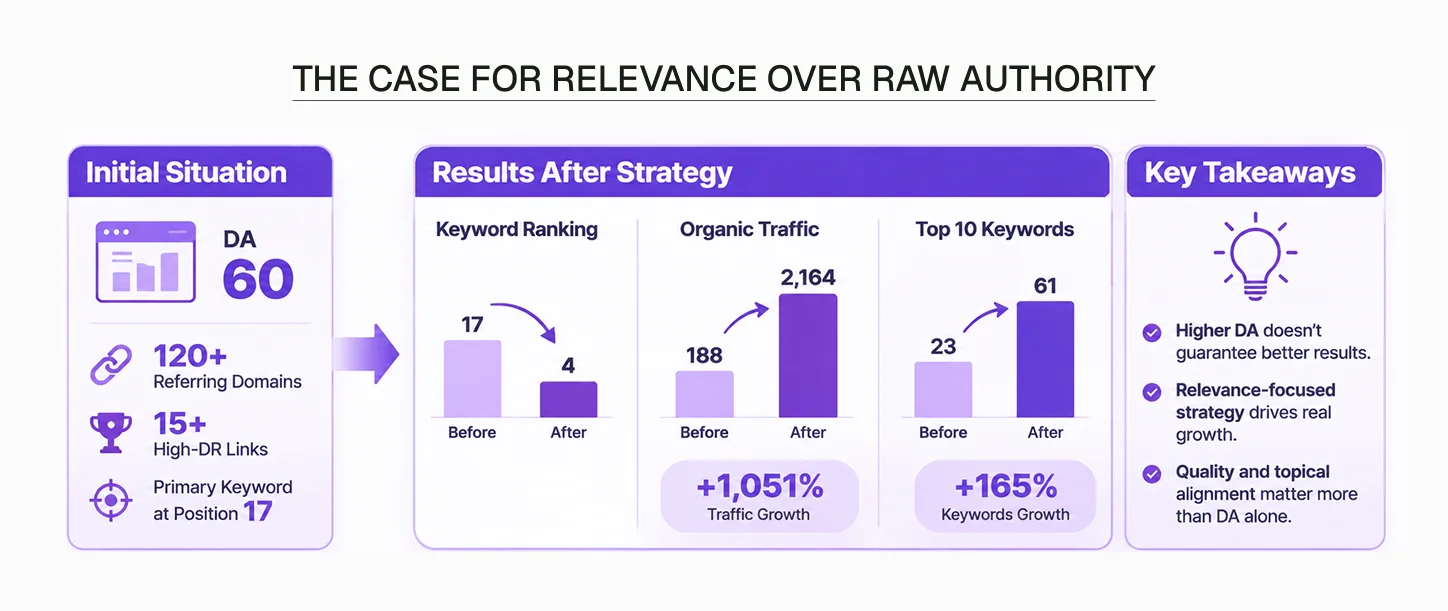
BloggerOutreach’s FinanceReference case study describes a site with DA 60, 120+ referring domains and 15+ high-DR links whose primary keyword remained at position 17.
The case study reports a later move to position 4 after a relevance-focused strategy, organic traffic moving from 188 to 2,164, and top-10 keywords increasing from 23 to 61.
The before/after arithmetic for traffic (+1,051%) and top-10 keywords (+165%) is internally consistent.
This is a useful illustrative case because it challenges a simplistic ‘higher DA equals better result’ approach.
6.2 Case-Study Arithmetic Audit
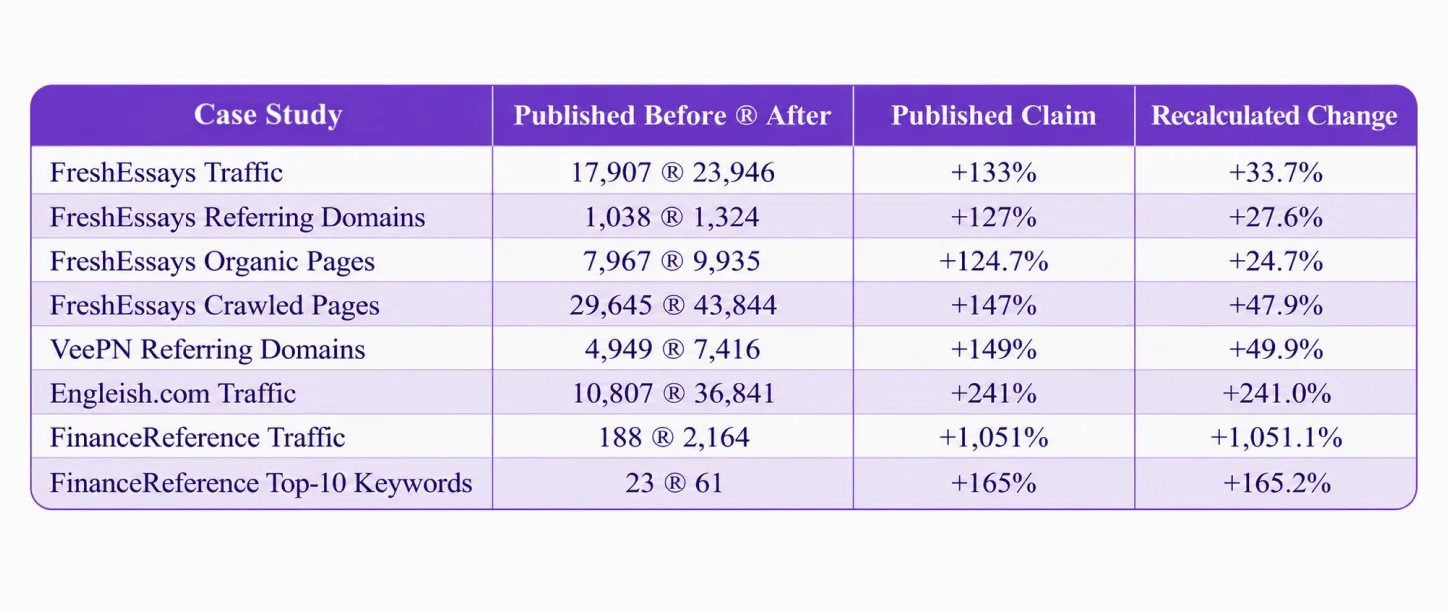
The first five examples show a consistent mathematical pattern: the published percentage appears in several instances to describe the after-value as a percentage of the baseline (for example, 23,946 is 133.7% of 17,907), while the copy labels it as percentage growth.
Percentage increase is calculated as (after – before) ÷ before × 100. Use the recalculated values unless the company can document a different baseline or metric definition.
Engleish.com and FinanceReference use conventional percentage-growth calculations consistently. The Engleish case reports estimated monthly organic traffic increasing from 10,807 to 36,841 (+241%).
6.3 Brandslane Cybersecurity Case Study
The Brandslane case study describes a six-month campaign with 60 placements on DA 50+ publishers, starting at DA 24, and 8,200 monthly organic visitors.
It reports +17,400 monthly organic visitors, DA 24 to 51, and an estimated additional organic revenue of $62,000 per month.
However, the headline’s ‘176% traffic boost’ is not straightforward to reconcile with the stated +17,400 visitors and baseline of 8,200.
Simply put, if +17,400 is the increment, the final value would be 25,600, and the increase would be about 212.2%. Meanwhile, if 176% is the increase, the increment would be about 14,432.
**The report page should clarify which figure is correct.
Chapter 7: AI Search Citations: Opportunity And Measurement Limits
AI-generated answers introduce a visibility outcome beyond conventional rankings: whether a brand, product or publisher is named or cited in a generated answer.
This outcome is distinct from a backlink, a brand mention, a referral visit, and a Google ranking.
7.1 AirOps 2026 Findings
AirOps’ 2026 State of AI Search report says only 30% of brands remained visible from one answer to the next and only 20% remained visible across five consecutive runs.
It reports that about 85% of brand mentions came from third-party pages rather than owned domains.
Meanwhile, in its commercial-search analysis, brands were 6.5 times more likely to be cited through third-party sources than through their own domains.
AirOps also reports a similar correlation strength between nofollow and dofollow links in its dataset (Spearman correlations of 0.509 and 0.504 respectively).
This association is reported by the study, not evidence that buying nofollow placements causes AI citations or that both link types have identical effects across all systems.
7.2 What The Research Means For Paid Placements
Third-party coverage may help AI systems encounter brand information, but not every third-party page is equally useful.
A citation from a relevant, trusted, frequently referenced source may be more valuable than a large volume of low-quality pages. AI answers can also change across runs, platforms, locations, account states, and prompt wording.
7.3 A Repeatable AI Citation Experiment
• Build 60–100 non-branded buyer prompts across 5–8 niches; publish the exact prompt list.
• Test ChatGPT with search, Perplexity, Google AI Overviews, and Gemini where available; record product, mode, region, and date.
• Run each prompt five times on at least three separate days, using fresh sessions.
• Record whether the brand is mentioned, whether a source URL is cited, whether the publisher domain appears, and where it appears in the answer.
• Compare placement domains with matched control domains by niche, traffic, and DR; publish matching rules.
• Report prompt-level and domain-level confidence intervals; do not claim that a placement caused a citation merely because the publisher domain appeared.
Chapter 8: Buyer Economics And Vendor Accountability
Don’t assume the cheapest link will deliver the best results. So how can you judge the deliverables of a good vendor nd decide what your link placement is actually supposed to deliver:
8.1 Compare Cost Per Outcome, Not Only Cost Per Link
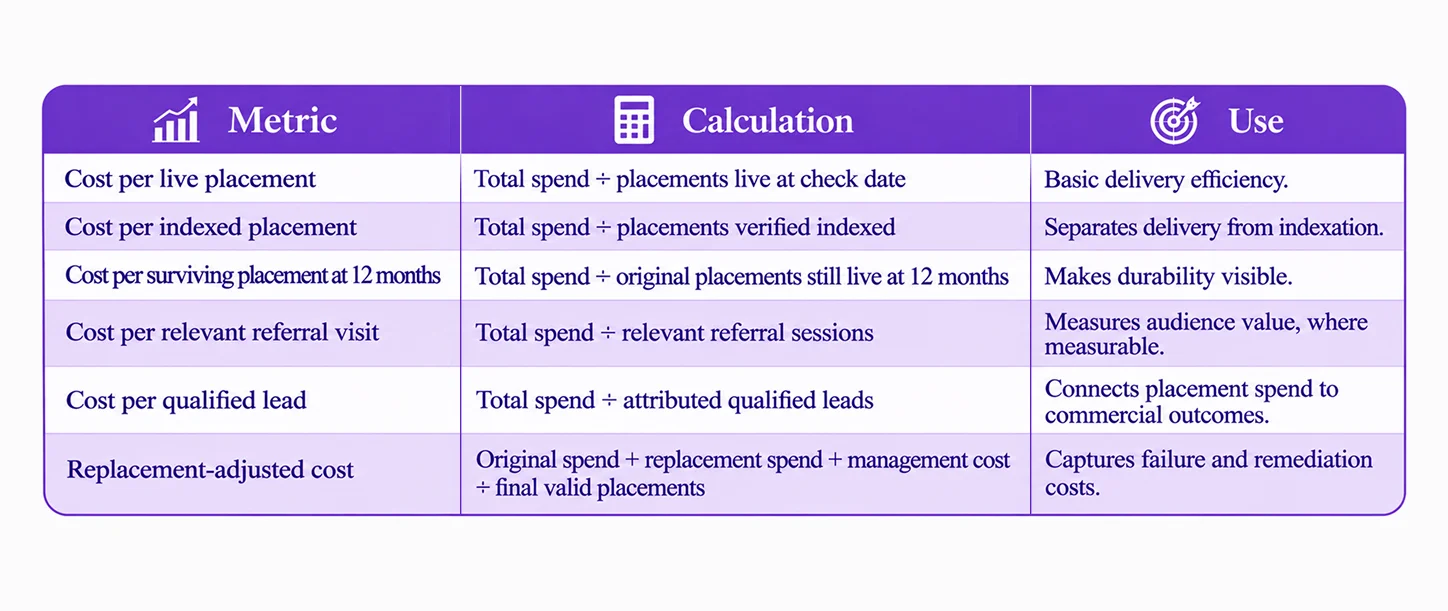
A low unit price can become expensive if the page is not indexed, the link disappears, the publisher is irrelevant, or the placement does not reach the intended audience.
Buyers should track several denominators.
8.2 Vendor Questions Buyers Should Ask
• Can I see a sample publisher list before payment, including page-level traffic and niche relevance?
• What is the exact definition of ‘permanent’ and what happens if a page or link disappears?
• What percentage of placements are still live at 6 and 12 months, and how is that measured?
• What percentage of pages are indexed at 30, 60, and 90 days? Which index-check method is used?
• What “rel attribute” is applied to paid links? Is the placement disclosed to readers?
• Are prices inclusive of content, negotiation, outreach, revisions, taxes, and reporting?
• What happens if a publisher changes the link to nofollow or removes the page?
• Can the vendor provide dated traffic snapshots and the actual published URL?
• Does the vendor report unsuccessful placements and refunds, not only successful deliveries?
Chapter 9: Bloggeroutreach Public-Company Evidence Audit
The company website describes a service portfolio spanning blogger outreach, guest posting, link building, content writing, AI-powered link building, GEO, Wikipedia and Grokipedia services.
Its public pages position the offering as manual, publisher-vetted, niche-relevant, and available with white-label reporting.
9.1 Public Metrics That Require Definitions
| Metric | Public figures found | Audit note |
| Campaigns/projects | 5,000+ campaigns; 1,200+ SEO projects | Could represent different periods or service scopes; no dated reconciliation published. |
| Publishers/bloggers | 12,000+ publishers; 2,000+ publisher network; 2,000+ manually selected; 4,700+ bloggers | May distinguish total marketplace, active sites and relationship-managed bloggers; definitions are not made consistent. |
| Customers/brands | 1,100+ agencies and brands; 1,000+ brands; 500+ brands | No definition of active, cumulative, unique or paying customer. |
| Placement volume | 5,000+ monthly placements | Not reconciled with campaign totals or the active publisher count. |
| Backlinks | 67,000+ | No time window, deduplication method or live-status definition. |
| Turnaround | 24–48 hours; 72 hours; 7–21 business days; Monday-to-Friday wording | Could refer to different milestones; pages should specify whether these mean first shortlist, draft, publisher acceptance or live URL. |
| Experience | Since 2017; LinkedIn founded 2018; 10+ years | Public dates are inconsistent and should be standardised. |
| Trust rating | Homepage displays 4.9 on Trustpilot; Trustpilot profile showed 3.1/5 from 12 reviews at inspection | The displayed homepage badge and live profile should be reconciled; profile rating is dynamic. |
The current pricing page says engagements are custom-quoted and describes delivery in 7–21 business days. The guest-posting page separately states 5,000+ monthly placements, a 2,000+ publisher network, 98% satisfaction, and a 72-hour average turnaround.
The homepage separately promotes 12,000+ publishers, 1,100+ agencies and brands, and 5,000+ campaigns. Each statement should include a clear definition, data owner, measurement date, and update cadence.
9.2 External Profile And Customer Feedback
The LinkedIn company profile describes BloggerOutreach as a privately held company in Kolkata, lists a founding year of 2018, and gives a company-size band of 11–50 employees.
The clientele includes 1,000 global brands and services from more than 1,500 content websites. These are profile disclosures, not audited corporate records.
At the latest Trustpilot page inspection on 2 November 2026, the profile displayed 3.1/5 from 12 reviews; 42% were five-star and 50% one-star.
Trustpilot also stated that the company had not recently invited customers to review and had not replied to negative reviews.
Annexure 1: What Buyers Should Do In 2026
- Start with the page and audience. Choose a publisher because its readers and editorial subject fit the target page, not because its DR is high.
- Use DR/DA as screening context only. Add organic traffic trends, page-level visibility, outbound-link review and editorial quality.
- Separate paid exposure from ranking manipulation. Require appropriate sponsored or nofollow qualification for paid placements.
- Ask for evidence at delivery. Verify URL status, target link, anchor, rel attribute, page quality and indexability.
- Measure survival over time. Require 90-day, 180-day and 365-day checks, with lost links and replacements reported separately.
- Track business outcomes. Referral sessions, qualified leads and revenue are more meaningful than domain metrics alone.
- Use repeated AI visibility tests. Report platform, prompt, location, date, run count and source citations.
- Audit the vendor’s own claims. Reconcile review ratings, publisher counts, placement volume, turnaround and case-study arithmetic.
- Prefer earned editorial coverage where the campaign can create genuine news, research or audience value. Paid placements and earned PR are not interchangeable.
Chapter 10: Bloggeroutreach’s Pricing, Publisher Economics And Competitive Position
If you are planning to buy paid link placements, you have the right to choose your vendor rationally and logically.
Here is an unbiased, qualitative comparison of Blogger Outreach and other competitors in the market. So, what are the key factors that you need to learn before you decide whose prices are suitable for your campaign:
10. 1 Beyond Placement Counts: What Does A Client Actually Pay?
Link-building providers are often compared by the number of publishers in their network, Domain Rating (DR), estimated organic traffic and the number of placements they deliver. These figures matter, but they don’t tell the full commercial story.
A buyer also needs to know how much a placement costs, whether the provider negotiates, how much it pays publishers, and how reliably it can secure placements.
The figures supplied by BloggerOutreach (BO) provide a basis for examining these questions. They cover client-facing prices, publisher acquisition costs, negotiated orders, publisher responses and a sample of 10 publishers across different niches and authority levels.
The analysis distinguishes between four types of information:
- BloggerOutreach data: operational figures supplied for this report.
- Competitor pricing: rates publicly advertised by other link-building providers.
- Industry benchmarks: independent or industry-published market research.
- Analysis: calculations and interpretations based on these figures.
This comparison matters, and the differentiating elements we found are highly significant. A publisher’s charge to Blogger Outreach
is not the price paid by BO’s client.
Similarly, an advertised competitor rate is not necessarily the final amount a customer pays after discounts or negotiations.
The objective is to establish:
- where Blogger Outreach is competitively priced
- where its commercial model offers flexibility
- where additional performance data is needed
10.2 Bloggeroutreach’s Client-Facing Placement Prices
Blogger Outreach reports the following average client prices:
| Placement category | Average price charged to clients |
| Normal-niche guest post or link insertion | 90–130 |
| Grey-niche guest post or link insertion | 150–200 |
These figures place Blogger Outreach in the lower-to-middle part of the managed link-building market when compared with several providers that publish fixed prices by DR tier.
The distinction between normal and grey niches is also relevant. Grey niches can involve more specialised publisher requirements, greater commercial sensitivity and fewer suitable publishing opportunities. Their higher average price reflects a different type of placement demand.
However, the price alone does not establish quality. A $100 placement on a relevant website with real visitors may be more useful than a $200 placement on a website with little topical relevance or weak traffic.
For this reason, price comparisons should consider publisher authority, traffic, niche relevance, content requirements and service inclusions.
10.3 Head-To-Head Pricing Comparison
The following comparison uses prices publicly displayed by competing providers. These are advertised rates, not independently purchased placements.
Prices may change, and different providers include different services in their packages.
| Provider | Published price | Pricing model |
| BloggerOutreach | 90–130 normal niche; 150–200 grey niche | Average client prices supplied for this report |
| FatJoe | $110 DR20+; $138 DR30+; $248 DR40+; $386 DR50+ | Fixed price by DR and traffic tier |
| Outreach Monks | $99 DR20+; $119 DR30+; $179 DR40+; $249 DR50+ | Per-placement pricing with content and manual outreach |
| Loganix | From $200 Essential; from $400 Authority | Managed guest-post packages with traffic and DR requirements |
| Editorial.Link | $375 for one; $350 each in a five-link package; $300 each in a 20-link package | Premium managed editorial placements |
| Adsy | $45 link insertion; $50 article posting; $200 content placement in the displayed listings | Marketplace with separate content and placement options |
Sources: provider pricing pages accessed for this report: FatJoe, Outreach Monks, Loganix, Editorial.Link and Adsy.
10.3.1 How Blogger Outreach Compares With Managed Providers
- Against FatJoe: Blogger Outreach’s normal-niche range of 90–130 overlaps with FatJoe’s $110 DR20+ and $138 DR30+ placements.
Blogger Outreach’s upper normal-niche price is still below FatJoe’s displayed DR30+ rate. FatJoe’s DR40+ and DR50+ rates are considerably higher than BO’s average normal-niche range.
- Against Outreach Monks: Blogger Outreach’s normal-niche range overlaps with the $99 DR20+ and $119 DR30+ tiers. Its grey-niche range of 150–200 also overlaps with the $179 DR40+ tier.
Outreach Monks includes a 750-word article, manual outreach, traffic verification, publisher approval and a six-month replacement guarantee in its published offer.
- Against Loganix: Loganix’s Essential package starts at $200 for DR/DA 30+ sites with 100–500+ monthly visits.
Its Authority package starts at $400, with an average DR/DA of 40+ and at least 1,000 monthly organic visits.
Blogger Outreach’s normal and grey-niche averages are below these entry prices. However, the package requirements and service scope are different.
- Against Editorial.Link: Editorial.Link publishes a base rate of $375 per backlink, with package rates falling to $300 per link. It specifies average DR50–90 and 5,000+ traffic for its standard packages.
Blogger Outreach’s supplied average prices are substantially lower, but this is a premium editorial-service comparison rather than a direct comparison of identical publisher inventory.
10.3.2 Marketplace Pricing Needs A Separate Comparison
Adsy displays lower entry prices, including $45 for link insertion and $50 for article posting. It also lists content placement options at higher prices.
These marketplace rates should not be compared directly with a managed outreach service. A marketplace buyer may need to select publishers, assess their relevance, compare metrics and manage content requirements.
The displayed price may also change when you add writing, additional content, or special-topic fees.
The same distinction applies to other publisher marketplaces: a low listing price does not necessarily include the same level of research, negotiation, quality control or campaign management.
Pricing conclusion: BO’s reported client prices are competitive with several managed providers. Its normal-niche rates overlap with FatJoe and Outreach Monks, while its grey-niche rates fall below some higher DR-based managed-service tiers.
It is not accurate to call Blogger Outreach the cheapest provider in the market, because lower-priced marketplace listings are available. A more defensible position is that Blogger Outreach offers competitive placement pricing with a flexible negotiation model.
10.4 Negotiated Pricing: Flexibility Beyond Fixed Rate Cards
One of Blogger Outreach’s more distinctive commercial figures is its order-negotiation rate.
According to Blogger Outreach’s internal database:
- 20% of orders are delivered at the original quoted price.
- 80% of orders are negotiated.
- In most negotiated cases, Blogger Outreach accepts lower prices proposed by clients.
This means most Blogger Outreach orders do not remain at the initial quoted amount.
This approach differs from providers that primarily display fixed prices by DR tier. FatJoe and Outreach Monks, for example, publish set per-placement rates. Their prices provide predictability, while BO’s reported approach gives clients more room to negotiate according to their available budget.
This flexibility can help agencies managing multiple clients, businesses with fixed campaign budgets, and buyers who need to adjust placement costs across different niches.
However, the 80% figure describes how often negotiation takes place. It does not establish the average discount.
Blogger Outreach should calculate the difference between the original quote and the final agreed price to strengthen this argument.
For example, if a placement is initially quoted at $150 and the final agreed amount is $120, the negotiated reduction is 20%.
Calculate the actual average and median reductions from completed orders rather than inferring them from the negotiation rate.
Commercial takeaway: Blogger Outreach’s strongest claim here is not that every order is cheaper than a competitor’s. It is that clients have a greater opportunity to negotiate the quoted price instead of choosing only from a fixed rate card.
10.5 Publisher Acquisition Costs: What Blogger Outreach Pays To Secure Placements
The client-facing price is only one part of the commercial model. Blogger Outreach also supplied the rates charged by 10 publishers to the company.
These are publisher acquisition costs, not the final prices charged to clients.
| Publisher | Niche | DR | Monthly traffic | Publisher charge to Blogger Outreach |
| dmletterstudio.com | Branding, marketing and design | 22 | 1,560 | $20 |
| mspcompanies.us | Business and data | 26 | 3,567 | $200 |
| myarticlescout.com | Digital marketing and SEO | 30 | 2,927 | $30 |
| youraverageguystyle.com | Men’s fashion | 29 | 3,084 | $60 |
| Salary.sg | Business and finance | 37 | 6,083 | $90 |
| kenji.ai | Marketing and media | 33 | 7,417 | $100 |
| everythingnew.net | Business and technology | 50 | 11,539 | $50 |
| playbattlesquare.net | Business and gaming | 48 | 8,040 | $30 |
| jarvisreach.io | Digital marketing | 41 | 8,425 | $120 |
| onlineplaymyworld.com | Business and gaming | 43 | 8,003 | $30 |
Source: Publisher rates and metrics supplied by BloggerOutreach. DR and traffic figures are the supplied values and have not been independently re-verified for this report.
10.5.1 What the sample shows
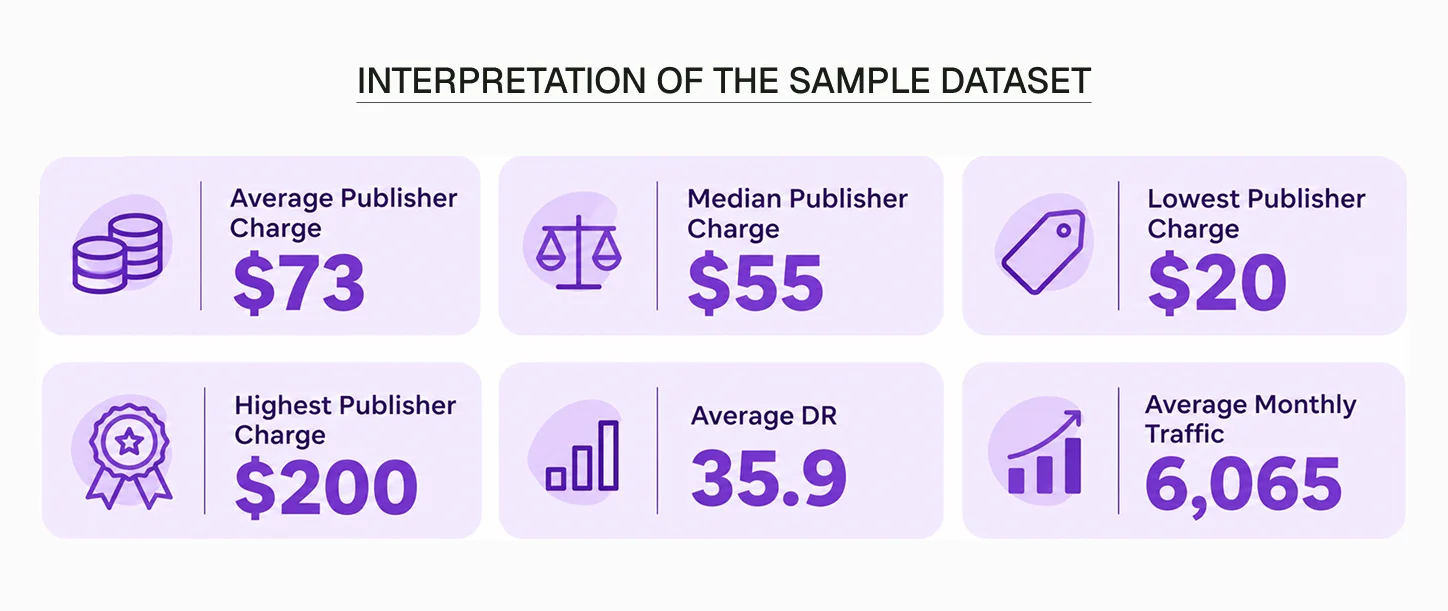
Across the 10 publishers:
| Metric | Result |
| Average publisher charge | $73 |
| Median publisher charge | $55 |
| Lowest publisher charge | $20 |
| Highest publisher charge | $200 |
| Average DR | 35.9 |
| Average monthly traffic | 6,065 |
The average publisher charge is higher than the median because one publisher charges $200. This is why the median is useful: it shows that half of the listed publisher rates are $55 or lower.
The sample also demonstrates that publisher prices do not necessarily increase in line with DR or traffic. For example:
- Everythingnew.net has DR50 and 11,539 estimated monthly visits, but charges Blogger Outreach $50.
- Jarvisreach.io has DR41 and 8,425 visits, but charges $120.
- Mspcompanies.us has DR26 and 3,567 visits, but charges $200.
- Playbattlesquare.net has DR48 and 8,040 visits, but charges $30.
This variation suggests publisher pricing depends on more than authority and traffic. Niche demand, editorial policies, content requirements, publisher availability and negotiation can also affect the rate.
A high DR does not automatically mean that a publisher is more expensive, and a lower price does not automatically mean that a website is a better deal.
10.5.2 Price by DR band
The sample can be grouped by authority level:
| DR band | Publishers in sample | Average publisher charge | Average monthly traffic |
| DR20–29 | 3 | $93.33 | 2,737 |
| DR30–39 | 3 | $73.33 | 5,476 |
| DR40–50 | 4 | $57.50 | 9,002 |
The average publisher charge falls across these bands, even though average traffic rises.
This does not mean higher-DR placements are generally cheaper. The sample is small and contains different niches and commercial arrangements. It does show that BO’s acquisition costs are not determined by DR alone.
10.5.3 How This Compares With Wider Market Pricing
BuzzStream’s 2026 guest-post study analysed nearly 500,000 websites, with more than 257,000 sites retained for its pricing analysis.
It reported an average vendor guest-post price of $461 and an estimated direct price of $295. Its DR-based analysis reported the following average direct prices:
| DR band | BuzzStream estimated direct guest-post price |
| DR20–29 | $225 |
| DR30–39 | $290 |
| DR40–49 | $384 |
| DR50–59 | $470 |
Source: BuzzStream’s 2026 link-building pricing research.
The Blogger Outreach sample’s publisher charges are lower than these broad market estimates in the corresponding authority ranges.
For example, its three DR30–39 publishers have an average acquisition cost of $73.33, compared with BuzzStream’s estimated direct guest-post price of $290 for that band.
10.6 What Does A Client’s Money Actually Buy?
The difference between publisher acquisition cost and the client-facing price matters when assessing BO’s commercial model.
For example, consider a hypothetical placement:
| Item | Amount |
| Publisher charge to Blogger Outreach | $60 |
| Final price charged to client | $110 |
| Difference | $50 |
The $50 difference is not net profit. It is the gross spread before content creation, outreach, account management, quality checks, payment processing, technology and other operating costs.
The Actual Gross Spread Is:
Gross Spread = Client Price − Publisher Charge
Gross Spread (%) = [(Client Price − Publisher Charge) ÷ Client Price] × 100
Example:
- Client price: $110
- Publisher charge: $60
- Gross spread: $110 − $60 = $50
- Gross spread percentage: ($50 ÷ $110) × 100 = 45.45%
This is the gross spread, not net profit. It does not account for content, outreach, operations or other business expenses.
This should be calculated using matched transactions. The average publisher cost from the 10-site sample cannot be subtracted from the average client price range to produce a reliable Blogger Outreach margin, because the publisher costs and client prices are not matched order by order.
A larger dataset could reveal which niches offer the best balance between publisher cost and client affordability. It could also help Blogger Outreach understand where negotiation is sustainable and where a lower client price leaves insufficient room to deliver the service properly.
10.7 Publisher Acceptance, Rejection And No-Response Rates
Blogger Outreach supplied three operational figures:
| Measure | Reported result |
| Overall acceptance rate | 70–80% |
| Rejected orders | 30 out of every 250 orders |
| Order rejection rate | 12% |
| Publisher no-response rate | 15% |
Order Rejection Rate = (Number of Rejected Orders ÷ Total Orders) × 100
Order Rejection Rate = (30 ÷ 250) × 100 = 12%
Example:
- Total orders: 250
- Rejected orders: 30
- Order rejection rate: (30 ÷ 250) × 100 = 12%
This means 12 out of every 100 orders are rejected, or 30 out of every 250 orders.
The 15% no-response rate is calculated from all publishers contacted, not from client orders.
The 70–80% acceptance figure is BO’s reported overall acceptance measure across publisher responses, accepted client orders and accepted placement opportunities.
Keep it separate from the order rejection and publisher no-response figures until a more detailed breakdown is available.
These measures have different denominators. Do not add them together or treat them as stages of one conversion funnel.
10.7.1 Why These Figures Matter
A large publisher database does not automatically mean that every publisher is suitable or available for a campaign. What matters is whether publishers respond, accept the proposed opportunity and eventually complete the placement.
Blogger Outreach’s figures provide a starting point for measuring that process.
The 12% rejection rate gives an order-level view of unsuccessful requests. The 15% no-response rate shows the proportion of contacted publishers who do not reply. The overall acceptance figure provides a broader view of acceptance across the process.
10.7.2 Comparison With Industry Outreach Benchmarks
A 2025 survey of 821 link-building professionals by The Backlink Company reported an average outreach success rate of 7.9%. It also reported that links went live an average of 8.3 days after the initial outreach email.
Source: State of Link Building 2025 survey.
BO’s reported 70–80% acceptance figure should not be compared directly with the survey’s 7.9% success rate. The survey measures outreach success across respondents, while BO’s overall acceptance measure combines different operational stages. The definitions and denominators differ.
The industry survey is still useful because it shows how difficult cold outreach can be at scale. BO’s internal figures could become a meaningful competitive benchmark once it records the number of publishers contacted, responses received, accepted opportunities and completed placements separately.
10.8 Delivery Guarantees: Compare The Promise With The Actual Outcome
Several competitors publish delivery or replacement guarantees.
- FatJoe advertises a lifetime link guarantee and a money-back guarantee on its blogger outreach service.
- Outreach Monks advertises a six-month replacement guarantee if a placement is removed.
- Loganix advertises guaranteed placement and states a typical turnaround of around three weeks.
- BloggerOutreach states on its public pricing page that most guest posts and placements are delivered within 7–21 business days, with a replacement or full refund if it cannot deliver within the agreed timeframe.
Sources: FatJoe, Outreach Monks, Loganix and BloggerOutreach pricing.
These policies are not identical. A delivery guarantee concerns whether the order gets completed. A replacement guarantee concerns what happens if a published link is later removed.
Neither policy alone proves that a provider has a higher long-term link survival rate.
Blogger Outreach should therefore report its actual delivery rate and replacement rate alongside its policy. That would let buyers compare the service commitment with the results achieved.
10.9 Where The Current Evidence Supports A Competitive Advantage
The available figures support a stronger position in some areas than others.
| Comparison area | BloggerOutreach evidence | Competitive assessment |
| Normal-niche pricing | 90–130 | Competitive with published FatJoe and Outreach Monks entry and mid-tier rates |
| Grey-niche pricing | 150–200 | Below some higher DR-based managed-service rates, including FatJoe DR40+ and Loganix Authority |
| Negotiation flexibility | 80% of orders negotiated | A potential differentiator against providers with fixed public rate cards |
| Publisher acquisition cost | 20–200 across the 10-site sample | Shows access to varied publisher price points; not yet a representative network-wide average |
| Publisher acceptance | 70–80% overall measure | Potentially useful operational evidence, but needs a consistent denominator |
| Order rejection | 12% | Clear order-level figure based on 30 rejected orders per 250 |
| Publisher no response | 15% | Useful operational figure, measured separately from order rejection |
| Placement completion | Not yet supplied | Needs a separate measured rate |
| Long-term link survival | Not yet supplied | Cannot yet establish an advantage |
| Indexation and time to index | Not yet supplied | Cannot yet establish an advantage |
| Ranking lift and ROI | Selected case studies available | Needs campaign-wide reporting, not only individual examples |
| AI citation lift | No complete BO-wide dataset supplied | Needs fixed prompts, platforms and measurement periods |
This comparison shows that Blogger Outreach has evidence to support a competitive pricing and negotiation position. It also has initial operational figures that could become a differentiator if they are reported consistently.
It does not yet have sufficient data to claim that its placements survive longer, get indexed faster or produce higher ranking and AI visibility improvements than competitors.
10.10 What Bloggeroutreach Should Measure To Strengthen Its Position
Pricing and publisher response data are useful, but the next stage is to connect them with placement quality and client outcomes.
Blogger Outreach should build a quarterly report that follows each placement from the initial order through to its long-term performance.
| Measurement | Recommended reporting |
| Average and median price | By niche, placement type, publisher DR and traffic band |
| Negotiation reduction | Median and average percentage reduction from initial quote to final price |
| Publisher acceptance | Accepted opportunities divided by valid opportunities submitted |
| Order rejection | Rejected orders divided by all eligible orders |
| Publisher no response | Publishers without a response divided by all publishers contacted |
| Placement completion | Live placements divided by accepted orders |
| Link survival | Percentage of eligible placements still live after 3, 6 and 12 months |
| Indexation | Percentage of published placement pages indexed after 30, 60 and 90 days |
| Link attributes | Distribution of follow, nofollow, sponsored and combined attributes |
| Time to index | Median days between publication and confirmed indexation |
| Ranking lift | Median keyword movement and percentage of tracked keywords improving |
| Campaign ROI | Attributed incremental profit or revenue, with the calculation method disclosed |
| AI visibility | Brand mentions and cited source URLs across a fixed set of AI prompts |
Each metric should include its sample size, reporting period, measurement method and exclusions. Blogger Outreach should also retain unsuccessful outcomes in the dataset rather than reporting only successful placements.
For paid placements, the report should record the actual rel attribute on the published link.
Google’s guidance on qualifying outbound links recommends rel=”sponsored” for paid links and accepts rel=”nofollow” for this purpose.
Report the presence or absence of an attribute accurately, not as a guarantee of ranking value.
10.11 Final Assessment: Where Bloggeroutreach Stands
The available figures support three commercial strengths.
1. Competitive placement prices: Blogger Outreach’s reported normal-niche prices of 90–130 overlap with several managed providers’ published entry and mid-level rates. Its grey-niche prices of 150–200 are below some higher-tier managed-service offers.
2. A flexible negotiation model: Blogger Outreach’s internal database reflects that 80% of orders are negotiated and that it generally accepts lower client proposals. This gives buyers more room to work within campaign budgets than a strictly fixed rate card.
3. Varied publisher acquisition costs. The 10-publisher sample shows rates from $20 to $200 across different niches, DR levels and traffic bands.
It also shows that DR alone does not determine publisher pricing. This gives Blogger Outreach a basis for matching placements to different campaign budgets. Although a larger sample is needed to establish network-wide cost patterns.
The publisher acceptance, rejection and no-response figures add another layer of operational evidence. They should be published separately and supported by clear definitions.
The next important measure is placement completion: how many accepted orders actually become live links?
The most credible competitive position, then, is not that BloggerOutreach is the cheapest or outperforms every competitor on every metric.
It is that Blogger Outreach combines competitive client pricing, flexible negotiation and access to publishers at varied acquisition costs.
By adding transparent delivery and long-term performance reporting, it can give buyers a clearer picture of what their money actually delivers.
Chapter 11: Conclusions
Paid editorial placements are not a single, consistent product. The market includes useful editorial partnerships, routine sponsored content, low-value link inventory, and link schemes designed primarily to pass ranking credit.
Buyers who compare them only by DA, DR, or headline price face avoidable risk.
Evidence from the 2026 market points to a scarcity problem. In BuzzStream’s marketplace analysis, only a small fraction of guest-post sites met its combined high-traffic and high-DR thresholds, and the high-quality segment commanded a substantial price premium.
Link insertion inventory was even more concentrated in the low tier. Survey evidence suggests buyers continue to spend, but cost, scalability, and ROI measurement remain persistent challenges.
Google’s policy creates a non-negotiable distinction between paid editorial exposure and paid ranking credit. A vendor that sells paid placements should make link qualification transparent.
Promoting unqualified do-follow links as a standard feature is difficult to reconcile with Google’s published guidance when the links are paid and intended to manipulate rankings.
For BloggerOutreach, public evidence supports a broad service offering, a substantial set of company-reported activity metrics, and a library of case studies.
It also exposes areas that need work: metric definitions, inconsistent scale claims, delivery-time clarity, review-profile reconciliation, case-study arithmetic, and explicit paid-link
compliance. These are not reasons to dismiss the business; they are concrete opportunities to make its claims more auditable.
The most credible next step is to publish a transparent placement-quality and accountability standard. To ensure that, you have to:
- Disclose paid-link attributes
- Publish a methodology for PBN screening
- Define what counts as an active publisher
- Make refunds and replacement performance easy to understand
- Show survival and indexation results when measured and correct case-study calculations
Appendix A. Data Dictionary For Future Public Reporting
| Field | Recommended definition |
| placement_id | Unique ID for one link on one publisher URL. |
| placement_type | New article / guest post / insertion / earned editorial mention / other. |
| publisher_domain | Canonical publisher domain. |
| publisher_url | Exact live page URL. |
| target_url | Destination URL. |
| publish_date | Date the page first became publicly accessible. |
| price_usd | Total client price for the placement; disclose inclusions. |
| publisher_fee_usd | Publisher payment, if tracked and publishable. |
| dr_at_order / da_at_order | Third-party metric, provider, date and value. |
| traffic_at_order | Estimated monthly organic traffic, provider, date and geography. |
| topic_match | Defined reviewer rubric and score. |
| link_rel | Observed rel attribute at publication and each recheck. |
| live_30d / live_90d / live_180d / live_365d | Link and page survival flags at fixed checkpoints. |
| indexed_30d / indexed_90d | Index status with method and exact check date. |
| referral_sessions | First-party analytics sessions attributed to the publisher, where available. |
| replacement_flag | Whether a replacement was issued; keep original placement status separate. |
| ranking_baseline / ranking_followup | Tracked keyword, target URL, location, device, tool and dates. |
| ai_prompt / ai_platform / ai_run | Exact prompt, platform, region, date and repeat number for citation testing. |
Appendix B. Recommended Formulas
- Percentage change = (After – Before) ÷ Before × 100.
- Live survival at 180 days = original placements still live at day 180 ÷ placements eligible for a 180-day check.
- Indexation rate at 90 days = pages verified indexed by day 90 ÷ placements eligible for a 90-day check.
- Cost per surviving placement = total placement expenditure ÷ original placements still live at the selected checkpoint.
- Replacement rate = original placements replaced by the vendor ÷ original placements delivered.
- AI citation rate = answers containing a citation to the tested domain ÷ total valid answer runs. Report brand mentions separately from source citations.
For ranking analysis, use a pre-registered observation window and, where possible, matched comparison pages. Report median position change, share improving/unchanged/declining, confidence intervals and known confounders. Do not use a single average rank change as proof of causality.
Appendix C. Research Source Library
All sources below were accessed or reviewed for this report on or before 2 November 2026. Dynamic pages (especially pricing and review profiles) may change. The description identifies how each source was used.
[1] BloggerOutreach homepage: First-party company claims, service positioning, displayed Trustpilot rating and publisher/campaign/customer counts.
[2] BloggerOutreach pricing: First-party pricing model, custom quotation, delivery and refund/replacement statements.
[3] BloggerOutreach blogger outreach services: First-party claims on backlink totals, campaigns, brands, publisher network, manual outreach and permanence.
[4] BloggerOutreach link building services: First-party service claims and operational metrics.
[5] BloggerOutreach guest posting services: First-party claims on monthly placements, publisher count, DA range, satisfaction, turnaround, and sponsored tags.
[6] BloggerOutreach content writing services: First-party article volume, industries, delivery and writer claims.
[7] BloggerOutreach About Us: First-party founding and customer-scale statements.
[8] BloggerOutreach help centre: Public help articles, including permanent-link statements.
[9] BloggerOutreach case study library: First-party case-study index and reported results.
[10] BloggerOutreach industry reports: Existing Search Authority Report listing.
[11] BloggerOutreach HTML sitemap: Page and post inventory used to identify relevant public content.
[12] Engleish.com case study: First-party traffic growth case study: 10,807 to 36,841 monthly estimated organic visits.
[13] FinanceReference high-DA case study: First-party example of high DA without target-keyword ranking progress and subsequent relevance-led strategy.
[14] Brandslane cybersecurity case study: First-party six-month campaign and reported growth figures.
[15] VeePN case study: First-party 2024 traffic and referring-domain claims.
[16] FreshEssays case study: First-party 2024 case-study metrics used for arithmetic audit.
[17] CapCut case study: First-party 2024 case-study metrics.
[18] Trustpilot BloggerOutreach profile: Third-party customer review profile; rating and review counts are dynamic, and reviews are self-selected.
[19] BloggerOutreach LinkedIn company profile: Third-party company profile with company description, founded year and size claims.
[20] BuzzStream guest-post cost study (2026): Independent vendor-published analysis of nearly 500,000 guest-post sites; 257,267 sites with complete DR, traffic and price data.
[21] BuzzStream link-insertion cost study (2026): Independent analysis of 421,259 sites; link insertion availability, pricing, and quality-tier distribution.
[22] BuzzStream link-building pricing guide (2026): Synthesis of 2026 guest-post, link-insertion and digital PR pricing.
[23] Reporter Outreach State of Link Building 2026: Survey of 500 SEO professionals in Q1 2026; self-reported budgets, methods, prices and AI-search beliefs.
[24] Editorial.Link Link Building Statistics 2026: Survey of 518 SEO professionals; budgets, pricing, risks and outsourcing.
[25] Google spam policies: Official policy on paid links, link spam and qualifying paid placements.
[26] Google qualify outbound links: Official rel=sponsored, rel=nofollow and rel=ugc guidance.
[27] Google link best practices: Official guidance on crawlable links and paid links.
[28] Google ranking systems guide: Official description of page-level ranking systems and PageRank/link analysis.
[29] Google technical requirements: Official statement that eligibility does not guarantee indexation.
[30] Ahrefs DR/DA ranking-factor explanation: Ahrefs explanation that third-party DA/DR scores are not Google ranking factors.
[31] Backlinko 12-million outreach email study: 2019 analysis with Pitchbox; 8.5% reply rate and outreach personalisation/follow-up findings.
[32] AirOps State of AI Search 2026: Vendor-published research on citation volatility and third-party source visibility.
Appendix D. Pre-Publication Verification Checklist
- Recheck every dynamic price, Trustpilot score, review count and service claim on publication day.
- Ask BloggerOutreach to confirm the definitions and dates behind public campaign, publisher, customer, backlink and placement figures.
- Correct the FreshEssays and VeePN percentage labels or publish a calculation note.
- Clarify Brandslane’s +17,400 visitors versus 176% headline arithmetic and document the revenue-estimation method.
- Review the guest-post page’s ‘no sponsored tags’ statement against Google policy and update buyer-facing disclosures.
- Publish a clear policy for paid-link rel attributes and publisher disclosure.
- Do not add any company-specific survival, indexation, rejection, ranking or AI-citation rate unless supported by a reproducible dataset.
- Keep dated copies of source pages and the calculation workbook used for this edition.