



| Client: Engleish.com Industry: English language and grammar education Primary focus: Organic visibility, authority building, relevant link acquisition |
Engleish.com Grew From 10,807 to 36,841 Monthly Organic Traffic. When the client was onboarded, the website had 10,807 monthly organic traffic.
Today, the site records 36,841.
That is an increase of 26,034 monthly visitors, or approximately 241% growth. In practical terms, Engleish.com has more than 3.4 times its original organic traffic.
The site now also carries a DA of 55 and DR of 61, giving it a substantially stronger authority profile alongside the traffic growth.
The Growth At A Glance
| Metric | Before Blogger Outreach | After Growth | Change |
| Monthly organic traffic | 10,807 | 36,841 | +241% |
| Traffic increase | — | +26,034 | +26,034 visitors |
| Domain Authority | — | 55 | Current DA |
| Domain Rating | — | 61 | Current DR |
The most critical factor in this Engleish case study isn’t the stark growth in visitors/traffic. The client brand is scaling in a competitive market where many others explain grammar, vocabulary, idioms, and use cases hands-on.
Hence, one thing is clear. Your growth does not only depend on the number of pages you publish or how high your ranking goes.
In fact, you need to find the right balance between editorial mentions, the site’s ecosystem, and your content’s effectiveness. And that’s where Blogger Outreach can play a decisive role.
The Client: Engleish.com
We will introduce the client in this section. Simply put, Engleish is a resource library for learning English, from beginner to intermediate and professional levels.
Engleish.com is an English-language resource built around practical learning. The client’s online content centres on grammar, idioms, synonyms/antonyms, similes, abbreviations, and daily language trivia.
The site, at the same time, makes conceptualisation of english language easier. Therefore, non-native learners can also benefit from the site’s content.
Its content covers grammar, words, verbs, idioms, synonyms, antonyms, metaphors, similes, abbreviations, and everyday language usage.
In addition, the site simplifies concepts that can otherwise be difficult for learners and general readers to understand. That creates a natural SEO growth opportunity for your brand.
Blogger Outreach found that Engleish.com had a strong base of tutorial content (visual and written). So Blogger Outreach first promoted that content and then built an airtight authority-building strategy.
The Starting Point: 10,807 Monthly Organic Visitors
When Engleish.com came to Blogger Outreach, its estimated monthly organic traffic stood at 10,807. That baseline matters because it shows the site was not starting from zero.
It already had search visibility, indexed content, and a functioning organic footprint. The task wasn’t simply to “get traffic.”
The opportunity was to build on an existing foundation and help the website compete at a larger scale. This distinction shaped the approach.
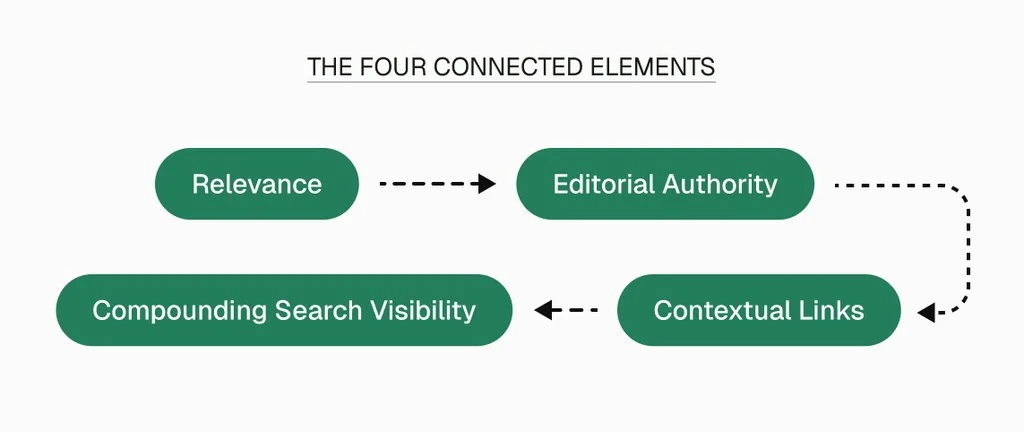
Rather than viewing backlinks as isolated deliverables, Blogger Outreach’s strategy can be understood through four connected elements:
Relevance → Editorial authority → Contextual links → Compounding search visibility
This strategy works well when you align it with adding only niche-relevant backlinks. However, link quality depends on more than how strong the link’s domain is.
In fact, what matters more is carefully inspecting where you place the link. That should be the biggest factor, the area of priority and focus.
While working for Engleish.com, that was the project team’s primary focus.
The Challenge Was Bigger Than Traffic
Engleish.com was competing for a tough spot. All similar content creators in the english language education market were also creating good content.
So, product-wise, the company was already in a good spot. However, that meant we needed a new differentiator. In fact, most others were also using long-tail keywords in tier content, as Engleish was also doing!
The brand is dealing with an important niche here. That’s why it is critical that we focus on authority building. Otherwise, the page visibility would have diminished. That’s where niche-based, relevant link building becomes so important.
So how did we actually plan for Engleish.com? At first, we wanted to send compact external signals to the pages. That also helped ensure a smooth flow of genuine traffic and improve the quality of editorial placements.
The Blogger Outreach Approach
If you want to build curated link authority, you need to choose where you place links carefully. You also need strong backlinks from either major market players or sources that matter to the audience.
1. Build Authority Around Relevance
There should be a basic sync between the publisher’s niche and the client’s target niche. That said, our client Engleish.com was working in the education niche.
That’s why we could reach out to a vast range of publishers. At least we did not have to focus only on the high DA/DR ones.
We published a blog on link relevance where we emphasized the same area. We were keenly targeting metrics. But our greater focus was on working with a consolidated publisher strategy and never being out of sync from it.
2. Prioritize Contextual Editorial Placements
A backlink can exist even if it is not particularly useful. More precisely, the placement itself matters. But how do we judge placement quality?
At first, see where does the link appears. Also, query what the article is about.
The other things to check out are:
- What is the surrounding paragraph discussing?
- Does the destination page genuinely help the reader?
- Does the anchor text make sense?
The answers to these questions determine whether a link feels editorial or merely inserted for SEO.
Blogger Outreach’s current link-building methodology emphasizes in-content editorial placements and manual publisher outreach.
Simply put, a contextual mention in a relevant article aligns better with the site’s subject than an unrelated placement chosen simply because the publishing domain has strong metrics.
3. Use Content As The Bridge Between The Publisher And The Client
Link building works better when the surrounding content is logical and fits naturally. That content around that area should not be mismatched with the hyperlink or the anchor text.
This is where Blogger Outreach’s content component becomes important. The publisher needs content that meets its editorial standards. At the same time, the client needs the article to reinforce its subject expertise.
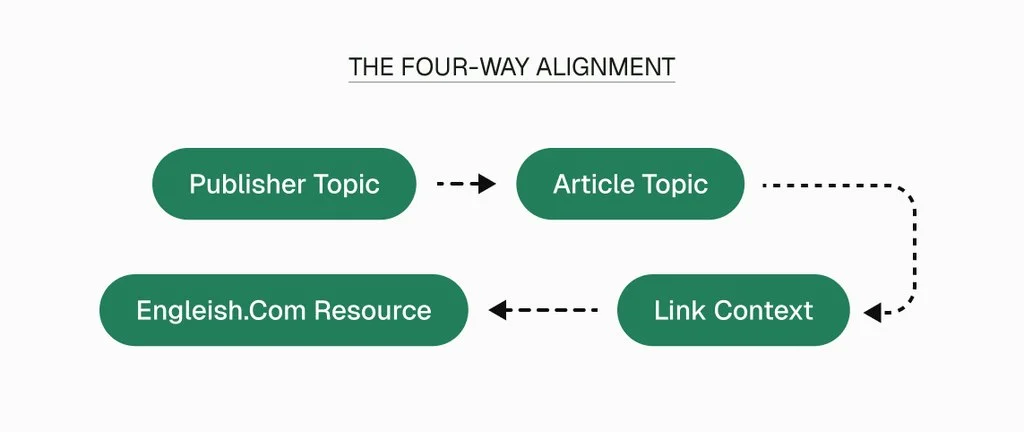
The link also needs to fit naturally into that discussion. And the reader needs to gain something from clicking it. Now, that creates a four-way alignment:
Publisher topic → Article topic → Link context → Engleish.com resource
The guest-posting vertical of Blogger Outreach is also based on the same principle. First, our team breaks down sites by current traffic and checks where they’re a topical fit for the client.
Then we check the DA. We don’t pick publishers based solely on their DA.
4. Keep Anchor Text Natural And Semantically Connected
Anchor text is another part of the authority equation.
Using the same exact-match phrase repeatedly can make a link profile look manufactured. A stronger approach is to use branded, partial-match, descriptive, and contextual anchors where appropriate.
Blogger Outreach’s own anchor text guide explains the importance of descriptive and natural anchor text while warning against excessive exact-match optimization.
For Engleish.com, this matters because the site’s subject is broad enough to support a large semantic vocabulary.
A natural authority profile can reference the site through phrases connected to:
- English grammar
- vocabulary resources
- language learning
- word meanings
- grammar explanations
- English usage
- language resources
- writing guidance
The objective is not to make every link look like a keyword. It is to make every mention make sense.
Why The Traffic Growth Matters
Engleish.com’s traffic moved from 10,807 → 36,841. That represents +26,034 monthly visitors and +241% organic traffic growth.
The increase is significant because it shows the campaign built on an existing organic foundation rather than creating visibility from nothing.
Traffic growth at this level also changes the website’s economics.
More organic visitors mean more opportunities for users to discover the site’s educational resources, move between related topics, revisit the brand, and enter through different search journeys.
The value compounds because search visibility is not confined to one keyword.
A grammar website can rank for thousands of related queries across words, expressions, usage questions, comparisons, definitions, and learning needs.
That makes authority particularly important.
The stronger the site’s overall search position becomes, the more opportunities it has to compete across that long-tail landscape.
DA 55 And DR 61: What They Tell Us
Engleish.com now reports:
DA: 55
DR: 61
These figures provide useful external benchmarks for evaluating the site’s link profile. But don’t interpret them as Google’s own authority scores.
DA is a Moz metric, while DR is an Ahrefs metric. They help benchmark domains and evaluate publisher opportunities.
But they are not Google ranking scores. Blogger Outreach’s current explanation of website authority makes this distinction clear.
For this case study, what matters more is the relationship between Traffic growth, authority metrics, relevant content, and external references, rather than any one number in isolation.
That is a stronger way to interpret the Engleish.com result.
Why Engleish.com’s Growth Is Relevant To Generative Search
The traffic story began in conventional organic search. But the underlying assets that supported that visibility also matter in a world shaped by AI-generated search results.
A site such as Engleish.com benefits from being:
- Topically focused
- Consistently useful
- Referenced by external publications
- Supported by credible contextual links
- Well-connected through relevant content
- Associated with a recognizable subject area
Those characteristics matter because generative search systems need authoritative sources to retrieve, compare, summarize, and cite.
Google’s documentation explains that its generative Search features use retrieval techniques to identify relevant and up-to-date web pages from the Search index.
This is where traditional SEO and the search generative experience overlap.
The objective is not to replace SEO with “AI optimization.” The objective is to build a site that deserves visibility in both environments.
From Link Building To Search Authority
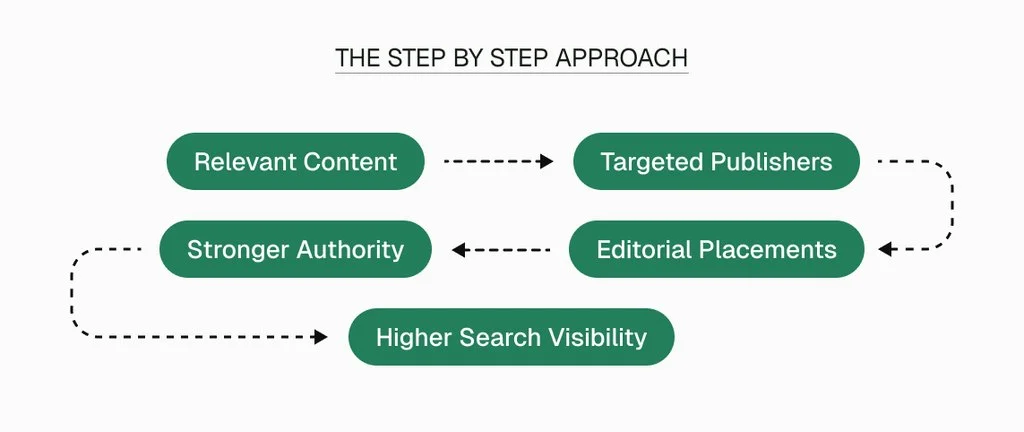
A key takeaway from the Engleish.com campaign: traffic growth isn’t just about collecting backlinks. It’s about building a relevant system. Here’s the winning formula:
Relevant Content → Targeted Publishers → Editorial Placements → Stronger Authority → Higher Search Visibility
That is also why Blogger Outreach has increasingly positioned its offering around authority rather than isolated link transactions.
Its current service architecture connects blogger outreach, link building, guest posting, content writing, and newer AI visibility services into a single search strategy.
For brands entering the search generative experience era, that distinction matters even more. An AI answer cannot cite a site that has no meaningful presence in the underlying information ecosystem.
A brand needs content worth referencing. It needs pages worth retrieving. Moreover, it needs external signals that reinforce its relevance. And it needs a consistent footprint across the subjects it wants to own.
What Blogger Outreach Did Differently
The Engleish.com case highlights several characteristics of Blogger Outreach’s model.
Manual Outreach Rather Than Bulk Automation
Blogger Outreach currently states that its outreach is manual, with pitches researched and personalized rather than sent through automated bulk systems.
That matters because domain metrics alone cannot evaluate publisher relevance.
Relevance Before Vanity Metrics
A DA number can help establish a quality threshold. It does not establish editorial fit.
The current Blogger Outreach methodology explicitly argues for evaluating relevance, organic traffic, publisher health, and editorial context alongside third-party metrics.
Editorial Content Rather Than Link-Only Execution
The link must be placed in content that matches it contextually. Do not place a random link in any unrelated content.
This creates a more natural relationship between publisher, topic, audience, and client.
Authority Building As A Long-Term Process
The objective is not to produce one spike and stop.
Instead, the objective is to strengthen the external authority supporting the site’s existing content ecosystem so future search opportunities have
a stronger foundation.
A Model That Now Extends Into AI Visibility
Blogger Outreach’s current services also include AI-powered link building and Generative Engine Optimisation.
That reflects the shift toward AI Overviews, AI Mode, and answer-oriented search experiences. That also makes “the Engleish result” relevant beyond the period in which the traffic was measured.
The Bigger SEO Lesson From Engleish.com
The strongest takeaway is not simply that traffic increased by 241%. It is that an established content site can use authority-building to increase the search demand it can capture.
Engleish.com had a clear subject. It had an existing organic footprint.
The opportunity was to strengthen the signals around that subject and allow the site to compete for a wider share of relevant searches.
That is a more durable way to think about link building.
It’s not about how many backlinks you get. It’s about whether those links actually reach the right topics, pages, and target audience.
What This Means For Brands Preparing For The Search Generative Experience
The transition to generative search does not make traditional authority-building irrelevant. Instead, it raises the standard.
Google’s current guidance says its generative search experiences still rely on its core Search systems. It also encourages site owners to create original, useful, satisfying content.
That means brands should still care about:
- Quality content
- Topical coverage
- Editorial mentions
- Relevant backlinks
- Real-world authority
- Strong internal linking
- Clear subject expertise
The search generative experience simply adds another destination where those signals can matter.
For a resource-driven site like Engleish.com, that is particularly valuable.
The more clearly the site is understood as a source for English language information, the more useful its content becomes across traditional search and emerging AI-assisted discovery.
The Engleish.com Result
The numbers tell the clearest part of the story.
| Before Blogger Outreach | 10,807 monthly organic visitors |
| After growth | 36,841 monthly organic visitors |
| Total increase | +26,034 monthly visitors |
| Growth rate | +241% |
| Current authority benchmarks | DA 55 & DR 61 |
Engleish.com did not need a completely different identity to achieve this growth. It needed stronger visibility around the authority it was already building.
That is what makes this case significant.
The campaign connects traditional SEO fundamentals like relevant content, contextual links, publisher quality, and authority, with the broader direction of search towards generative experiences.
Key Takeaway: Building Authority That Can Travel Across Search
The future of search will keep changing.
The terminology has already moved from Search Generative Experience to AI Overviews, AI Mode, and broader generative search experiences.
Google’s own documentation makes clear that these systems remain connected to the underlying Search ecosystem and the web content within it.
The lesson from Engleish.com is therefore straightforward.
A brand should not build authority for one interface. It should build authority that remains useful wherever people discover information.
Engleish.com’s growth from 10,807 to 36,841 monthly organic visitors, along with a current DA of 55 and DR of 61, shows what that kind of authority-building can look like in practice.
The search generative experience may change how users discover information.
The fundamentals that make a website worth discovering remain much more stable:
- Useful content
- Relevant authority
- Editorial credibility
- Strong contextual relationships
That foundation is what Blogger Outreach helped strengthen for Engleish.com.
The Results
| Metrics | Before | After |
|---|