


Modern SEO grew up fast, and loud metrics lost their shine. In fact, sites with fewer but context-rich backlinks hold their ground longer, move more cleanly across updates, and feel more trustworthy to both users and crawlers.
When your brand and pages link into recognized entities and topical clusters, you ride Google’s semantic rails rather than fighting them.
In fact, entity link building outperforms raw counts because it compounds topical authority, anchors meaning across your content graph, and communicates credible intent. This way, link building in SEO shifts from volume to relevance.
Understanding Entity Link Building
An entity is a thing that can be identified unambiguously. It can be people, organizations, products, places, and even ideas. Also, machines can store, connect, and evaluate it.
In general, search systems work to understand entities and how they relate to one another rather than just counting word strings. Basically, keywords represent queries, and entities represent meaning. When you build backlinks around entities, you plug pages into a knowledge fabric that outlives short-term ranking froth.
How Entity Link Building Works?
Entity link building attaches your pages to topics that are already real in the graph. It uses semantic relationships that reflect how experts talk and how sources cite. This is more than swapping anchor text.
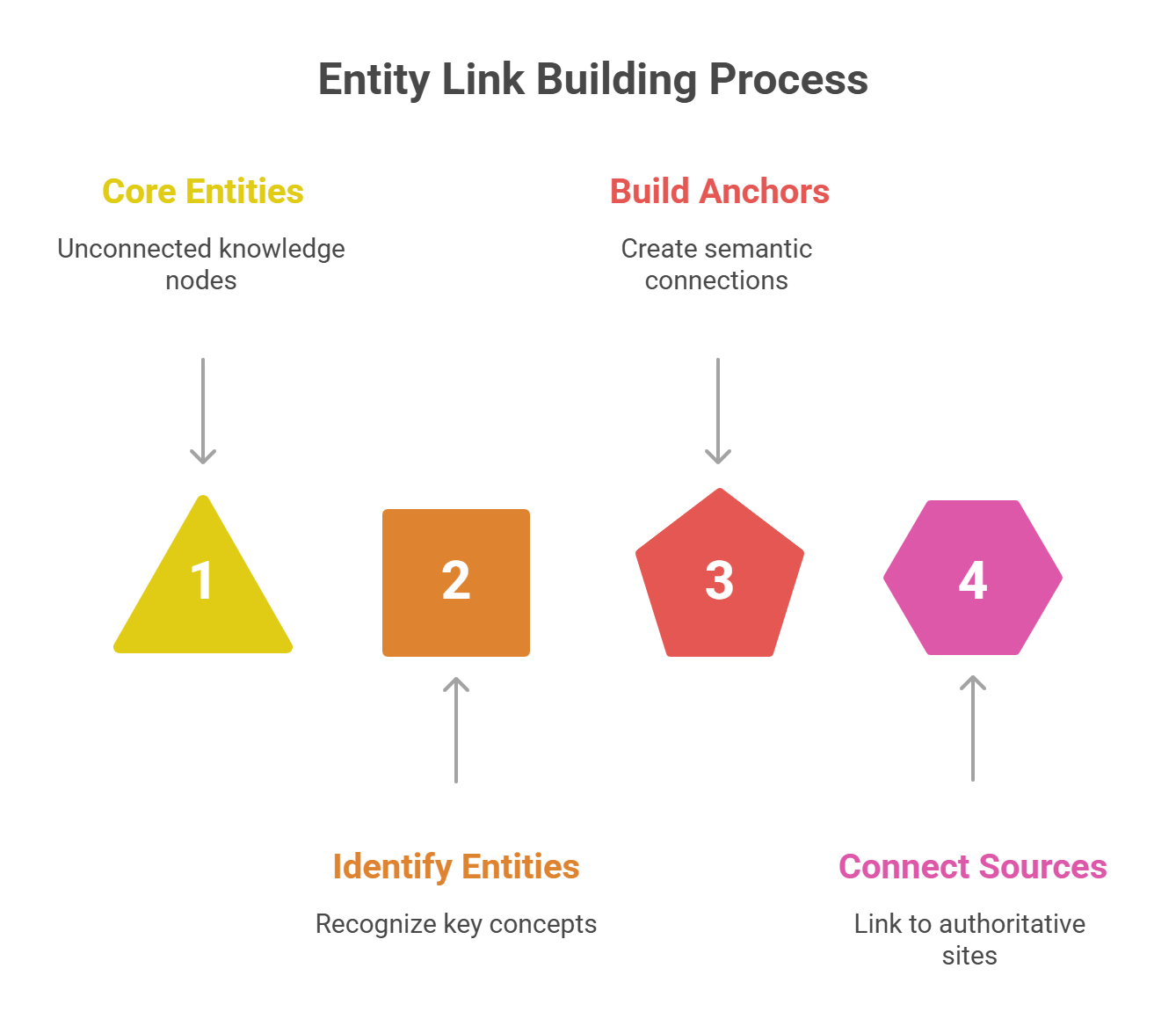
It is about context around the anchor, the source’s topical neighborhood, and the coherent chain of linked documents.
This way, knowledge graphs and contextual signals bind the story together. Your content becomes a node that belongs. When that happens, crawlers can infer relevance. The links support intent rather than chase it.
How Entity SEO Differs From Traditional Link Building
Classic link building scored big on DA, DR, and counts. You have to get more referring domains, stack metrics, and hope authority flows.
Meanwhile, Entity SEO Leans Into Meaning:
- It prefers fewer links from sources that are deeply tied to your niche.
- It cares about expert context and recognizable relationships.
The measure is not only authoritative but also fit. This is closer to editorial validation than raw amplification. The output feels slower but steadier.
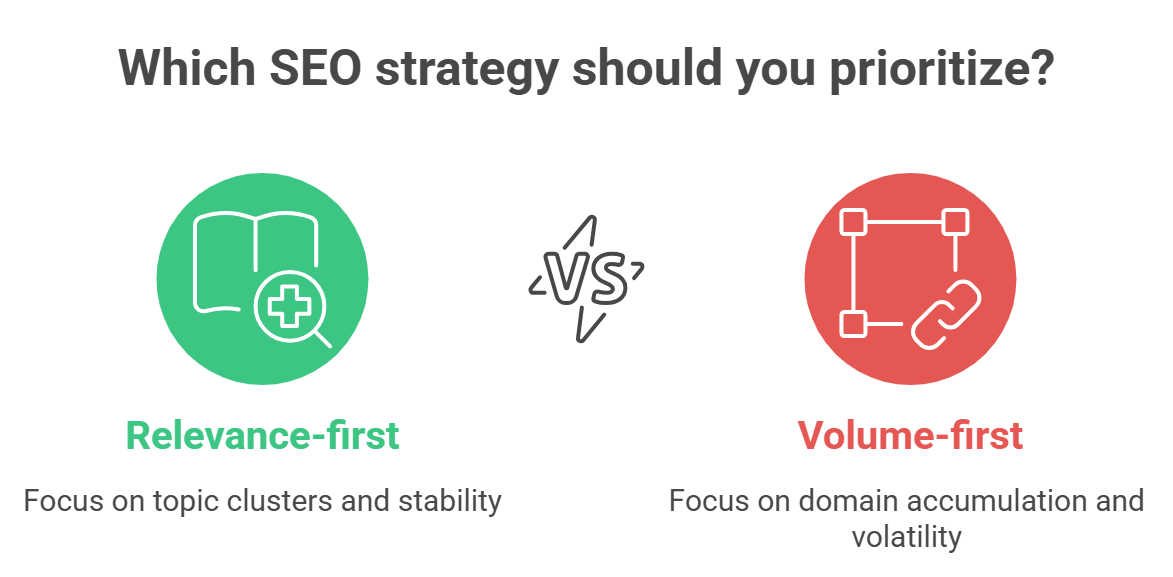
Why Relevance Outweighs Volume In Modern SEO?
The following are the major reasons why relevance outweighs volume in modern SEO:
1. Google’s Shift Toward Semantic Search
Algorithm changes nudged the market away from tricks and toward understanding. These include semantics, intent, and disambiguation. All are baked into how ranking works now.
When search prioritizes meaning, a large pile of weak, off-topic backlinks stops helping. The machine asks if your page belongs to a topic environment. If yes, you get better visibility and steadier impressions. If not, counts become ballast.
Essentially, you carry weight without movement. Hence, relevance becomes the driver because it connects entities to queries.
2. The Rise Of Topical Authority Over Domain Authority
Topical authority tightens your footprint. It says your site is consistently strong on a focused set of subjects:
- Context-rich backlinks reinforce that footprint by linking you to sources already known within the topic.
- Relevance signals beat raw metrics when the query space is well defined, and user expectations are narrow.
- Domain authority serves as a generic proxy, but topical authority determines whether you win nuanced searches and long-tail intent.
In practice, building links that deepen your topic cluster will yield more reliable gains than chasing a higher average domain score.
3. Impact Of Irrelevant Or Low‑context Links
Irrelevant links dilute your profile. They introduce mixed messages. Crawlers see you associated with random nodes and rank conservatively. Users experience a content mismatch and drop off quickly, sending negative engagement signals.
Over time, low‑context links resemble spam even if they are not obviously toxic. As a result, the site becomes noisy, and the pages become less clear. Relevance cuts the noise by removing loose ends and keeping your backlink graph tidy and legible.
Key Benefits Of Entity-Focused Link Building
The following are the major benefits of entity-focused link building:
1. Strengthening Brand Identity And Recognition
Entities are anchors for brand memory. When your site consistently appears near credible sources in your niche, users and machines begin to tie your name to that domain of knowledge.
The effect shows up in query co-occurrence, branded navigational searches, and more confident snippets. It also helps with visibility in panels and rich results because a trail of high-context citations backs your identity. High-quality backlinks from trusted, topic-native sites do this work better than a heap of generic mentions.
2. Enhancing Contextual Authority
Contextual authority is the felt sense that your content belongs in every conversation about the topic. Entity link building lifts this by stitching you into established clusters.
When your articles cross-reference expert guides, case studies, and authoritative analyses, the page context thickens. This supports subject-matter expertise and steady ranking across related queries. It beats thin coverage, where each page stands alone and fails to compound.
3. Improving Keyword Ranking Stability
Semantically linked pages resist shocks. If updates target low‑quality signals, your relevance foundation holds. Also, ranking volatility drops because your position is earned through fit rather than manipulation.
4. Boosting E‑E‑A‑T Signals
Experience, expertise, authoritativeness, and trustworthiness often surface through cues. These include real author bios, credible citations, transparent sourcing, and consistency in topic coverage.
Entity link building heightens these signals by connecting you to known authorities and recognized institutions. If you care about editorial trust, you support it with white hat link building that feels natural, useful, and verifiable.
Practical Strategies For Building Entity-Relevant Backlinks
If you want to build entity-relevant backlinks, the following are some practical strategies:
1. Conducting Entity Mapping And Topic Clustering
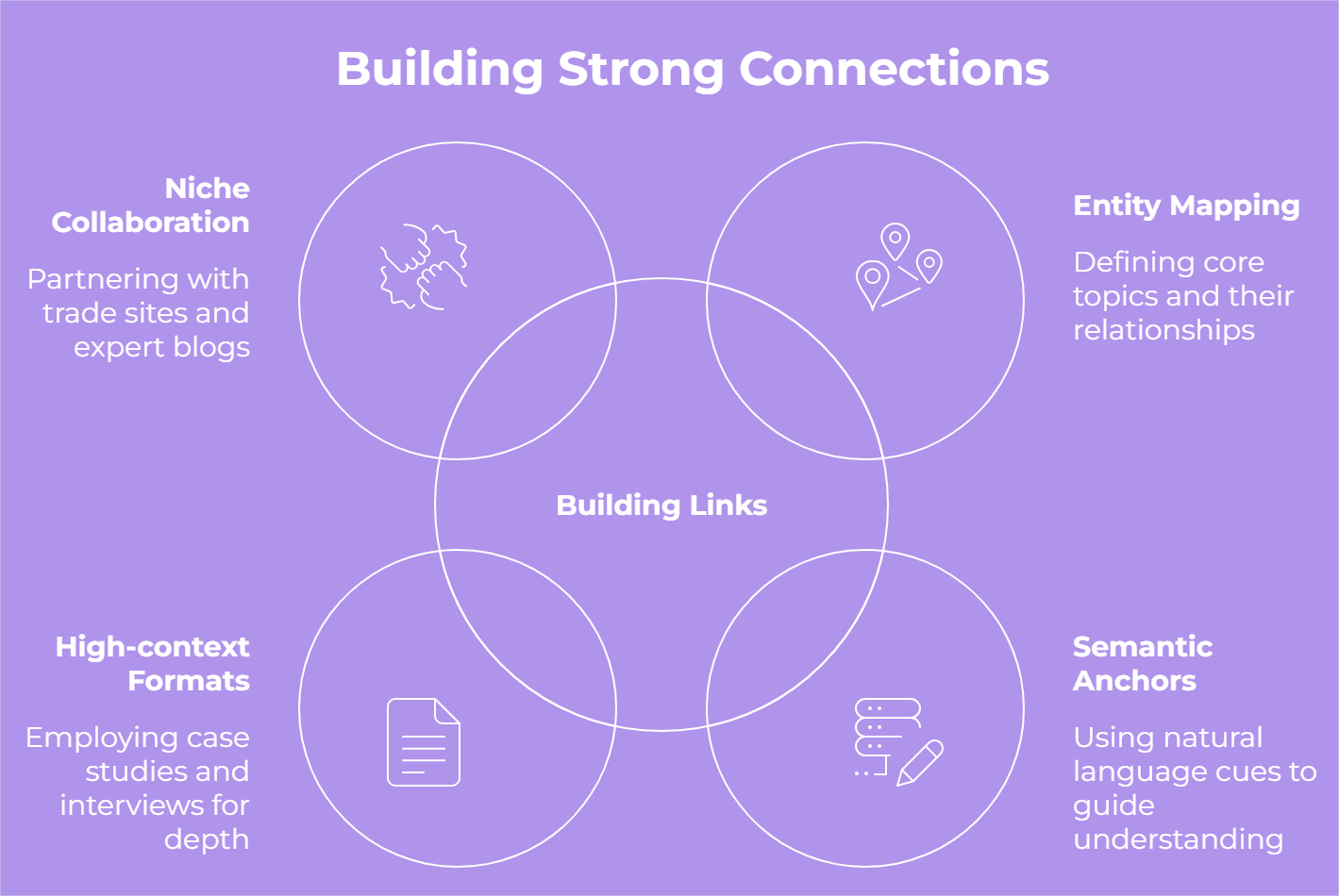
Start by listing core entities tied to your brand. These might be products, methods, standards, disciplines, or problems.
Follow The Steps Below To Conduct Entity Mapping:
- Define five to ten core entities and two layers of supporting topics.
- Audit existing content for coverage and depth.
- Mark gaps and draft briefs that include target entities, ideal sources, and candidate anchors.
- Plan internal links first, then external outreach.
2. Using Semantic Anchor Texts Effectively
Anchor text should read like a sentence fragment from a human who knows the topic. Natural language anchors supply context around entities and intent. Also, avoid over-optimization that repeats exact phrases without reason. Moreover, mix brand mentions, concept anchors, and citation-friendly language.
In this case, the goal is clarity. If the anchor name-checks an entity and points to content that clearly belongs to it, you win. This is where link building best practices meet editorial judgment.
3. Leveraging High‑context Content Formats
Some formats carry more context per link:
- Expert interviews
- Case studies with data
- Methodological explainers
- Comparative reports
When these pieces attract citations, the backlinks are inherently meaningful because they resolve questions and reference stable entities. Pair them with backlink building techniques that prioritize earned mentions. Also, use footnotes, references, and transparent sourcing to invite links.
4. Collaborating With Niche-Relevant Websites
Work with sites that serve your audience’s immediate needs:
- Trade publications
- Professional communities
- Research labs
- Standards bodies
- Technical blogs with real editors
Outreach should offer value: shared data, co-authored guides, or reproducible analyses. So, keep metrics in mind, but do not let them override relevance. Done right, your profile accumulates high-quality backlinks that reflect topical fit rather than vanity.
Example Mapping Table: Entities And Link Intents
| Core entity | Support entities | Link intent | Content format |
| Payment security | PCI DSS, tokenization, fraud detection | Cite standards and case data | Technical explainer + case study |
| Remote work productivity | time tracking, asynchronous communication | Reference studies and tools | Research roundup + interviews |
| Sustainable packaging | lifecycle analysis, biodegradable materials | Link to lab results and compliance | Comparative report + supplier profiles |
Common Mistakes In Entity Link Building
The following are some of the major mistakes you must avoid while you are dealing with entity link building:
1. Overloading With Tangentially Related Entities
It is tempting to pad pages with half-related terms and external references, especially when chasing quick wins from link building services that prioritize volume over relevance.
That puffing makes the content brittle. Forced relevance signals to both readers and crawlers that the page is trying to appear broader than it is.
Hence, you have to trim aggressively and keep the entity set tight.
2. Ignoring Entity Consistency Across Platforms
Your brand, product names, author identities, and key topics should align across your site, social profiles, press mentions, and structured data. In fact, inconsistency breaks recognition.
If you run link building in SEO services, the same rule applies to your own materials. Be the example you want clients to follow. Hence, keep naming stable and categories consistent.
3. Using Generic Anchors That Add No Semantic Value
“Click here” wastes a signal. Vague anchors are missed chances to clarify intent. So, make sure to replace them with language that situates the link inside the topic.
In fact, even small shifts help. For instance, a sentence that names the method, dataset, or standard adds value. Generic anchors signal low editorial care. They pull the page toward ambiguity.
Future Of Entity-Based SEO And Link Building
Expect the future of entity-based SEO and link building in SEO to look like the following:
1. Growing Importance Of Structured Data
Schema markup gives machines explicit clues. These include product, article, organization, person, and dataset. In general, marking entities increases visibility and supports disambiguation.
As search leans harder into knowledge-centric indexing, structured data behaves like a persistent passport. It reduces confusion and stabilizes context when words alone are messy.
2. AI’s Role In Understanding Web Entities
Indexing is moving toward richer graphs. In fact, systems infer relationships and reconcile inconsistent names. They evaluate source integrity and topical fit beyond lexical overlap. That trend favors clean entity strategies.
If your content sits neatly inside recognized clusters, AI models will find it, link it, and rank it with more confidence. However, if your profile is noisy, the models shrug.
3. Entity Networks Will Replace Traditional Backlink Scoring
The market will continue to use numeric proxies because they are convenient. But inside ranking systems, the weight of a link will hinge on where it lives in the entity network.
Quantity metrics will only matter if the links belong. Also, context will dominate because context clarifies intent and reduces risk. In practice, the future means scaling relevance, not just acquisition.
Relevance vs. Volume: Which One Is Better?
The following are the major differences between relevance and volume in the context of SEO:
| Dimension | Relevance-first approach | Volume-first approach |
| Primary goal | Fit within topic clusters and entities | Accumulate referring domains quickly |
| Typical sources | Niche publications, expert blogs, standards bodies | General directories, broad guest posts |
| Anchor style | Natural language with entity cues | Exact match or generic anchors |
| Stability across updates | Higher, due to semantic coherence | Lower, sensitive to quality filters |
| Impact on user trust | Positive, signals expertise | Mixed, may feel promotional |
| Long-term compounding | Strong, content network deepens | Weak, diminishing returns |
Choose Entity Link-Building Now!
Relevance beats volume because meaning is the currency of modern search. In those cases, entity link building in SEO serves as scaffolding for that meaning. Essentially, it ties pages to recognized topics, reduces ambiguity, and builds trust, as editorial ecosystems do.
When teams choose fit over speed, their backlink profiles get quieter and stronger. As a result, rankings become more stable, users get clearer answers, and brand identity takes shape.
In fact, the path starts with entity mapping, continues with context-rich sources, and rewards patience. This is how link building in SEO matures from counting links to building understanding.