

Authority building is the process of earning trust for your pages, site, and brand so search engines, AI tools, and people rely on you. It works as an ecosystem, not a single score.
Main finding: Most guides blame one cause, usually bad backlinks or a low domain score. In practice, mistakes happen at six connected layers: page, topic, site, publisher, links, and brand. A weakness in one layer weakens the others.
Inference: You need to fix the following 6 mistakes, layer by layer, to build authority.
This article defines authority building, shows what will change in 2027, and then covers two mistakes per layer, how they chain together, and a repair plan.
What Is Authority Building? (The Direct Answer)
Authority building is the long-term work of proving expertise and trustworthiness at every level where search engines and AI systems judge you.
For instance, the page, the topic, the site, the publishers who mention you, the links you earn, and your wider brand.
How It Will Change In 2027 (Forecast):
In 2027, expect authority to be judged less by one third-party score and more by consistency across layers.
AI systems pick passages, check outside sources, and favor brands that trusted sites mention. Scores like DA will matter less. Publisher quality and brand mentions will matter more.
The Six Mistakes To Fix First, One Per Layer
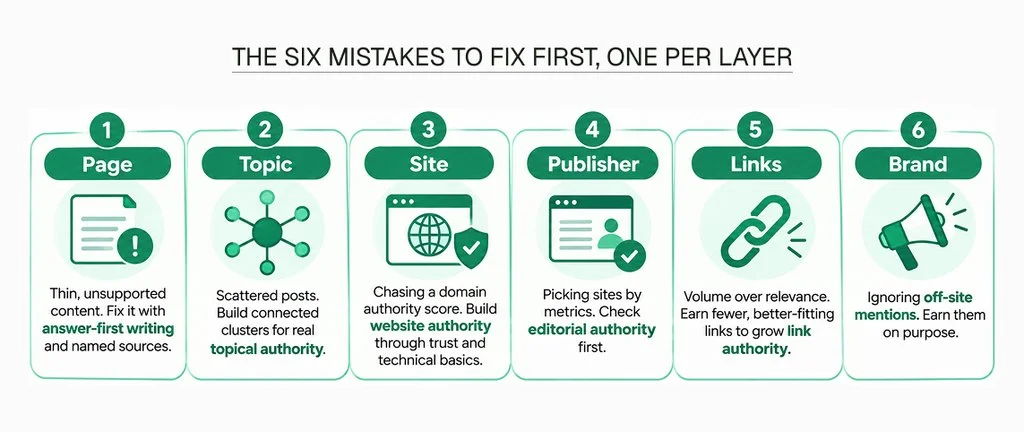
- Page: Thin, unsupported content. Fix it with answer-first writing and named sources.
- Topic: Scattered posts. Build connected clusters for real topical authority.
- Site: Chasing a domain authority score. Build website authority through trust and technical basics.
- Publisher: Picking sites by metrics. Check editorial authority first.
- Links: Volume over relevance. Earn fewer, better-fitting links to grow link authority.
- Brand: Ignoring off-site mentions. Earn them on purpose.
Keep reading to the end. The conclusion includes a 12-point ecosystem audit, a 3-month repair plan, and the hidden mistake that undoes fixes in all six layers.
Think of authority as six layers that feed each other:
| Layer | What it covers | Typical failure |
| Page | Credibility of one URL | Generic, unproven content |
| Topic | Depth across a subject | Scattered, overlapping posts |
| Site | Overall trust and technical health | Chasing a score, weak foundations |
| Publisher | Quality of sites that mention you | Choosing by metric, not standards |
| Links | Relevance and quality of backlinks | Volume, exact-match anchors |
| Brand | Mentions and consistency across the web | Invisible outside your own site |
The flow runs both ways. Strong pages build topic depth. Topic depth builds site trust. Trusted sites attract better publishers and links.
Strong links and mentions lift your pages, and your brand’s presence feeds AI answers. A break anywhere slows the loop.
Layer 1: Page-Level Mistakes
Most people do page-level content wrong. Are you making the same mistakes? Check again.
Mistake 1: Treating A Page Score As The Goal
Page-level scores are third-party estimates, not Google rankings. Semrush, Moz, and Ahrefs each use their own calculation to measure authority, so each score is one tool’s interpretation.
According to a Backlinko study, teams that chase page authority numbers often skip the real work of improving the page.
Fix: Treat the score as a symptom. Improve the page’s answer quality, sources, and internal links, then watch the score follow.
Mistake 2: Publishing Generic, Unproven Content
AI summaries are not always accurate, and sources are being checked more closely. A WashU audit of 61,212 AI Overview citations found about 11% of verifiable claims were unsupported or contradicted the cited source. Pages with clear, checkable claims have an edge.
Raw AI drafts also hurt. Ahrefs data reported by Loganix shows 71.7% of pages cited in AI Overviews mixed human input with AI help, and only 2.5% were fully AI-written.
Fix:
- Put the direct answer in the first two sentences under each heading.
- Name the source, year, and what was measured.
- Add one first-hand example or original number per page.
- Have a human expert review every draft.
Layer 2: Topic-Level Mistakes
Most people think the most important thing is to cover a topic in depth. However, many don't look into the topic's depth. They rarely notice they are making one of these 3 mistakes:
Mistake 3: Publishing Scattered Posts
Ten posts on ten unrelated topics build no depth. Authority compounds when pages support each other.
One SaaS audit source says authority built through backlinks and topical depth takes roughly 3 to 6 months to compound. Random publishing resets that clock.
Fix:
- Pick one core subject you can prove expertise in.
- Build a pillar page, then cluster pages that each answer one sub-question.
- Link pillar and clusters both ways, and link related clusters to each other.
**Our guide on topical authority walks through this in more detail.
Mistake 4: Covering The Topic, But Not The Questions Around It
AI search no longer matches only your exact keyword. Google has confirmed that its system splits a search into related sub-queries when AI is triggered.
Ahrefs found only about 38% of URLs cited in AI Overviews also ranked in the top 10 results.
Many sites also create several near-identical posts for one keyword. They end up competing with themselves.
Fix:
- List the follow-up questions for each topic: costs, comparisons, mistakes, and “how do I” queries.
- Give each question one clear home page.
- Merge or redirect overlapping posts.
Layer 3: Site-Level Mistakes
Most people chase usual metrics like DA and DR, but few notice these site-level mistakes in broad daylight.
Mistake 5: Making A Domain Score Your Target
Domain authority is a useful comparison number. It is not a Google metric, and a site can inflate it without earning real trust.
When a score becomes the target, people chase tactics that move the number, not the reader’s trust.
Fix: Use scores to compare competitors or shortlist publishers, never as your main goal. Your real targets should be rankings across a topic, qualified traffic, and citations.
Mistake 6: Weak Trust And Technical Foundations
You can publish great content and still stall if the site is weak behind the scenes. Content Marketing Institute stresses that if technical SEO is off, a site’s authority won’t grow, even with strong content and design.
Fix: Check these basics for website authority:
- Crawlable, indexable pages with no broken templates
- Fast, mobile-friendly pages
- Real author pages, an About page, and clear contact details
- Consistent brand name, logo, and descriptions across the site
Layer 4: Publisher-Level Mistakes
Have you ever wondered that you might not be choosing the right publishers? If not, here’s the biggest mistake you might be silently making during publisher selection:
Mistake 7: Choosing Placements By Metric, Not By Standards
A site can post a high score because it sells links, not because it earns trust. Our guide on editorial authority frames it as a property of the publisher, not of the link.
Fix: Judge every publisher on four questions:
- Selective: Does it reject more pitches than it accepts?
- Independent: Would this content exist without payment?
- Disclosed: Is any paid relationship labeled honestly?
- Consistent: Has quality held up over time?
Mistake 8: Hiding Paid Relationships
Compensation is not the problem. Disguising it is. Google’s guidance says paid links should be tagged with rel="sponsored" and that links meant to manipulate rankings shouldn't look natural.
Fix: Label paid placements properly. Use publishers that review content and don’t guarantee placement for payment.
A transparent link from a strong publisher is safer than an undisclosed one that looks organic.
Layer 5: Link-Level Mistakes
Stop buying random links that don’t match your niche today. Don’t check only DA and DR of a publisher before matching.
Mistake 9: Volume Over Relevance, And Robotic Anchors
Buying many links from loosely related sites produces short bursts and later slides. One Entrepreneur contributor argues a single high-quality backlink is worth more than ten low-quality ones. Treat that as a rule of thumb, not a law. The direction is sound.
Exact-match anchors repeated across many sites also look engineered. Digital Silk recommends descriptive, natural anchor text so users and algorithms both understand relevance.
Fix:
- Prioritize relevance first, then publisher quality, then count.
- Vary anchors: brand names, partial matches, and natural phrases.
- Link to pages that deserve the link, such as original research, tools, and guides.
**Read more in our guide to link authority.
Mistake 10: Ignoring Internal Links And Link Upkeep
Many teams focus on external links and forget their own. Content Marketing Institute advises using an internal linking strategy and checking your backlink profile regularly for harmful links. Links also break, pages move, and earned links get lost.
Fix:
- Link from strong pages to pages you want to lift.
- Fix broken links and redirect chains monthly.
- Review new and lost backlinks every quarter.
- Reclaim lost links with a short, polite outreach note.
Layer 6: Brand-Level Mistakes
Branding hinges on your brand's visibility. People might see your brand logo, but not the notion, feelings, and perspectives behind it. So what are the exact mistakes you are making with branding?
Mistake 11: Staying Invisible Outside Your Own Site
AI systems describe brands using what the wider web says about them. In Ahrefs’ branded-search research, Wikipedia, YouTube, and LinkedIn were the most common outside citations.
Ahrefs’ study of 75,000 brands also found YouTube mentions were the strongest factor correlating with AI Overview visibility.
One 2026 analysis also found brand mentions correlated with AI visibility about three times more strongly than backlinks did. That last figure comes from a single source.
Treat it as a signal, not a rule. AI Overviews Currently Appear for 83% of Branded Searches +2
Fix:
- Publish expert content on YouTube and LinkedIn.
- Pitch original data to journalists and bloggers so they mention you with or without a link.
- Keep your brand description, founder bios, and facts identical everywhere.
Mistake 12: Treating authority as a campaign, not a system
Teams launch a push, see no change in two weeks, and quit. Others never measure anything beyond one score.
Fix: Track one or two signals per layer:
- Page: rankings, time on page, citations
- Topic: cluster rankings and impressions
- Site: indexing, speed, crawl errors
- Publisher: share of placements on sites that pass the four-question check
- Links: relevant referring domains, lost links
- Brand: mentions, branded searches, AI citations
Review quarterly and expect slow compounding.
How Mistakes Chain Together (The Domino Map)
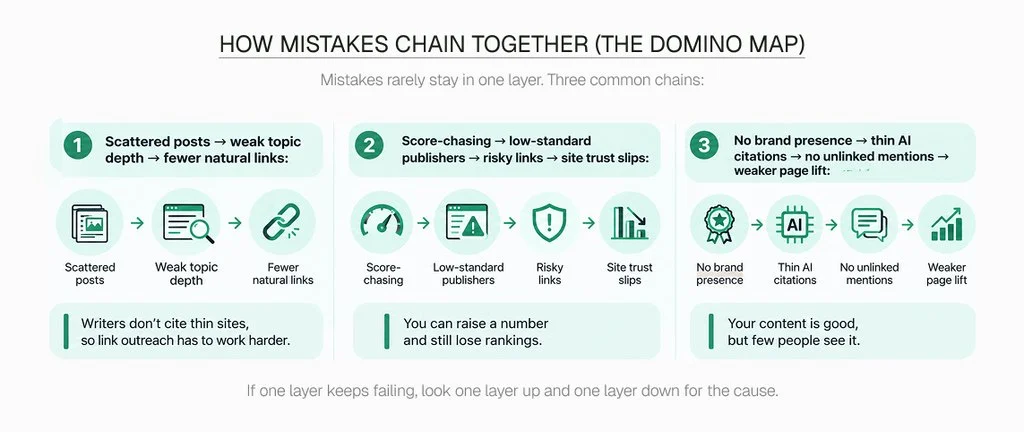
Mistakes rarely stay in one layer. Three common chains:
- Scattered posts → weak topic depth → fewer natural links: Writers don’t cite thin sites, so link outreach has to work harder.
- Score-chasing → low-standard publishers → risky links → site trust slips: You can raise a number and still lose rankings.
- No brand presence → thin AI citations → no unlinked mentions → weaker page lift: Your content is good, but few people see it.
If one layer keeps failing, look one layer up and one layer down for the cause.
Which Layer Is Your Weakest? A Quick Diagnostic
| Symptom | Likely layer | First fix |
| Good content, but rankings are flat | Topic or site | Check cluster gaps and technical health |
| Many links, but rankings are unstable | Publisher or links | Audit publishers against the four questions |
| Ranking, but not cited in AI answers | Brand or page | Add sources, answer-first sections, off-site mentions |
| Traffic drops after a link campaign | Links or publisher | Review anchors, disclosure, and publisher quality |
| New pages rank slowly | Site | Check internal links, crawl paths, and trust pages |
Complete 12-Point Ecosystem Audit, 90-Day Repair Plan, and the Hidden Mistake To Strictly Avoid
Authority building works when all six layers move together. In 2027, expect more weight on passage-level answers, publisher quality, and brand mentions. Here are the extras I promised.
The 12-Point Ecosystem Audit
Give one point for each “yes”:
- Key pages open with a direct answer.
- Every major claim names a current source.
- Each page has a named author and bio.
- One pillar page and linked clusters exist for your core topic.
- No two pages compete for the same keyword.
- You track topic-level rankings, not just single keywords.
- Your site is crawlable, fast, and mobile-friendly.
- About, author, and contact pages are complete.
- Placements come from publishers that pass the four-question check.
- Paid links are disclosed with rel="sponsored".
- Anchors are varied, and you review lost and new links quarterly.
- Your brand appears on at least two off-site channels, such as YouTube and LinkedIn, with consistent details.
Scoring: 0 to 4 means rebuild the foundations. 5 to 8 means fix your weakest layer. 9 to 12 means maintain and expand.
The 3 Month Repair Plan
- Days 1 to 30: Run the audit, find your weakest layer, and fix the five highest-impact pages.
- Days 31 to 60: Build or repair the pillar page, merge overlapping posts, and clean up internal links and technical issues.
- Days 61 to 90: Shortlist ten publishers using the four questions, pitch one original data point, and publish one video or LinkedIn piece.
Avoid This Mistake
Still fixing layers in isolation? A team that builds links without improving pages, or writes content without a brand presence, will keep hitting the same wall.
Treat authority as one system and review all six layers every quarter.