


Imagine that two publishers make your outreach shortlist.
Publisher A has a Domain Authority of 78. Your link would appear on a new contributor page, three clicks from the homepage, inside a broad article that mentions your subject once.
Publisher B has a DA of 49. It covers your niche every week. Meanwhile, your link would be placed inside an established, closely related article that already attracts search traffic and has links pointing to it.
So, now the question is: which placement is stronger?
If DA makes the decision, Publisher A wins before anyone examines the page. Again, if link authority makes the decision, Publisher B may be the better investment.
That does not make Domain Authority useless. It exposes a more expensive mistake: using a domain-level screening metric to predict the value of a specific link.
This article takes the comparison one step further. Domain Authority tells you where strength may exist. Link authority asks whether any of that strength can reach the exact page you want to grow.
Link Authority VS Domain Authority: The Direct Answer
Domain Authority (DA) is Moz's third-party, domain-wide prediction of relative ranking strength. Meanwhile, Link Authority is industry shorthand for the probable ranking value a particular link can contribute to a particular destination page.
Google publishes neither a Link Authority score nor Moz's DA. For prospecting, DA is a useful first filter. For choosing a placement, link authority is the more precise question.
| Point of comparison | Domain Authority | Link authority |
| Unit being evaluated | The entire domain | One link between two specific pages |
| Type of measure | Proprietary Moz score | SEO concept with no universal score |
| Scale | 1–100 | No standard scale |
| Best use | Comparing domains and building an initial publisher shortlist | Judging whether a proposed placement fits a target page |
| Main inputs or considerations | The domain's link profile and Moz's predictive model | Linking-page strength, relevance, context, anchor, attributes, destination fit and durability |
| What it cannot prove | That a particular link will help a particular page rank | The exact ranking change a link will cause |
| When to use it | Before detailed qualification | Before approval and again after publication |
The main difference here is scope. DA assesses a domain. On the other hand, Google Search returns pages.
First, Be Precise About Domain Authority
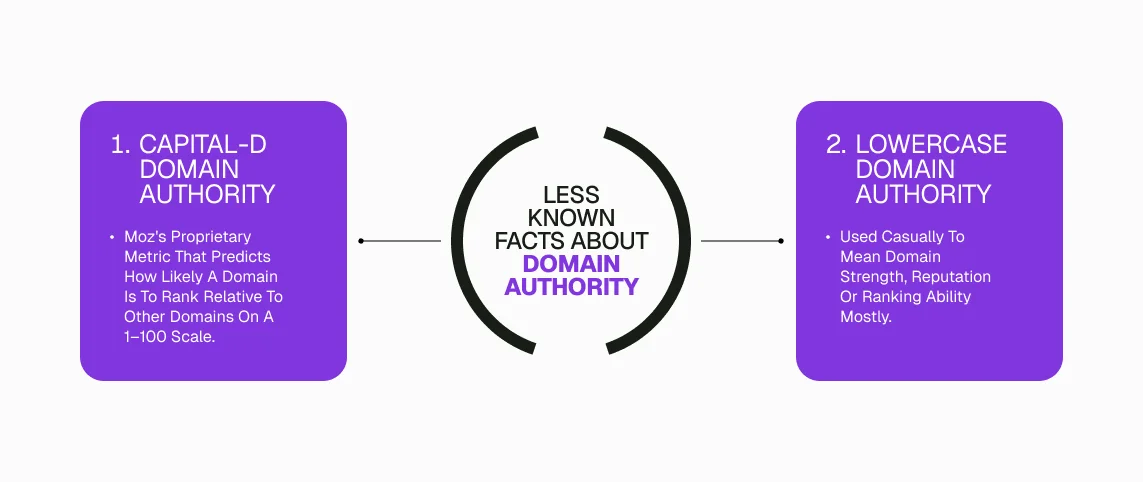
For Image:
Heading: Less Known Facts About Domain Authority:
1. Capital-D Domain Authority
Moz's proprietary metric that predicts how likely a domain is to rank relative to other domains on a 1–100 scale.
2. Lowercase domain authority
Used casually to mean domain strength, reputation or ranking ability mostly.
We explored the mechanics, strengths and limitations in our complete guide to what Domain Authority is and how it is calculated. The short version is worth restating because the industry often mixes a metric with a much broader idea.
Capital-D Domain Authority is Moz's proprietary metric. It predicts how likely a domain is to rank relative to other domains on a 1–100 scale.
It is comparative, not an absolute quality grade. A DA 45 site may be strong in a niche where competitors sit between DA 20 and 30. Yet weak in a SERP dominated by DA 70 brands.
Lowercase domain authority is often used casually to mean domain strength, reputation or ranking ability. Ahrefs' Domain Rating and Semrush's Authority Score also use 0–100 scales.
But they have different data and methodologies. Similarly, DA 60, DR 60, and Authority Score 60 are not interchangeable.
Most importantly, DA is not a Google ranking factor. Google's own guide says its link-analysis systems include PageRank, which remains part of its core ranking systems.
Google does not say that it imports a third-party domain score. That leaves DA with three legitimate jobs:
- Compare your domain with direct search competitors.
- Reduce a large publisher database to a workable shortlist.
- Track broad changes in a backlink profile alongside business outcomes.
It should not be asked to do a fourth job: guarantee that a proposed link will move rankings.
Our discussion of Google's broader view of website authority makes the same distinction from another angle. Real authority is the body of evidence surrounding a site. The authority metrics that deserve mention in this regards are useful content, credible references, topical consistency, editorial recognition and user trust. Not any one number in a third-party dashboard.
What Is Link Authority?
Link authority is the probable search value carried by one hyperlink from a source page to a destination page.
“Probable” matters. No public tool shows exactly how much internal PageRank Google assigns to a link, which signals it discounts, or what ranking movement that link caused.
Tools such as Moz Page Authority and Ahrefs URL Rating can estimate a page's strength. They do not measure the final effect of an individual backlink with certainty.
At BloggerOutreach, the useful way to discuss link authority is therefore operational, not mystical:
Link authority is the likelihood that a crawlable, contextually relevant and editorially justified link will help a well-matched destination page through discovery, relevance and link-based ranking signals.
A placement can also create referral traffic, recognition and secondary coverage. Those are valuable digital PR outputs.
But they should be reported separately from presumed ranking credit.
This difference becomes important when an excellent media mention is nofollowed or when a followed link generates no qualified visitors.
Link Authority Is Not Page Authority, Pagerank Or Link Equity
These terms describe related ideas, but collapsing them produces bad campaign decisions.
| Term | Practical meaning | Who defines or calculates it? | Correct use |
| Domain Authority (DA) | Relative ranking-strength prediction for a domain | Moz | Domain comparison and initial filtering |
| Page Authority (PA) | Relative ranking-strength prediction for a URL | Moz | Estimating the strength of a source or target page |
| URL Rating (UR) | Strength of a page's backlink profile on a 0–100 scale | Ahrefs | Page-level backlink comparison |
| PageRank | Google's evolving link-analysis system | Understanding why links between pages can matter; the internal score is not public | |
| Link equity | Informal term for value that may flow through links | SEO industry | Explaining transfer mechanics, not reporting an exact Google metric |
| Link authority | Probable strength and strategic usefulness of one link | SEO industry; no standard formula | Evaluating a specific source-page → link → target-page opportunity |
Page metrics help. They are still proxies. A strong source page can contain a weak, irrelevant or improperly qualified placement.
Conversely, a new page with modest page-level metrics can become stronger if it earns internal and external links over time.
The Gap That Most Articles Miss: Authority Has to Survive a Handoff
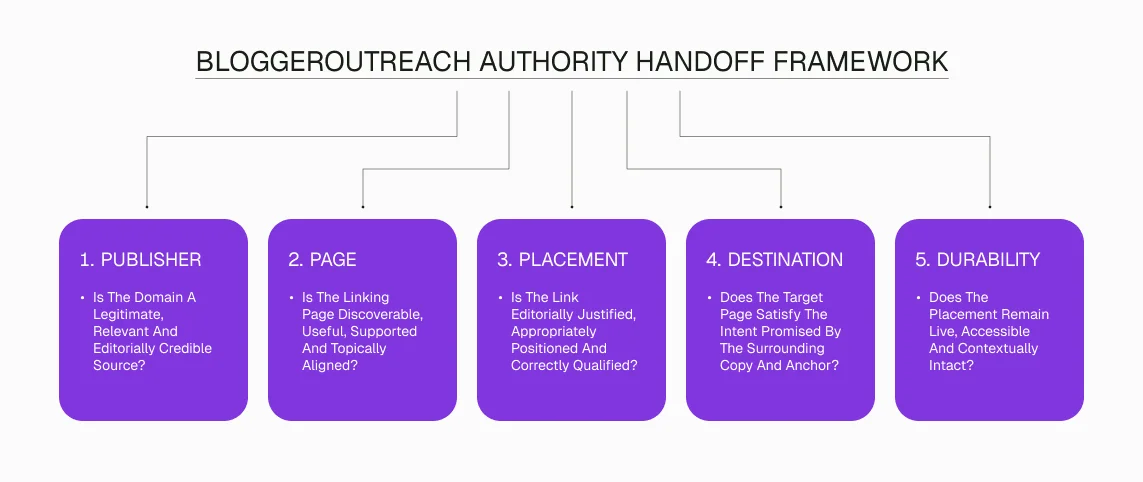
BloggerOutreach Authority Handoff Framework.
- Publisher: Is the domain a legitimate, relevant and editorially credible source?
- Page: Is the linking page discoverable, useful, supported and topically aligned?
- Placement: Is the link editorially justified, appropriately positioned and correctly qualified?
- Destination: Does the target page satisfy the intent promised by the surrounding copy and anchor?
- Durability: Does the placement remain live, accessible and contextually intact?
Most discussions of link authority vs Domain Authority stop after saying that page-level relevance matters. That is correct, but incomplete.
Authority is not collected at the domain and automatically deposited into every site it links to. A proposed placement has to pass through a chain of decisions. We call this the BloggerOutreach Authority Handoff Framework.
Da Contributes To Gate 1. It Cannot Answer Gates 2 - 5.
| Gate | What deserves attention | Strong signs | Warning signs | Decision question |
| Publisher | Domain quality and genuine audience | Consistent niche, organic visibility, real authors, transparent ownership, selective editorial standards | Topic sprawl, sudden traffic loss, thin posts, obvious link-selling patterns | Would this publication be credible without its DA badge? |
| Page | Strength and purpose of the source URL | Close topical fit, internal links from relevant hubs, useful content, search visibility or direct backlinks | Orphan page, weak indexation, mass-produced contributor archive, no topical connection | Why should this page be discovered, read or cited? |
| Placement | The actual hyperlink and its context | Body-copy placement, explanatory sentence, descriptive natural anchor, editorial reason to cite | Footer/sidebar link, forced exact match, unrelated paragraph, crowded outbound-link block | Does the link help a reader at this exact point? |
| Destination | The page receiving the link | Indexable, intent-matched, factually strong, internally connected, conversion path appropriate to the query | Thin sales page, wrong country or audience, cannibalised keyword, weak content, broken canonical setup | Is this the page that deserves to rank for the promised subject? |
| Durability | The link after publication | Stable URL, maintained article, clear update policy, monitoring and reclamation process | Temporary post, routine link deletion, URL churn, content rewrites that remove context | Will this placement still exist and mean the same thing in a year? |
This is the unique strategic point: link authority is not only a source-side property. It is the quality of the entire handoff.
Gate 1: Domain Authority Opens The Investigation
Suppose a campaign brief requests publishers with DA 50+ and genuine organic traffic. That threshold is a reasonable procurement control. It prevents the team from spending equal time on every website in a large database.
But a high DA can coexist with poor editorial standards, irrelevant coverage or unhealthy outbound-link behaviour. That is why a publisher's editorial authority and evidence of independent judgment deserve a separate review.
Ask:
- Does the site have a consistent purpose and audience?
- Does it reject topics that do not fit?
- Are articles attributed to credible writers?
- Do older pages still receive updates and internal links?
- Is outbound linking selective, useful and transparent?
- Has organic visibility remained broadly credible rather than collapsing while DA stayed high?
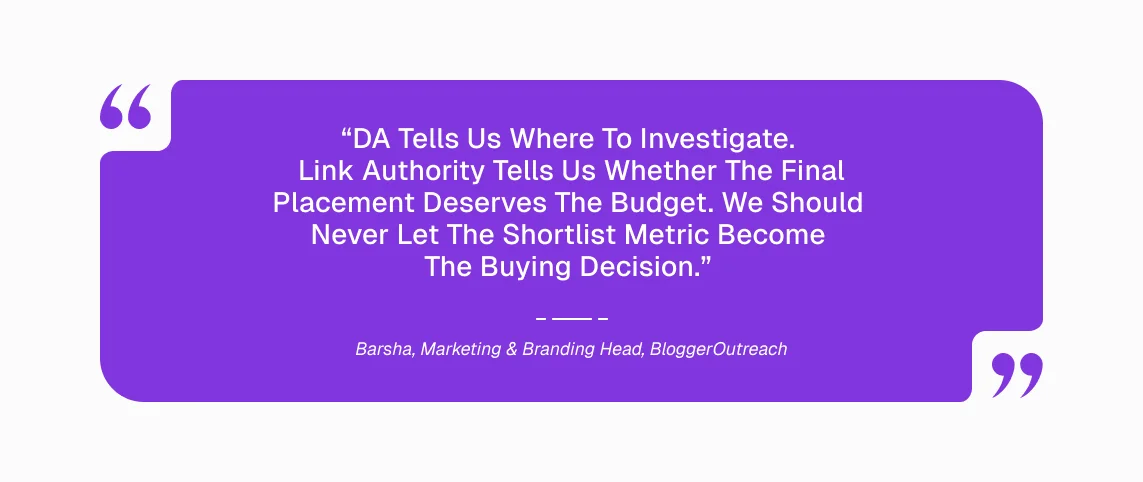
DA opens the file. However, it does not close the case.
Gate 2: The Source Page Decides How Much Strength Is Available
The domain may be powerful while the proposed page is not.
A newly published guest article begins with no direct external backlinks. It can still receive value through the publisher's internal links, category structure and site navigation.
But a page buried in an orphaned contributor archive is not equivalent to a well-supported resource linked from a relevant hub.
This page-level difference is visible in current industry data. In an Ahrefs study of the top 20 results across one million high-volume US keyword SERPs, referring domains had a Spearman correlation of 0.255 with rankings, compared with 0.131 for Domain Rating.
Both correlations were weak and do not establish causation. Still, page-specific referring domains correlated almost twice as strongly as the domain-wide DR metric in that dataset.
That is not proof that every direct backlink beats domain strength. It is a warning against treating domain strength as a substitute for page analysis.
Look at:
- The source page's own backlinks or page-level authority estimate.
- Internal links pointing to the page and the relevance of those source pages.
- Whether the page is crawlable and intended for indexing.
- The page's topic, audience and search intent.
- Organic traffic and ranking keywords, where data is available.
- The number and nature of other outbound links.
Google advises site owners that every important page should receive at least one internal link and that descriptive internal anchor text helps people and Google understand pages.
The same guidance should make buyers suspicious of placements on pages the publisher itself barely acknowledges.
Gate 3: Context Determines Whether the Link Makes Sense
Consider this sentence in an article about employee expense management:
“Teams comparing receipt workflows should calculate approval time, exception rates and policy adoption before choosing an expense platform.”
A link from “expense platform” to a detailed product-comparison resource has a clear purpose for the reader. However, a link from “best financial software” to an unrelated homepage, added at the end of the paragraph, does not.
Google's link guidance says anchor text should be descriptive, reasonably concise and relevant to both the linking page and the destination. It also says the words around a link provide context. That does not justify forcing the primary keyword into every anchor.
In fact, Google's spam policies identify optimised anchor text in paid guest posts or advertorials that pass ranking credit as a form of link spam.
This creates an important compliance rule for marketers and agencies:
- An editorial link should exist because it helps the reader understand or verify something.
- Advertising, sponsorships and other compensated placements should be transparently disclosed and appropriately qualified.
- Google recommends rel="sponsored" for paid placements; nofollow remains acceptable in that situation.
Google treats nofollow, sponsored and ugc as hints, not as a public promise of ranking credit. A nofollow link from a major publication can still create referral traffic, brand exposure and secondary citations. However, it should not be sold as guaranteed PageRank.
Gate 4: The Target Page Must Be Ready To Receive The Link
This is where many link campaigns lose value after winning a respectable placement.
Suppose an HR software company wants to rank a service page for “employee onboarding software.” The outreach content links to the company's homepage using the anchor “onboarding checklist.”
Even if the source is credible, the handoff is confusing. The anchor promises a checklist, the destination introduces the company, and the desired ranking URL receives no direct link.
A better campaign begins with the destination:
- Identify the page that needs to rank.
- Confirm its primary intent and competitive gap.
- Improve weak content, evidence and internal links before outreach.
- Build the publisher angle around a genuine reason to reference that destination.
- Use anchor text that accurately sets the reader's expectation.
Ahrefs' study of roughly 14 billion pages found that 96.55% received no estimated traffic from Google. Among approximately 20 million pages with no referring domains, only 2,997 received more than 1,000 monthly search visits. To sum up, the ratio is about 1 in 6,671.
Some no-backlink pages can rank, particularly on strong domains and for low-competition topics. For competitive pages, however, a campaign should not assume that general domain strength will compensate for a poorly supported target URL.
Links can amplify a worthy page. They cannot repair search intent, original evidence, technical indexability or a weak offer on their own.
BloggerOutreach's VeePN cybersecurity campaign illustrates the target-side principle. The case study shows that placements were directed to selected landing pages, comparison posts and cybersecurity guides rather than defaulting to the homepage.
Across the campaign, it reports 149% growth in referring domains, a 176% organic-traffic increase and 174% growth in ranking keywords. Those are aggregate campaign outcomes.
In other words, they are not merely proof that any one link caused a particular increase. On the contrary, the destination strategy is exactly what a domain-only brief would miss.
Gate 5: Authority Must Survive After Publication
A campaign report that marks a link “delivered” and never checks it again is measuring production, not authority.
In Ahrefs' study of links pointing to 2,062,173 websites since January 2013, at least 66.5% had rotted and 74.5% were classified as lost.
The study covers a long period and does not predict the survival rate of any new BloggerOutreach placement. To sum up, it does prove that link durability is a material measurement problem.
Links disappear when:
- A publisher deletes or redirects the source page.
- An editor removes the citation during a content refresh.
- The destination URL changes without a proper redirect.
- A canonical or indexing setup changes.
- The site closes, migrates or restructures its archive.
- The surrounding text changes until the link no longer has the same relevance.
The live date is therefore the start of measurement, not the end. If a campaign experiences a sudden visibility loss, use a structured diagnosis such as our guide to investigating a Google rankings drop before blaming or replacing individual links.
Three Examples That Show Why DA Alone Misleads
Study these examples carefully to understand the truth about domain authority:
Example 1: The DA 81 Generalist Vs The DA 54 Specialist
A cybersecurity company can choose between:
- A DA 81 general business site offering a new article in a broad “technology” category.
- A DA 54 security publication offering a citation inside a detailed guide to zero-trust access.
The target page explains zero-trust network access. The second placement has closer page-to-page relevance, a clearer reader reason and a more aligned audience.
If its source page is healthy and the placement is editorially legitimate, it may be the stronger link despite the lower DA.
DA identifies the larger domain. Link authority identifies the cleaner handoff.
Example 2: A Strong Publisher Points To The Wrong URL
A B2B payments brand earns a link from a DA 70 finance publication. The article discusses late-payment benchmarks, but the link points to the homepage. The actual benchmark report sits two folders deeper and receives no direct citation.
The campaign secured a credible domain but missed the most defensible destination. Linking to the original report would give readers the evidence promised by the paragraph and strengthen the URL most likely to attract further citations.
Example 3: A Nofollow Media Mention VA A Followed Commodity Link
A journalist mentions a logistics platform in a national publication and uses a nofollow link. Separately, a thin multi-topic blog offers a followed link inside an article assembled around a keyword.
If the only question is potential ranking-credit transfer, the followed attribute may look more attractive.
Meanwhile, if the question is total business value, the media mention may bring a real audience, branded searches, sales conversations and secondary links from writers who discover the story.
This is why brand authority extends beyond backlinks. It is also why digital PR teams should separate link-equity assumptions from referral, reputation and coverage outcomes.
Why One Strong Link Can Outperform Dozens Of Weak Ones
Link value is not a loyalty scheme in which every backlink adds one point.
Google's ranking systems analyze relationships between pages. Meanwhile, its spam systems attempt to neutralize manipulative patterns.
That said, a strong link can outperform a large batch of weak links because it combines several scarce qualities:
- A credible source page with authority available to pass.
- A tight topical relationship between the source and destination.
- An editorial reason for the citation to exist.
- A prominent, useful position in the main content.
- A natural anchor and explanatory surrounding sentence.
- A destination that fully answers the implied question.
- A stable placement that remains accessible over time.
Large-scale studies support the importance of links without proving a fixed causal formula. Backlink's analysis of 11.8 million Google search results found that the number-one result had 3.8 times as many backlinks on average as positions two through ten.
Ahrefs' one-million-SERP study found that referring domains correlated more strongly with rankings than DR. Neither study says that buying 3.8 times more links will create a number-one ranking.
The practical lesson is narrower: page-level link evidence matters, and you can't infer its quality from DA alone.
Which Metric Should You Prioritize?
The answer depends on the decision in front of you.
| Marketing decision | Prioritize | Why |
| Compare your domain with SERP competitors | DA, DR or Authority Score plus actual search performance | A domain-wide benchmark is appropriate at this stage |
| Reduce 5,000 publishers to a first shortlist | DA plus traffic and niche filters | Speed matters before manual review |
| Choose between two specific placements | Link-authority analysis | The source page, context, destination and terms are now known |
| Improve rankings for one commercial URL | Page-level gap and link authority | A domain-wide score cannot show whether that URL is under-supported |
| Build a digital PR programme | Editorial reach, relevance, audience, mentions, links and brand outcomes | A followed link is only one possible output |
| Price a link-building campaign | Difficulty, editorial effort, relevance, risk, content and reporting—not DA alone | You are paying for research and execution, not a coloured badge |
| Report campaign success | Target rankings, non-brand traffic, referral visits, conversions, qualified mentions and link retention | Neither DA nor link authority is a business outcome |
This distinction should also shape budgets. Our analysis of link-building pricing and what clients are actually paying for shows why cost rises with editorial difficulty, niche restrictions and execution quality. A placement should not command a premium simply because one tool reports a larger domain score.
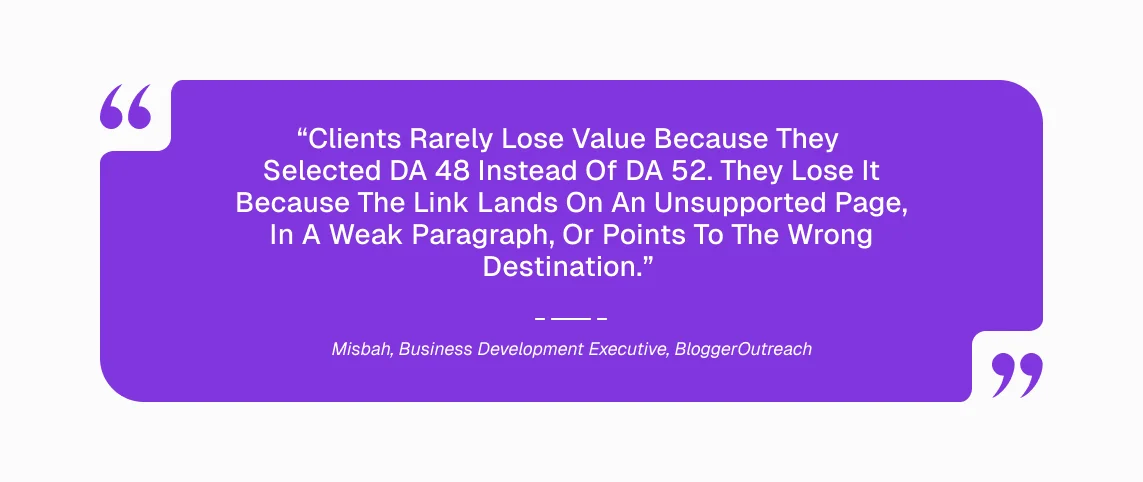
How Bloggeroutreach Applies Both Levels Of Authority
A serious campaign does not choose between domain authority and link authority. It uses each at the right stage.
1. Diagnose The Page-Level Gap
Start with the keyword, target URL, and the pages already winning. Compare content quality, search intent, referring domains, page-level authority, internal links and brand evidence.
The brief should say which URL needs help and why.
2. Use DA as a Qualification Threshold
DA can remove obviously weak prospects from a large set.
It then sits beside estimated traffic, niche fit, site health, ownership and outbound-link patterns. No single metric gets veto-free control.
3. Evaluate Editorial Fit
The outreach angle must fit the publisher's audience. The link must support a claim, example or next step in the article.
This is where relationship-driven link-building methods and placement types become more useful than ordering a raw quantity of links.
4. Engineer The Handoff
The source topic, surrounding paragraph, anchor and destination should tell one coherent story.
If the destination is not the best resource for that story, improve it or choose another page before outreach begins.
5. Measure Search And PR Outcomes Separately
Track ranking and organic-search changes for the target URL. Separately record referral sessions, conversions, branded discovery, media mentions and secondary citations. Brands trying to build presence across multiple authority platforms need both views.
6. Monitor the Placement
Confirm that the link stays live, its attribute remains accurate, the source page remains accessible, and the destination does not break during a migration.
Reclaim value before replacing it with more inventory.
BloggerOutreach's role is not to promise PageRank for sale. It brings strategy, manual publisher qualification, relevant content, relationship-led outreach, transparent placement terms, and defensible reporting into one campaign.
A 90-Day Link Authority Measurement Plan
No report can isolate a link as the sole cause of a ranking change. SEO campaigns run alongside content updates, internal links, competitor activity and algorithm changes. A disciplined baseline still makes the contribution easier to evaluate.
| Timing | Checks | Evidence to record |
| Before outreach | Target intent, current position, impressions, clicks, conversions, direct referring domains, internal links | Search Console export, analytics baseline, backlink snapshot, annotated target-page version |
| On publication | Correct destination, anchor, surrounding copy, link attribute, disclosure, status code, canonical and crawlability | Live URL, screenshot, HTML check, publication date |
| After 30 days | Source-page indexation, internal support, referral traffic, link status, early impressions | Index check, source metrics, analytics referral report, monitoring log |
| After 60–90 days | Target keyword movement, non-brand clicks, new referring domains, assisted conversions, earned secondary links | Search Console comparison, rank trend, CRM/analytics data, backlink changes |
| Quarterly | Link retention, source-page changes, redirect health, target-page freshness | Retention report, lost-link review, content update record |
Do not declare success because DA increased by three points. Do not declare failure because a ranking did not move in seven days. Review the page, its competitors and the whole authority handoff.
Link Authority VS Domain Authority: Which Will Be Blogger Outreach’s Primary Focus In 2026-27?
Domain Authority is a portfolio-level benchmark. On the other hand, link authority is a placement-level judgment.
Use DA to compare domains and control prospecting quality. Then ask the questions DA cannot answer:
- Which page will link?
- Why does the citation belong there?
- What anchor sets the right expectation?
- Which destination deserves the endorsement?
- Will the link remain useful after publication?
That approach connects link building to the larger role of building real website authority: creating evidence that search engines, publishers and people have a reason to discover, reference and trust.
So going forward we won’t be asking anymore: “How high is the publisher's DA?” Instead, our query will be: “How much credible authority can this exact placement deliver to this exact page, and how will we know?”
If your campaign is still buying domain scores, BloggerOutreach can help rebuild the brief around target pages, competitive gaps, editorial fit and outcomes that a business can actually measure.
Frequently Asked Questions (FAQs)
What Is The Difference Between Link Authority And Domain Authority?
Domain Authority is Moz's domain-wide comparative score. Link authority describes the probable ranking value of a specific link between a source page and a target page. DA is useful for filtering; link authority is useful for placement decisions.
Is Domain Authority A Google Ranking Factor?
No. Google does not use Moz's Domain Authority score. DA can correlate with underlying link strength, but it remains a third-party prediction and should not be treated as Google's grade for a website.
How Do You Measure Link Authority?
There is no universal Link Authority score. Assess source-page strength, topical relevance, editorial context, anchor text, link attributes, outbound-link patterns, destination fit and retention. Then measure target-page search and business outcomes over time.
Can A Lower-DA Site Provide A Stronger Backlink?
Yes. A lower-DA specialist page can be a better placement when it has closer topical relevance, credible editorial standards, strong page-level support, a real audience and a natural reason to cite the destination.
Does A Nofollow Link Have Authority?
Google treats nofollow as a hint and generally does not treat it like an unqualified editorial endorsement. A nofollow link can still deliver referral traffic, brand exposure and secondary citations. Paid links should use sponsored or nofollow.
Does Anchor Text Affect Link Authority?
Anchor text and its surrounding sentence help explain the destination. Use concise, descriptive and natural wording. Forced exact-match anchors, particularly in paid placements intended to pass ranking credit, can create spam-policy risk.
Why Did A High-Da Backlink Fail To Improve Rankings?
Common reasons include a weak source page, poor relevance, an unsupported target URL, mismatched intent, an unsuitable anchor, technical indexation problems, strong competitors, link qualification or insufficient time and supporting evidence.
Should I Focus On Link Authority Or Domain Authority?
Use both at different stages. Apply DA when comparing domains and creating a shortlist. Prioritise link-authority analysis when approving a specific page, placement, anchor and destination.