


What is Domain Authority? If you work in SEO, you have probably seen websites described as DA 30, DA 50, or DA 70.
Domain Authority (DA) is one of the most widely used third-party SEO metrics for estimating a website's relative ranking strength.
But there is an important distinction to make upfront: Domain Authority is not a Google ranking factor. Moz created it to help SEO professionals compare the relative strength of websites.
Google uses hundreds of signals in its ranking systems. Meanwhile, Google’s own documentation makes clear that PageRank is only one part of a much broader ranking system.
That makes DA useful. But only when it is interpreted correctly.
For a link-building campaign, a high DA can be a useful starting filter. But the real question is not simply, "Can I get a backlink from a DA 70 website?"
Instead, you should ask:
"Can this website give my brand a relevant, credible and valuable link that strengthens the overall authority of my site?"
This mindset difference is the backbone of modern link building. Most importantly, this is also how BloggerOutreach approaches publisher selection.
What Is Domain Authority?
Domain Authority is a proprietary metric developed by Moz that predicts how likely a website is to rank in search engine results compared with other websites.
It uses a 1–100 scale, with higher scores representing greater predicted ranking strength. However, DA is best understood as a comparative metric, not an absolute grade.
For example, a DA 45 website may be extremely competitive within a niche where most competing sites have DA 20–30.
The same DA 45 website may have a significant authority gap if its competitors are DA 70–80.
So instead of asking: “Is a DA of 50 good?”, ask:
How does my DA compare with the websites I am competing against?
This makes DA particularly useful for competitor analysis, backlink prospecting and campaign benchmarking.
Is Domain Authority A Google Metric?
No. Google does not use Moz's DA score to rank websites. As Google claims, its ranking systems use many different signals and technologies.
While links remain important, Google says links help it understand relevance and discover pages. To sum up, Google has no metric called "Domain Authority."
So if your DA increases from 40 to 55, that does not mean Google has awarded your website an authority score of 55.
What may have changed is the underlying backlink profile that Moz uses to calculate its estimate.
How Is Domain Authority Calculated?
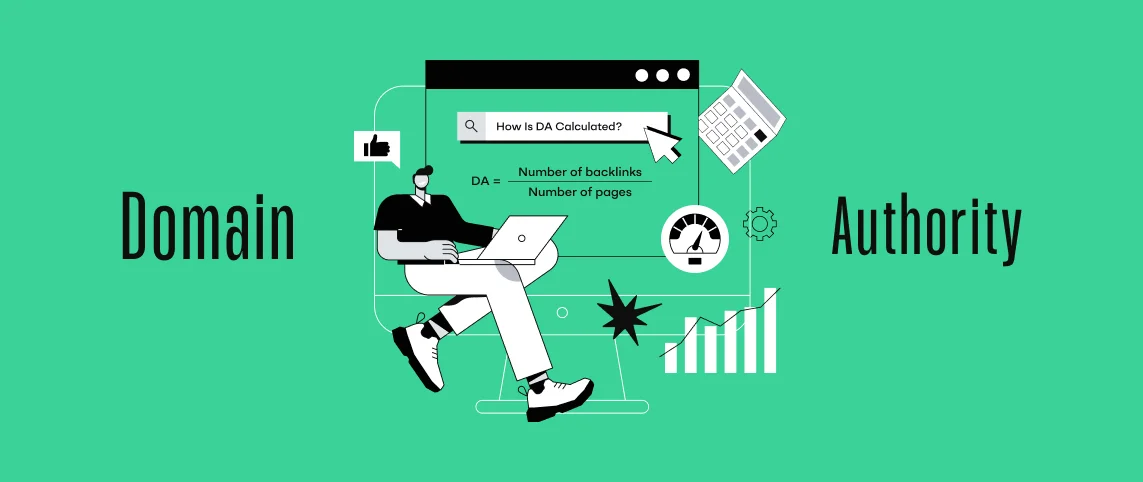
Moz uses a machine-learning model to calculate Domain Authority. It is not a simple formula such as: DA = number of backlinks ÷ number of pages
Instead, DA is derived from link-related data and is designed to predict ranking ability relative to other domains.
This difference matters because not all backlinks are equal. Consider two websites:
| Metric | Website A | Website B |
| Backlinks | 10,000 | 1,200 |
| Referring domains | 35 | 250 |
| Topical relevance | Low | High |
| Editorial links | Few | Many |
| Organic visibility | Weak | Strong |
Website A has more backlinks. Meanwhile, website B may have the stronger backlink profile. This is why simply increasing backlink volume is not a reliable way to build domain authority.
Google itself says links are used as a signal for relevance and discovery. At the same time, its broader ranking systems consider many other signals.
The Link Signals Behind Domain Authority
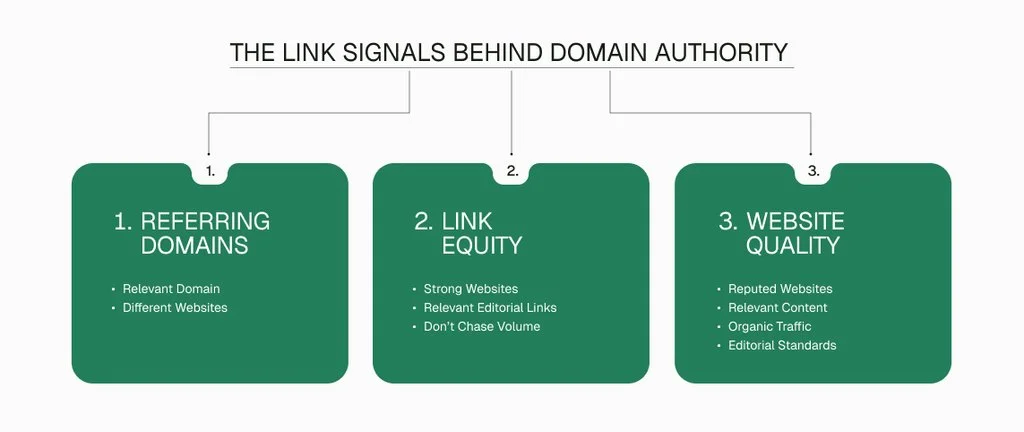
While Moz's exact proprietary calculation should not be reduced to a simplistic formula, several concepts are particularly important when evaluating the strength of a domain's link profile.
1. Referring Domains
A referring domain is a unique website linking to your site. Suppose you receive:
- 100 links from one website
- 50 links from another website
- 25 links from a third website
You have 175 backlinks but only three referring domains. Now compare that with 100 links coming from 100 different relevant websites.
The second profile provides much greater diversity.
That is one reason why effective link building focuses on acquiring links from a growing pool of relevant websites rather than repeatedly obtaining links from the same publisher.
2. Quality Of Linking Websites
A backlink from a reputable, established website is generally more valuable than a link from a low-quality site.
But "high quality" does not simply mean "high DA." A publisher should also be examined for:
- Organic traffic
- Relevant content
- Editorial standards
- Existing backlink profile
- Audience alignment
- Outbound-link patterns
- Site health
Ahrefs makes a similar point in its own guidance: Domain Rating can be a useful proxy when judging link prospects. But marketers should not evaluate a website based on site-wide authority alone.
3. Link Equity
The strength of the sites linking to your domain can influence the strength of your overall backlink profile. But authority does not simply accumulate like points.
A hundred weak links do not automatically outperform ten strong, relevant editorial links. This is why modern link building has moved away from a pure volume approach.
DA VS DR VS Semrush Authority Score
DA is not the only authority metric marketers use. The three metrics you will encounter most often are:
- Moz Domain Authority (DA)
- Ahrefs Domain Rating (DR)
- Semrush Authority Score (AS)
They all use a 0/1–100-style scale. But they do not measure exactly the same thing.
| Metric | Platform | Primary Focus | Scale | Main Strength |
| Domain Authority | Moz | Predicted ranking strength based heavily on link signals | 1–100 | Simple domain comparison |
| Domain Rating | Ahrefs | Strength of backlink profile | 0–100 | Strong backlink analysis |
| Authority Score | Semrush | Link power, organic traffic and spam-related signals | 0–100 | Broader domain evaluation |
Therefore, DA 60 does not equal DR 60 or Authority Score 60. To sum up, the scores come from different databases and methodologies.
Moz Domain Authority: Strengths And Limitations
DA can be a genuine marketing metric. However, Google does not consider it to be a ranking factor. So, DA has its own perks and challenges:
Strengths Of DA
- Easy to understand: A 1–100 scale makes DA easy to communicate to clients and marketing teams.
- Useful for publisher filtering: If you are evaluating thousands of potential websites, DA can provide an initial quality threshold.
- Useful for competitor comparison: You can compare your domain against competitors to identify an approximate authority gap.
Limitations Of DA
- It is not a Google ranking factor: A DA increase does not guarantee better rankings.
- It does not represent the whole website: DA primarily helps you understand relative domain strength. It does not tell you whether a publisher has a relevant audience or whether its content fits your niche.
- High DA can hide poor relevance: A DA 80 website about an unrelated subject may be a weaker strategic link prospect than a DA 50 website that is deeply relevant to your industry.
This distinction matters for link-building campaigns.
Ahrefs Domain Rating (DR)
Domain Rating (DR) is a proprietary metric that Ahrefs uses. It helps you compare the backlink strength of your brand/website.
Ahrefs describes DR as a metric measured on a 0–100 logarithmic scale. Its calculation considers the strength of referring domains and how those domains distribute their authority through links.
Ahrefs' current 2026 guidance also emphasises that DR is primarily a measure of backlink-profile strength. To clarify, it is not a measure of traffic, brand popularity or domain age.
Strengths Of DR
- Excellent for backlink-profile research
- Useful for comparing competing websites
- Helpful when analyzing referring domains
- Useful for identifying potential link opportunities
Limitations Of DR
DR does not directly tell you:
- Whether the website gets meaningful organic traffic
- Whether its content is relevant to your niche
- Whether its audience matches yours
- Whether a particular page is a good place to earn a link
Ahrefs itself advises users not to judge a website on authority alone and recommends considering backlink quality and other site-level factors.
Source: https://ahrefs.com/website-authority-checker?utm_source=chatgpt.com
Semrush Authority Score
Semrush's Authority Score takes a broader approach. Semrush currently describes Authority Score as a compound metric based on three main areas:
- Link power
- Organic traffic
- Spam-related signals
Semrush's 2026 guidance specifically describes Authority Score as a way to benchmark websites against competitors and track changes over time.
Strengths Of Authority Score
- Considers organic traffic: This gives the metric a dimension that purely link-based metrics do not directly provide.
- Looks for suspicious patterns: Semrush incorporates signals intended to identify unnatural or manipulated link profiles.
- Useful for broader prospect evaluation: It can help SEO teams evaluate a website beyond backlinks.
Limitations Of Authority Score
- Still a third-party metric: Google does not use Semrush's Authority Score as a ranking factor.
- Traffic is estimated: The organic traffic component comes from Semrush's own data and estimates, not the publisher's private Google Analytics or Search Console account.
- Not directly comparable with DA or DR: An Authority Score of 60 should not be treated as equivalent to DA 60 or DR 60.
Which Authority Metric Should You Use?
There is no reason to choose only one. Each metric answers a slightly different question.
| Metric | When to Use It | Best For |
| Moz DA (Domain Authority) | When you want a quick, recognizable benchmark for domain strength or publisher filtering. | Comparing domains and shortlisting link-building opportunities |
| Ahrefs DR (Domain Rating) | When you are conducting detailed backlink research and want to understand the strength of a site's referring-domain profile. | Analyzing backlink profiles and referring domains |
| Semrush Authority Score | Use this when you want to consider backlink strength alongside estimated organic traffic and spam-related signals. | Broader evaluation of website authority and quality |
For serious link building, however, use these metrics as filters rather than final decisions.
Why DA Alone Is Not Enough For Link Building
Imagine you have two publishers:
| Evaluation Factor | Publisher A | Publisher B |
| DA | 72 | 51 |
| DR | 68 | 49 |
| Authority Score | 63 | 57 |
| Organic traffic | 4K | 32K |
| Topical relevance | Low | High |
| Editorial fit | Moderate | Strong |
If you judge only by DA, Publisher A wins. But Publisher B may be the better SEO opportunity. Why? Because Publisher B has:
- Stronger topical relevance
- More organic visibility
- Better audience alignment
- Strong editorial fit
This illustrates an important principle:
Authority metrics help identify potentially strong publishers. They do not tell you which publisher is strategically right for your campaign.
How BloggerOutreach Uses Domain Authority
This is where DA becomes particularly useful.
BloggerOutreach uses authority metrics as part of its publisher-selection process. But does not treat DA as the only quality criterion. Other critical authority metrics that matter here include Editorial Authority, Brand Authority, and Website Authority, among others.
According to the current BloggerOutreach website, publishers in its network are manually vetted for genuine traffic, editorial standards and domain health, and its current offering emphasizes DA 50+ publishers.
Source: https://www.bloggeroutreach.io/?utm_source=chatgpt.com
Here is a brief overview of the process that we actually follow at Blogger Outreach:
Authority → Traffic → Relevance → Editorial Quality → Publisher Selection
That said, we don't limit ourselves to DA → Buy Link. That’s why Blogger Outreach is better than most competitors in the same space.
BloggerOutreach's current positioning also emphasizes editorial placements and manually selected publishers rather than simply providing a database of high-metric websites.
DA Acts As A Quality Threshold
For example, a campaign might require:
- DA 50+
- Genuine organic traffic
- Relevant niche
- Healthy domain
- Editorial placement
- Appropriate target page
- Natural anchor text
DA helps establish the minimum authority level. The other checks determine whether the publisher is actually worth using.
What The BloggerOutreach Data Shows
The value of this approach becomes clearer when you look at BloggerOutreach's published case studies.
A March 2026 BloggerOutreach case study for a B2B SaaS/project-management client reports that the campaign secured 60 new referring domains, all from DA 50+ editorial publishers.
The client's reported DA increased from 24 to 51 over six months, while monthly organic visitors increased by 17,400.
The campaign did not simply target high-DA sites.
BloggerOutreach reports that the publishers were also:
- Verified for organic traffic
- Relevant to SaaS, B2B software or productivity
- Selected after competitor backlink research
- Used for editorial placements
The case study also reports that the client's competitors ranking on page one had an average of 340 referring domains at DA 45+, compared with 62 for the client. That makes the DA metric much more useful in a competitive analysis.
The objective was not to "Get the DA number higher." Rather, it was: "Close the authority and referring-domain gap against the websites already winning in search."
Relevance Can Beat Generic Authority
BloggerOutreach's VeePN case study provides another useful example.
The campaign targeted high-authority cybersecurity publications, with the publisher-selection process also considering real organic traffic and audience alignment.
BloggerOutreach reports a 176% increase in organic traffic, 149% growth in referring domains, 174% growth in ranking keywords, and a 210% increase in organic traffic value.
The case study's key takeaway is particularly relevant to the DA discussion:
Niche relevance beats generic authority.
That does not mean authority is unimportant. In fact, it means authority becomes more valuable when it comes from the right context.
The Main Takeaway:
A cybersecurity company earning a link from a relevant cybersecurity publication can make more strategic sense than receiving a link from a much higher-authority site with no meaningful connection to cybersecurity.
A Bigger Example: CapCut
BloggerOutreach's CapCut case study illustrates why authority should be considered part of a broader SEO campaign.
The company reports that CapCut's organic traffic increased from 2.2 million to 11.7 million. Meanwhile, referring domains increased from 4,523 to 10,763. The number of ranking keywords reportedly grew from 400,000 to 4.8 million.
For publisher selection, BloggerOutreach says it looked for websites with at least DA 40 and 10,000+ organic monthly traffic, while also prioritizing relevance.
Again, the lesson is not that DA alone produced the traffic increase. The campaign combined:
- Keyword research
- Competitor analysis
- Publisher selection
- Authority thresholds
- Organic traffic requirements
- Contextual guest posting
- Tailored content
- Natural anchor placement
That is a much more realistic model of how authority-building works.
How To Improve Domain Authority
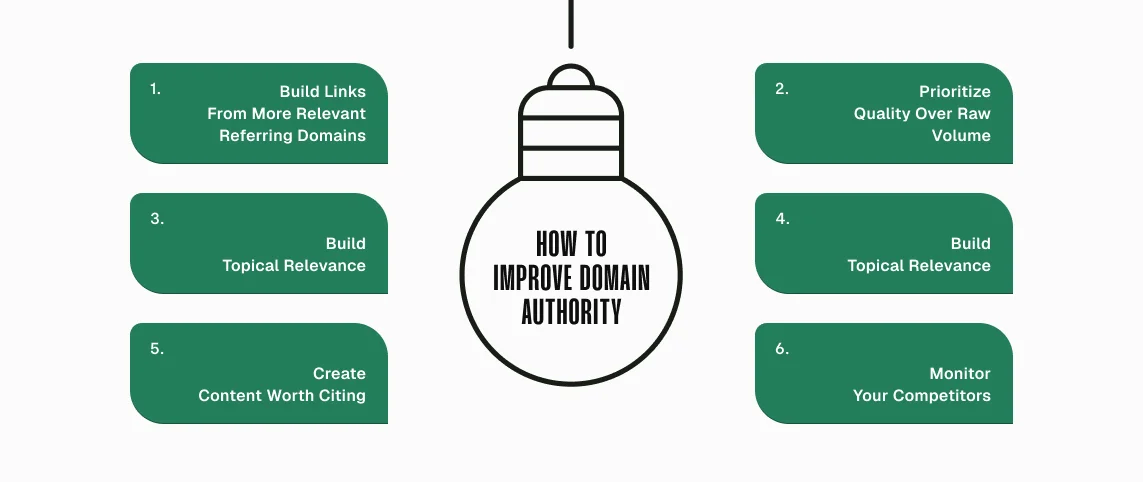
If your DA is lower than your competitors, your SEO goal should not be to increase ot only! Instead, focus on improving the signals behind it. Here is a clear description of what you should do:
1. Build Links From More Relevant Referring Domains
One of the most effective ways to strengthen a backlink profile is to earn links from a broader range of credible websites.
2. Prioritize Quality Over Raw Volume
Ten strong editorial links can be strategically more useful than dozens of low-quality placements.
3. Build Topical Relevance
Your backlink profile should make sense for your business.
A SaaS company should ideally build relationships across SaaS, technology, business, productivity and related publications. Not random high-DA websites.
4. Create Content Worth Citing
Original research, statistics, expert commentary, useful tools and genuinely comprehensive resources give other publishers a reason to reference your site.
5. Monitor Your Competitors
Don't choose a random high-DA target. Look at the websites already ranking for your target keywords.
For example, what does their referring-domain profile look like? Or, what types of publishers link to them?
You should also focus on what authority ranges appear repeatedly. And what topics and pages attract those links?
That information gives you a much more useful link-building benchmark.
6. Measure SEO Outcomes, Not Just DA
The primary factors you need to track are:
- Organic traffic
- Ranking keywords
- Referring domains
- Target-keyword positions
- Traffic value
- Conversions
- Brand visibility
You can include DA in the reporting dashboard. But it should not be the only number that determines whether a campaign succeeded.
Domain Authority Is A Benchmark, Not The Goal
So, what is Domain Authority?
It is a third-party Moz metric that helps SEO professionals estimate and compare the relative strength of domains. It is useful for competitor research, publisher filtering and link-building strategy. But it is not a Google ranking score.
The same principle applies to Ahrefs DR and Semrush Authority Score.
DA tells you one thing. Meanwhile, DR tells you another. Authority Score adds another layer. Yet, none of them tells the whole story.
The strongest SEO decisions are always based on combined metrics like:
- Relevant referring domains
- Genuine organic traffic
- Editorial quality
- Topical relevance
- Healthy backlink profiles
- Competitive gaps
- Actual ranking and traffic data
That is why BloggerOutreach doesn't treat DA as the end goal. Its current publisher-selection approach combines authority thresholds with manual vetting for traffic, editorial standards and domain health.
And its published case studies show why that broader approach matters:
1. VeePN reported 176% organic traffic growth
2. Freshessays reported 133% traffic growth
3. The March 2026 B2B SaaS case study reported a DA increase from 24 to 51
4. It also posts about 17,400 additional monthly organic visitors.
Use DA to shortlist opportunities. Use relevance and quality to choose them. Measure success by what actually happens to rankings, traffic, and business, not by the authority score alone.