


Today I want to talk about something most people learn the hard way. Imagine you used two backlinks in your reports.
They may appear similar when you include them in the report body. But their roles would be quite different.
One appears on a page that real people read. You might have used the other on a page nobody visits. That copy could be about a topic your product has nothing to do with.
That gap is what people mean by link quality. Google doesn't specify a link volume that improves link quality.
However, Google offers clear guidance on what links should look like and which link building techniques it considers manipulation.
I've read through it so you don't have to. Here we will discuss how it translates into decisions you can make before you buy a placement. Plus how our own workflow handles each link.
What "Link Quality" Means To Google?
Google says it uses links to judge a page's relevance and to find new pages. That's about the extent of what it commits to.
There's no official score, and Domain Authority belongs to Moz, not Google. It's a useful estimate, but DA isn't Google's opinion of a site.
This is why a DA 70 link on a generic business blog can lose to a DA 45 link on a niche site that covers your exact subject.
We went through that example in detail in our piece on link authority vs. domain authority. Here’s the short version of it: judge the page and the placement, not just the domain.
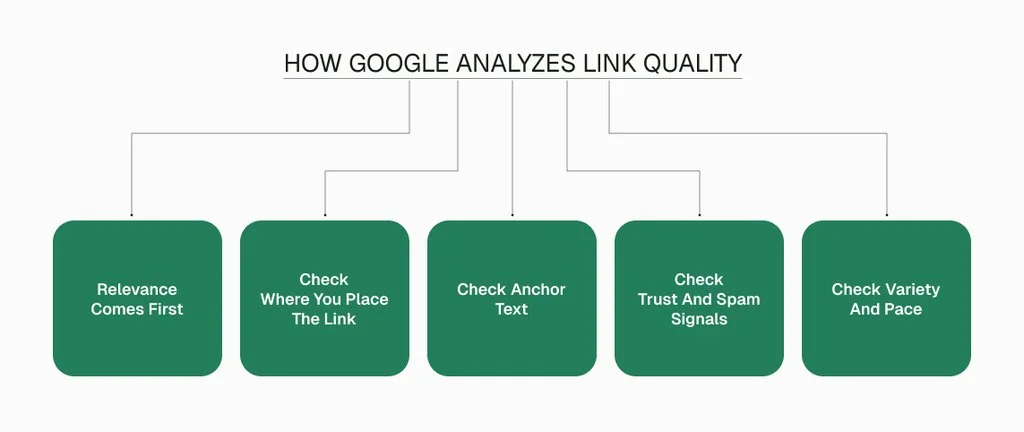
Relevance Comes First
Picture a guide to zero-trust security that links to a VPN comparison. It makes sense. Now put that same link in a banana bread recipe. Readers would notice, and so would Google.
That’s where Blogger Outreach becomes critical. On BloggerOutreach, you pick the publisher yourself through “Explore Sites” and filter by category, country, DA/DR, traffic and price.
The idea is to confirm topic fit before you pay for link building. If you'd rather hand that job over, our blogger outreach service can shortlist and pitch for you.
Where You Place The Link, And What's Around It
Google pays attention to the words surrounding a link, because they explain what it points to.
A link in the body of an article, inside a sentence that actually helps the reader, gives Google plenty to work with.
On the other hand, a link tucked into a footer, a sidebar or an author bio gives it very little, and looks more like an ad. That’s where the link quality drops.
That gap is also visible across hordes of disappointing guest posts, which we covered in why most guest post links fail to rank.
When you order through the “Buy Content” tab, you set the content type, word count, keywords, anchor text and landing page. Then, writers matched to your niche draft the piece, and you approve it before it goes anywhere.
If the publisher asks for changes, the rewrite is our job, not yours. A client named Sergei Antoine once told us that a publisher rejected the article he'd supplied, and our team simply wrote a fresh 1,000-plus-word version and got his links placed.
That's the standard we're aiming for with our content writing service: a link has to earn its spot in a real article.
Anchor Text
Google's own link best practices ask for anchor text that is descriptive, fairly short and relevant to both pages. And they say plainly not to stuff keywords in.
The spam policies go a step further and spots the optimized anchor text in paid guest posts as link spam.
So the instinct to put your paid keyword in every anchor is the wrong one. Brand names, plain descriptions and the occasional partial match, mixed over time, read better and carry less risk.
At Blogger Outreach, you choose the anchor and the destination page when you order.
That said you can send each link to the page that really answers the sentence around it, instead of defaulting to the homepage. For more on this, see our guide to getting high-quality backlinks.
Trust And Spam Signals
Google's spam policies describe link spam as links built mainly to improve rankings. The primary actions that count as link spamming are:
- automated link creation
- link swaps at scale
- junk directories
- keyword-heavy links
They also say buying and selling links is a normal part of how the web works, as long as paid links are marked with rel="sponsored" or rel="nofollow".
I'd take that at face value. A marked link can still send visitors, build recognition and earn mentions elsewhere. And nobody, us included, can honestly promise ranking credit from a link Google may choose to discount.
What you can actually control is the neighborhood where you place the link.
That said, we review publishers on our platform, Blogger Outreach, when they join for niche, traffic, and PBN or spam practices. Meanwhile, our quality control team checks each order from content through to final placement.
No matter who you buy from, check the site's traffic trend, glance at what else it links out to, and ask whether it publishes anything for a fee.
Variety And Pace
Google looks at patterns more than individual links. Ten links from one site in one week would look suspicious.
However, a site with a spread of publishers, anchor styles and destination pages, arriving over time, is something that people genuinely refer to. Pair the links with good content and some brand mentions.
Once you do that, your profile won’t seem fake anymore. We laid out the options in our overview of link building methods and placement types.
How We Ensure Link Quality At Blogger Outreach?
It's easier to compare workflows than promises. So let's do that with “Authority Builders”, a well-known curated marketplace. Its published standard is clear:
- Every site needs at least 1,000 monthly visitors verified through Ahrefs
- goes through a review of 40-plus criteria
- Placements come with a 12-month guarantee
You choose a site from a list showing DA, DR, traffic and Trust Flow, send over your URL and anchor, and they confirm the topic with the webmaster before invoicing. It's a good benchmark to measure any vendor against.
Our approach differs in a few practical ways. You can filter sites by category and country on top of the usual metrics, or skip the browsing and use managed outreach.
Meanwhile, the anchor text, keywords and landing page are set in one place. At the same time, the content is drafted in 24 to 48 hours by niche-matched writers.
Also every placement comes with a white-label report showing the live URL, DA, traffic and anchor text.
On quality safeguards, we screen publishers at onboarding, check orders along the way, and offer a replacement or refund if a placement isn't delivered in the agreed time.
Our real advantage is having all of that in one dashboard. One caveat: placements typically go live in 7 to 21 business days, depending on the publisher's schedule.
A Real Example
In our VeePN case study, links went to specific landing pages, comparison posts and cybersecurity guides rather than the homepage. VeePN reported 149% growth in referring domains and a 176% jump in organic traffic across the campaign.
Those figures cover the whole campaign, so they don't prove any single link did the work. What they do show is why planning the destination matters.
Before You Accept Any Link
Ask yourself a few things. For iinstance”Does the page share your topic and audience?”, :Is the link in body copy, in a sentence that helps the reader?
Is the anchor descriptive instead of forced? Does the site show real traffic and a clean set of outbound links? Is paid content marked the way Google asks? And will you go back and check the link after it's live?
Start Building Quality Links Today!
In conclusion, link quality isn't just one number. It comes down to a few simple things.
Is the link on a relevant page? Is it placed naturally in the article? Does the link text make sense? Is the site trustworthy? And does it look natural next to your other links?
If you'd like to see it in action, here's how to place an order on the platform. Or you can browse our guest posting services.