


A prospect hears about your company on a podcast. Later, they see your founder quoted in an industry article. A customer recommends your product in a forum. None of these references may send a large wave of traffic. Some may not even include a link.
Yet something important has changed. Your company is no longer making every claim about itself. Other people are placing it inside a real conversation.
That is where brand mentions become valuable.
Many businesses still judge online authority through backlinks alone. They count links, compare Domain Authority scores, and assume the largest number wins.
This misses a large part of how people discover and judge a brand. It also misses the difference between being visible and being known for something.
What To Expect From This Guide
This guide takes a more useful approach. A brand mention is not simply a “backlink without the link.” It is a piece of evidence.
The name, source, context, and claim around that mention help readers understand what the brand does and whether it deserves attention.
The same distinction matters in search. Google has not confirmed unlinked brand mentions as a direct ranking factor. A mention does not pass PageRank in the way a normal followed link can.
However, relevant third-party references can still support recognition, reputation, referral discovery, branded demand, and the wider picture we describe as brand authority.
Brand Mentions: The Short Introduction
A brand mention is a public reference to a company, product, service, founder, or other clearly branded asset.
It may appear in an article, review, video transcript, podcast description, social post, forum, directory, research paper, or AI-generated answer. The reference may be linked or unlinked.
The best mentions do more than repeat a name. They connect that name to a topic, problem, claim, or experience.
For example:
- “BrightPay” is only a name.
- “BrightPay is payroll software” adds category meaning.
- “Our finance team used BrightPay to reduce manual payroll checks” adds experience and a reason to remember the name.
This difference is the heart of the article. A weak mention identifies a brand. A strong mention explains why the brand belongs in the conversation.
Key Takeaways
- Brand mentions can be linked or unlinked, positive, neutral or negative.
- An unlinked mention is not the same as a backlink and should not be sold as one.
- Relevance, independence, context and accuracy matter more than raw mention volume.
- Mentions can support brand recognition, topical association, reputation and branded discovery.
- Research has found correlations between web mentions and AI visibility, but correlation does not prove that mentions caused the visibility.
- The best strategy is not “get mentioned everywhere.” It is “be meaningfully discussed in the places your audience and industry already trust.”
What Counts As A Brand Mention?
A mention can refer to more than the company name. It may name:
- The business or website
- A product or service
- A founder, executive or recognized expert
- A study, framework, tool or report created by the company
- A campaign or event closely associated with the brand
Here Are Common Examples:
| Mention type | Simple example | Main value |
| Linked editorial mention | A journalist cites your original study and links to it | Discovery, referral traffic, context and potential link value |
| Unlinked editorial mention | A trade publication names your company in an industry analysis | Recognition, reputation and topic association |
| Expert mention | Your subject expert is quoted in a news article | Personal expertise and brand credibility |
| Customer mention | A user discusses a real experience in a review or community | First-hand social proof and product insight |
| Co-mention | Your brand appears beside recognized companies in the same category | Category and competitor association |
| Owned mention | Your own website describes the brand and its claims | Definition and consistency, but not independent validation |
| AI mention | An AI answer names your brand in its response | Visibility inside a new discovery journey |
Not every reference is useful. A scraped directory listing, an inaccurate description, or a hundred copied press-release pages may increase the count without improving the quality of the brand’s digital footprint.
Brand Mention, Citation, Co-Mention And Branded Search: What Is The Difference?
These terms are often mixed together, but they describe different events.
| Term | What it means |
| Brand mention | The brand is named in public content, with or without a link |
| Citation | A source is credited or linked as support for information; the brand name may or may not appear prominently |
| Co-mention | The brand is discussed near another company, product, person or topic |
| Branded search | A person searches for the brand or a brand-plus-topic phrase |
| Backlink | One webpage links to another webpage |
A co-mention does not transfer another company’s authority by magic. Its value is in the context. If several independent HR publications discuss two payroll platforms in genuine comparisons, readers can understand that both belong to the same category. A random list of company names does not create the same meaning.
Brand Mentions Are Not Backlinks Without A Link
This is the first myth to remove.
A followed backlink creates a clickable path between two pages. Google openly states that its systems analyze links, including through PageRank, to understand pages and assess which may be helpful. An unlinked mention does not create that path and should not be treated as a substitute.
The two can still work together.
| Question | Backlink | Unlinked brand mention |
| Is it clickable? | Yes | No |
| Can it send direct referral traffic? | Yes | Rarely and indirectly |
| Can it pass conventional link equity? | Potentially, depending on the link | No conventional link equity |
| Can it explain what the brand is known for? | Yes, through anchor and surrounding copy | Yes, through surrounding copy |
| Can it support recognition or reputation? | Yes | Yes |
| Can it reveal public sentiment? | Sometimes | Often |
This is why a complete authority strategy needs more than one signal. Website authority is not a single public Google score, and Domain Authority is a third-party prediction rather than a Google metric. Links, content quality, technical access, editorial reputation and brand recognition perform different jobs.
Do Brand Mentions Directly Improve Google Rankings?
There is no responsible way to promise that an unlinked mention will move a page from position 12 to position 5.
Google has not listed unlinked brand mentions as a direct ranking factor. Recently, Google’s John Mueller also rejected the idea that plain mentions are simply counted like links.
The answer to this question is important because many SEO articles still use the phrase “implied link” as if it were a confirmed description of Google’s current ranking system.
What Google Does Confirm Is Broader:
- Its ranking systems use many factors and signals, not one universal authority score.
- Its systems analyze links between pages.
- RankBrain helps Google understand how words relate to concepts.
- Google’s helpful-content guidance asks whether a site would appear well trusted or widely recognized as an authority if someone researched it.
- Quality raters research a website's and creator's reputation through real-user experiences and the opinions of relevant experts.
Quality-rater guidelines do not directly control rankings. Google says this clearly. However, they are still useful because they show the quality and trust concepts Google asks raters to examine.
So a sensible conclusion would be:
“Search authority becomes more believable when a brand’s own claims are supported by accurate, relevant, and independent evidence elsewhere.
That evidence may include links, reviews, expert commentary, citations, and brand mentions. No single reference guarantees a result.
The Missing Angle: A Brand-Topic Evidence Chain
Most literature mentions that strategies begin and end with monitoring. A tool finds the brand name, the marketing team adds it to a report, and someone emails the publisher to ask for a backlink.
That process comes with some genuine opportunities. But it does not explain what the mentions are building.
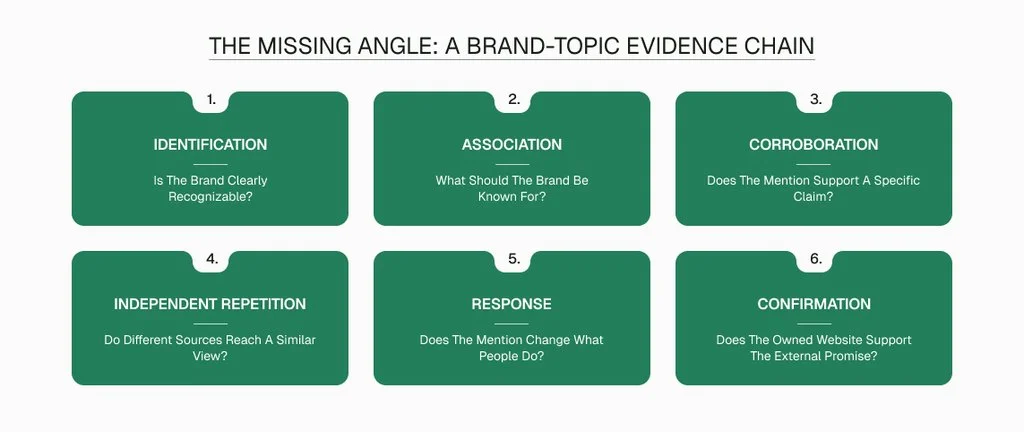
At BloggerOutreach, a more useful way to examine brand mentions is through a Brand-Topic Evidence Chain. This is a planning framework, not a Google metric.
1. Identification: Is The Brand Clearly Recognizable?
The first job of a mention is to identify the correct business.
This sounds simple until two companies share a similar name. Imagine a software business called “Anchor.” If articles mention only “Anchor,” a reader may not know whether the reference means a podcast tool, a financial company, or a different product.
A clearer mention might say:
“AnchorFlow, the inventory-planning platform for independent retailers...”
Therefore, we can conclude that the category, audience, and full name remove ambiguity. Consistent company names, product names, executive profiles, and business descriptions also make the wider web less confusing.
2. Association: What Should The Brand Be Known For?
The next job is to connect the name with a relevant subject.
Suppose an HR software company earns 60 mentions. Forty appear in generic startup roundups. Again, twenty appear in detailed articles about payroll compliance, employee onboarding, and workforce planning.
The smaller group may be more useful because it creates a clearer association between the brand and the problems it actually solves. To conclude, this reflects the same relevance-first logic behind topical authority: broad visibility is not the same as focused expertise.
3. Corroboration: Does The Mention Support A Specific Claim?
“Company X is innovative” is vague. On the contrary, “Company X’s study analysed 2,000 anonymised support tickets and found that...” is checkable.
Strong mentions often have an evidence object behind them:
- Original research
- A transparent case study
- A product test
- A named expert’s explanation
- A customer’s documented experience
- A useful tool or dataset
The mention becomes more credible because a reader can understand why it exists.
4. Independent Repetition: Do Different Sources Reach A Similar View?
One publisher repeating a press release across 50 partner sites does not provide the same evidence as five independent sources discussing the brand for different valid reasons.
In the same vein, source diversity matters because each independent mention represents another editorial, expert, or customer decision. It also reduces dependence on one platform. A brand that exists only on its own site and one social network has a fragile footprint.
This is where editorial authority matters. A reference from a focused publication with real editorial standards may carry more human trust than dozens of automatic listings.
5. Response: Does The Mention Change What People Do?
Authority is not complete when the mention goes live. Look for a response:
- More branded searches
- Direct visits
- Referral visits
- Demo requests or assisted conversions
- Newsletter sign-ups
- More journalist inquiries
- More natural mentions from new sources
Not every response can be attributed to one article. Brand discovery is often messy. Someone may hear the name in a webinar, see it again in an article, and search for it a week later. That does not make the earlier mentions worthless. It means last-click reporting cannot show the whole journey.
6. Confirmation: Does The Owned Website Support The External Promise?
A mention creates an expectation. Your website must confirm it.
If publishers describe your company as a specialist in healthcare cybersecurity but your site contains only generic IT pages, the chain breaks. The same happens when an expert is widely quoted but has no clear author profile or when a study is mentioned without a stable source page.
Before scaling outreach, improve the page that deserves attention. Give it clear authorship, evidence, updated facts, internal links, useful definitions, and a logical next action. External recognition works best when the owned experience supports it.
What Makes A Brand Mention High Quality?
Do not score mentions by domain metrics alone. Use questions that reflect the actual job of the placement.
| Quality check | Ask this question | Warning sign |
| Topical fit | Is the surrounding discussion closely related to what we do? | The brand is inserted into an unrelated article |
| Source credibility | Does the source have real expertise, readers or editorial standards? | The site publishes any subject for anyone |
| Independence | Did the writer have a genuine reason to include us? | The reference exists only because it was required |
| Descriptive depth | Does the mention explain the brand’s role or evidence? | It is a context-free name drop |
| Accuracy | Are the name, product, claim and facts correct? | Old pricing, wrong category or exaggerated result |
| Audience fit | Are the source’s readers people we need to reach? | Large traffic with no relevant audience |
| Source diversity | Are independent types of sources discussing us? | Most mentions come from one network |
| Durability | Is the page useful enough to remain live and discoverable? | Temporary, thin or copied content |
Why Brand Mentions Matter For Search Authority
We will discuss some indispensable areas that make brand mentions more important:
They Create Recognition Before The Search
People do not always discover a brand on Google. They may first encounter it in a newsletter, video, conference recap, or community discussion.
When the name later appears in search results, it is no longer unfamiliar. That recognition can affect real behavior even when no single mention can be credited for the final click.
They Build Topic-Specific Reputation
Reputation is not universal. A respected project-management company is not automatically an authority on personal finance.
Relevant mentions help show the area in which customers, writers, and experts recognize a brand. This is more precise than trying to become “authoritative” everywhere.
They Reveal How The Market Describes You
Your positioning statement may say “AI-powered revenue intelligence.” However, customers may repeatedly call the product “a simple sales-call summary tool.” to clarify there is a huge difference between the two.
In the same vein, an analysis of brand mentions reveals:
- Language customers naturally use
- Features people remember
- Problems associated with the brand
- Competitors mentioned beside it
- Incorrect or outdated claims
- New content and product opportunities
This turns monitoring into research rather than reputation theatre.
Mentions Can Support AI-Era Visibility; But There’s A Caveat
AI systems can mention a brand without linking to it, or cite a page without naming the brand prominently.
A 2026 Semrush study illustrates the difference. It reviewed 3,981 domain appearances for 115 prompts across 14 countries and four AI search systems.
In that sample, 61.7% were “ghost citations”: the system cited a domain but did not name the brand in the answer.
The study was limited to its chosen prompts, markets, and platforms. But it shows why citation counts and visible brand mentions should be measured separately.
An Ahrefs study of 75,000 brands reported correlations of roughly 0.66 to 0.71 between branded web mentions and visibility across the AI surfaces it studied. The researchers used Spearman correlation and clearly warned that correlation does not establish causation.
The sample also filtered for domains with DR above 40 and a high-volume branded term, so the results should not be applied blindly to every small business.
The lesson is not “buy more mentions to control AI.” It is that brands with a broader, visible, and relevant web presence were more likely to appear in those measured AI responses. That supports a diversified visibility strategy, not a guarantee.
Google’s current spam policies also cover attempts to manipulate generative AI responses in Google Search. Fake recommendations, covert community promotion, and mass-produced brand name drops are therefore poor long-term tactics.
How To Find And Track Brand Mentions
You do not need an expensive platform to begin. Start with a manual search, then add monitoring tools when the volume becomes hard to manage.
Use Simple Search Queries
Search for:
- "Brand Name" -site:yourwebsite.com
- "Product Name" -site:yourwebsite.com
- "Founder Name" "Brand Name"
- "Brand Name" reviews
- "Brand Name" alternatives
- Priority topic + "Brand Name"
- Common misspellings and old product names
The -site: part removes many pages from your own website. It helps you focus on third-party references. Repeat the search for the web, news, videos, and the communities that matter in your niche.
Combine Several Monitoring Sources
No tool sees the whole web. Use a combination of:
- Search alerts for new indexed pages
- SEO tools with content or web indexes
- Social-listening tools
- Review-platform notifications
- Media-monitoring services
- Referral reports in your analytics platform
- Customer-support and sales notes
Google Search Console can show branded queries that lead to your site. It does not provide a complete list of unlinked mentions. Referral reports also miss people who see a mention and later return through a search or direct visit.
Classify Before You Count
For each result, record:
- Date and source
- Topic and page type
- Linked or unlinked status
- Positive, neutral, mixed, or negative sentiment
- Accurate or inaccurate description
- Independent, sponsored, owned or syndicated source
- Audience relevance
- Possible response: thank, correct, answer, reclaim or monitor
This small amount of classification prevents ten copied press-release pages from looking more important than one detailed industry review. It also helps a brand build a presence across authority platforms without depending on a single channel.
How To Earn Brand Mentions That Mean Something
Now use what the audit shows to earn stronger references.
1. Decide What You Want To Be Mentioned For
Do not begin with a publisher list. Begin with a subject.
Complete this sentence:
“When people discuss __________, our brand should be considered because __________.”
For example:
“When small manufacturers discuss reducing machine downtime, our brand should be considered because our maintenance dataset shows where preventable stoppages begin.”
This prevents random visibility campaigns.
2. Build Proof Before Promotion
Writers need a reason to mention you. So, create one. In this connection, the useful mention-worthy assets include:
- A small but transparent industry study
- A benchmark based on anonymized internal data
- A calculator, checklist or template
- A detailed before-and-after case study
- A clear expert view on a current issue
- An original diagram or framework
- A regularly updated statistics page
Google’s people-first guidance asks whether content provides original information, research or analysis and adds value beyond existing results. The same qualities also give publishers something worth discussing.
3. Map The Relevant Conversation
List the places where your topic is already discussed:
- Trade publications
- Specialist blogs
- Podcasts and video channels
- Professional associations
- Relevant newsletters
- Customer review platforms
- Genuine industry communities
- Journalists and independent analysts
This is more useful than filtering thousands of sites by DA. A smaller, topic-specific publication can be the better placement when its readers, editors, and coverage closely match the subject.
4. Offer Evidence, Not A Promotional Paragraph
Editors rarely need another company description. They may need a number, an example, a source, or an experienced viewpoint.
Therefore, compare these pitches:
Weak: “Please mention our award-winning platform in your article.”
Better: “We reviewed 1,400 anonymized onboarding sessions and found that users who completed the import step first reached activation sooner. I can share the method, limitations and category breakdown if useful for your article.”
The second pitch gives the writer a reason to care. It also leaves the editorial decision with the publisher.
5. Use Digital PR And Guest Contributions For The Right Reason
Digital PR can turn original evidence and expert insight into media coverage. A relevance-led guest posting strategy can place useful expertise in front of an established audience.
Neither method should be reduced to forced brand repetition. The article must help the host publication’s reader. If compensation is involved, disclose links and qualify them as Google requires.
Google identifies paid links that pass ranking credit, large-scale link exchanges, and optimized links in low-value guest content as possible link spam.
6. Let Customers Speak In Their Own Words
Real customer experience can produce the most useful mentions, especially for products that require trust.
Ask for honest feedback after a real service moment. Do not script praise, hide incentives or create fake community accounts.
A mixed but truthful review profile is more believable than a wall of identical five-star language.
7. Reclaim Links Selectively
An unlinked editorial mention can sometimes become a useful backlink. Ask when the link would genuinely help the reader. For example, when the article discusses your study but does not provide a path to the full method.
Do not request a link for every name drop. A forced link can turn a natural mention into an awkward sentence.
Evaluate the exact page, context and destination, following the same placement-level logic used to assess link authority.
How To Measure Brand Mentions Without Creating A Vanity Score
A single “mention authority score” can hide the details that matter. Use a scorecard instead.
Establish A Baseline
Track:
- Exact company name
- Common misspellings
- Product and service names
- Founder and expert names
- Original studies, tools and campaign names
- Brand-plus-topic combinations
- Brand-plus-review, pricing, alternative and complaint searches
Separate owned pages, copied syndication and genuinely independent references.
Review The Mention Portfolio
Measure these dimensions each month or quarter:
| Dimension | Useful measure |
| Visibility | Total new mentions and pages that remain live |
| Diversity | Unique domains, source types and authors |
| Relevance | Percentage of mentions within priority topic areas |
| Context | Descriptive mentions versus name-only mentions |
| Sentiment and accuracy | Positive, neutral, negative, mixed and factually incorrect mentions |
| Authority | Mentions from sources with relevant expertise and editorial standards |
| Link status | Followed, nofollow, sponsored and unlinked references |
| Audience response | Referral visits, direct visits, branded searches and assisted conversions |
| Conversation share | Your relevant mentions compared with selected competitors |
| AI visibility | Brand appearances for a fixed, repeatable set of category questions |
Do not combine all of this into one unexplained number. A drop in total mentions may be acceptable if relevance, source quality and qualified traffic improve.
Use A Fixed Question Set For AI Tracking
AI answers vary by platform, location, prompt wording and time. To make comparisons less noisy:
- Create 20 to 50 real questions from the customer journey.
- Separate informational, comparison and purchase-intent questions.
- Keep the prompts unchanged during the measurement period.
- Record whether the brand is named, cited, accurately described or recommended.
- Review which third-party sources appear repeatedly.
- Treat movement as directional evidence, not a guaranteed causal result.
This shows whether your brand is present in useful conversations rather than merely counting its name across the web.
A 30-Minute Brand Mention Audit
Use this quick check before planning a campaign.
Search The Name
- Does Google clearly show the correct business?
- Are the company description, location and key people consistent?
- Are important reviews, profiles and publisher references accurate?
Search The Topic
- Is the brand mentioned in discussions about its priority topics?
- Do those mentions explain why the brand is relevant?
- Are competitors present where the brand is absent?
Check The Evidence
- Do you have original facts, examples or expertise publishers can use?
- Does each important claim lead to a strong owned page?
- Are the author, reviewer, date and method clear?
Highlight The Sources
- Do mentions come from several independent sources?
- Do those sources have a real audience and a clear editorial focus?
- Are sponsored relationships and links disclosed correctly?
Check The Outcome
- Are branded searches, referral visits or assisted conversions changing?
- Are journalists, partners or customers creating new mentions naturally?
- Is the market describing the brand accurately?
If most gaps appear under “Search The Topic,” you do not have a volume problem. You have an association problem. If most gaps appear under “Check The Evidence,” more outreach will only distribute a weak story.
Common Brand Mention Mistakes
- Chasing Volume Without Meaning
One hundred copied references do not create one hundred independent endorsements. Remove syndication and duplicates before reporting results.
- Targeting High-DA Sites Outside The Niche
A broad site may look impressive in a spreadsheet but contribute little topic relevance or qualified discovery. Use domain metrics for comparison, not as the final decision.
- Treating Every Negative Mention As A Removal Problem
Some negative mentions reveal genuine service or product issues. Correct false facts, respond calmly and fix repeated problems. Trying to erase fair criticism can create a larger reputation issue.
- Forcing Every Mention Into A Backlink
Some references are valuable because they are natural. Request a link only when it improves the page for readers.
- Measuring Only The Final Click
A mention can introduce the name while another channel receives the conversion credit. Combine referral data with branded search, direct traffic, sales feedback and assisted conversion paths.
- Trying To Manipulate Communities Or AI Answers
Fake forum posts, undisclosed recommendations and mass-produced comparison pages weaken trust. Google’s spam policies now explicitly include attempts to manipulate generative AI responses in Search. Build genuine evidence and earn the conversation.
A Practical 90-Day Plan
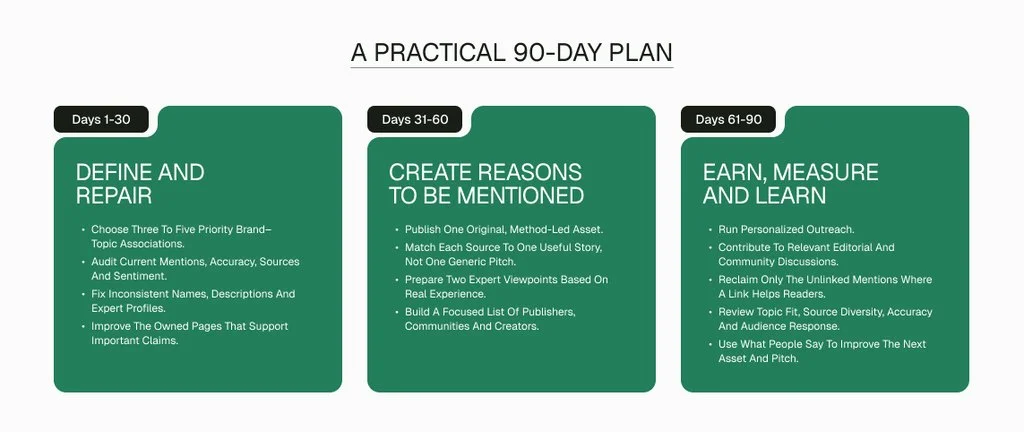
Here is the final success blueprint:
Define And Repair (Days 1-30)
- Choose three to five priority brand–topic associations.
- Audit current mentions, accuracy, sources and sentiment.
- Fix inconsistent names, descriptions and expert profiles.
- Improve the owned pages that support important claims.
Create Reasons To Be Mentioned (Days 31-60)
- Publish one original, method-led asset.
- Prepare two expert viewpoints based on real experience.
- Build a focused list of publishers, communities and creators.
- Match each source to one useful story, not one generic pitch.
Earn, Measure And Learn (Days 61-90)
- Run personalized outreach.
- Contribute to relevant editorial and community discussions.
- Reclaim only the unlinked mentions where a link helps readers.
- Review topic fit, source diversity, accuracy and audience response.
- Use what people say to improve the next asset and pitch.
This creates a repeatable loop:
Useful evidence → relevant outreach → independent mentions → audience response → stronger owned content → better future evidence
For teams that need help building the publisher side of that loop, BloggerOutreach’s outreach service focuses on niche relevance, editorial placements and transparent reporting. The goal should be a credible authority footprint, not a spreadsheet filled with context-free URLs.
Frequently Asked Questions About Brand Mentions
What Are Brand Mentions In SEO?
Brand mentions are online references to a company, product, expert or branded asset. They may be linked or unlinked. In SEO, they help you study recognition, topic association, reputation, public language, and potential link opportunities. An unlinked mention does not pass conventional link equity.
Are Brand Mentions A Google Ranking Factor?
Google has not confirmed unlinked brand mentions as a direct ranking factor. Avoid claims that each mention increases rankings. Relevant mentions can still contribute to discovery, reputation, branded demand and the wider evidence surrounding a brand.
Do Unlinked Brand Mentions Have Value?
Yes, but not the same value as a backlink. A credible unlinked mention can introduce the brand, explain its expertise, provide social proof, reveal sentiment and create branded discovery. It may also become a link opportunity when linking to the original source helps the reader.
Are Linked Mentions Always Better?
No. A link can be irrelevant, paid, low quality or placed on a page nobody reads. An unlinked reference in an influential industry report may create more recognition and trust. Judge the source, context, audience and campaign goal before comparing them.
How Can A Small Business Earn Brand Mentions?
Start narrowly. Publish useful local or niche data, offer a qualified expert for interviews, document a genuine case, contribute to specialist publications and participate honestly in the communities where customers ask questions. A small business does not need national media to become recognised within a focused market.
How Many Brand Mentions Does A Company Need?
There is no universal number. A specialist B2B company may need fewer but more focused mentions than a mass-market consumer brand. Compare source diversity, topic relevance and audience response over time rather than chasing a fixed quota.
Can Brand Mentions Help AI Visibility?
Studies have found correlations between branded web mentions and visibility in some AI systems. This does not prove that adding mentions causes an AI platform to name a brand. Build an accurate, diverse and useful web presence, then measure a stable set of relevant prompts over time.
Build A Meaningful Brand Mentions Footprint
Brand mentions matter most when they reduce uncertainty.
They help a reader answer simple but important questions:
- Is this a real and recognisable company?
- What does it actually do?
- Why is it relevant to this subject?
- Who else has seen its work?
- Is the claim supported by experience or evidence?
That is the difference between name repetition and search authority.
Do not aim to place your company name everywhere. Build proof worth discussing. Earn references in the right conversations. Keep those references accurate. Then make sure your own website delivers on the promise other people have repeated.
When that system works, backlinks, mentions, branded searches, referrals and recommendations stop behaving like separate marketing activities. They become connected evidence that the brand belongs in the market it wants to lead.