


If you have a website, you can publish hundreds of articles and optimize every page for search engines. But it might still struggle to earn quality backlinks. WHY?
The problem is not how much content it produces. It is whether that content gives other publishers a compelling reason to reference it.
That is where editorial links come in.
An editorial link is a backlink that another website gives you because its writer or editor believes your content is worth referencing.
You don't pay for it, exchange links for it, or negotiate to get your link included. The publisher independently chooses to link to your website. WHY?
The main reason is that it adds useful information, evidence, or context for their readers.
For example, a journalist writing about AI in recruitment might discover your original research, use one of its findings, and link to your report.
That is an editorial link. The logic is simple: the journalist chose your research because it supported their story.
This guide explains how to earn these links, evaluate their quality, and make your content more useful to publishers and AI-powered search experiences.
Why Are Editorial Links Important For SEO?
Not all backlinks are equally valuable. So which ones should you choose?
Try to get a link from a website that belongs to your sector and links to your page, data, statement, or ideas in a closely related article.
So the key takeaway is to choose backlinks based on relevance.
But of ofcourse, there are other parameters to consider when evaluating the quality of editorial links.
Relevance checked? Great!
Now we will check out the purpose that the editorial links are serving for you. Choose editorial links only if:
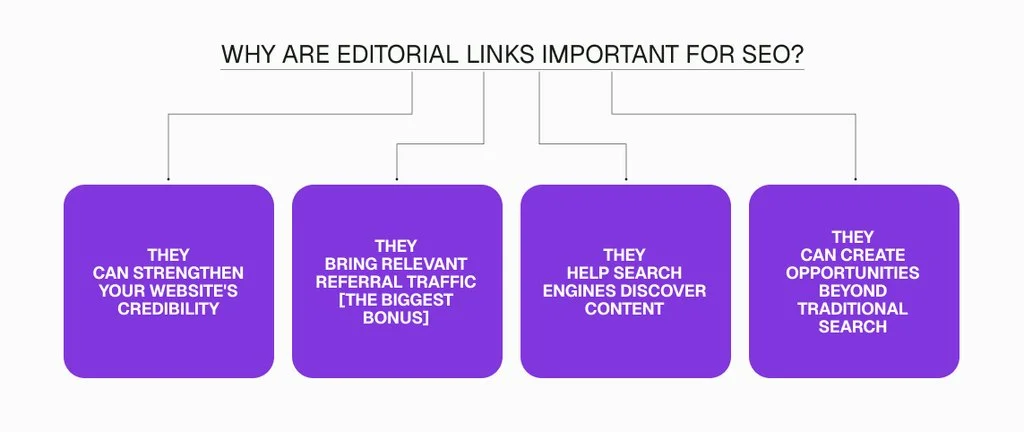
1. They Can Strengthen Your Website's Credibility
When an established publication references your research, expertise, or original data, it gives your brand recognition with an audience that didn't know about you. The best part: they are from your niche only.
Whenever a website does that, Google receives trust signal. Again, that trust helps establish your website’s credibility in the eyes of the search engine.
2. They Bring Relevant Referral Traffic [The Biggest Bonus]
This is the most worthwhile reason to start building editorial links today. A reader who clicks a link to your research from an article about a topic they are researching.
When they see your link, they're likely to be interested in checking out what else you've written on the same or a related topic.
That gives you traffic, which we call referral traffic in SEO terms. Now some people will argue that such small traffic is not worth.
But that’s not true. The traffic volume might be less than what you will get from a well-planned advertising campaign. But that small traffic is very relevant, which will send better trist signals.
3. They Help Search Engines Discover Content
Links help search engines find pages and understand relationships between them.
Imagine GSC shows your average position was 39. After a few quality editorial links, the search engine will prioritizing your content more.
As a result, the average position in GSC will ascend to 34 or 32 in a month. In simpler words, search engines will find it easier to discover and place your content if there are quality editorial links.
Sure, no editorial link can guarantee higher rankings. But an ecosystem of good editorial links will definitely helo you get better SEO impressions.
4. They Can Create Opportunities Beyond Traditional Search
Editorial links can lead to brand partnerships, better brand recall, expert invitations and more.
Even if your Google rankings don’t grow immediately after a link placement, these outcomes build a cluster of trust signals that will improve your rankings over time.
Therefore, the key takeaway is that you cannot judge the benefits of editorial links by adding them to the net link count. Instead, check how many of the links are relevant, contextual and organically placed.
What Are The Different Types Of Editorial Links?
There are different kinds of editorial mentions. The editorial links that you get from publishers can be:
- Research and data citations: A journalist or writer links to your survey, industry report, original dataset, or research finding.
- Expert citations: A publisher references an expert's commentary, analysis, or professional insight.
- Resource links: A writer recommends your guide, calculator, template, tool, or educational resource because it helps readers.
- News and media mentions: A publication links to your website while covering a relevant company announcement, industry development, or news story.
- Reference links: An author links to your article to support a claim, explain a concept, or provide additional reading.
These formats have one thing in common: the link exists because the source adds something to the article.
How To Differentiate Between Normal Link Placements And Editorial Links?
A link does not become editorial simply because it appears inside an article. If the link was paid for or exchanged, it should be treated as a paid placement.
An editorial link is placed because a writer or editor believes your content is worth referencing.
Editorial Links VS. Guest Posts VS. Paid Links: How To Differentiate Quickly?
Many SEO professionals still think a link is a link. In reality, an editorial link’s value isn't the same as a paid link's.
So now the question is: how can you easily differentiate a paid link from editorial links or guest posts:
| Link type | How it happens | What determines the link? |
| Editorial link | A publisher independently references your content | Editorial value and relevance |
| Guest post link | You contribute an article to another website | Content contribution and publisher agreement |
| Paid placement | You pay for publication or promotion | Commercial arrangement |
| Link exchange | Two websites agree to link to each other | Mutual agreement |
| Directory link | Your website is listed in a directory | Listing criteria or submission |
If you are promoting your page or brand, you can certainly go for guest posting on other’s websites of buying links.
However, those are commercially exchanged links, not organically gained. That’s a distinction worth noting.
Google’s policy is strict about this distinction.
Google's spam policies identify buying or selling links intended to manipulate rankings as link spam. Paid placements and advertisements should use rel="sponsored" or rel="nofollow" where appropriate.
A paid article does not become an earned editorial link just because it is published on an established website.
If your strategy includes paid placements, understand the difference between earning independent editorial coverage and buying publication exposure.
Our industry report, Paid Editorial Placements 2026, explores the landscape of paid-placements and how they can help your brand grow in 2027.
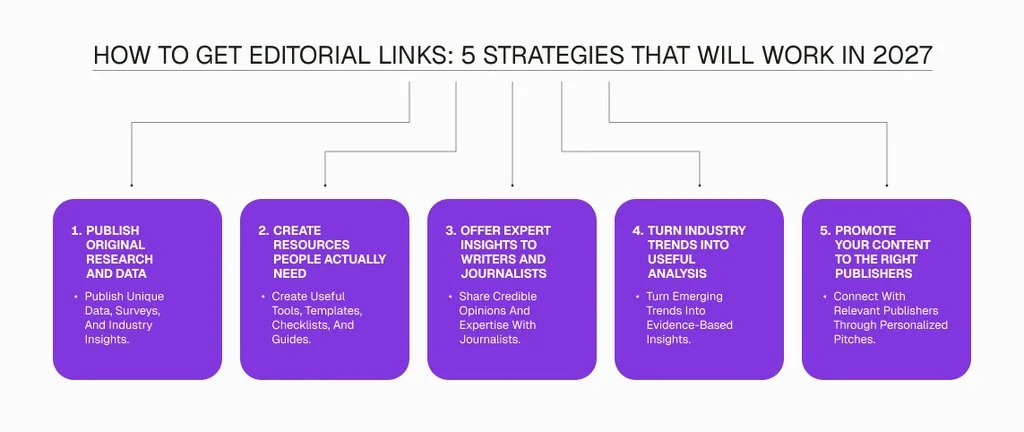
How To Get Editorial Links: 5 Strategies That Will Work In 2027
Most brands or websites overlook a simple strategy. In 2026, Google did not welcome asking publishers to link to your content. In 2027, you must stop doing that completely.
Improve your page content so that publishers notice you naturally. Remember, no publisher is actually looking to promote your article by placing your link in their content.
Here are 5 reasons you can give publishers to link your page to their content:
1. Publish Original Research And Data
The best way to attract editors' attention is to do original research with real statistical or metrics-led data. You can't get that information by rewriting another’s article in your own words. The following example will make things clear:
- AI will heavily influence content creation in 2027
- A survey of 500 employees found that content volume will increase in 2027 because AI use is rising. But that did not guarantee higher revenues.
You'll find the former broad speculation in almost every other article. However, an editor can challenge, build on, or cite the latter finding.
A common misconception: original research requires a network, money and tools.
That is wrong. You don’t need SPSS for your first data-sampling project. An Excel sheet is good to start with. With no budget and just your laptop, you can conduct:
- Customer or industry surveys.
- Anonymized internal business data
- Year-on-year trend comparisons.
- Expert interviews
- Small-scale experiments
- Analysis of publicly available datasets
2. Create Resources People Actually Need
You don't always need to write a 4000- or 5000-word article. The article should cover a problem, who faces it, how to solve it and what the easiest ways are to avoid it.
How To Make Your Content Noticeable In 2027?
Using these in your article increases the chance of publishers referring to your content or your page:
- Free calculators and assessment tools
- Downloadable checklists
- Industry benchmarks
- Comparison table
- Detailed how-to guides
- Templates and practical frameworks
An Example:
For example, a marketing agency could publish a practical website audit checklist.
A financial technology company could create a calculator that helps businesses estimate transaction costs. A workforce development organization could release a skills-gap assessment framework.
The question to ask is simple: would another writer find this resource useful enough to recommend it to their audience?
If the answer is yes, you have a stronger starting point for earning editorial links.
3. Offer Expert Insights To Writers And Journalists
Journalists often need credible sources who can explain a development, interpret new data or provide a perspective that goes beyond the headline.
You can make your expertise easier to discover by:
- Publishing clear expert biographies
- Identifying the subjects your team can comment on
- Sharing timely, evidence-based opinions
- Responding to relevant media requests
- Offering specific commentary instead of generic company statements
A useful expert response should answer the question directly, explain why it matters and include a meaningful observation or example.
Avoid sending generic introductions that say your company is an industry leader and would love to be featured. Explain precisely what insight you can contribute to the story.
4. Turn Industry Trends Into Useful Analysis
Writers already have access to news announcements and trending topics. What they often need is an explanation of what those developments mean.
That creates an opportunity for businesses with genuine industry knowledge.
For instance, instead of publishing another article titled "Top AI Trends in 2027", analyse how AI adoption is changing a specific business function. Compare the impact across company sizes, industries or operating models. Explain where the benefits are appearing and where the limitations remain.
A useful analysis should contain:
- A clear industry question
- Evidence supporting the argument
- Relevant comparisons
- A distinct point of view
- Practical implications for readers
The goal is not to be the first website to discuss a trend. It is to provide an explanation that other publishers can use.
5. Promote Your Content To The Right Publishers
Publishing something valuable is only half the job. The people who could reference it need to discover it.
Build a focused list of journalists, editors, industry publications, newsletter writers and bloggers who cover the subject your content addresses.
Then personalise your outreach.
A useful outreach message should explain:
- Why you are contacting that particular writer.
- What relevant finding, resource or insight you have.
- How it could add value to their existing coverage or future reporting.
- Where they can review the original material.
Do not ask for a backlink as the primary value proposition. Offer the information first and let the publisher decide whether it belongs in their work.
A smaller list of relevant contacts is usually more useful than a large database of unrelated websites.
What Makes Content Worth Linking To?
Before investing in outreach, look at your content from a publisher's perspective.
Would a writer cite it? Would it help them explain something? Does it contain information that is difficult to find elsewhere?
Content that attracts editorial links generally has at least one of these qualities:
- Originality: It offers a finding, perspective or resource that is not simply repeated elsewhere.
- Evidence: Claims are supported by data, sources, examples or demonstrable experience.
- Relevance: It addresses a topic that the publisher's audience cares about.
- Clarity: The information is easy to understand, verify and reference.
- Usefulness: It helps readers answer a question, make a decision or understand a development.
This is also why publishing more content does not necessarily produce more editorial links. If ten articles repeat the same commonly available advice, they give publishers very little reason to cite any one of them.
A single well-researched industry report may offer more link opportunities than dozens of generic blog posts.
How To Evaluate The Quality Of An Editorial Link
A backlink report can make a link look impressive. But a high domain rating does not automatically mean that the link is relevant, trustworthy or useful.
Before accepting a link-building opportunity or evaluating a link you have earned, use this checklist.
The 10-Point Editorial Link Quality Checklist
| What to check | What a good link looks like |
| 1. Topical relevance | The linking website covers your industry or a closely related subject. |
| 2. Publisher credibility | The publication has a clear identity, editorial purpose and credible content. |
| 3. Article relevance | The specific article is relevant to your page or resource. |
| 4. Editorial context | Your link supports a statement, example, source or recommendation. |
| 5. Audience value | Readers have a genuine reason to click through. |
| 6. Content quality | The referring article offers useful information rather than existing mainly to host links. |
| 7. Link placement | The link appears naturally within relevant content. |
| 8. Destination quality | Your linked page delivers what the surrounding text promises. |
| 9. Transparency | Any paid or sponsored relationship is disclosed, and the link is qualified appropriately. |
| 10. Long-term value | The link has the potential to bring relevant visitors, credibility or continued discovery. |
You can score each criterion from 0 to 2:
- 0: The link does not meet the criterion.
- 1: It partially meets the criterion.
- 2: It meets the criterion well.
A score out of 20 gives you a structured way to compare opportunities. It is an internal evaluation tool, not a Google ranking formula.
One important warning: do not let a high score compensate for a fundamentally unsuitable link. A paid link intended to pass ranking credit doesn't become compliant just because the publisher has a strong reputation or the article is well written.
How To Find Websites That Can Give You Editorial Links
Finding relevant publishers is easier when you start with the topic rather than a list of high-authority websites.
Try these approaches:
Search for publications covering your subject. Look for websites that regularly publish industry news, research, expert commentary and educational content in your niche.
Study who cites your competitors. Examine which publications reference their original reports, tools, research and expert insights. These websites may also cover your subject, although that does not mean they will automatically link to you.
Find articles that reference similar resources. Search for existing industry reports, studies and tools that have received editorial coverage. Understand why those resources were useful to the writers.
Monitor journalists and industry conversations. Follow writers who regularly cover your subject. Their reporting interests can help you identify timely opportunities.
Look for unlinked brand mentions. A publisher may already mention your company without linking to it.
If a link would help readers find the relevant source, a polite request may be appropriate. However, a brand mention is not automatically an editorial link, and publishers are not obliged to add one.
The objective is to identify publishers with a genuine reason to reference your work, not simply websites willing to publish a link.
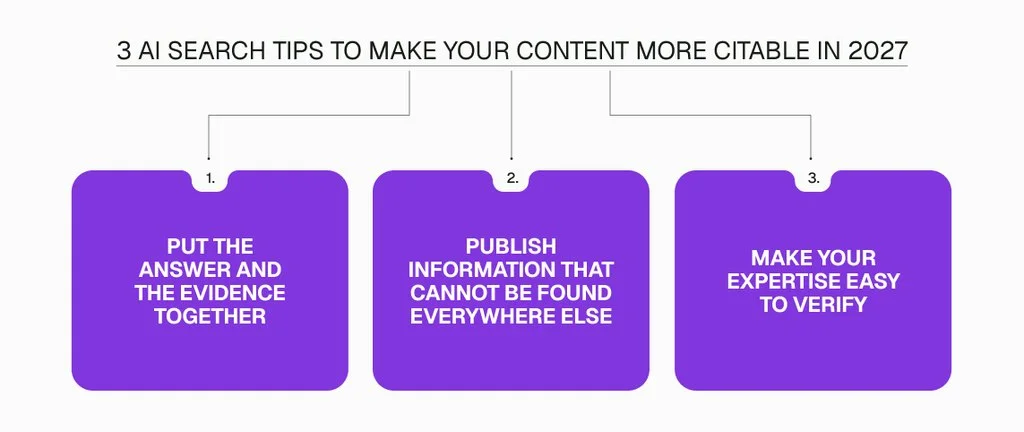
3 AI Search Tips To Make Your Content More Citable In 2027
Editorial links and AI search visibility are not the same thing. A backlink does not guarantee that your website will appear in an AI Overview, and there is no reliable shortcut for securing an AI-generated citation.
However, the qualities that make content worth referencing, like original information, credible evidence and clear explanations, can also make it more useful as a source.
Google's guidance for AI features in Search continues to emphasise foundational SEO, helpful content, accessibility and unique value.
It does not prescribe a separate set of special requirements for appearing in AI Overviews. https://developers.google.com/search/docs/appearance/ai-features
Here are three practical ways to improve your content's usefulness in AI-powered search experiences.
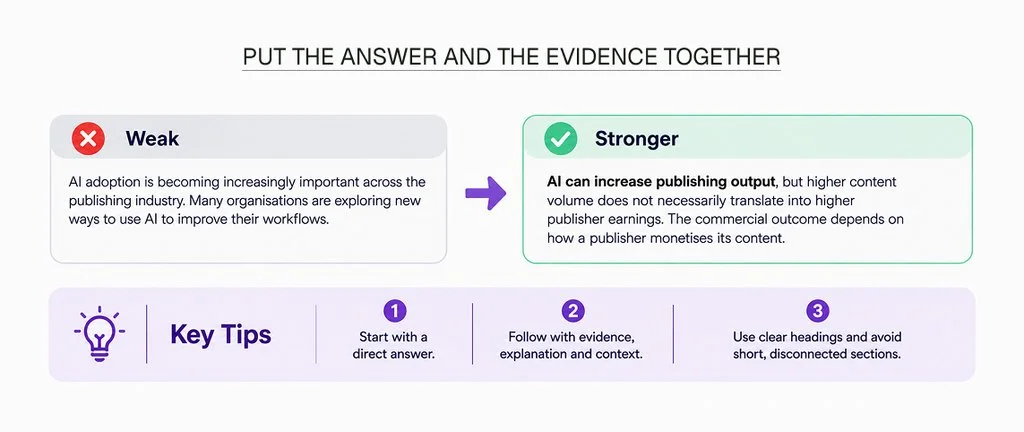
1. Put The Answer And The Evidence Together
Do not make readers, or search systems, work through several paragraphs before discovering your main point.
Start important sections with a direct answer, then provide the evidence, explanation and context.
For example:
Weak: AI adoption is becoming increasingly important across the publishing industry. Many organisations are exploring new ways to use AI to improve their workflows.
Stronger: AI can increase publishing output, but higher content volume does not automatically translate into higher publisher earnings. The commercial outcome depends on how a publisher monetises its content.
The stronger version gives readers a clear takeaway. The evidence and analysis that follow can then explain why.
Use descriptive headings, meaningful subheadings and concise explanations. Do not mistake this for writing every section as a collection of short, disconnected answers. Depth still matters.
2. Publish Information That Cannot Be Found Everywhere Else
AI-powered search experiences can draw on multiple sources. If your article repeats information already available across dozens of websites, it has little distinctive value.
Give your content something original to contribute:
- First-hand research
- Proprietary or carefully analysed data
- Expert observations
- Real-world examples
- Transparent methodologies
- Comparisons that reveal something new
For example, instead of publishing another generic guide to AI in marketing, analyse how AI adoption relates to content output, production time, and publisher earnings. Explain the differences between business models and what the findings mean.
This approach can help both human publishers and AI-powered systems identify why your source is worth considering.
3. Make Your Expertise Easy To Verify
Trust is not established by repeatedly describing your company as an authority. It is built through evidence.
Make it easy for readers to understand:
- Who wrote or reviewed the content.
- What experience or expertise informs it.
- Where the data came from.
- When the information was published or updated.
- Which claims are based on research and which are interpretation.
- What limitations apply to the findings.
Also make sure important information is accessible as text, your pages can be crawled and indexed, and your structured data accurately reflects visible page content.
Google's guidance specifically recommends making important content available in text, maintaining clear technical foundations, and creating useful, distinctive material.
It also cautions against chasing artificial AI-search optimisation tricks.
The practical takeaway: build content that deserves to be cited, rather than trying to engineer a citation.
Common Editorial Link-Building Mistakes To Avoid
Even a promising strategy can fail when execution focuses on link quantity instead of editorial value.
Avoid these common mistakes:
- Sending generic outreach: A mass email asking for a backlink gives publishers little reason to respond.
- Chasing domain authority alone: A high page authority score cannot make an irrelevant website valuable to your audience.
- Publishing content without original value: Rewriting existing articles does not give publishers a compelling reason to cite you.
- Using manipulative link exchanges: Excessive reciprocal linking can create link spam risks.
- Confusing paid placements with earned links: Commercial arrangements should be transparent and links qualified appropriately.
- Expecting immediate results: Editorial coverage depends on relevance, timing, publisher interest and editorial decisions.
- Treating AI visibility as a guarantee: No content format, backlink or optimisation trick guarantees inclusion in an AI Overview.
The best link-building strategies are built around sustainable relationships and useful information, not shortcuts.
Are Editorial Links Free?
Genuine editorial links are earned through independent publisher decisions, not purchased.
You may still spend money creating research, developing resources, conducting outreach or promoting your work.
Those costs do not make an independently chosen editorial link a paid placement.
But how long does it take to get editorial links?
There is no fixed timeline. It depends on your content's quality, the relevance of your publisher list, the news cycle, and whether writers find your material useful.
Research-led campaigns may take weeks or months to produce meaningful coverage.
Give Publishers These 3 REASONS To Reference You
Ultimately, getting editorial links comes down to one question: Why should a publisher reference your content instead of someone else's?
Give them at least one of these three compelling reasons:
1. You Have Something New To Share
Why it matters: Publishers need fresh information, not another version of something their readers have already seen.
- Publish original research, proprietary data or first-hand findings.
- Share industry insights that challenge common assumptions.
- Provide statistics, comparisons or discoveries that other sources cannot easily replicate.
Give them something they can't easily find elsewhere.
2. You Make Their Story More Valuable
Why it matters: Writers want sources that help them explain a topic, support an argument or give readers a more complete understanding.
- Offer expert commentary that adds a meaningful perspective.
- Create practical tools, guides and resources that answer real questions.
- Provide clear evidence and examples that strengthen an article.
Give them something that makes their readers glad they included it.
3. They Can Trust What You Publish
Why it matters: Publishers put their own credibility on the line when they cite another source. They need information they can verify and confidently use.
- Show where your data comes from and how it was collected.
- Make author expertise and research methodology clear.
- Support claims with reliable evidence and acknowledge limitations.
Give them a source they can confidently stand behind.
The takeaway is simple: don't approach editorial link building as a request for a backlink. Approach it as an opportunity to contribute something valuable to another publisher's work.
When you consistently offer original information, useful insights and credible evidence, you give publishers genuine reasons to reference you.
And give your content a better chance of earning attention beyond your own website.