

Content authority is the trust that readers, search engines, and AI tools place in your content. It is built from real expertise, proven facts, clear structure, and a steady record on one topic.
What We Found: Many top-ranking guides say authority earns AI citations mainly through ranking well. But Ahrefs found that only about 38% of URLs cited in AI Overviews also appear in the top 10 results, so ranking alone is no longer enough.
What It Means: Authority is now judged passage by passage, not page by page.
What Is Content Authority? (The Direct Answer)
Content authority is the credibility your content carries on a topic. Readers believe it, Google ranks it, and AI tools cite it.
How It Changes In 2027: Expect a shift from page-level to passage-level judgment. AI search splits a question into sub-questions and picks the best passages. Hence, in 2027, clear, self-contained answers backed by named experts and original data will beat long, generic pages. Brand mentions across the web will matter more alongside links.
How To Make Content Authoritative:
- Approach: Cover one topic deeply, with a pillar page and linked cluster posts.
- Style: Answer first, then explain. One idea per paragraph.
- Writing skills: Add first-hand experience, original numbers, and named sources.
- On-page elements: Author bio, publish and update dates, citations, FAQs, schema, internal links.
- Off-page proof: Brand mentions, expert quotes, and a presence on YouTube and LinkedIn.
- Upkeep: Recheck facts every 6 to 12 months.
Keep reading. In the final section, you will find a 12-point authority scorecard, a 90-day plan, and the one mistake that badly degrades your content authority despite everything you do.
Content Authority VS. Topical Authority VS. Domain Authority VS. E-E-A-T
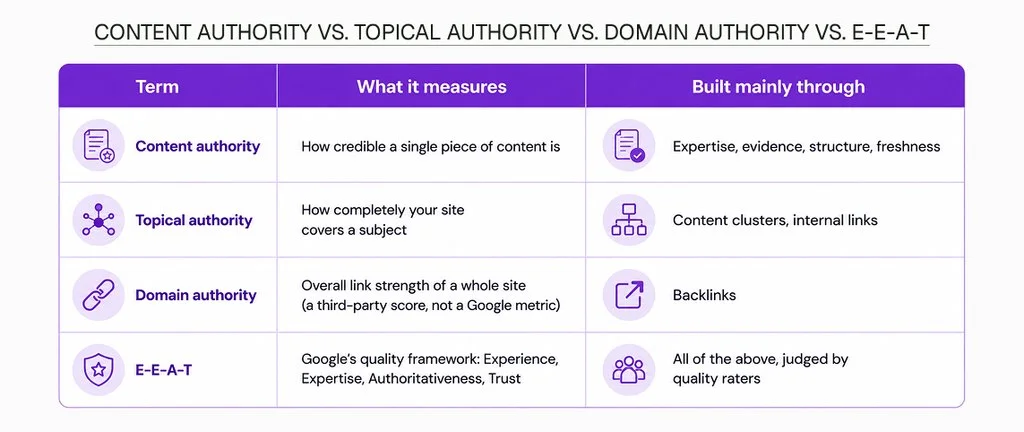
You need to understand what these 3 terms specifically stand for. These 3 related authority signals will ultimately establish your content authority.
| Term | What it measures | Built mainly through |
| Content authority | How credible a single piece of content is | Expertise, evidence, structure, freshness |
| Topical authority | How completely your site covers a subject | Content clusters, internal links |
| Domain authority | Overall link strength of a whole site (a third-party score, not a Google metric) | Backlinks |
| E-E-A-T | Google’s quality framework: Experience, Expertise, Authoritativeness, Trust | All of the above, judged by quality raters |
Topical authority comes from content quality and uniqueness, while domain authority leans on technical work such as link building.
Content authority sits underneath both. Weak pages drag down a strong site, and strong pages can lift a young one.
Why Ranking Alone No Longer Proves Authority
Older advice says that if you rank on Google, AI tools will cite you. That is only partly true today.
- Ahrefs reports that AI Overviews now pull far fewer pages straight from the original results, about 38% now versus about 76% in July 2025.
- The reason is query fan-out. Google confirmed that its system splits a search into related sub-queries when AI is triggered. Pages that show up across those sub-searches get cited.
- YouTube is also a major source. Among AI Overview citations that did not rank in the top 100, 18.2% were YouTube URLs.
- Citation does not guarantee accuracy either. A WashU audit of 61,212 citations found that about 11% of verifiable claims were unsupported or contradicted the cited source. Clear, verifiable claims are your edge.
What this means: You are not writing for one keyword anymore. You are writing for a whole chain of related questions.
What Will Change In 2027 (Forecast)
These are reasoned predictions based on current data, not guarantees.
- Passage-level selection grows. Each section needs to work as a standalone answer.
- Question-style content gains. Nearly 65% of question-form searches produced an AI Overview, against 9.5% of other searches. Question-led headings match how people search.
- Brand signals rise. For brand searches, the most common outside citations were Wikipedia, YouTube, and LinkedIn. Other sites will increasingly describe your brand, so you need to shape that story.
- Proof beats polish. Readers can spot generic AI copy. Original data, screenshots, and named experts will be the differentiator.
- Each AI engine behaves differently. One 2026 analysis found only 11% of domains cited by ChatGPT were also cited by Perplexity for the same query. Don’t rely on one platform’s playbook.
Step 1: Choose The Right Content Approach
Authority comes from depth on a narrow topic, not scattered posts. Search Engine Journal quotes these 6 points:
- Pick one core topic that matches your real expertise.
- Map the sub-questions. List what a reader would ask next: definitions, comparisons, costs, mistakes, and “how do I...” questions. This also mirrors fan-out queries.
- Publish a pillar page that covers the topic broadly.
- Write cluster articles, each answering one sub-question in depth.
- Link them both ways, between the pillar and clusters and between related clusters.
- Audit quarterly. Update stale pages and fill gaps. Topical authority doesn't happen overnight. It takes diligent research and writing.
Step 2: Adopt An Authoritative Writing Style
Answer first. Put the answer in the first one or two sentences under every heading. Then add context. This helps readers and gives AI tools a clean passage to lift.
An Example From Blogger Outreach’s Archive:
- Weak: “Content authority helps you rank better and get more traffic.”
- Strong: “After we merged six thin posts into one updated pillar page, organic clicks to that topic rose within a quarter.”
Keep paragraphs short. One idea each, two to four sentences.
Use plain words. Authority does not mean complicated language. Explain terms the first time you use them.
Step 3: Build the Writing Skills That Signal Expertise
- First-hand experience. Say what you tested, built, or got wrong. Google added “Experience” to its quality framework to reward exactly this.
- Original evidence. Run a small survey, analyze your own data, or document a before-and-after result. AI tools cannot invent original research.
- Named sources. Replace “studies show” with the organization, year, and what was measured.
- Balanced claims. Say where a tactic does not work. Honest limits build trust.
- Editing discipline. Typos and wrong figures erode credibility fast.
Use AI carefully. Ahrefs data cited by Loganix shows 71.7% of pages cited in AI Overviews combined human input with AI help, while only 2.5% were fully AI-written.
The practical lesson is to let AI help with outlines and drafts, and keep the insight, examples, and fact-checking human.
The same source notes that up to 82% of Americans say they can spot AI-written copy.
Step 4: Add the On-Page Elements That Prove Authority
| Element | Why it helps | How to do it |
| Author bio | Ties content to a real expert | Add role, experience, and links to LinkedIn or published work |
| Reviewer line | Adds a second trust layer for sensitive topics | “Reviewed by [name, credential]” |
| Dates | Shows the content is current | Show “Published” and “Last updated” dates, and change them only when the content truly changes |
| Cited sources | Makes claims checkable | Link to primary sources, not summaries of summaries |
| Question-style headings | Matches how people and AI search | Use H2s and H3s phrased as real questions |
| Summary box or TL;DR | Gives a clean passage to cite | Two to three lines near the top |
| Tables and lists | Easy to scan and extract | Use for comparisons and steps |
| FAQ section | Covers related sub-questions | Four to six real questions with short answers |
| Internal links | Shows topic depth | Link to the pillar and related cluster pages |
| Schema markup | Passes structured details to search engines | Use Article, Person, Organization, and FAQ schema |
A schema reality check: AI models like GPT-5 and Gemini generally don’t read JSON-LD directly.
Meanwhile, Google and Bing index it and pass enriched details into the retrieval layer. Schema helps, but it supports good content and does not replace it.
Step 5: Build Authority Beyond Your Own Website
AI tools describe brands using what the wider web says about them.
- Earn mentions, not only links. One 2026 analysis found brand mentions correlated with AI visibility at 0.664, about three times the 0.218 for backlinks. That is a single study, and correlation is not proof, but the direction is clear.
- Publish on YouTube. Ahrefs research on 75,000 brands found YouTube mentions were the strongest factor correlating with AI Overview visibility.
- Keep your LinkedIn and Wikipedia-style facts consistent. Brand name, founder bios, and descriptions should match everywhere.
- Give experts your best data. Quotable stats and clear explanations get cited by other writers.
How to Measure Content Authority
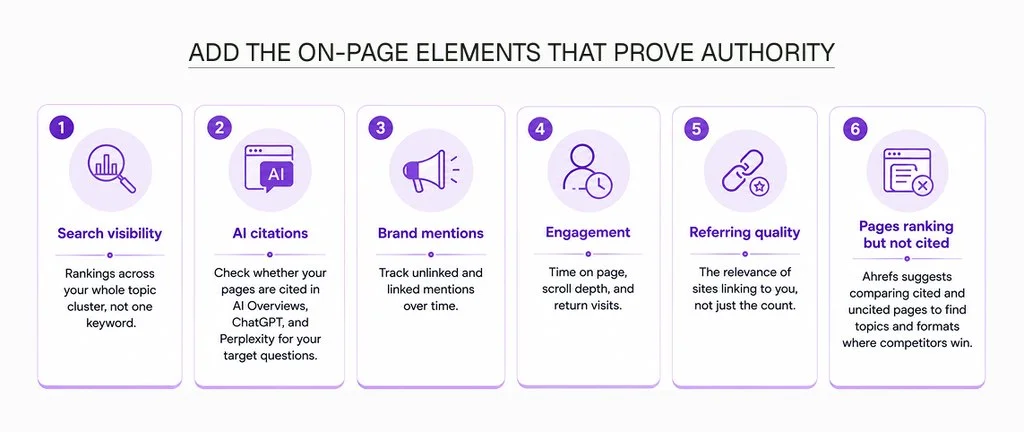
- Search visibility: Rankings across your whole topic cluster, not one keyword.
- AI citations: Check whether your pages are cited in AI Overviews, ChatGPT, and Perplexity for your target questions.
- Brand mentions: Track unlinked and linked mentions over time.
- Engagement: Time on page, scroll depth, and return visits.
- Referring quality: The relevance of sites linking to you, not just the count.
- Pages ranking but not cited: Ahrefs suggests comparing cited and uncited pages to find topics and formats where competitors win.
Seven Mistakes That Weaken Content Authority
- Publishing broad posts with no clear expert behind them.
- Using raw AI output with no edits or added experience.
- Citing vague “studies” without naming the source.
- Changing the “updated” date without updating the content.
- Writing many thin pages instead of one strong page.
- Ignoring off-site presence on YouTube, LinkedIn, and forums.
- Treating authority as a one-time project.
Your 12-Point Authority Scorecard, 90-Day Plan, And The One Mistake That Cancels Everything
Content authority is earned through real expertise, verifiable proof, and consistent coverage of one topic.
In 2027, it will be judged more at the passage level and across the wider web. Here are the extras I promised.
The 12-Point Authority Scorecard
Give your page one point for each “yes”:
- A named author with a real bio
- An answer in the first two sentences of each section
- At least one piece of original data or first-hand experience
- Every key claim linked to a named, current source
- Question-style headings
- A summary or TL;DR near the top
- A table or list for comparisons or steps
- An FAQ section
- Internal links to and from the pillar
- Article, Person, and Organization schema
- Updated within the last 12 months
- Mentioned or cited by at least one outside source
Scoring: 0 to 4 needs a rebuild. 5 to 8 is credible but replaceable. 9 to 12 is citation-ready.
The 90-Day Plan
- Days 1 to 30: Choose your topic, map sub-questions, and score your ten most important pages.
- Days 31 to 60: Rewrite the weakest pages with answer-first formatting, bios, and citations. Publish the pillar page.
- Days 61 to 90: Add original data to two pages, publish one YouTube video, and pitch your data to three outside writers.
The One Mistake That Cancels Everything
Publishing claims you cannot prove. One unsupported statistic can undo months of trust, with readers and with AI systems that check sources. Verify first, then publish.