



Open any SEO tool, and you’ll probably see two or three “authority” numbers side by side, each looking official and none of them explaining what they mean.
Blog posts and client reports use the terms as if they all meant the same thing, and that’s where the trouble starts. What should I target, page authority, domain authority or website authority?
People have an unusual urge to link to pages that offer lofty metrics like high DA, DR, or both. But in most cases, the pages that actually link to high-authority pages get no reach at all.
That shows a clear gap in our understanding of page and domain authority, and even website authority. Backlinking to random pages isn't the best authority signal you can send back to your web page.
But don’t worry. Blogger Outreach exists to help you differentiate the three and suggest which one you should focus on most.
Let us also understand individually what they stand for and why all three can interchangeably help you in your brand/page/website’s growth.
What Is Page Authority?
Page Authority is a Moz metric that estimates how well one specific page is likely to rank. It ranges from 1 to 100, and the score comes mostly from link data: how many sites link to the page and how strong those sites are.
The “one specific page” part is what trips people up. Your homepage, your pricing page, and last week’s blog post can each carry a completely different score even though they share a domain.
Page Authority also works on a logarithmic scale, so going from 20 to 30 is far easier than going from 70 to 80, and the number only means something when you hold it up against the pages you’re competing with.
What Is Domain Authority?
Domain Authority uses the same 1 to 100 idea, but it scores an entire domain rather than a single URL. Moz built it to predict how well a whole site might rank against others, and like Page Authority, it leans heavily on backlinks.
Agencies and publishers love it because it’s quick. You can glance at a number and form an opinion about a site in a few seconds, which is useful and also a little dangerous. For the mechanics behind it, Blogger Outreach’s guide to Domain Authority and how it’s calculated covers it properly.
What Is Website Authority?
Website authority differs from the other two because it isn’t a metric. It’s the general idea that a site has earned trust and credibility over time through its links, content, brand, expertise, and how people actually use it.
Domain Authority is one tool’s attempt to put a number on part of that idea.
The idea itself is much bigger than any score, which is why Blogger Outreach’s piece on what Google means by website authority is worth reading if you’ve ever wondered whether Google “has” a score for this (it doesn’t publish one).
The Three Side-By-Side
| Page Authority | Domain Authority | Website Authority | |
| What it covers | One URL | A whole domain | A site’s overall credibility |
| Type | Moz metric | Moz metric | General concept |
| Scale | 1 to 100 | 1 to 100 | None |
| Built from | Links to that page | Links to the whole domain | Links, content, brand, trust, expertise |
| Best for | Judging if a page can compete | Comparing and vetting sites | Long-term strategy |
| Used by Google? | No | No | Google judges trust with its own systems |
Look at that last row again. Moz’s scores are third-party estimates, so they’re handy for comparing things, but Google isn’t reading them.
Page Authority VS Domain Authority
My favorite way to explain this is: Domain Authority describes the neighborhood, and Page Authority describes the house.
A good neighborhood helps (a new article on a well-known site tends to get going faster than the same article on a brand-new blog), but people don’t search for neighborhoods.
They get a list of individual pages, and the one with better links, a better answer, and clearer relevance usually wins.
That’s how a smaller site can beat a giant on one particular query.
Its domain might be far weaker, yet if one page has picked up strong links and covers the subject thoroughly, that page’s Page Authority can end up higher than the giant’s equivalent.
Domain Authority VS Website Authority
People treat these as the same thing, and they really aren’t. Domain Authority is a number from one company’s formula, while website authority is the real-world trust any formula tries to guess.
Picture two sites that both score DA 45. One earned its links from respected publications in its industry. The other collected them from low-quality directories and link swaps.
On paper, they look identical, but a search engine (and a reader) would treat them very differently. Blogger Outreach walks through a version of this problem in Link Authority VS Domain Authority: Why A High-DA Link Can Still Fail.
Do These Scores Affect Google Rankings?
Not directly. Google doesn’t use Moz’s Page Authority or Domain Authority in ranking, and these numbers exist so that SEOs can compare and predict.
That said, what they’re built from- mainly the quantity and quality of links- does matter to search engines, so the scores loosely point to something real.
My advice is to treat them as a ruler, not a goal. A Page Authority score can tell you whether your page looks competitive next to what’s already ranking, but earning a higher number isn’t the point in itself.
What Is A Good Page Authority Score?
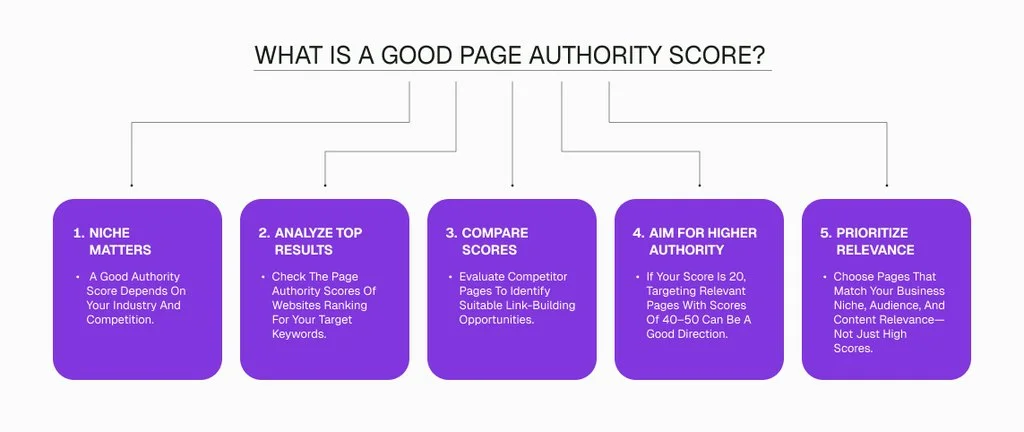
Your product or service niche matters most here. For example, if you are targeting a website authority of around 20 DA, that's good for local authority.
The local niche is critical here. But a 20 DR will actually be useless if you are targeting something like IT tech, business, or finance. So that still leaves us a bit in doubt.
The next question that naturally arises is: how can I tell whether a page has a good authority score and fits my business’s niche requirements?
First, check the exclusive page authority of your primary results. After that, compare your results and decide which placements fit you.
If your authority score is 20 and the page you are linking to has a score of 40 to 50, you are in the right direction.
How To Check These Scores
Moz Link Explorer is where Page Authority and Domain Authority come from. Other tools have their own versions: Ahrefs calls them URL Rating and Domain Rating, and Semrush uses Authority Score.
They each run on their own database, so the numbers will never match exactly, and you’re better off picking one tool and tracking changes in it over time than trying to translate between them.
How To Improve Page Authority
Since Page Authority depends so much on links to one URL, most of the work comes down to a few things done together.
Most small businesses want to drive traffic to their homepage, so they make it the center of their focus. However, that is not how strategy works for them.
A better approach is to link editorial placements to other pages, not just the homepage.
Start by earning relevant backlinks to the page itself, not just to your homepage. Again, the kind of pages you link with also matter.
If you link your brand to a random content page, you won’t get decent reach. Why? It will confuse Google about the kind of reach, people, and the authority that you are actually targeting. That’s why it is important to stick to your niche.
And try to build topical depth around it, because a page surrounded by related, well-linked content looks like part of real expertise rather than a one-off post.
How To Improve Domain And Website Authority
At the domain level, it takes longer. Earning links from relevant, trusted publications over time strengthens the whole site, and publishing within a focused niche builds the topical expertise behind it.
Brand recognition matters too, since mentions and coverage add credibility that no single score captures, a point Blogger Outreach explores in Editorial Mentions VS Backlinks: Which Signals Matter For Authority?.
If you want to understand why two links that look the same in a report can carry very different weight, their study on how Google evaluates link quality is a good next stop.
Which One Should You Focus On?
It depends on the decision you're facing. When you’re vetting a guest post site, Domain Authority is a fair first filter, provided you also check the site’s real traffic, relevance, and editorial standards.
When you’re asking whether a specific page can rank for a keyword, Page Authority tells you more, because it describes the page you’re actually pushing.
And when you’re planning for the next couple of years, website authority is the real prize, since it’s the trust that supports everything you publish.
Think of them as layers that stack on each other instead of competitors, and you’ll avoid over-optimizing any single number.
Where Blogger Outreach Fits In
Blogger Outreach works mainly on the link side. It earns backlinks that raise Page Authority for your key pages and, over time, strengthen the domain overall.
The focus is on niche-relevant placements on manually vetted sites with real traffic, under a stated zero-PBN policy, so the links build credibility instead of just inflating a score.
Here’s how the services connect to the three layers:
- Blogger outreach services: editorial links from niche-relevant blogs that you can point at the exact pages you want to lift.
- Guest posting services: content placed on authority sites in your field, with links to your priority URLs.
- Link building services: scalable, white-hat in-content backlinks, including white-label options for agencies.
- Content writing services: SEO articles that can strengthen the pages you want to rank.
- AI-powered link building and GEO services: for carrying your authority into AI search tools like ChatGPT and Perplexity.
If you can’t tell whether your weak spot is at the page level or the domain level, the free SEO audit compares your authority with competitors and flags harmful links, and the pricing page shows costs up front.
Frequently Asked Questions
Is Page Authority The Same As Domain Authority?
No. Page Authority scores one URL and Domain Authority scores a whole domain, though both use Moz’s 1 to 100 scale.
Is Website Authority A Google Ranking Factor?
Google doesn’t publish a metric with that name. It judges trust and relevance with its own systems, and scores like Page Authority and Domain Authority are outside estimates of similar signals.
Can A Page On A Low-DA Site Outrank A High-DA Site?
Yes, and it happens often. A page with strong, relevant links and a better answer can beat a page with a stronger domain alone.
How Long Does It Take To Raise Page Authority?
There’s no fixed timeline. The score updates as new links are discovered and processed, so it can take several weeks or months after you earn links for the number to move.
Should I Buy Links Based On Domain Authority Alone?
I wouldn’t. A high score says little about whether the site has real readers, relevance, or editorial standards, so check those first.
Which Should You Target?
Your page authority indicates whether you can compete with other pages in a similar niche in search results. On the other hand, Domain Authority evaluates the site’s strength based on the parameters search uses.
Ultimately, website authority tells you whether you can trust the brand behind the page. So, if you are trying to build authority from scratch, you must target all three.
And that’s where Blogger Outreach’s curated service list will be helpful for you.




