


Ask an SEO professional to name a website with “high authority,” and you will probably hear a number.
⇝ DA 70.
⇝ DR 80.
⇝ Authority Score 60.
But Google does not see your website that way.
Google does not give your domain a public authority score. In fact, Google explicitly says third-party SEO tools do not have access to its internal ranking data, and that the predictions those tools make are their own.
So what does Google actually mean by authority?
The better answer is not a number. It is evidence.
Google's systems look at hundreds of factors when determining which results are relevant and useful for a query.
Its documentation also describes systems that understand links between pages, including PageRank, and systems designed to identify helpful, reliable information.
That gives us a more useful way to think about Website Authority:
| Website Authority is not a score you can see in an SEO tool. It is the strength of the signals and evidence surrounding a website that help demonstrate its relevance, expertise, usefulness, and trustworthiness. |
This should give you more clarity on how to build real website authority. Instead of asking: “How do I increase my DA?”, ask:
“What evidence am I building that makes my website worth ranking, referencing, and trusting?”
That is where content, topical relevance, editorial mentions, links, brand visibility, and a consistent publishing strategy come together.
Google Does Not Use Your DA Or DR As Its Authority Score
Let's settle the most common misconception first.
DA is a Moz metric. DR is an Ahrefs metric. Other SEO platforms have their own measurements.
They can be useful.
They can help you compare potential publishers.
In fact, they can help you evaluate the relative strength of domains.
But they are not Google's measurements.
Google's current guidance is very clear: third-party SEO tools do not have access to Google's internal ranking data. Meanwhile, their predictions should not be confused with information coming directly from Google.
Google recommends evaluating third-party recommendations against its own Search guidance.
This matters because a high DA does not automatically make a page authoritative for every topic.
Consider two websites:
Website A: DA 80, but publishes about dozens of unrelated subjects.
Website B: DA 45, but consistently publishes expert resources about cybersecurity.
If someone searches for a highly specific cybersecurity question, Website B may have a much stronger topical case.
That is why third-party metrics are best treated as benchmarks, not Google's verdict.
So What Should You Measure?
Look beyond one number:
- Relevant referring domains
- Organic visibility
- Ranking keyword growth
- Brand mentions
- Editorial placements
- Traffic from relevant audiences
- Content depth
- Topical coverage
- Organic conversions
- Visibility for commercially important searches
These metrics show whether your authority-building work is driving business and search visibility.
What Can Google Actually Understand About Your Website?
Google's Search documentation gives us a useful starting point.
Google crawls the web, indexes content, and then uses hundreds of factors to determine which results are most relevant and useful for a particular query.
Its systems can understand:
- What Your Content Is About
Google analyzes the text and other content on a page to understand its subject.
- How Pages Connect
Googlebot discovers many URLs through links. Google says that the vast majority of new pages it finds every day are discovered through links, making links an important part of the web's discovery system.
- Whether Content Demonstrates Useful Qualities
Google's guidance discusses experience, expertise, authoritativeness, and trustworthiness (E-E-A-T). Its systems can identify these qualities through a mix of signals. Google also makes an important distinction: E-E-A-T itself is not a specific ranking factor.
- Whether The Result Is Relevant
Google says that when serving results, it looks for pages that are relevant and high quality for the user's query.
Put these together and a clearer picture emerges.
Google does not need to know:
“Is this domain DA 70?”
It needs to understand things more like:
- “What is this site about?”
- “Does this page answer the query?”
- “Is the information useful and trustworthy?”
- “How does this page connect to other information on the web?”
- “Do other relevant websites reference this information?”
That is the evidence-based side of authority.
Authority Is A Reputation Built Across The Web
Think about how authority works outside SEO.
Suppose you are looking for a cybersecurity consultant.
You find two professionals. One has a profile claiming to be an expert. The other has:
- Published research
- Articles in respected cybersecurity publications
- Speaking appearances
- Industry references
- Case studies
- Years of relevant experience
Who would you trust? Considering all odds go your way, the second professional has evidence supporting the claim.
Websites work in a similar way.
Your own website can tell Google and users that you are an expert. But relevant external references can reinforce that story.
This is one reason links remain important.
Google's documentation says its link analysis systems understand how pages link to one another and include PageRank among its core ranking systems.
But that does not mean: More links = more authority.
It means the web's link structure provides information that Google's systems can use.
At the same time, the context behind the links matters.
The Difference Between A Link And An Authority Signal
Here is where many link-building strategies go wrong. They treat every backlink as an isolated asset. However, a better approach is to ask:
What does this backlink tell us?
Imagine a SaaS company receives a link from a gardening website.
The domain might have an impressive third-party metric. But the connection is difficult to explain.
Now imagine the same SaaS company is referenced by:
- A B2B software publication
- A productivity website
- A business operations blog
- A SaaS industry publication
The second profile tells a much more coherent story.
And we have real Blogger Outreach data that illustrates this principle.
Case Study Analysis
In a 2026 case study for a project-management SaaS company, Blogger Outreach reports that its campaign focused exclusively on SaaS, B2B software, and productivity publishers.
Before outreach, the client had 62 referring domains, while the top 10 ranking competitors averaged 340 referring domains at DA 45+.
The campaign ultimately secured 60 editorial placements across relevant DA 50+ publishers.
The interesting part is not simply the DA threshold. It is how the publishers were selected.
The campaign mapped competitor backlink profiles first and identified three publisher categories that dominated the niche:
- B2B software review sites
- Productivity and business operations blogs
- SaaS-focused industry publications
That is authority building through context.
The reported outcome was significant:
- The client's DA moved from 24 to 51
- Monthly organic visitors increased by 17,400
- The site reached 25,600 monthly visitors with 14 keywords on page 1 after 6 months.
The case study also reports that 12 placements on DA 65+ sites in the right niche outperformed the client's previous 40 random links.
| An Important Takeaway: The objective should not be to collect the biggest possible number of links. It should be to build a link profile that makes sense for the brand and its subject area. |
Google's Perspective: Relevance Before Reputation
Google's own documentation repeatedly emphasizes relevance and helpfulness.
Its Search systems are designed to return information that is relevant to a user's query. However, its people-first content guidance asks whether content provides original information, substantial value, expertise, and a satisfying experience.
Based on what we have learnt so far, real website authority is a culmination of:
Relevant content + useful experience + credible references + consistent topical presence
Most of us, however, mistake it for only high DA + lots of backlinks.
This distinction matters most when you are building links.
A link from a relevant publication can contribute to a much stronger authority story than a link acquired simply because the website has a high third-party score.
Google's own SEO Starter Guide says links can connect users and search engines to relevant resources and can provide context about a topic.
It also recommends using descriptive anchor text so users and search engines can understand what the linked page contains.
So the question is not just: “Can we get a link?” It should be:
“Does this placement make sense?”
What We Learned From Blogger Outreach’s Clients
The Blogger Outreach case-study library provides several examples where the measurable outcome goes beyond a change in one authority metric.
VeePN: 176% More Organic Traffic
VeePN's cybersecurity campaign is particularly relevant to the authority discussion.
Blogger Outreach reports:
- 149% increase in referring domains, from 4,949 to 7,416
- 176% increase in organic traffic
- 210% increase in organic traffic value
- 174% increase in ranking keywords
- 218% increase in crawled pages
More importantly, the campaign strategy focused on cybersecurity-specific publications, security news platforms, VPN review sites, and privacy blogs.
The case study explicitly identifies niche relevance over generic authority as a key takeaway. (BloggerOutreach.io)
That is exactly the distinction brands need to understand. The goal isn't simply to “get 50 more referring domains.” Rather, it is to “get relevant websites within our subject ecosystem to reference us.”
You can read the full VeePN link-building case study for the campaign breakdown.
Freshessays: Authority Building In A Difficult Niche
Authority becomes even more interesting when the niche itself creates outreach challenges.
Blogger Outreach's Freshessays case study reports a 133% increase in traffic. Meanwhile, the organic traffic moved from 17,907 to 23,946.
At the same time, the referring domains increased from 1,038 to 1,324, while organic pages increased from 7,967 to 9,935. The case study also reports:
- 124.7% growth in organic pages
- 147% growth in crawled pages
- 127% growth in referring domains
- 148% growth in traffic value
The takeaway isn't that a particular percentage increase in referring domains guarantees a corresponding traffic increase.
From my experience as a content strategist for 9 years and as a writer @bloggeroutreach.io for 3 years, it doesn't. Instead, the case demonstrates something more useful:
Authority building has to work within the reality of the niche.
If relevant publishers are difficult to find, generic outreach will not solve the problem. You need better publisher research, better content, better positioning, better outreach, and stronger topical relevance.
That is where a specialist outreach team can create value. See the full Freshessays case study.
CapCut: Authority Can Scale With Visibility
CapCut provides another interesting example because of the scale involved.
Blogger Outreach reports that CapCut's organic traffic increased from 2.2 million to 11.7 million, a reported 430% increase.
At the same time:
- Organic ranking keywords increased from 400,000 to 4.8 million
- Referring domains increased from 4,523 to 10,763
- Crawled pages increased from 254,892 to 3,795,502
- Organic traffic value increased from $250,474 to $1,077,867
Again, these numbers should not be interpreted as proof that Google's algorithm simply rewarded the site because its referring-domain count increased.
The campaign involved contextual guest posting, keyword research, content creation, natural anchor-text placement, and visual content. (BloggerOutreach.io)
That is precisely the bigger lesson.
| Key Takeaway: Authority is not one SEO activity. It results from multiple activities reinforcing each other. Explore the full CapCut case study. |
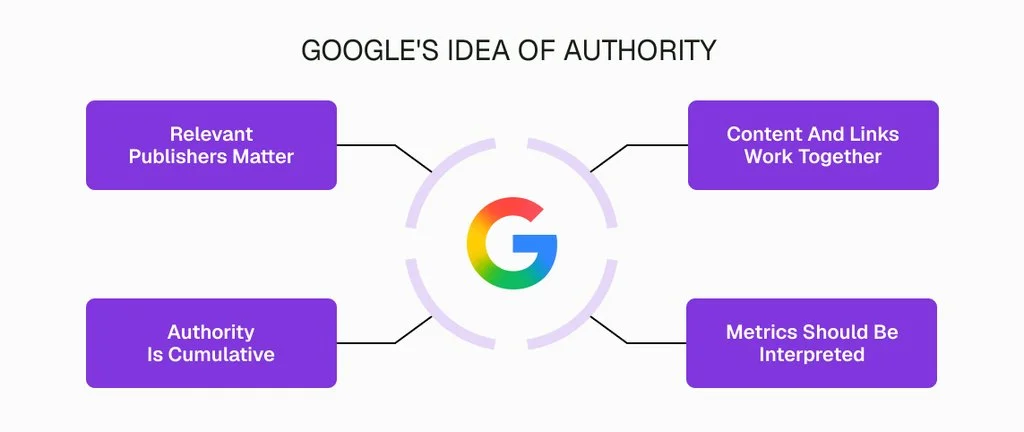
What These Case Studies Tell Us About Google's Idea of Authority
Once I put the examples together, a pattern emerged.
1. Relevant Publishers Matter
VeePN's campaign focused on cybersecurity publications. The newer SaaS case focused on SaaS, B2B, and productivity publishers.
The publisher categories matched the client's subject area. However, not simply because they were available.
2. Authority Is Cumulative
The newer SaaS case involved 60 editorial placements over six months rather than a one-off link acquisition push.
That matters because authority is not something you establish with one impressive backlink. In reality, it is built through repeated evidence.
3. Content And Links Work Together
The campaigns did not consist of links alone.
They involved content creation, keyword research, publisher-specific content, and outreach.
That aligns with Google's people-first approach, which emphasizes original, useful, substantial content rather than content created primarily to manipulate rankings.
4. Metrics Should Be Interpreted, Not Worshipped
DA and DR can help campaign managers set publisher-selection criteria.
But Google itself warns that third-party tools do not have access to its internal ranking data.
So DA can be a campaign filter. However, it should not become the definition of authority.
Why Blogger Outreach Is More Than A Backlink Provider
This is where the practical side of the discussion comes in. If authority is built from multiple forms of evidence, managing authority cannot simply mean buying links.
You need a system that connects:
| Strategy → Publisher Research → Content → Outreach → Placement → Measurement |
That is where Blogger Outreach positions itself as a one-stop authority-building solution. Its current SEO and Authority offering includes:
- Blogger outreach
- White-hat link building
- Guest posting
- Specialist content writing
The company reports 5,000+ campaigns, a DA 50+ average across its publisher offering, and a 100% manual approach.
The distinction is important.
Blogger Outreach does use third-party metrics as part of publisher evaluation. But those metrics can be treated as selection criteria, rather than pretending they are Google's own authority measurements.
That is a much more defensible SEO approach.
A One-Stop Authority-Building Workflow
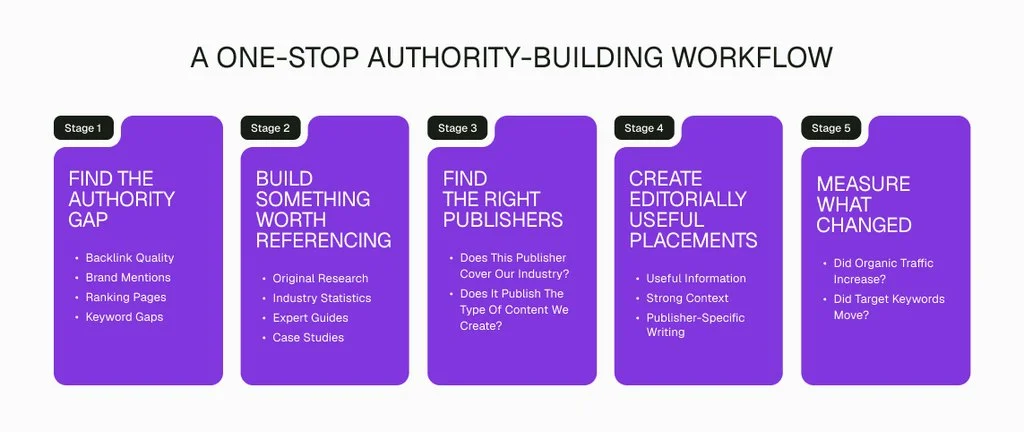
A strong authority campaign can be structured into five stages.
Stage 1: Find The Authority Gap
Start by examining:
- Competitor referring domains
- Topical publisher coverage
- Ranking pages
- Keyword gaps
- Existing brand mentions
- Existing backlink quality
The 2026 SaaS case study demonstrates this approach:
“Competitor backlink analysis identified an average of 340 referring domains among page-one competitors versus 62 for the client.
That turns competitor research into a publisher roadmap.
Stage 2: Build Something Worth Referencing
Links are easier to earn when there is something useful behind them.
That could be:
- Original research
- Industry statistics
- Expert guides
- Data studies
- Case studies
- Tools
- Expert commentary
- Comprehensive resources
Google's own guidance asks whether content provides original information, substantial analysis, and value beyond what is already available.
The content is therefore not an accessory to link building.
It is part of the authority-building asset.
Stage 3: Find The Right Publishers
Now move beyond: “What sites have DA 60+?” Because it is time to ask:
- Does this publisher cover our industry?
- Does its audience overlap with ours?
- Does it publish the type of content we create?
- Does the placement make sense editorially?
- Does the website have real organic visibility?
- Are there relevant pages where our resource fits naturally?
This is where manual blogger outreach becomes valuable.
Blogger Outreach says its outreach process involves manual pitching, publisher negotiations, and niche-specific content creation.
Stage 4: Create Editorially Useful Placements
A guest post should not feel like a 1,000-word excuse to insert a backlink. Simply put, the article should work for the publisher, even if the links were removed.
That means:
- Useful information
- Natural brand references
- Relevant anchor text
- Strong context
- Publisher-specific writing
- A genuine reason for the reader to click
This also keeps the campaign aligned with Google's broader people-first philosophy.
Stage 5: Measure What Changed
Do not finish the campaign by saying: “We built 50 links.” Ask:
- Did organic traffic increase?
- Did target keywords move?
- Did relevant referring domains grow?
- Did more pages gain visibility?
- Did branded searches increase?
- Did referral traffic appear?
- Did important commercial pages improve?
- Did the brand gain visibility within its niche?
This is how you connect link building to actual authority-building outcomes.
What Should Your Authority Dashboard Look Like?
Instead of a single DA number, build a dashboard with five categories.
| Area | What to track |
| Search visibility | Organic traffic, impressions, clicks, ranking keywords |
| Topical authority | Relevant referring domains, niche mentions, topical coverage |
| Content strength | Organic pages, high-performing content, original resources |
| Brand authority | Brand searches, editorial mentions, referral traffic |
| Link profile | Quality placements, relevant domains, link growth |
You can still include DA and DR. Just place them in the right category, i.e., third-party benchmarks.
Not Google authority score.
The Biggest Mistake: Building Authority For The Metric
Imagine spending six months trying to increase DA. What happens then? You succeed! Most importantly, your DA goes from 35 to 60.
But your important commercial keywords have not moved. Also, your organic conversions have not increased.
The bottom line is that your brand is still barely mentioned in its industry.
So does that mean you've built meaningful authority? Probably not enough. Now imagine another six-month campaign where:
- Relevant publishers begin mentioning your brand
- More industry websites reference your resources
- Your ranking footprint expands
- Organic traffic grows
- Your most important pages gain visibility
- Your content is increasingly recognized within your niche
That is a much stronger definition of authority. The number in Moz or Ahrefs might increase too. But that is the output, not the objective.
So, What Does Google Mean By Website Authority?
Google does not give you a public authority score. It does not look at your DA and decide:
“This is a DA 70 site, so let's rank it higher.”
Its systems evaluate pages using many signals related to relevance, quality, links, content, usability, and other factors. Google also maintains specific systems for link analysis and PageRank.
In the same vein, Google's people-first guidance emphasizes original, useful, reliable content. In addition, Google asks whether a site is recognized as trustworthy or authoritative in its subject.
That evidence can come from your content. It can also come from your site's topical depth, relevant editorial references, links, and brand recognition.
And it builds over time.
Stop Optimizing For Scores
DA and DR are useful SEO tools. But they are not Google.
If you build your entire SEO strategy around improving those numbers, you risk optimizing for a proxy instead of the thing the proxy is supposed to represent.
The better strategy is to build the underlying evidence.
- Create useful content.
- Own a clear subject area.
- Earn relevant editorial references.
- Build relationships with publishers in your niche.
- Measure rankings, visibility, traffic, and brand growth, not just authority scores.
That is also why authority building works best when content, outreach, publisher research, and link acquisition operate together.
Blogger Outreach brings those pieces under one roof through blogger outreach, link building, guest posting, and specialist content writing. Especially with campaigns built around manual outreach and publisher selection.
Important Lesson For Clients
The lesson is not that one backlink strategy guarantees those numbers. The lesson is simpler:
Authority becomes valuable when it translates into greater visibility, stronger relevance, and measurable search growth.
So don't ask: “What's my authority score?” during quarterly client audits. Instead ask:
“What evidence have I built that my website deserves to be trusted?”
That's the kind of website authority worth building.
| Here’s a more carefully crafted definition of Website Authority for readers: Google's concept of Website Authority is best understood as the evidence accumulated around a website that helps demonstrate its relevance, expertise, usefulness, and trustworthiness. It is not a single numerical score. |
Google's concept of Website Authority is best understood as the evidence accumulated around a website that helps demonstrate its relevance, expertise, usefulness, and trustworthiness. It is not a single numerical score.
Ready to build it?
Explore Blogger Outreach's SEO and authority services and turn publisher relationships, quality content, and relevant editorial placements into a long-term authority-building strategy.
| Ready to build it? Explore Blogger Outreach's SEO and authority services and turn publisher relationships, quality content, and relevant editorial placements into a long-term authority-building strategy. |