


The SEO landscape keeps evolving, and that’s not changing in 2026. While link building is critical, the process (guest posting vs niche edits) continues to spark debates.
While a significant number of marketers and brands choose guest posts, niche edits aren’t left far behind.
In this scenario, where backlinks are destined for devolution, choosing either guest posts or niche edits isn’t wise. While the either/or approach dominated the years past, this year, it’s all about blending both.
Here’s more than a theoretical comparison to help you choose the right path for link building in 2026:
Understanding Core Definitions: Creation vs. Leverage
Before examining strategic applications, establishing precise definitions prevents the conceptual confusion that undermines most guest posting vs niche edits discussions.
Guest Posting: Authority Through Content Creation
Guest posting is the ideal way to gain backlinks. Through guest blogging for SEO, your brand publishes high-quality content on industry-relevant websites. In exchange, you acquire links pointing to your domain through contextual conversations.
The Benefits?
- You’re building connections within your industry.
- The post is getting published on a third-party website that talks about your business.
- It’s the ideal way to demonstrate topical authority and meet E-E-A-T standards.
- Brands can also build industry relations with influential publishers.
The value proposition of guest posts extends beyond getting the link. You’re not simply securing a link; you are creating content for social sharing long after link acquisition.
Niche Edits: Strategic Link Insertion
This is what you call curated links or link insertions, and it involves placing your backlink into existing and already published content on relevant websites.
The upside to this link-building process is skipping content creation. Service providers get a list of curated links placed across domains (publishers) with high-performing pages with existing traffic.
Comprehensive Pros And Cons Analysis
Strategic link building requires an honest assessment of each tactic's strengths and limitations. This comparative breakdown quantifies the trade-offs shaping guest posting vs niche edits decisions:
Guest Posting vs Niche Edits: 2026 Strategic Comparison
| Criteria | Guest Posting | Niche Edits |
| Content Requirement | Requires fresh article creation | Uses existing published content |
| Turnaround Time | 4–8 weeks editorial cycle | 7–21 days average |
| Cost Structure | Content + outreach + placement fee | Placement fee only |
| E-E-A-T Signals | Strong (author bio + thought leadership) | Moderate (context-based relevance) |
| Ranking Speed | Medium-term impact | Faster due to aged pages |
| Brand Visibility | High exposure to new audiences | Limited incremental exposure |
| Anchor Control | High flexibility | Limited by existing context |
| Best For | Authority building & brand growth | Tactical ranking boosts |
Navigating The 2026 Google Algorithm Landscape
Link building practices evolved heavily between 2025 and 2026. The September 2025 update increased scrutiny on backlink quality, forcing SEOs and agencies shift focus on quality.
So, we heavily shifted from a volume-based approach to a relevance-focused approach. Here are more details:
The Relevance-Over-Volume Mandate
The Google Search Engine continues to emphasize quality and relevance. That’s why there was an emphasis on targeting low-quality backlinks generated through guest posting networks in the September 2025 update.
Guest Posts Flagged By The Changed Algorithm:
- Fail to stay aligned with the publishers’ platform.
- Topical alignment is paid less attention to.
- Publishers often take irrelevant guest contributions.
This enforcement put guest post services maintaining adherence to editorial standards, relevance at a better place. Comparatively, services only operating with a pay-for-placement approach started to see it disguised as an editorial opportunity.
But why the shift toward niche edits? And why is it often more logical? Relevance answers and resolves this confusion.
Story: Let’s say that you have a local bakery, and you need to build links for the business website. So, you chose a link-building service provider and mutually curated a list of links to get placed across domains.
They reached out to publishers within relevant niches with mostly aged pages (DR50+) that are around one to three years old and have steady traffic.
In this case, placing those links on the selected pages requires less editorial effort and bandwidth for content creation. The best part? Unlike guest posts, where fresh content has to wait to perform and pull in traffic, niche edits are done on pages with pre-existing traffic.
Cost Breakdown In 2026
Guest posting involves multiple cost layers content production, editorial outreach, relationship management, and publisher placement fees. Because of these additional efforts, pricing is higher.
In 2026, Placements Typically Fall Within These Ranges:
- DR40–50 websites: $150–$300
- DR50–70 websites: $300–$600
- DR70+ publications: $600–$1,500+
Niche edits eliminate content creation costs since links are inserted into existing articles. As a result, pricing is generally 20–30% lower.
- DR40–50 pages: $100–$250
- DR50–70 pages: $250–$450
- DR70+ aged pages: $450–$900
While niche edits are more budget-efficient, guest posts often justify higher investment through added brand exposure and long-term authority value.
More so, the tactic inherently aligns with Google's preference for editorially justified links within established content.
"As Google’s algorithm continues to evolve, brands and businesses must make smarter decisions to go with guest post and niche-edits, where needs are specific,”
says Ejaz Ahmed (COO at BloggerOutreach)
YMYL And E-E-A-T Considerations
For Your Money or Your Life (YMYL) topics, such as finance, health, and legal, Google's E-E-A-T evaluation heavily favors guest blogging for SEO on recognized authority sites.
A financial advisor's guest contribution to Forbes or Investopedia carries algorithmic weight that no niche edit can replicate, regardless of the target page's domain authority.
The byline, author bio, and association with trusted publishers create E-E-A-T signals impossible to achieve through link insertion alone.
However, for non-YMYL commercial queries, SaaS tools, e-commerce products, B2B services, niche edit links within topically relevant, DR50+ content demonstrate sufficient relevance. On top of that, it no longer requires the thought leadership positioning that guest posts provide.
Strategic Selection Framework: Matching Tactics to Objectives
Effective guest posting vs niche edits decisions begin with an honest objective assessment. When you need to build links, start by asking yourself what’s the best algorithm-compliant and effective way forward:
When Guest Posting Dominates
- If you’re launching a new website, building a new brand, or creating a platform that needs authority signals, go for guest posts. New domains require trust signals to rank competitively. When associated with established publishers, getting recognized on the search engine ranking page becomes easier.
- When marketing for expert-dependent industries (tax consulting, SaaS, professional services), creating thought leadership content becomes essential. CEOs and executives also need to establish visibility on recognized platforms for market positioning. Guest posts are the ideal solution for these types of requirements.
- Targeting YMYL keywords where E-E-A-T significantly impacts rankings. Health, finance, and legal verticals demand the credibility that only bylined contributions to authority sites provide.
- Brands and marketers never want to lose out on the compound returns they can receive from guest posts. A guest post provides backlinks, brand awareness, traffic, social proof, and natural link attraction.
- Operating in relationship-driven industries where publisher connections create business development opportunities beyond SEO. This is where contextual link building through guest posts becomes essential.
When Niche Edits Excel
- Some landing pages require rapid ranking improvement. For example, product pages, service offerings, and commercial landing pages require an instant boost, which niche edits can help achieve.
- Marketers often have a limited budget to work with. That’s where niche edits can help by lowering expenses by up to 20% to 30%.
- Operating on compressed timelines where 4-to-8-week guest posting cycles are prohibitive. Product launches, seasonal campaigns, and time-sensitive initiatives need faster implementation.
- When you want to support established sites with existing authority that need strategic link placements rather than brand building, mature domains benefit from targeted contextual backlinks without extensive content creation.
ROI Model: Measuring Strategic Impact
Guest posting generates layered returns. Beyond ranking improvements, it builds brand authority, referral traffic, credibility signals, and can attract secondary backlinks naturally. Its return compounds over time.
Niche edits deliver more immediate ROI. When applied to commercial landing pages, they often create faster keyword movement and quicker revenue impact.
For example, a $500 guest post may take 2–3 months to influence revenue but can continue delivering value long-term. A $300 niche edit may push a money page into top positions faster, generating quicker short-term revenue.
The most stable ROI model blends both authority compounding through guest posts and ranking acceleration through niche edits.
The Hybrid Optimization Strategy
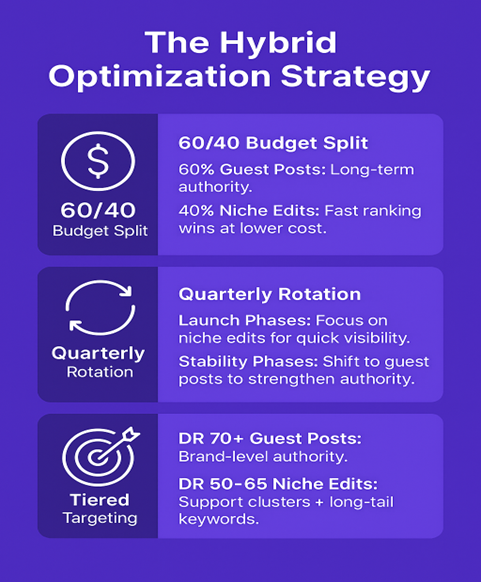
For most organizations, exclusive reliance on either tactic leaves performance on the table.
The Optimal Approach Combines Both:
- 60/40 Budget Allocation: Dedicate 60% of link-building budgets to guest blogging for SEO for sustained authority development, 40% to niche edit links for tactical ranking improvements and budget efficiency.
- Quarterly Rotation: Alternate focus based on business cycles. Launch quarters emphasize niche edits for rapid visibility; consolidation periods shift toward guest posts for authority solidification.
- Tiered Targeting: Reserve premium guest post placements (DR70+, major publications) for brand-level campaigns; use mid-tier niche edits (DR50-65) for supporting long-tail keyword clusters.
Implementation Realities: Overcoming Common Obstacles
When implementing guest posts or link insertion for building a link profile, marketers and SEO come across the following challenges:
(i) The Content Quality Challenge
Low-quality guest post services flood markets with generic, AI-generated content that damages both publisher reputations and client link profiles.
The solution requires vetting processes that evaluate actual published work, editorial relationships, and placement sustainability rather than accepting promises of quick placements.
Red Flags Indicating Low-Quality Services:
- Guaranteed acceptance rates significantly exceeding (legitimate publications reject most pitches).
- Minimal content requirements (sub-1,000 words suggest minimal editorial standards).
- Immediate placement promises (quality publications have editorial calendars requiring 4 to 8 weeks lead times).
- Unwillingness to share previous placement examples or client references.
(ii) The Niche Edit Authenticity Problem
Unscrupulous providers insert links into obviously modified content, adding paragraphs solely to accommodate client links, creating thin "resource pages" listing dozens of unrelated links, or placing links in irrelevant articles using tenuous topical connections.
These manipulative placements survive only until the next algorithm update. Invest in niche edit links from providers demonstrating genuine editorial relationships, showing placement examples within contextually-relevant content, and willing to walk away from low-quality opportunities rather than forcing placements.
(iii) Budget Allocation Tensions
Organizations often struggle to balance short-term ranking pressure with long-term authority building. Marketing leadership demands immediate results while SEO teams advocate for sustainable strategies requiring patience.
The resolution: implement hybrid approaches demonstrating quick wins through strategic niche edit links while simultaneously building the guest blogging for SEO foundation that ensures those wins stabilize and compound.
Present quarterly results showing both immediate traffic improvements and growing authority metrics that predict sustained performance.
(iv) The Way Forward
The future of link building goes beyond choosing between creation and leverage. It requires more than the relation between speed and sustainability, or contextual backlinking and brand building. It's about building an understanding that you require both strategic link building and building a brand.
Both guest posting and niche edits can help brands achieve the desired result. But success hinges on balancing both and strategic deployment.
Organizations that are following a hybrid framework instead of stressing over guest post vs niche edits can withstand updates with resilience. They have a richer link profile, giving them an edge against algorithm updates.
Plus, high-quality content published through guest posts and rapid niche edits simultaneously keep pushing visibility and authority upwards. So, the way forward in 2026 isn't about choosing guest posts over niche edits, or vice versa. It's about finding the right balance.
How AI Is Reshaping Guest Posting And Niche Edits In 2026
AI has made prospecting and outreach faster through automated domain analysis, authority scoring, and link gap detection. It helps identify relevant placement opportunities more efficiently than manual research.
However, search engines now detect automation footprints more aggressively. Overused anchor patterns, thin AI-generated content, and mass placements are easier to flag.
In 2026, sustainable link building combines AI-assisted research with human editorial judgment. Automation improves efficiency, but authenticity determines longevity.
Frequently Asked Questions:
A: Neither tactic wins on its own in 2026. Guest posting builds long‑term authority and E‑E‑A‑T signals, while niche edits deliver faster relevance‑based ranking gains. A hybrid approach offers the best results.
A: Yes. When placed naturally within relevant, aged, high‑quality content. Niche edits that are forced, irrelevant, or inserted into thin pages are risky and can be devalued by algorithm updates.
A: Guest posting is essential for new domains, YMYL topics, thought leadership, or industries needing credibility signals. It’s the preferred method when building authority, trust, and long‑term brand visibility.