



Guest posting looks shiny from the outside when budgets go up, outreach lists grow, and inboxes notify. Yet many links refuse to move the needle. It is not always the content. Rather, it is often the context, the placement, and the subtle signals around the link.
The money line is that guest post backlinks can work, but only if the surrounding environment is calibrated for relevance, intent, and crawlability.
Google does not reward generic placements anymore. Rather, it reads the page, paragraph, anchor, and the neighborhood. Also, it weighs signals that feel human, such as editorial judgment, coherent topic fit, and natural-language anchors.
Also, Google looks at reliable internal linking on the host site. Now, benchmarks have shifted toward people-first content, credible sources, and clear topical authority. The fix starts with link placement discipline and ends with measuring what truly correlates with ranking movement.
Understanding Why Guest Post Backlinks Fail
The following are the major reasons why guest post backlinks fail at the outset:
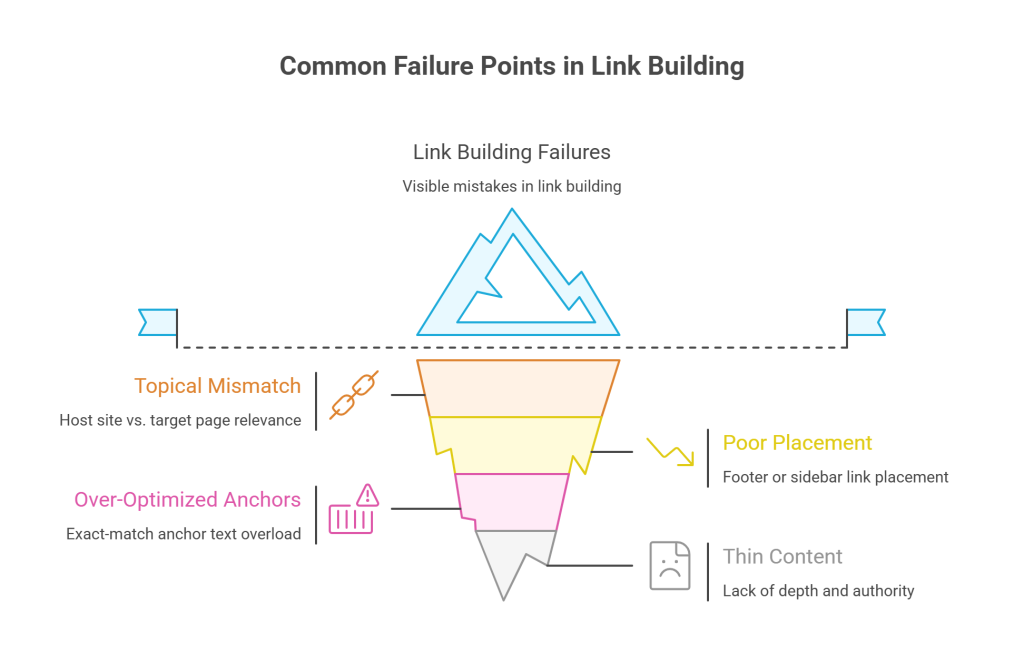
1. Lack Of Topical Relevance Between Host Site And Target Page
The niche mismatch problem is that if the host site writes broadly about lifestyle and your target page is a deep SaaS onboarding guide, link equity diffuses across the site.
Google now reads entity relationships, topical clusters, and passage-level context. When the host page’s semantic footprint does not align with your destination, the link feels like a stray.
It does not mean search engines do not like variety. Rather, they are prudent about topical continuity. If the page’s headings, internal links, and body copy orbit different concepts, your link sits outside the gravitational pull that would otherwise carry it forward.
How Google interprets this today is more granular. It is not just domain-to-domain relevance, but page-to-paragraph coherence. In fact, a link nested within a section that clearly supports the destination subject tends to convey more credible signals.
2. Poor Link Placement Within The Content
Of course, placement of guest posts matters. In fact, links in footers, sidebars, or author boxes rarely deliver the editorial weight you think they do. The signal hierarchy favors in-body, editorially integrated links that actually help the reader. In this case, context trumps convenience.
Also, the crawl path matters. For instance, links higher up, within meaningful sections, tend to be encountered earlier, indexed more confidently, and valued more.
So, always ask yourself: Does this link live inside the narrative that supports the destination page’s intent, or is it a tag-along at the end?
3. Over‑Optimized or Unnatural Anchor Text
Using exact-match anchors repeatedly across guest posts is not good practice. This is because they draw the wrong kind of attention. In fact, natural anchors behave like real sentences. These are varied, contextual, partial-match blends, branded with plus topical descriptors, and framed as problem-solution.
When you write anchors to match how a person would recommend a resource without forcing the keyword, you avoid filter triggers and keep semantic context intact. Over-optimization is rarely about a single link. Rather, it is about pattern detection across similar placements, anchors, and sites.
4. Low‑Quality Or Thin Guest Post Content
Thin content can sabotage a good link. Basically, shallow posts do not build enough topical density to pass meaningful signals. If your paragraphs are filler or your examples are generic, the editorial environment around the link lacks authority.
In 2026, expertise shows through in how you reason, how you cite, how you contrast frameworks, how you build arguments, and how you layer unique insights. Guest post SEO does not reward surface-level takes. In fact, the link rides on the quality of the host page’s discourse.
5. Links Published On Low‑Authority Or Spammy Domains
PBN (Private Blog Network)-like farms are easy to spot. In fact, overlapping IPs, templated layouts, thin category pages, strange outbound link ratios, and inconsistent publishing cadences expose them.
Authority is not just DA/DR. Rather, look for real readers, consistent editorial standards, credible authorship, natural internal links, and external references that make sense.
Essentially, a good metric stack includes referring domain quality, topical trust, and link neighborhood health. Guest posting backlinks on suspicious domains rarely survives long enough to matter. Worse, they drag your profile toward patterns that search engines down-rank.
6. Lack Of Internal Linking Support On The Host Site
Without internal links from relevant hub or category pages, your post sits in isolation. In fact, internal links distribute equity and create crawl paths that connect themes.
When the host site plugs your post into a cluster, the link to your target is multiplied across the site’s topical graph. The cluster includes category pages, pillar articles, and related posts.
Basically, two or three well-placed internal links can change crawl priority and indexing stability. This piece of guest post link building is often ignored, yet it is one of the cleanest multipliers.
The Role Of Contextual Placement In Link Performance
The following are the reasons why contextual placement is necessary for link performance:
1. Google Prioritizes In‑Content Editorial Links
Editorial links read like recommendations. They live inside arguments, examples, or definitions. They earn proximity to topical terms and entities that surround them. That proximity helps search engines understand usefulness.
Also, editorial backlinks are framed by sentences that explain why the resource is relevant right now, in this paragraph, for this idea. Moreover, people-first content does not toss links for compliance. Rather, it places them to help the reader advance. That human-centered logic translates into better signals.
2. Link Placement Influences Crawl Depth And Indexing
If your link sits inside a buried section or appears only after a long scroll, it might be seen late or treated as peripheral. In fact, placing a link within the first meaningful sections improves visibility. These sections are core definitions, frameworks, or data.
Search engines also evaluate template areas differently from body content. Sidebar and footer regions are often de-weighted. Within the narrative, the link inherits context and is indexed with greater intent. Meanwhile, buried links rarely boost rankings because they sit outside the content’s semantic center.
How To Fix Guest Post Link Placement Issues?
If you want to fix guest post link placement issues, do the following:
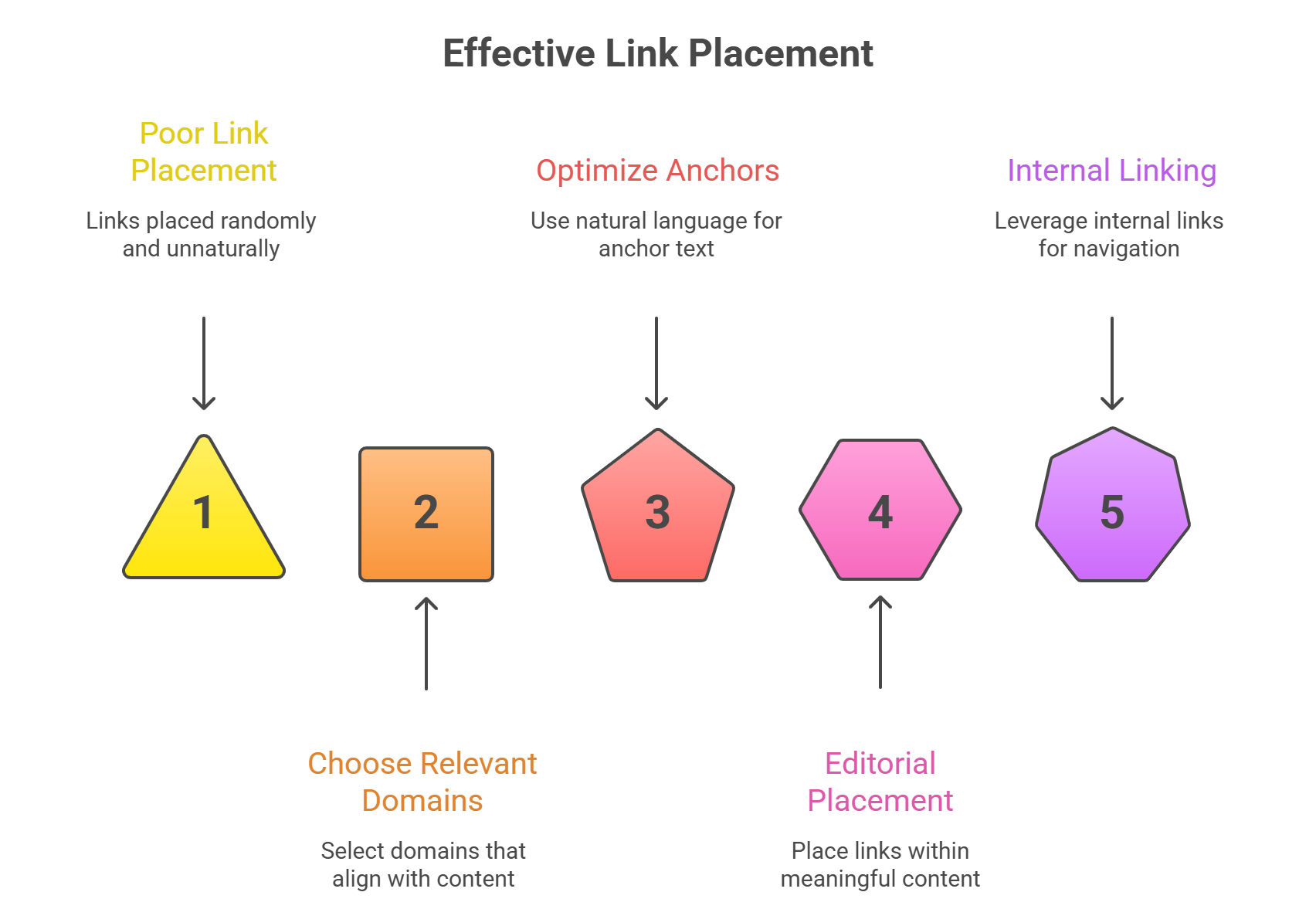
1. Choose Domains That Align With Your Topical Category
First, adopt a relevance-first approach and prioritize sites with clear topical clusters that match your destination page. Also, examine category architecture, internal hubs, and recent articles to validate fit.
If your destination is fintech onboarding, pursue hosts with consistent content on finance operations. In fact, guest-blogging backlinks placed in mismatched verticals create noise. Hence, use quick checks like categories, breadcrumb trails, author history, and internal link patterns to confirm alignment.
2. Optimize Anchor Text For Natural Language Processing
Write anchors that flow as part of the sentence. Also, describe the resource’s function, not just its keyword. Moreover, mix partial-match, branded, and phrase-level descriptors.
At the outset, anchor diversity matters more than chasing exact phrases. The win is in producing anchors that complete the thought: problem, solution, resource.
This approach supports NLP-driven context extraction and reduces the number of filter flags. It is a mature way to practice guest post SEO across multiple placements without sounding scripted.
3. Ensure Editorial, In‑Body Link Placement
Aim for in-body, context-rich placement near relevant sections. So, integrate links early enough to be read, but not so early that they feel forced.
Moreover, surround the link with supportive language: what the resource explains, which gap it fills, and why the reader should click.
Also, ask publishers explicitly for editorial integration rather than author-box dropping. For guest post placement, editors respond better when you frame links as reader aids, not as deliverables.
4. Invest In High‑Quality, Expert‑Led Guest Content
The heavy lift is in the content around the link. Show expertise through comparisons, original frameworks, or simple data points with clear reasoning.
I’ve seen plenty of guest posts that look good on paper but offer no real insight, and those links rarely move rankings. Guest post link building without substance is like wiring a house with no power. Brands that pair real experience with thoughtful guest posting services earn links that actually matter, because the content is worth referencing.
5. Leverage The Host Site’s Internal Linking Network
Politely request one or two internal links from relevant pillar pages. Also, offer suggested anchors that feel natural on their side. Moreover, provide exact URLs that the editor can drop quickly.
When your guest post is plugged into the host’s cluster, your link gains reach and resilience. To be honest, internal networks are underrated amplifiers and work even better when your post targets a subtopic that bridges two pillars.
6. Audit Published Guest Posts Regularly
After publication, check whether your links remain dofollow, in-body, and intact. After that, verify indexing, crawl status, and internal references.
If changes break the context (for example, anchor text is altered awkwardly or the link is pushed to an author box), request a professional edit. Also, keep relationships intact by explaining the reader's benefit, not just SEO outcomes.
Best Practices For Scalable And High‑Impact Guest Posting
To scale and make a high impact with guest posting, do the following:
1. Build Topic Clusters Before Scaling Guest Posts
Clusters are landing zones for link equity. If your site has hubs with supporting spokes, external links plug into a system that redistributes authority.
Without clusters, links hit isolated pages, and gains leak away. Also, plan pillars and spoke content before heavy outreach. Then aim guest posts at pages that reinforce those hubs. The setup primes editorial backlinks to do more than nudge a single URL.
2. Balance Quantity With Relevance And Quality
Link velocity is contextual. For instance, larger sites can absorb more links, but relevance still rules. Hence, avoid repetitive anchors, similar sites, and templated copy. Do fewer, better placements over a longer horizon.
You can scale responsibly by alternating between thought leadership pieces and practical how-tos, each serving distinct sections of your cluster.
3. Track Link Performance With The Right Metrics
Measure impact where it matters: indexation health, ranking movement for target queries, assisted conversions, and qualified referral traffic. Look for improved crawl frequency on the destination page.
Watch internal link acquisition within the host site if you negotiated it. Also, ignore vanity metrics when they do not correlate with results. Basically, DA is a proxy, not a KPI. It does not explain whether your link is contextually integrated in a way that a reader would find useful.
Link Placement Types And Their Typical Impact
The following are the most effective types of link placements and their impacts:
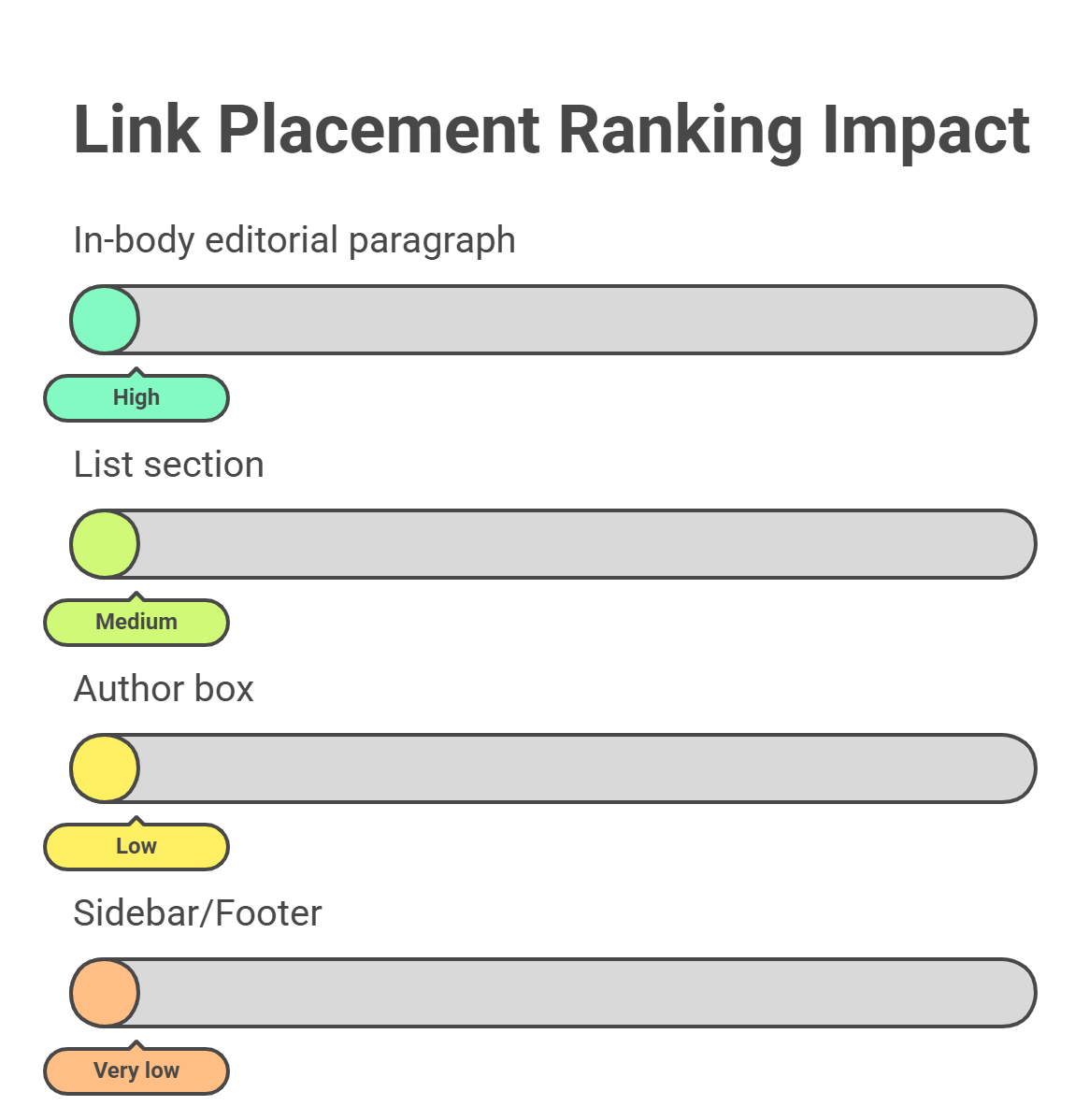
| Placement Type | Context Quality | Typical Impact on Ranking Signals | Notes |
| In-body, editorial paragraph | High; semantically aligned | Strong | Best practice: aim for early-to-mid sections with topical proximity |
| In-body, list or roundup section | Medium; dependent on framing | Moderate | Works if the list is thematic and the sentence-level context is provided |
| Author box | Low; templated and peripheral | Weak | Minimal editorial value; often de-weighted by templates |
| Sidebar or widget | Very low; navigational | Weak | Treated like navigation; little topical framing |
| Footer | Very low; boilerplate | Weak | Rarely helpful; avoid relying on this |
Fix Link Placement Now!
Most guest post backlinks fail for predictable reasons. In fact, mismatched topics, weak guest post placement inside templates, over-optimized anchors, thin content that does not earn trust, and host sites that do not internally support new posts limit impact.
Hence, pick domains with strong topical clusters, place links inside editorial paragraphs, write natural anchors, build expert-led pieces, and secure internal links that multiply reach. Also, audit published work and measure outcomes that map to real search behavior, not vanity proxies.
Build links that matter with relevance-first outreach at Blogger Outreach.