



It surely does. But not how most people assume. Internal linking doesn’t create authority out of nothing.
Instead, it follows a calculated pattern. Internal linking SEO also helps distribute the authority one page gains to other pages. The internal link ecosystem tells the search crawler which pages are actually important.
If you can really leverage this ranking strategy, you can improve your site’s average search rankings without any investment.
Honestly, you don’t have to pay to buy a new backlink. But without a strong internal link network, you cannot build credible authority.
What Is Internal Linking?
Internal linking means linking from one page on your website to another page on the same website. A blog post pointing to your pillar guide counts. So does a navigation menu, a footer link, or a “related articles” block.
It sounds almost too basic to matter. But these links are the roads of your site. If there aren’t any, crawlers can’t find your pages easily, and visitors can’t move between them either.
How Internal Linking Passes Authority
Let’s break down the process in some simple steps. Your website has a DA of 75 and a DR of 57. So when another page links to your website, it passes authority to it.
Through internal linking SEO, you can distribute that authority to other pages, too. The best part is that you don't need to backlink to your website again. Now, check which pages hold most of the authority.
The homepage is expected to have the highest authority. So your best articles would be linked to the homepage. So consider those the best links you can get.
Think of a page with ten great backlinks as a reservoir. Internal links are the channels that carry water to the pages that need it. Without channels, the water just sits there.
Google has said for years that links help it discover pages and understand how they relate. It doesn’t publish a formula, so any exact numbers you see online are estimates.
One thing is consistent: a page buried with no internal links pointing to it tends to struggle, even when the content is good.
What Internal Linking Can’t Do
This is where a lot of articles oversell it, so let’s be straight.
Internal linking SEO can’t make a weak site look trusted to the outside world. It only redistributes what you already have.
If your whole domain has almost no backlinks, rearranging internal links won’t create strength where it doesn’t exist. It also can’t rescue thin or off-topic content. A link to a poor page just points people at a poor page.
That’s why the honest answer to the title question is “yes, with a limit.” It builds authority within your site. You have to earn external authority separately.
Internal Linking And Topical Relevance
Authority isn’t only about strength. It’s also about relevance, and this is where internal linking does its best work.
When you group pages around a subject and link them sensibly, you show search engines that you cover that subject in depth.
A pillar page links to its supporting articles; they link back, and related ones link to each other. That structure is what people mean by a topic cluster, and it’s the clearest signal of expertise a site can give.
Blogger Outreach covers the wider idea of how authority gets judged in What Does Google Mean By Website Authority?. It’s useful background if you’re deciding how much weight to give a number like DA versus actual relevance.
Anchor Text And Placement Matter
Not all internal links are equal. Two things make the difference.
Anchor Text
Descriptive wording tells both readers and crawlers what the target page is about. “Our guide to email deliverability” says something.
“Click here” says nothing. You don’t need exact-match phrases every time, and repeating the same anchor over and over can look forced. Vary it naturally.
Placement
A link inside the main body of an article, surrounded by relevant text, usually carries more meaning than one tucked into a footer.
Put your important links where a real reader would actually want to follow them.
Site Structure, Click Depth And Orphan Pages
How do you define that your website is properly designed? First, keep your most important webpages easy to find. Let me tell you why. If someone has to click six times just to reach your homepage, it sends a negative impression.
People will think the authority of your main page does not matter much. That’s why you should make sure people can reach your main pages in just a few clicks.
The next important thing to address is orphan pages, which weaken your authority signals. What are orphan pages?
These are pages that aren't linked to by any internal links. Crawlers can still reach them. The sitemap, however, is their only gateway.
However, the weak internal support is a serious concern. So what should you do now? First, do a brief inspection of your site’s pages. That’s how you will come to know about the orphan pages.
After that, simply connect them. That’s how you can fix a major site issue with just a few basic steps.
Real-World Examples Of Internal Linking At Work
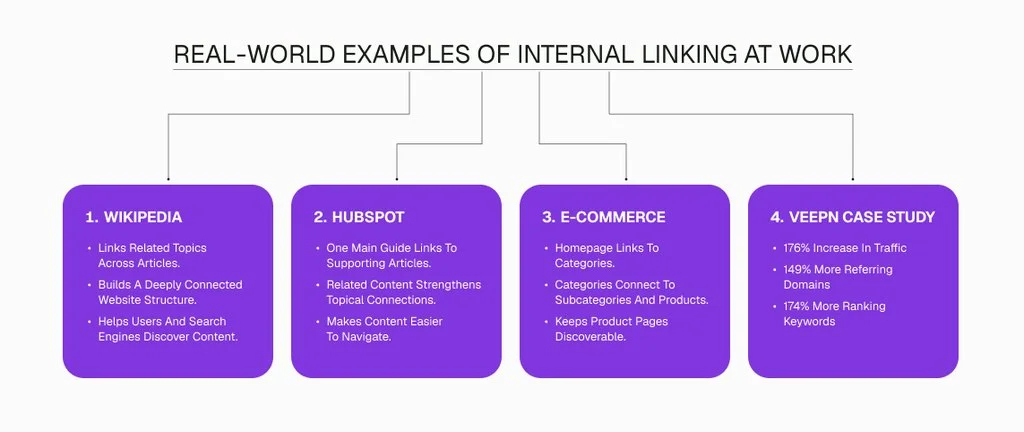
How do some of the biggest authority holders handle internal linking SEO? These are all well-recognized names:
Wikipedia
Almost every article links out to many related ones, and that dense web is a big reason the site ranks for such a huge range of topics. It’s an extreme case, but it shows what a deeply connected structure can do.
HubSpot’s Content Hubs
HubSpot helped popularize the pillar and cluster model, where a big guide connects to many narrower articles. The internal linking between them is the whole point.
E-commerce category structure
Large online stores usually link from the homepage to categories, then to subcategories, then to products.
That hierarchy lets authority flow downward and keeps every product reachable. Stores that skip this and rely only on search boxes often make products invisible to search engines.
A Link Building Example
Blogger Outreach’s VeePN case study in cybersecurity reports a 176% traffic increase, 149% more referring domains, and 174% more ranking keywords.
Those are the agency’s own figures. The takeaway is that external links to key pages deliver more when the site is organized to pass that strength along.
Internal Links VS Backlinks: You Need Both
People sometimes frame this as a choice. It isn’t. Backlinks bring authority in. Internal linking SEO spreads it out.
Picture earning a strong editorial link to your best guide. If that guide links to nothing, the benefit stays trapped on one page.
If it links to your related articles and your service pages, the benefit reaches them too. If you build links without an internal plan, you can end up with a few strong pages and many forgotten ones.
If you still need a simpler explanation of why link quality is so important for authority building, read Link Authority VS Domain Authority: Why A High-DA Link Can Still Fail on Blogger Outreach’s website.
The link should also be relevant and trustworthy. That combination sends a clear, strong signal to your website.
How To Improve Your Internal Linking: A Practical Approach
You don’t need special software to begin.
Start by listing your most important pages: the ones that earn money or that you most want to rank. Check which of your strongest pages (by backlinks or traffic) could link to them, and add contextual links.
Next, go through new articles and link them to older relevant ones, and update older ones to point to the new content. Find orphan pages and give them proper links.
Finally, review anchor text and swap vague phrases for descriptive ones.
Don’t stuff links in. A reasonable rule is to add one when it genuinely helps the reader, and skip it when it doesn’t. A handful of relevant links beats dozens of random ones.
Common Internal Linking Mistakes
Linking everything to everything is the first. It dilutes the signal.
Using the same exact-match anchor every time looks unnatural. Another is ignoring older content, because your oldest posts often have the most authority to share.
Broken internal links waste both strength and visitor patience. And relying only on the main menu, rather than links inside your content, misses where much of the value sits.
Where Blogger Outreach Fits In: Topical Or Website Authority?
Internal linking SEO is an on-site job. Blogger Outreach works on the other side of the equation: earning the external links that give your site authority to distribute in the first place.
It focuses on niche-relevant placements on manually vetted sites with real traffic, rather than chasing metrics alone. The network states a zero-PBN policy, with publishers typically in the DA 30 to 80+ range.
So, in the usual framing, Blogger Outreach primarily builds website authority through links, with a relevance lens that also supports your topical signals.
It doesn’t replace the internal work, though. Someone still needs to structure your pages, and that’s your side of the job. The services line up like this:
- Blogger outreach services earn editorial links from niche-relevant blogs, ideal for strengthening the pages you plan to link internally.
- Guest posting services place your content on authority sites in your field, with links pointing to your key pages. Their guide to building a winning guest posting strategy explains how to choose which pages to link to.
- Link building services provide scalable, white-hat in-content backlinks, including white-label options for agencies.
- Content writing services supply SEO articles that you can slot into your clusters and link together.
- AI-powered link building and GEO services help brands carry that authority into AI search.
Not sure whether your problem is weak links or weak structure? Blogger Outreach offers a free SEO audit that compares you with competitors, and you can review pricing before deciding.
Make A Final Call
So, does internal linking SEO help to build authority? It builds the part you control. It spreads strength across your pages, clarifies your topics, and makes sure no good page gets left behind.
It just can’t replace the trust that comes from other websites choosing to link to you.
The strongest approach combines both halves: earn relevant backlinks from sites your niche respects, then use smart internal linking to put that strength to work.
If you’re ready for the first half, Blogger Outreach can help.




