



Search Engine Optimization or SEO encompasses several different elements. Without a proper understanding of how Do-Follow and No-Follow Links work, it is impossible to do SEO.
In simple words, Do-Follow No-Follow Links are like addresses that lead to your website. However, both of them have different functions and usefulness.
In this article, we help you understand the relevance of both do-follow and no-follow links.
We also help you with the definition, benefits and best practices of two of SEO’s most misunderstood technical terms.
Both the varieties of links are subsets of the ‘Link Building for SEO’ functions.
If you want a definitive guide to link building, be sure to check out this article.
Link building is a process in which you place your website links on several other publisher platforms.
This helps you attract new traffic, gain visitors, and improve your SEO scores. It also helps you climb Google’s Search Engine Rankings Page (SERPs).
However, all the above benefits come from two types of links- do-follow and no-follow links.
There has been a lot of confusion regarding do-follow and no-follow links. This confusion centers on how useful they are in the larger scheme of link building for SEO.
In order to improve the health and metrics of any website, do-follow and no-follow links are important. However, both of them serve a different purpose altogether.
 If you want the simplest differentiation between do-follow and no-follow links, it is this-
 In order to understand why Google has given publishers the right to categorize links, we need to understand several factors.
We have briefly discussed how pre-2005 without no-follow links, spamming was a major problem. However, this spam was concentrated on areas where publishers did not have much control.
For example, web spamming with do-follow links in the comments section was a huge issue. Likewise, spamming with do-follow links on forums, social media, sites like Reddit, Quora and others was the norm.
This helped fraudulent advertisers and websites rank very high on Google’s SERPs. This problem was overshadowing websites that had great content and information. However, such sites were not engaging in such practices.
In order to create a level playing field and make ‘great content win,’ Google had to do something about the problem. Hence, no-follow links were born.
In other words, Google made it a point that without great and quality content, nothing could rank on Google.
Google wants all the do-follow links to be earned the right way!
In order to understand why Google has given publishers the right to categorize links, we need to understand several factors.
We have briefly discussed how pre-2005 without no-follow links, spamming was a major problem. However, this spam was concentrated on areas where publishers did not have much control.
For example, web spamming with do-follow links in the comments section was a huge issue. Likewise, spamming with do-follow links on forums, social media, sites like Reddit, Quora and others was the norm.
This helped fraudulent advertisers and websites rank very high on Google’s SERPs. This problem was overshadowing websites that had great content and information. However, such sites were not engaging in such practices.
In order to create a level playing field and make ‘great content win,’ Google had to do something about the problem. Hence, no-follow links were born.
In other words, Google made it a point that without great and quality content, nothing could rank on Google.
Google wants all the do-follow links to be earned the right way!
 In order to protect the interests of good publishers, Google created the no-follow link. If you are a publisher or a blogger, you need to know where you should use the no-follow link.
I have compiled a small list to help publishers understand what content should they use the no-follow link.
In order to protect the interests of good publishers, Google created the no-follow link. If you are a publisher or a blogger, you need to know where you should use the no-follow link.
I have compiled a small list to help publishers understand what content should they use the no-follow link.
Do-Follow and No-Follow Links: Definitions
Do-Follow Links: are those hyperlinks, which lead both Search Engines as well as Human Visitors to another website. In other words, from both the traffic point of view, as well as the metrics point of view, do-follow links are beneficial. Do-follow stand above the no-follow links in terms of hierarchy. Most publishers, webmasters, and others are only after do-follow links as it serves a dual purpose. Link building for SEO depends on do-follow links, more than they do on no-follow links. No-Follow Links: are hyperlinks not given attention by search engines. No-follow links will help you drive traffic to your website (if someone clicks on them). However, from a link building for SEO point of view, they do not contribute anything. In other words, not everyone is enthusiastic about getting no-follow links for their website. No-follow links have their own advantages, which we will discuss later on. To an average visitor, both the links appear the same. For the visitor, both types of links take him to where he wants to go. From a traffic standpoint, both the links count. It is only when you dig into the HTML (as Search Engines do) that you will be able to understand the difference. Let us look at what our friends at Ahrefs did by putting up a picture of the differences in code-
If you want the simplest differentiation between do-follow and no-follow links, it is this-
- Do-follow links help your Search Engine Rankings.
- No-Follow Links do not help your Search Engine Rankings.
Google and Do-Follow and No-Follow Links
Before getting into details, it is important to understand why Google created distinctions between do-follow and no-follow links. Google introduced the no-follow link in 2005. Since then the no-follow attributes and features have not changed much. In other words, pre-2005, all links were do-follow. However, webmasters used the do-follow link artificially in order to boost their rankings on Google search pages. This gave rise to a problem called ‘Page Rank Sculpting’. This practice artificially allowed people to rank their websites on search engines. “If you’re a blogger (or a blog reader), you’re painfully familiar with people who try to raise their own websites’ search engine rankings by submitting linked blog comments like “Visit my discount pharmaceuticals site.” This is called comment spam, we don’t like it either, and we’ve been testing a new tag that blocks it. From now on, when Google sees the attribute (rel=“nofollow”) on hyperlinks, those links won’t get any credit when we rank websites in our search results. This isn’t a negative vote for the site where the comment was posted; it’s just a way to make sure that spammers get no benefit from abusing public areas like blog comments, trackbacks, and referrer lists.”- Google Press Release, 2005.
Link Building for SEO pre-2005 was quite an abused phenomenon. Private Blog Networks, Link Directories, and other scrupulous means were in vogue. This is not to say that they are not in existence today. However, today Google and others have taken serious action against them. The good publishers were the ones who were suffering because of links being only of a do-follow nature. Web spamming was the norm, and Google had to do something about it. It wanted to give the good publishers the right to control and moderate the kind of content that they would want to put forth.Do-Follow and No-Follow Links: Benefits
Writing an article about the benefits of do-follow links is like selling a banana to a monkey! It is that obvious. However, for the benefit of people who are being introduced to SEO, we will list some of the major benefits-- Do-follow links help in contributing to the SEO metrics of a website. (SEO Juice and Link Juice).
- Follow links are more credible and worthy recommendations from Google.
- This kind of link helps you climb Google’s SERPs. (More do-follow links in authority sites, better your chances of ranking).
- Do-follow links attract traffic and new visitors from the host website to your website.
- Follow links increase visibility and discoverability by search engines.
- No-follow links are endorsements for your page.
- A no-follow link appears the same in the eyes of visitors, just as a do-follow does.
- These links are beneficial if you want to increase traffic to your website.
- No-follow links help retain regular readers and increases loyalty.
- They also contribute towards making direct and indirect sales for your business.
Link Building for SEO: What Matters Most
In order to understand why Google has given publishers the right to categorize links, we need to understand several factors.
We have briefly discussed how pre-2005 without no-follow links, spamming was a major problem. However, this spam was concentrated on areas where publishers did not have much control.
For example, web spamming with do-follow links in the comments section was a huge issue. Likewise, spamming with do-follow links on forums, social media, sites like Reddit, Quora and others was the norm.
This helped fraudulent advertisers and websites rank very high on Google’s SERPs. This problem was overshadowing websites that had great content and information. However, such sites were not engaging in such practices.
In order to create a level playing field and make ‘great content win,’ Google had to do something about the problem. Hence, no-follow links were born.
In other words, Google made it a point that without great and quality content, nothing could rank on Google.
Google wants all the do-follow links to be earned the right way!
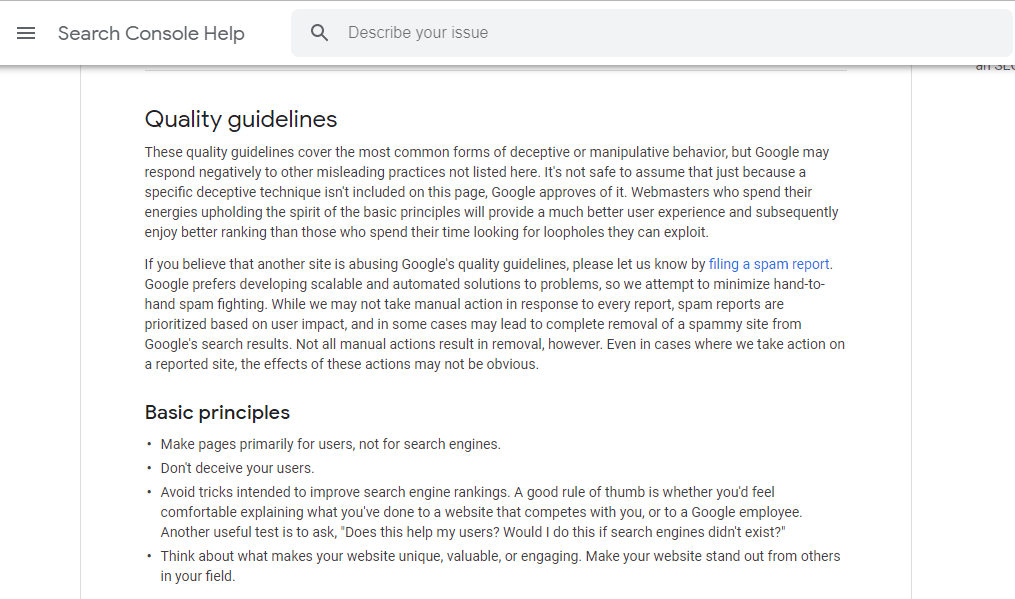
Source- Google Guidelines
Do No-Follow Links Contribute to SEO?
This is where things start to get interesting. Google in almost all its publications and releases has categorically denied this. However, when asked upfront about whether no-follow links contribute to link building for SEO, they had the following answer. “In general, we do not follow them.”- Google’s Reply to Brian Dean at Backlinko If I were reading this correctly, as many of you are, I would say that this is a rather ambiguous statement. Neither is Google being upfront about it nor is it denying it. Many experts in the industry have tested this. Most have come out with rather shocking results. People like Adam Smith, Survey Monkey and Brian Dean all reported positive SEO results from no-follow links. What does this say about no-follow links not contributing to SEO? I personally have seen mixed results. Maybe the bots of Google make certain errors when it comes to targeting no-follow links. Alternatively, the algorithms cannot always make the difference between different types of codes. No matter what the explanation, no-follow do contribute to SEO scores. According to me, more than the direct SEO juice, the referral Website Traffic Juice contributes to this.How should Publishers use No-Follow Links?
In order to protect the interests of good publishers, Google created the no-follow link. If you are a publisher or a blogger, you need to know where you should use the no-follow link.
I have compiled a small list to help publishers understand what content should they use the no-follow link.
- Use a no-follow link when you are dealing with a writer or a website for the first time.
- Try to give a no-follow link to all links in the comments section.
- The same stands for the forum or community section of your website.
- Use a no-follow link if there is any monetary transaction involved.