

Your website might have hundreds of backlinks! However, that doesn't guarantee your pages will rank for the keywords you want. So what is the problem that you are not addressing properly?
In reality, you might be focusing only on the total number of links, not their quality. That brings us to the second question: what makes a high-quality backlinks?
First, check where the links are coming from. Next, check the quality of the linking page. Finally, find out why a publisher chose to publish your link!
Let me explain these basics with an example. Take an accounting website, for example.
The firm is a consultancy business offering financial services. Now, this business gets a backlink from a blog that covers financial management problems MSMEs face.
The next example is of another company from the same niche. But this business gets a backlink from a profile that publishes multi-niche content, ranging from fashion to finance.
Interestingly, this multi-niche site has high DA and DR. So does that make it a better source to backlink to the financial services website? Keep reading to find out!
What Makes A High-Quality Backlink?
The metrics count does not guarantee that you are linking to a good website. To clarify, there is a difference between going after backlink count and evaluating backlink quality.
A high-quality backlinks profile is built on authentic, credible sources that are relevant, contextual, and editorially strong. Instead, it is hard to judge backlink quality using metrics like DA, DR, site traffic, or similar metrics alone.
So simply analyze the actual page you are being linked to.
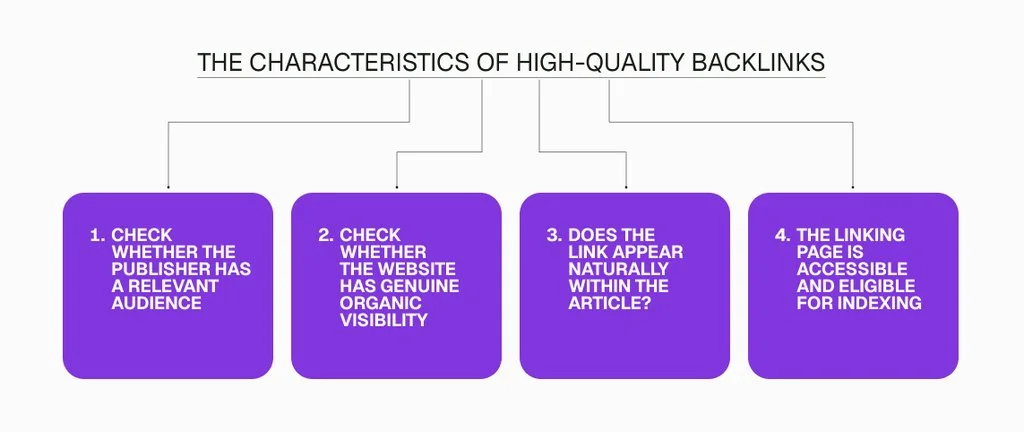
The Characteristics Of High-Quality Backlinks
Don't launch your promotional campaign just like that! And if you are about to pay for your placement, please wait a bit.
I know the agency you are working with has shown you some high numbers. Maybe they promised to build 80 backlinks a month. But what will you achieve with that game plan?
Honestly, nothing! But why?
A high backlink count will give your traffic numbers a temporary surge. However, that will eventually drop because you didn’t check the quality of the sites or the content on the pages linking to you.
Consider the 2 examples I shared above. If the 2nd business hadn’t checked that the links pointed to a multi-niche content site, the backlink would have been useless.
Here is a list of a few characteristics that will help you define whether backlinking to a source is good for your site or not:
1. Check Whether The Publisher Has A Relevant Audience
The most important thing to analyze is the website's subject. Then check the niche of readers who regularly engage with the website.
Here is an example to clarify what I mean. Consider you have a consultancy business where you sell software that handles projects for clients. As a project management company, you need backlinks from publications that match your service type or business niche.
But what if the website is not contextual? In that case, you need an obvious reason for linking to such a page. Without that reason, another backlink would do little for your software business.
To do this right, we need to be good at publisher selection. On Bloggeroutreach.io, you can control which publishers link to your business.
We have an inventory of 17,000+ active publishers. That’s why there are a few things that you will always get from us:
- Sites that are an exact fit for your business niche
- Your preferred link volume (ensuring link quality)
- Choose publishers easily, based on location, traffic count, and the publishers’ authority
| Pro Tip: What should you do if you are still not able to select which publishers are best for you? Simply open the publisher’s site and check out a few of the content published lately. But what do you need to check exactly? First, see if the subject is covered with a 360-degree approach. Also check does the content offers something that is actually helpful for the readers in your category. If you find the content actually helpful, it is worth linking to your site. The important part is what you do with that shortlist. Rather than automatically choosing the publisher with the highest DA, read a few of its articles. Check whether it covers your subject in a meaningful way and whether your target page would offer something useful to its readers. |
If you want to know why and how link quality will make an actual difference to your business growth, we have made a separate explainer blog for that. Please give it a read: link relevance and its role in link building.
2. Check Whether The Website Has Genuine Organic Visibility
Why do you need to emphasize traffic more than DA and DR? Traffic shows what people actually read on your site. It shows where most footfall comes from.
Traffic can tell you something DA and DR cannot: what people find on the website through search. Are they landing on specific service pages, or the home page, or the content page where you actually need them to land?
So if you've decided to evaluate traffic, here are some related parameters that will give you a clear picture of where the site stands now in terms of traffic. First, check the most important metric: organic traffic.
Next, see which keywords the traffic is distributed across and how good the pages with traffic are in terms of content quality and UI/UX.
3. Does The Link Appear Naturally Within The Article?
You need a good reason to include high-quality backlinks. I get that the DA/DR is fine and the niche of the website is also contextual. Even the content looks fine. However, there is still a problem.
Check if the inclusion of the link in a certain paragraph or on a certain line is actually logical and rational, or does it seem totally forced? That is a major thing that a lot of people actually miss.
Yes, they miss that even with good backlink quality. That is why this list matters: it helps you assess backlink strength and ensure you are actually building business from your link campaign.
That said, here are a few reasons why your link can appear in a specific section or line:
- That paragraph is discussing your product category or niche
- It adds useful info to the readers through the link addition
- The sentence is logically the best fit for the link in that content piece
- Is the section easily understood by the reader?
4. The Linking Page Is Accessible And Eligible For Indexing
You have selected your publishers! Great! But even a publisher with a strong domain rating and authority can still fail to give you the traction you deserve. Imagine the page it publishes does not get indexed.
Yes, that is a possibility. If you are thinking that a high DA/DR site cannot have any non-indexed links, you are wrong!
So it is important that you check each of the published links manually. The goal is to confirm they are publicly available, are active and are indexed too.
If you have access to GSC, check Google’s indexing list directly. Google has technical requirements which you must fulfil in order to be eligible for Search.
For more detail, read Google's technical requirements for Search.
Also, do not confuse indexation with ranking value. An indexed page does not guarantee that Google will count a particular backlink as a ranking signal. Indexation is one check in the evaluation process, not proof that a placement will improve your rankings.
For clients running campaigns through BloggerOutreach, the sensible next step after publication is to review the live URL and monitor the page over time. A successful publication is an important milestone, but it should not be treated as a guaranteed SEO outcome.
What Should Make You Reject A Backlink Opportunity?
Some warning signs are easy to miss when a publisher's metrics look impressive.
A website that publishes about everything. A publication covering unrelated subjects with little editorial consistency may accept content with little consideration for its audience.
Traffic that tells a confusing story. A sudden decline, an unexplained spike, or traffic concentrated in unrelated topics deserves investigation. Third-party tool estimates aren't definitive, so check more than one signal before deciding.
Articles that exist mainly to host links. If most posts seem like commercial placements, include multiple unrelated outbound links, or offer little useful information, be cautious.
Repeated exact-match anchors. Using the same money keyword in every placement can make the link profile look unnatural. Anchor text should describe the destination and fit the sentence.
Promises of guaranteed rankings. No publisher or link-building service can guarantee that Google will reward a placement with improved rankings.
Google's spam policies also explain how manipulative link schemes can violate its guidelines. Paid placements require particular care: advertising and sponsored links should be appropriately qualified, typically using rel="sponsored" or rel="nofollow" where applicable. Buying a placement does not automatically make it a ranking signal.
BloggerOutreach clients should evaluate the publishing opportunity on its actual merits and understand how the publisher handles sponsored content. A high DA cannot compensate for an unsuitable website or an arrangement that conflicts with Google's policies.
How To Evaluate A Backlink Before You Order It
Use this checklist when comparing publisher opportunities. It is especially useful when several websites have similar prices or authority scores.
- Topical match: Does the website cover my industry or an audience relevant to my business?
- Editorial relevance: Does the proposed article have a genuine reason to reference my target page?
- Organic visibility: Does the website attract relevant search traffic, and are its traffic trends credible?
- Publisher quality: Is the site maintained, with useful content and a consistent editorial focus?
- Page indexation: Is the published URL accessible and eligible to appear in Google Search?
- Link placement: Will the link appear in a meaningful part of the article?
- Anchor text: Does the anchor accurately describe the destination without forcing a keyword?
- Spam signals: Does the website show signs of mass-produced content, manipulative link selling, or an unnatural outbound-link profile?
- Campaign fit: Does this publisher add something useful to my existing backlink profile?
You do not need a perfect score from every SEO tool to find a good publisher. You need enough evidence to understand what you are buying and why the placement makes sense.
Why Publisher Selection Matters When Using BloggerOutreach?
What do you need to do in order to select a suitable publisher?
At first, you can check out the websites of the publishers you are targeting. Then select the best ones from that curated list. To choose them, review some of the latest content and see what people search for most when they visit the site.
You can also leave the publisher matching to us, if that suits you. We check the content and determine whether it syncs with your brand POV. After that, we can talk with the publisher and prepare the content for you.
Without a vast publisher network like ours, that is difficult. Especially if you try to do it manually, it will be even harder.
With Blogger Outreach, it's no problem at all. We will share as much publisher data with you as you need, so that you can make a well-informed decision.