



SaaS teams and agencies feel the squeeze as deadlines pile up, rankings wobble, and budgets remain flat. Even then, growth targets stay loud.
In that noise, two link‑building plays keep showing up: link insertions and new guest posts. Both promise relevance, signals, and momentum.
Primarily, link insertions show up as a clean lever in fast‑moving campaigns, while guest posts are a slower and content‑heavy build. Therefore, read on to get a better idea of what works best for you.
Understanding The Core Differences Between Link Insertions And Guest Posts
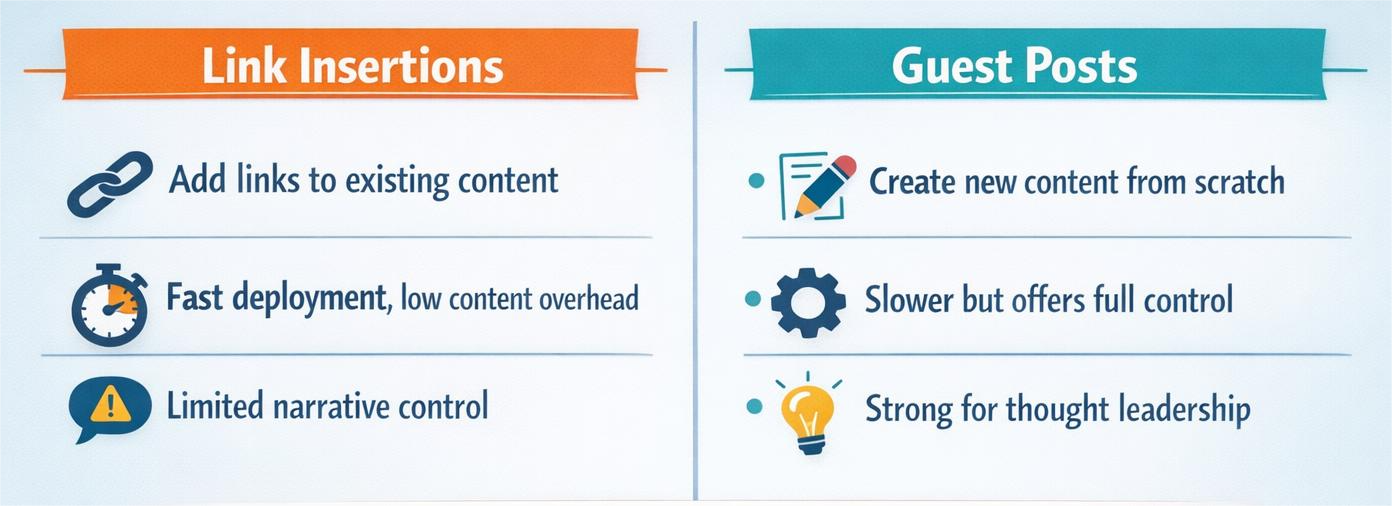
The following are some of the major differences between link insertions and guest posts:
| Aspect | Link Insertions | Guest Posts |
| What It Is | Adding a link to an existing published article. | Publishing a brand‑new article on a third‑party site. |
| Content Source | Uses pre‑written, indexed content with existing traffic. | Requires full new content creation. |
| Control Level | Low, and must fit into the page’s existing narrative. | High, and you shape structure, tone, and depth. |
| Context Fit | Positioned inside an already‑relevant paragraph. | Content crafted specifically around your topic. |
| Deployment Speed | Fast and minimal production work. | Slow and needs briefs, writing, edits, and approvals. |
| SEO Basis | Relies on the authority of an established page. | Builds a new asset that develops authority over time. |
| Main Purpose | Quick relevance and efficient acquisition of niche edit backlinks. | Thought leadership, depth, and long‑term authority. |
Link Insertions vs. New Guest Posts: Evaluating The SEO Impact
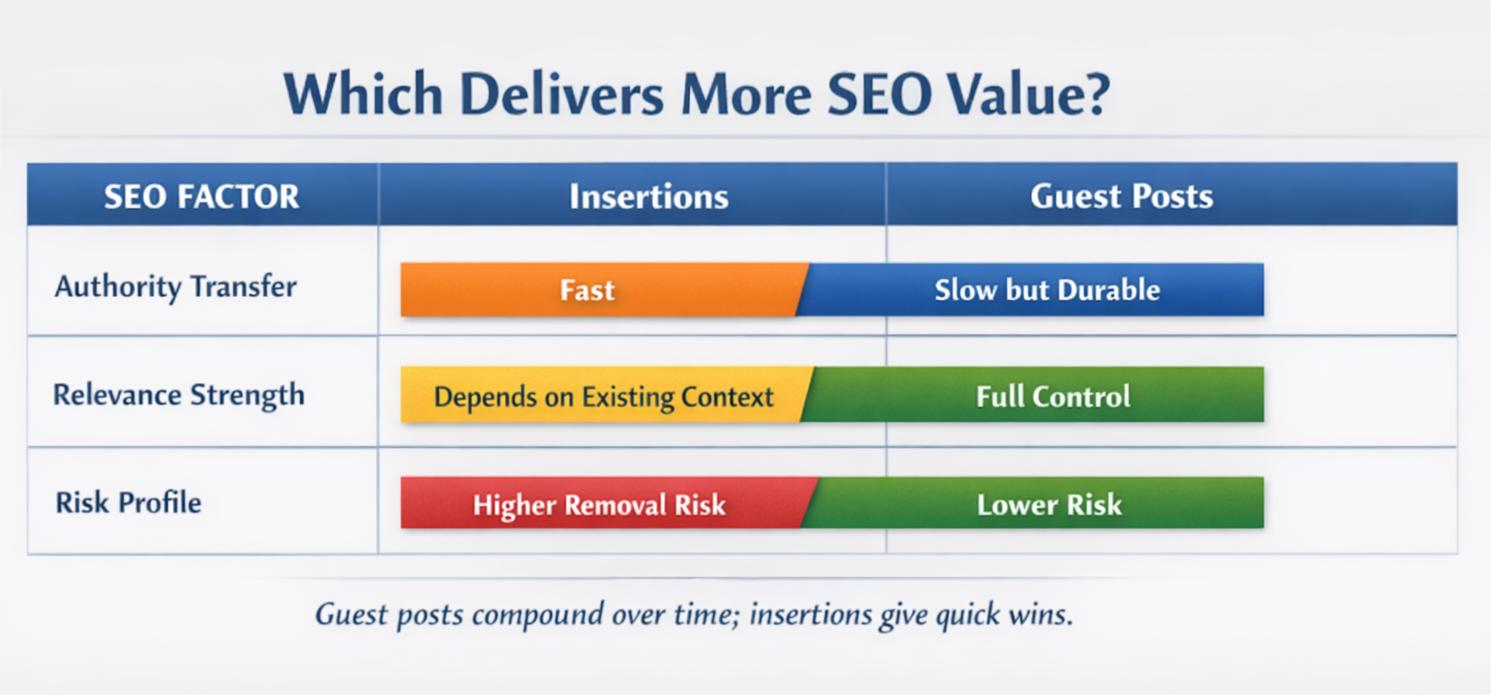
SEO impact comparison between link insertions and new guest posts:
| SEO Dimension | Link Insertions | New Guest Posts |
| Authority Transfer | Fast authority transfer. Leverages existing, already‑indexed pages with strong topical alignment. | Builds authority slowly. More durable as it creates a new, content‑rich asset to attract secondary links and internal references. |
| Relevance Strength | Highly dependent on the relevance of the existing paragraph and the page's historical ranking signals. | Full control over topical depth, narrative framing, and keyword alignment. |
| Operational Speed | Faster to deploy, with minimal content creation overhead. | Slower due to drafting, editing, and publisher review cycles. |
| Editorial Control | Limited control over page structure and tone because the content already exists. | High control over headings, arguments, examples, and how the link is positioned inside the narrative. |
| Risk Profile | Subject to editor updates, link rot, or page pruning. The value decreases if the page's rankings decline. | Lower removal risk. Performs more predictably over time as the post functions as a standalone asset. |
| Indexing Dynamics | Benefits immediately from established indexing and traffic. | Requires fresh indexing and may take longer to gain traction. |
| Scalability | Scales efficiently with low content overhead. | More resource‑intensive to scale due to content production demands. |
| Brand Positioning | Limited room for narrative building or thought‑leadership framing. | Strong vehicle for positioning, storytelling, and subject‑matter depth, especially important for SaaS. |
| Long‑Term Value | Strong short‑term impact but dependent on host page longevity. | Durable long‑term asset that compounds through citations and organic shares. |
| Suitability for SaaS | Useful for feature pages, documentation, and quick authority boosts in competitive SERPs. | Effective for educational content, category creation, and trust‑building in complex buyer journeys. |
| Suitability for Agencies | Helps maintain predictable KPIs and fast client delivery cycles. | Great for clients pursuing topical authority, thought leadership, or industry visibility. |
Scalability Analysis: Which Strategy Grows Faster?
Both link insertions and guest posting are scalable in their own ways. The following are some of the major strategies to grow faster:
1. Cost‑Per‑Link Comparison At Scale
At volume, link insertions typically lower the cost per acquired link by avoiding content production. Guest posts raise costs due to drafting and editorial management. However, when guest posts earn secondary links or drive referral traffic, the effective cost per valuable link can shrink. The answer depends on your campaign goal and measurement window.
The Following Table Shows A Cost Profile Comparison:
| Dimension | Link Insertions | Guest Posts |
| Content Production | None or minimal | Full article creation |
| Direct Placement Cost | Low to moderate | Moderate to high |
| Effective Cost Over 6–12 mo | Lower if placements are stable | Competitive if posts earn secondary links |
| Hidden Ops Cost | Vetting pages and anchors | Briefs, edits, artwork, publisher coordination |
2. Workflow Complexity And Team Bandwidth Requirements
Link insertions compress workflows through outreach, vetting, placement, and quality assurance (QA). Meanwhile, guest posts expand workflows through ideation, drafting, editing, publisher alignment, placement, and QA.
In fact, agencies with lean teams insert first. Larger content teams can absorb guest post cycles. Both need clear SOPs to prevent anchor drift and fit issues.
3. Publisher Acceptance Rates And Relationship Leverage
Publishers may accept insertions more quickly if the update aligns with their editorial goals. Others prefer fresh content that adds value to their catalog. Of course, relationships matter in both.
Also, agencies with consistent, high‑quality contributions will see smoother acceptance for guest posts. For insertions, relevance and utility to the existing article drive acceptance more than brand name.
4. Long‑Term Asset Value And Compounding SEO Effects
Guest posts can pull in citations, internal links, and social shares. That compounding improves over quarters. Meanwhile, link insertions rely on the host page’s durability and ongoing traffic. If the page continues to rank, your value persists. Also, if it falls, the link’s impact fades.
Link Insersions vs. New Guest Posts: Which One Is the Better Choice?
To find out which one is the better choice, consider the following:
| Decision Criteria | Link Insertions | New Guest Posts |
| Best Fit for SaaS Brands | Ideal when SaaS teams need quick authority boosts for feature pages, comparison pages, or documentation hubs without producing new content. Works well during product launches or technical rollouts where speed matters more than narrative depth. | Ideal for explaining complex products, educating the market, or framing new categories. Works best when SaaS brands want thought leadership, storytelling, or deeper narrative alignment. |
| Best Fit for Marketing Agencies | Useful for agencies managing multiple clients with limited budgets and tight delivery cycles. Niche edits help maintain predictable KPIs and faster reporting rhythms with minimal production overhead. | Strong for agencies building long‑term authority for clients, especially in competitive niches. Useful when delivering high‑quality editorial assets and strategic SEO depth. |
| Performance Scenarios: Speed & Budget Constraints | Excels in fast‑moving campaigns, triage situations, low‑budget months, or authority bursts needed during algorithm turbulence or ranking drops. Tactical and responsive. | Excels when goals include brand building, demand generation, deeper topical authority, and audience education. Performs better in long‑horizon strategies with compounding value. |
| Narrative Control | Limited. You adapt to the existing page and fit naturally into the content. | High. Full control over structure, tone, themes, and the strategic placement of your key messages. |
| Longevity of Value | Value depends heavily on the host page's stability, relevance, and continued performance. | Value grows as the content earns citations, social shares, and internal links across the publisher’s ecosystem. |
| Scalability Potential | More scalable for teams with limited bandwidth; easier to execute in volume with vetted sites. | Harder to scale due to writing requirements, editorial cycles, and publisher involvement, but more impactful per asset. |
Combining Both Strategies For Maximum ROI
If you want to get maximum ROI, you must combine both strategies:
1. Building A Balanced Link‑Building Portfolio
Balance looks like layered sprints: insertions for speed and relevance, and guest posts for depth and authority.
Therefore, To Ensure Balance, Do The Following:
- Map landing pages to funnel stages.
- Assign insertion anchors to feature or documentation pages.
- Assign guest posts to problem education and thought leadership.
- Keep a live scoreboard.
2. When To Insert Links vs. Commission New Content
Sequence matters when it comes to inserting links and commissioning new content:
- Insert links to existing articles early to drive quick lifts.
- Commission guest posts in parallel, aiming to publish within 6–8 weeks.
In fact, once posts are indexed and gain traction, add selective links to them to kick-start authority. This cross‑pollination compounds without bloating the cost.
3. Data‑Driven Decision Making For Channel Attribution
To ensure data-driven decision-making for channel attribution:
- Track rankings, referral traffic, assisted conversions, and secondary link accrual.
- Attribute gains to placement types.
- Use cohorts of pages.
- Compare the 30-, 60-, and 120‑day windows.
- Adjust mix monthly.
If guest posts in a niche consistently earn organic citations, increase allocation. Moreover, if insertions on certain sites hold strong and boost feature pages, keep them in rotation.
Cost–Benefit Summary And Scaling Recommendations
To find out the cost-benefit results, you have to factor in the following:
1. Short‑Term vs. Long‑Term ROI
Short-term favors insertions, since they are fast and measurable. In fact, long-term favors guest posts that compound. Also, balanced portfolios outperform extremes.
The shape of ROI is time‑dependent. So, expect quicker wins from insertion campaigns and deeper gains from content‑led placements.
2. Budget Allocation Models For Different Growth Stages
Early‑stage SaaS with constrained budgets can start with a 70‑30 split in favor of insertions. Meanwhile, agencies running multi‑client programs can operate at a 60‑40 split to keep delivery predictable.
As content engines mature, shift to 50‑50 or 40‑60 in favor of guest posts for core topics. Also, rebalance quarterly based on objective metrics.
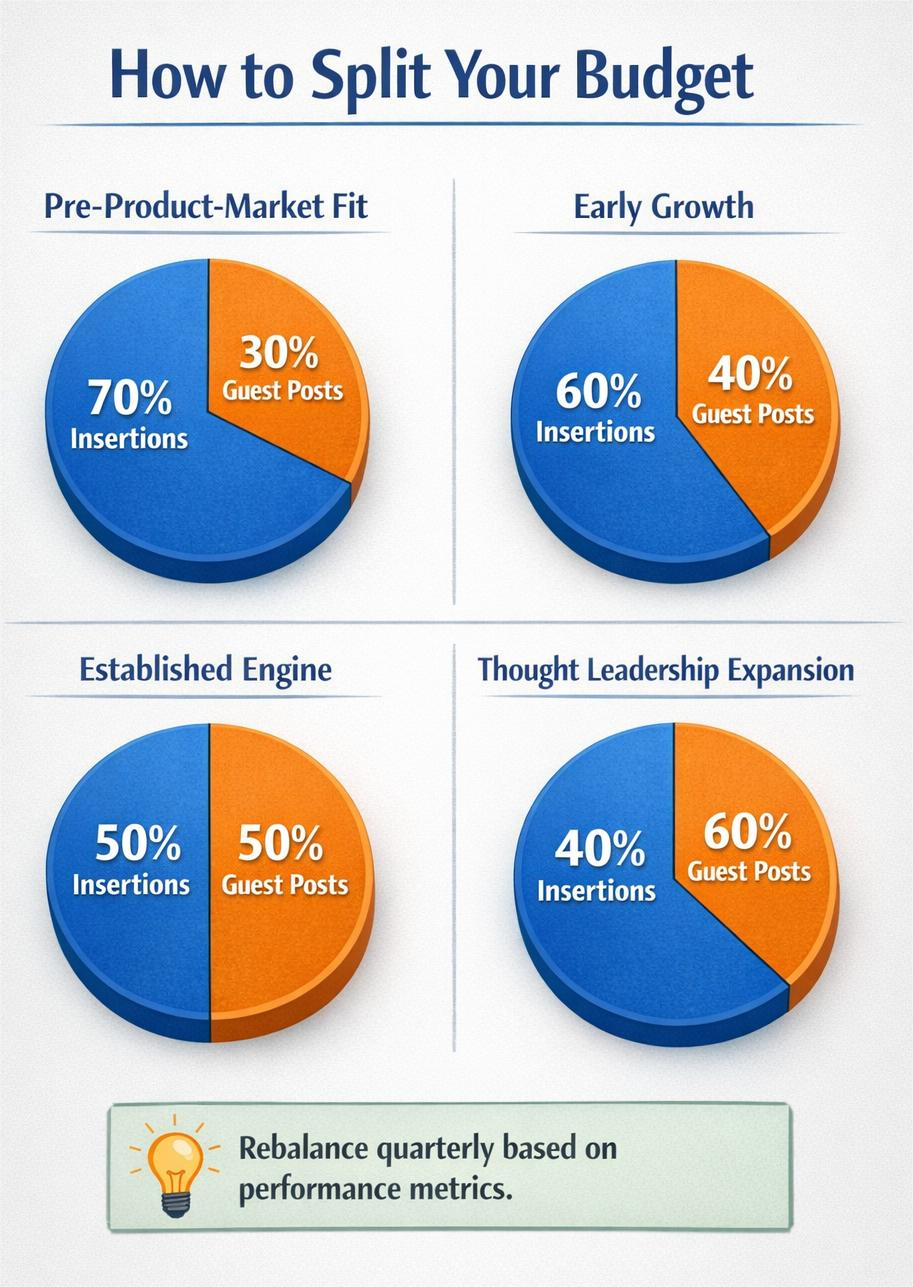
Table 2. Suggested Allocation By Stage
| Stage | Link Insertions | Guest Posts |
| Pre‑Product‑Market Fit | 70% | 30% |
| Early Growth | 60% | 40% |
| Established Content Engine | 50% | 50% |
| Thought Leadership Expansion | 40% | 60% |
Which Strategy Scales Better For Most SaaS And Agencies?
Scaling is about repeatable delivery with compounding upside. For speed, insertions scale cleaner. For durable authority, guest posts scale smarter. In fact, most teams need both. Also, a living framework that adjusts weights monthly. It is not a binary choice, but portfolio math with operational realities in mind.
Always keep in mind that insertions deliver quick, contextual gains when publishers and pages are vetted. Meanwhile, guest posts deliver durable assets, build trust, and offer potential for earned citations. Balanced portfolios outperform single‑channel bets over quarters.
Hence, SaaS and Agency Marketers must build a dual‑track program and maintain reliable pipelines for link insertion services. Also, it is important to commission high‑quality, topical guest posts at a steady cadence.
Moreover, make sure to evaluate cohorts quarterly and adjust allocations based on performance. Furthermore, keep anchors natural, and favor contextual backlinks over superficial placements. Apart from that, ship consistently and improve incrementally. That is how momentum turns into compounding results.
Scale backlinks without sacrificing quality. Build contextual links that actually move rankings and revenue.
Register on Blogger Outreach and start compounding growth.